Review: Braddock’s Defeat: The Battle of the Monongahela and the Road to Revolution, by David Preston. Oxford University Press, 2016. Reviewed by David A. Powell

Emerging Revolutionary War is honored to welcome back guest historian David A. Powell. 

When George Washington opened fire on a small party of Canadian militia commanded by Joseph Coulon de Villiers de Jumonville in May of 1754, he fired the first shots of what would eventually become the French and Indian War – and the Seven Years War across the rest of the globe. Many scholars have also acknowledged that this incident set the spark for what would become our own American Revolution.

51n-wna6fhl-_sx328_bo1204203200_
Braddock’s Defeat: The Battle of the Monongahela and the Road to Revolution, by David Preston.

Of course, Washington intended none of those things; instead he was carrying out the British Crown’s policy of staking claim to and defending the Ohio Country, lately disputed between France and Britain.  However, Jumonville’s death set irreversible forces in motion, not the least of which was the capture of Washington’s own company of Virginia Colonial Militia at Fort Necessity by a much larger French response in June of 1754.

The direct consequence of that encounter was the creation of a new British army, including two regiments of regulars and a train of artillery, rushed from Ireland and England to re-assert Crown control over the forks of the Ohio. Command of this new expedition fell to Major General Edward Braddock. Arriving in 1755, Braddock’s mission was to lead this new force from Fort Cumberland, in western Maryland, to the site of the French Fort Duquesne (present-day Pittsburgh.) That campaign ended in disaster on July 9, 1755 when Braddock’s column collided with a combined force of French and Indians just a dozen miles short of Duquesne, resulting in horrific British losses – including Braddock.

Not surprisingly, this story has been fertile ground for historians. Fine monographs have already been written on the campaign, as well as on the French and Indian War as a whole. Having a particular interest in the period, I have read a number of those works. Naturally, I was curious when I first heard of Dr. David Preston’s new book exploring the campaign.

Preston, a professor at the Citadel, has delivered a tremendous book. Combining new research and close analysis of previously known sources, he provides fresh new perspective on General Edward Braddock, his ill-fated expedition, and the French & Indians opposing him.

Preston finds that Braddock, far from being an unyielding martinet uninterested in either the “savages” or using Colonials, worked hard (if unsuccessfully) to bring Indian warriors into his force, and showed more respect for the colonial elements under his command than some previous historians have portrayed. A number of factors precluded Braddock’s success here, but it was not for want of trying.

Where Preston’s interpretation really shines is in exploring the French and Indian sides of the war. A new account of the battle, located in a French archive, casts new light on the French efforts to defend Fort Duquesne – a venture whose success was by no means a sure thing. Preston also explores the Indian Nations’ complex and diverse reasons for casting their support with the French, which was also not certain. Preston makes it clear that the French defense was in many ways based on fortuitous circumstances rather than planning, especially in regards to the timing of the campaign.

Preston’s detailed description of the battle in question on July 9 presents a clear and detailed exploration of the sequence events as far as they can be known; where the author speculates he notes that, and explains the basis of his interpretation. Above all, his narrative is well-written, exciting and drama-filled.

Preston also excels in his summation of the long-term impact of Braddock’s defeat, both on the fortunes of British North America in the two years following the battle (which ran from bad to disastrous) and on the longer term consequences: the development of light infantry and ranger tactics, leadership, and the growing rift between American colonials and England.

Students of both the Seven Years War in America and the American Revolution will want to read Braddock’s Defeat. Get your copy today.

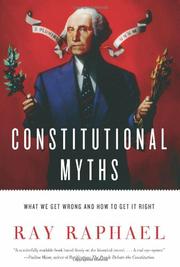
Review: Constitutional Myths: What We Get Wrong and How to Get It Right by Ray Raphael

Review by Jim Howell

Constitutional Myths by Ray Raphael is a well written, if potentially controversial book that takes a fairly in-depth look at eight constitutional interpretations that are currently popular political positions. The 301-page monograph provides an excellent, brief synopsis for each topic, which is referred to as a “myth”. Each constitutional “myth” has a more elaborate explanation after the initial brief summary with a significant amount of supporting primary source evidence.

const_myths
Constitutional Myths by Ray Raphael

Raphael, a scholar of the Founding Fathers, has written extensively on the early United States and his frequent footnotes often refer to his previous research and primary documents from the period in question. Of particular note is his constant reference to the two most extensive constitutional documents, Notes of Debates in the Federal Convention and The Federalist Papers.

From the very beginning of the book, Raphael makes it clear that the Constitutional Convention set out to remedy the defects in the Articles of Confederation. Some of these defects were the inability of the central government to tax, draft citizens to form an army, or pass a variety of laws. In short order, this lead to a number of problems in the states and in all likelihood, the demise of a number of states to European powers. The pendulum that had swung to a severe distrust of a distant, powerful government was on its way back to establishing a strong government that could look out for the interests of its constituents.

Readers of the more conservative persuasion, who often take a position in favor of small government, impartial Founding Fathers, and originalism, will likely find some of the positions in Constitutional Myths controversial. Despite some of the positions that present day conservatives argue the founding fathers supported, Raphael goes to great lengths to refute those modern day positions and provide the context behind the decisions that were made in 1787.

One of the best examples of this in Constitutional Myths was the chapter devoted to The Federalist Papers. As detailed, The Federalist Papers were written by three authors; James Madison, Alexander Hamilton, and John Jay. They were written as a tool to advocate for the adoption of the Constitution, not to provide commentary on the finer points of the Constitution. Additionally, a number of the points in The Federalist Papers were made by delegates who did not necessarily agree with the argument they were making, but believed in the compromises of the constitution and were trying to sell the agreement to the necessary number of states for ratification.

Raphael’s treatment of originalism is especially thought provoking given its popularity in today’s political climate. The Constitution and its interpretation have been open for debate from the moment it was ratified. The delegates of the Constitutional Convention created a compromise and it would be a mistake to ascribe any specific meaning to the original intent; as any given founder may have had differing thoughts on what a particular clause might mean. The author makes the astute point that the Constitution is a framework inside which the various states, United States Congress, Supreme Court, and the president are meant to work.

Details:

336 pages, ISBN-13: 978-1595588326

Published by: New Press


*Jim Howell is a librarian in Northern Virginia and enjoys reading modern military history and science fiction*

Congratulations to William Griffith

Our enthusiastic congratulations to Emerging Revolutionary War’s William Griffith on the release of his new book, The Battle of Lake George, England’s First Triumph in the French and Indian War. The book, published by Arcadia Publishing and The History Press, is now available for sale in books stores and online.9781467119757

From the press release of the book,

“In the early morning of September 8, 1755, a force of French Regulars, Canadians and Indians crouched unseen in a ravine south of Lake George. Under the command of French general Jean-Armand, Baron de Dieskau, the men ambushed the approaching British forces, sparking a bloody conflict for control of the lake and its access to New York’s interior. Against all odds, British commander William Johnson rallied his men through the barrage of enemy fire to send the French retreating north to Ticonderoga. The stage was set for one of the most contested regions throughout the rest of the conflict. Historian William Griffith recounts the thrilling history behind the first major British battlefield victory of the French Indian War.”

Recently, ERW had the chance to sit down and talk with William about the book.

Q: This book fills an important gap in the French and Indian War, why has this campaign been overlooked for a publication like this?

W: I think that the Battle of Lake George has been overlooked for multiple reasons. When we think of the opening years of the French and Indian War we tend to immediately think of the events transpiring in western Pennsylvania (i.e. Jumonville Glen, Fort Necessity, and the Battle of the Monongahela), and do not really place Lake George at the forefront until the surrender of Fort William Henry in 1757. The significance of the Battle of Lake George has also been up for debate by historians, many whom believe it was a stalemate or inconsequential engagement, but in my opinion they are entirely incorrect. Because of these sentiments, when looking at the year 1755 the predominant focus has been placed on Braddock’s Defeat. Tragedy draws attention, and that is exactly what the Battle of the Monongahela was. Not only has scholarship relating to the Battle of Lake George been placed on the backburner to Edward Braddock, but it has also been pushed aside by the Siege of Fort William Henry and the subsequent “Massacre” – another tragic event. The Battle of Lake George is a prime example of history overshadowing history, and hopefully my book will be able to bring the event out of the darkness and into mainstream French and Indian War scholarship.

Q: Why did you choose the campaign to Lake George as your first book?

W: Even before I was born my family vacationed every year along the western shore of Lake George. When I was five years old my father brought me to my first historic site – Fort William Henry – and from then on my passion for history began to blossom. After that each trip to the lake during the summer caused my interest in upstate New York’s colonial history to grow and it soon became a big part of my life. There are some places on this earth that have the power to transport you to another time or place. Lake George is one of them. It truly forms a connection with people and for me, so did its history – especially the 1755 battle, which I could find no substantial work done on. In a quest for myself to learn more about the event, I determined in high school that when I was to write my first book it would be on the long neglected battle. I ended up writing it a lot sooner than I imagined I would.

Q:If there was only one thing a reader took away from this book, what would you want it to be?

W: An interest in the French and Indian War and a desire to learn more about this period in our history. If a visit to Amazon, the bookstore, or Lake George occurs after reading my work, then I succeeded.

Q:How accessible are the sites attributed to the campaign to visitation?

W:Extremely accessible. All three sites associated with the Battle of Lake George are preserved to some extent or at least enough so to interpret and visit. The battlefield of the main engagement fought during the afternoon is the largest and is preserved as the Lake George Battlefield Park at the southern end of the lake astride the reconstructed Fort William Henry and busy Lake George Village. Interpretation here is really bad though. Only one sign actually explains the 1755 battle although there is an impressive monument serving as the centerpiece of the site. Along present day Route 9 roughly three miles or so south of Lake George is the site of the morning engagement, the “Bloody Morning Scout,” and an obelisk dedicated to Colonel Ephraim Williams of the 3rd Massachusetts Regiment who was killed during the opening engagement. About a mile or so closer to the lake along Route 9 is a pond with signage interpreting it as “Bloody Pond,” the site of the final confrontation during the battle. It is possible that this could be the actual pond, but there is speculation that it was actually located several hundred yards further into the woods and is now dried up

Q:What is next book or publication you are working on?

W: I am currently not working on any publications. As I complete my master’s degree at Norwich University this next year and a half or so I plan on focusing on my studies, maybe doing a bit of research here and there when I am free. I do have aspirations to publish more, however, and would like to write a biography of George B. McClellan (my historical idol) focusing on his life from November 1862, when he was removed from command of the Army of the Potomac, to his death in 1885. I would also like to create some sort of guidebook for the Battle of Lake George, Siege of Fort William Henry, Battle of Carillon, and the 1759 British capture of Fort Ticonderoga.

Q:How does one get a copy?

W: The History Press usually distributes locally, so if you live in the upstate New York area near Albany/Lake George you can probably run down to your nearest bookstore and purchase one. If not, then it is available on Amazon and other major retailers online. If you happen to attend a signing or talk that I am doing then you can certainly also pick one up from me.


 

Review: The French and Indian War and the Conquest of New France, by William R. Nester. Published by the University of Oklahoma Press, 2014 (paperback).

Both the American Revolutionary War and the French and Indian War (as it was called in North America) have been the subject of many history books.  The original American sources have been pretty much culled through, as have many of the British sources.  But French sources have not received the same scrutiny.  Why this is the case, is not clear.  Of course, the French language is a barrier to English-speaking historians.  I believe another factor is that French historians have not shown much interest in either war, and when they have, they have failed to use adequate footnotes, making it difficult for other historians to follow up on the sources they have used and confirm their credibility.  In the French and Indian War and the Conquest of New France, William R. Nester, a professor at St. John’s University in New York City, helps to address this imbalance.  His history of the French and Indian War (called the Seven Years’ War in Europe), which was fought from 1754 to 1763, is from the French perspective and he has relied on many original French sources.  Interestingly, despite the title of the book, about half of the book, if not more, occurs in France and the rest of Europe.   This decision is understandable; paraphrasing one contemporary, Canada was lost on the battlefields of Germany.

Nester
“The French and Indian War and the Conquest of New France”

Nester starts his history by explaining the disorganized and weak state of the French political system.  One might believe that because France had a monarchial system, its government was efficient, but the contrary was true.  For one, the French legislature, dominated by merchants, lawyers and the middling classes who suffered the burden of heavy taxation (aristocrats were not taxed), frequently hesitated or refused King Louis XV’s constant requests for more funds to fight his wars and pay for his extravagant lifestyle.  As a result, his administration was constantly deep in debt and always short of funds it needed to fight.

The court of King Louis XV was a convoluted maze of intrigue, dominated by the king’s beautiful but conniving mistress, Madame de Pompadour.  Due to her heavy influence on King Louis XV, if she did not approve of a general or a foreign diplomat, that individual would either never be retained or would eventually be fired.  This was no way to run a great country.  Continue reading “Review: The French and Indian War and the Conquest of New France, by William R. Nester. Published by the University of Oklahoma Press, 2014 (paperback).”