The Daughters of the American Revolution (DAR) are showcasing a collection of unique historical objects tied to the Revolutionary War. The exhibit, “Remembering the American Revolution: 1776-1890,” opened at the DAR Museum on October 9 and will run through September 3, 2016.
“The exhibition explores how people following the fight for independence preserved, made, and bought items in order to retain a connection to the war,” the museum said in a recent press release. “More than 100 objects from the DAR Museum collection, and the many personal stories that accompany them, help visitors learn about the American Revolution in a whole new light.” Continue reading “DAR Exhibit Showcases Rev War Material Culture”→
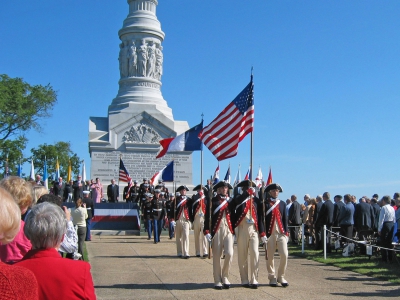
Yorktown Day Patriotic Exercises in front of the Victory Monument in Yorktown, Virginia. Photo: Colonial National Historic Park
Today marks the ultimate “this day in history.” It’s Yorktown Day!
On October 19, 1781, General Cornwallis surrendered his army to General Washington at Yorktown, Virginia, after a long and debilitating siege. The very first Yorktown Day, however, actually saw Cornwallis absent from the event. On the morning of the 19th Cornwallis signed capitulation documents and sent them back to Washington. That afternoon, when the official surrender ceremony was to take place, Cornwallis failed to show. On the very first Yorktown Day, British General Charles O’Hara surrendered his sword to General Benjamin Lincoln.
Nevertheless, it was with zeal and jubilation that the news of the British surrender reached Congress, who immediately agreed that the date and the site should be memorialized for posterity. Just ten days after the surrender, on October 29, 1781 Congress passed a resolution “that the United States, in Congress assembled, will cause to be erected at York, in Virginia, a marble column, adorned with the emblems of the alliance…and inscribed with a succinct narrative of the surrender of Earl Cornwallis to his excellency, General Washington, Commander-in-Chief of the combined forces of America and France…”[1]
Time passed however, and Congress failed to make good on their resolution to erect a formal monument at the site. When the Marquis de Lafayette visited the site of the siege on Yorktown Day 1824, it was not a grand marble column that greeted him, but a grouping of wooden obelisks marking locations of redoubts and the scene of the British surrender. Lafayette’s experience of Yorktown Day was a grand jubilee of remembrance, reflection, and pomp and circumstance, and the real monument to American liberty on display that day was Lafayette himself, along with the throng of veterans who turned out to greet him.[2]
As the first centennial celebration of Yorktown Day loomed in the hearts and minds of Americans, attention returned to Congress’s 100-year old promise of erecting a permanent memorial at Yorktown. The renewed cries came from Boston, another revolutionary city, when in 1875 the mayor supported a unanimous petition “asking that Congress (will) fulfill its pledge to erect at Yorktown, Virginia, a marble column commemorative of the last and crowning battle of the Revolution.”[3] In 1880 Congress again took up the mantle, and
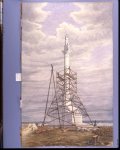
Original architectural drawing showing the Yorktown Monument nearing completion, with scaffolding still in place. Richard Morris Hunt, 1884. Library of Congress.
accepted a design by architects R. M. Hunt and Henry Van Brunt and sculptor J.Q.A. Ward, who endeavored to remain true to the original century old stipulation that the monument be a column, and surrounded it in classical symbolism. The cornerstone for the monument was laid during Yorktown Day festivities in 1881—the centennial Yorktown Day commemoration.
Yorktown Day is as robust and ceremonial today as it was in 1781, 1824, and 1881. The day often includes wreath laying and commemorations, visits from dignitaries and special guests, and a throng of enthusiastic history buffs, veterans, and families from far and wide celebrating “the last and crowning battle” of the American Revolution.
How are you celebrating Yorktown Day?
Artillery firing at the Yorktown Victory Center, a museum of the American Revolution administered by the Jamestown-Yorktown Foundation. Photo: Jamestown-Yorktown Foundation
[1] As quoted in A Full History of the Monument Erected by the U.S. Government to Commemorate the Close of the Revolutionary War, At Yorktown, October 19th, 1781. Being a Narrative of its Inception, Construction, Completion, and Official Examination (Philadelphia, 1890), pg 15.
[2] For more on Lafayette’s visit to Yorktown in October 1824, see Thomas A. Chambers, Memories of War: Visiting Battlegrounds and Bonefields in the Early American Republic (Ithaca, 2012).
[3]Congressional Record: Containing the Proceedings and Debates of the Forty-Fourth Congress, First Session; Also Special Session of the Senate, Volume IV (Washington, D.C., 1876), pg. 401.
You can almost feel the cold weather from just looking at the painting. With the snow on the ground, and white specks of wintry mix falling in the distance, one almost wants to say “brrr.”
With rags wrapped around feet, heads bowed into the storm, and no two soldiers dressed a like the painting depicts winter 1777 for the American Continental Army. The title “The March to Valley Forge” also concocts images of the harshness of that winter during the American Revolution.
And in the middle of the picture, sits George Washington, astride his horse, staring at the marching soldiers in silent tribute. One of the soldiers is depicted doffing his cap at Washington. Respect, admiration, and solidarity of the joint struggle of the war, is present, by just examining the painting a little closer.
That is why this painting below, done by William Trego, a century and a few years after this march would have happened, is my favorite painting about the American Revolution.
“Remember the ladies,” Abigail Adams wrote in a letter to her husband during his service in the Continental Congress. And those words are how we now most often remember her: “Remember the ladies.”
And John did. He pined for her. His long public career—in the Continental Congress, as a minister in Europe, as vice president, as president—kept them apart for long stretches. They spent ten of their fifty-four years of marriage separated by war, by sea, by duty.
So they wrote—some 1200 letters in all. “My dearest friend,” he addressed her, and he meant it.
The lively correspondence between John and Abigail illuminates not only a great American love story but also a great political partnership. Among the company of great Founders, Abigail was the one forced to stay at home—by social convention and family duty—but she refused to be forgotten. Continue reading “Remembering John and Abigail (part two)”→
Down the street from the Governor’s Palace in Colonial Williamsburg sits a two-story brick structure. Living historians, in first-person, debate the road to the American Revolution.
When Abigail Adams died in late October, 1818, her husband, John, brokenhearted, said, “I wish I could lie down beside her and die, too.”
Today, the two are entombed side by side, along with their son John Quincy and his wife, Louisa Catherine, in a well-lit, whitewashed crypt beneath the United First Parish Church in Quincy, Mass. I’ve come here to pay my respects to the former presidents and first ladies, but mostly I’m here to say thanks to John, and to remember him because he worried he’d be forgotten. Continue reading “Remembering John and Abigail (part one)”→
His last name jumps off the page, much like the term shrapnel usually does when leaving an artillery piece.
“Shrapnel” as defined by Merriam-Webster Dictionary is “a projectile that consists of a case provided with a powder charge and a large number of usually lead balls that is exploded in flight” or more simply “bomb, mine, or shell fragments.”
Either definition brings to mind images of death, destruction, maiming, and killing for any military historian.
A lot of understanding history is understanding connections. Making relevant connections
Robert “King” Carter
and interpreting those connections to people. Recently I played a part in curating a new exhibit at the Manassas Museum. This exhibit “A Virginia Aristocracy: The Carters of Virginia” focuses on the Carter family in Virginia and their vast influence. Beginning with Robert “King” Carter, the Carters amassed great wealth and land in Virginia. The Carters were one of the leading families in colonial Virginia and their influence was felt all the way up to the Civil War.
As I was leading an exhibit talk last weekend, I started to make some of those connections that I love to share with the public. One that I knew about, but didn’t really contextualize until talking to a small group was how the Carters influenced the course of American history. In a way beyond their ancestry to future U.S. Presidents, but in a connection that “King” Carter never intended.
Last week, Michael Harris wrote about the Battle of Brandywine and in his conclusion mentioned his excellent history on this important battle in the American Revolution.
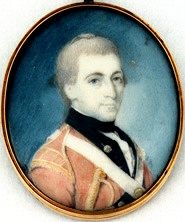
While reading his work, I came across the account of Captain Patrick Ferguson.
Captain (Major) Patrick Ferguson
Harris describes it as one of the most “potentially momentous” non-incidents of the entire American Revolution.
Emerging Revolutionary War and Revolutionary War Wednesday is pleased to welcome guest historian and author Michael C. Harris this week.
The Battle of Brandywine was fought on September 11, 1777. Visiting the battlefield to commemorate what took place there began just three years later. On his way to Virginia in 1780, the Marquis de Lafayette made a point of stopping for day at the battlefield where he was wounded and giving a tour to the officers that were travelling with him. An older Lafayette returned in 1825 during his celebrated 15-month tour of America.
However, it would not be until after the American Civil War during the golden age of preservation that any kind of markers or monuments began to appear around the ten-square-mile landscape. During the 1877 centennial, artillery pieces were placed to mark the fighting near Sandy Hollow. Eighteen years later, a monument was dedicated along Birmingham Road supposedly marking the spot where Lafayette was wounded. Had Lafayette been alive, he would have been able to put out the error in location.







 Emerging Revolutionary War Era