

By year’s end in 1755 the perils of war had blanketed the North American landscape as the battle for the continent raged between England and France. The opening years of conflict in what would come to be known as the French and Indian War were fought during a time of peace between the two mighty European powers in which no declaration of war would be announced until 1756. However, King George II and Louis XV had assembled the largest armies ever seen on the North American continent up to that time to defend and expand their respective colonial possessions. These measures were far from peaceful, and it was evident that after blood had been spilled in New York, Pennsylvania, and Nova Scotia, a declared war was inevitable.
The story of the campaigns of 1755 begins the previous year when tension in the Ohio River Valley boiled over, precipitating armed conflict. Colonial expansion (England moving west, France moving south) forced these two super powers on a collision course that culminated in May 1754 when a detachment of Virginians under the command of George Washington opened fire on a party of French colonial troops that were on a “diplomatic” mission to order all Englishmen out of the Ohio River Valley. These were the first shots fired in what eventually evolved into the French and Indian War. Although the only territory disputed over in 1754 was the land surrounding present day Pittsburgh, by the following year England’s eyes turned to French military strongholds in Nova Scotia, the Great Lakes region, and upstate New York.
The plan orchestrated by England’s Captain General, the Duke of Cumberland (George II’s son), for 1755 was to be carried out on four fronts in order to counter all of France’s military gains the previous year. Placed in command of the British regular troops being sent to the colonies, as well as the colonial provincial units then being raised for the coming campaigns, was Major General Edward Braddock. Meeting in Alexandria, Virginia in April with the royal governors of Maryland (Horatio Sharpe), Massachusetts (William Shirley), New York (James De Lancey), Pennsylvania (Robert Morris), and Virginia (Robert Dinwiddie), Braddock laid out Cumberland’s plans and what was to be expected of the colonies taking part in the various expeditions. Also present at the conference was William Johnson of New York, who was personally appointed by the general as Superintendent of Indian Affairs for the northern colonies.

William Johnson was given command of the provincial force that was to move north from Albany, NY and capture the French stronghold at Crown Point astride Lake Champlain. Using his close ties with the Iroquois, it fell upon his shoulders to muster Native American support and recruit warriors for his expedition as well as William Shirley’s thrust against Fort Niagara at the southwestern end of Lake Ontario. A clash of personality and interests between the two men would eventually lead to Shirley being denied of Indian support for his offensive and Johnson obtaining all that was offered from the Mohawks.

Along with these two armies moving through New York, efforts to secure the Chignecto Isthmus in Nova Scotia by capturing Fort Beauséjour, as well as a major push to take Fort Duquesne at the Forks of the Ohio River were also formulated. Robert Monckton was given overall command of the force that would advance from New England and capture Beausejour, and Edward Braddock himself would lead a large 2,400 man army of regulars and provincials that would oust the French from the Ohio River Valley. Upon capturing Duquesne, Braddock was then set to move north and link up with Shirley to assist in the capture of Fort Niagara. On paper the plan appeared clear and simple, and the men believed all the objectives could be taken with ease. By winter 1755, North America should belong to George II.
More times than none, plans that appear perfect on paper are hardly ever executed properly. This was the case for England’s grand scheme to capture the continent in 1755 before a large scale conflict with France could be forced upon them. On July 9, Braddock’s force made it to within several miles of the French at Fort Duquesne before it was attacked and defeated, suffering nearly 900 casualties, including the general who suffered a mortal wound. He later died during his army’s retreat to Fort Cumberland, Maryland four days later. By the end of the month, Colonel Thomas Dunbar, Braddock’s successor, had his men marching eastward towards Philadelphia where they would enter winter quarters in the middle of summer.

With Edward Braddock’s demise, William Shirley was elevated to the position of Commander-in-Chief. Mourning the loss of his son, who served as a secretary to Braddock and was killed during the fighting along the Monongahela River, he was given the task of trying to avoid another disaster. Good news arrived from Nova Scotia later that summer as Monckton reported that his expedition had been a success. Fort Beauséjour and Gaspereau had fallen and the Chignecto Isthmus was secure. This British victory then in part led to the first ever ethnic cleansing to occur in the modern world. Thousands of French Acadians were deported out of the country to prevent any possible uprisings that might hinder British colonial expansion and military efforts against New France.

The victory in Nova Scotia was the only successfully executed expedition of the four-pronged movement against the French in North America. Although Shirley and Johnson would not meet any sort of battlefield defeat in their efforts, Monckton’s campaign was the only one that captured its main objective.
Arriving at Fort Oswego at the southeastern corner of Lake Ontario, William Shirley was determined to repair and strengthen the old fortification before advancing any further. His time spent there went by wasted as he just simply could not get his army properly supplied or moving to capture Fort Niagara. He returned east to New York City and left his army at Oswego hoping to resume the offensive the following summer. As William Shirley failed to capture Fort Niagara, so too did William Johnson fail to capture Crown Point. However, Johnson’s army was able to secure the southern end of Lake George and defend New York from a French advance into the colony’s interior.

Among the dead and dying of Braddock’s command along the Monongahela River in July 1755, wagons filled with the general’s personal and official military correspondence were captured by the French-Canadians and their Native allies. Within these papers were the plans for the British offensives against New France. Freshly arrived from France and now having the knowledge of his enemy’s intentions, Jean Armand, Baron de Dieskau, the newly appointed General-in-Chief of regular troops in the colonies, sought to move against Johnson’s force south of Lake George from Crown Point, and then move west to deal with Shirley. On September 8, 1755, roughly three thousand British and French troops clashed south of and at the base of Lake George. When the day finally came to an end, Dieskau’s army had been repulsed and was sent retreating north towards Ticonderoga. With the southern shore of the lake now securely in British hands, Johnson’s army began construction of what would become Fort William Henry. Had Dieskau succeeded in dislodging Johnson’s men from the lake, it is quite possible that he could then have overrun Fort Lyman (Edward) fourteen miles to the south, and then marched his victorious army against Albany where he could have captured a major supply base and cut New England off from the rest of the colonies.

Even though Johnson failed to capture his objective, he still claimed the only battlefield victory over France for England in a year of military disasters. Braddock was dead and his army mauled by the French outside Duquesne; Shirley was bogged down at Oswego and refused to go any further; Johnson was recovering from a wound received at Lake George while his army erected defenses; and Monckton’s men were deporting Acadians following their successful siege. Britain had failed to expel the French from North America before a full-scale war could be declared. As tension grew in Europe over alliances and territorial possessions, the world went to war in May 1756. Ultimate control of North America would be determined by how much attention could be placed on defending the British colonies and New France without risking defeat elsewhere throughout the world’s battlefronts.
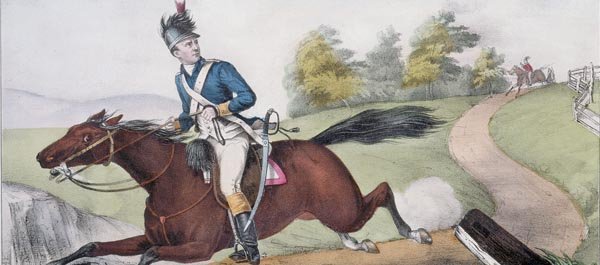


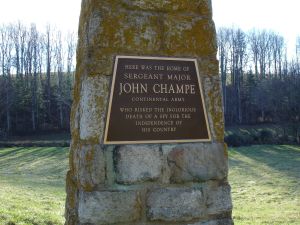
 went off to war as the “Champe Rifles” (8th VA Infantry). In the early 20th century, the location of his home was marked with a small obelisk (reportedly made by stone from the foundation of the home). Today the monument sits on the south side of Route 50 a few miles west of Aldie.


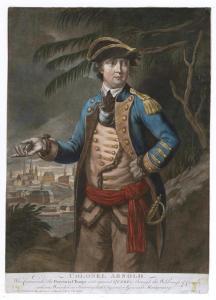 Washington also learned of Arnold’s treason on September 24th during his planned visit to West Point. Washington reportedly took the news calmly and began to investigate the depth of treason in his officer corps. Maj. Lee assisted Washington in his investigation, and both found no evidence of other American officers involved in the plot. Washington then turned to the capture of Arnold, and that is where our “hero” comes into the story.





 Emerging Revolutionary War Era