Emerging Revolutionary War welcomes back guest historian Drew Palmer. He is the founder of Revolutionary Maryland; click here to learn more about that blog.
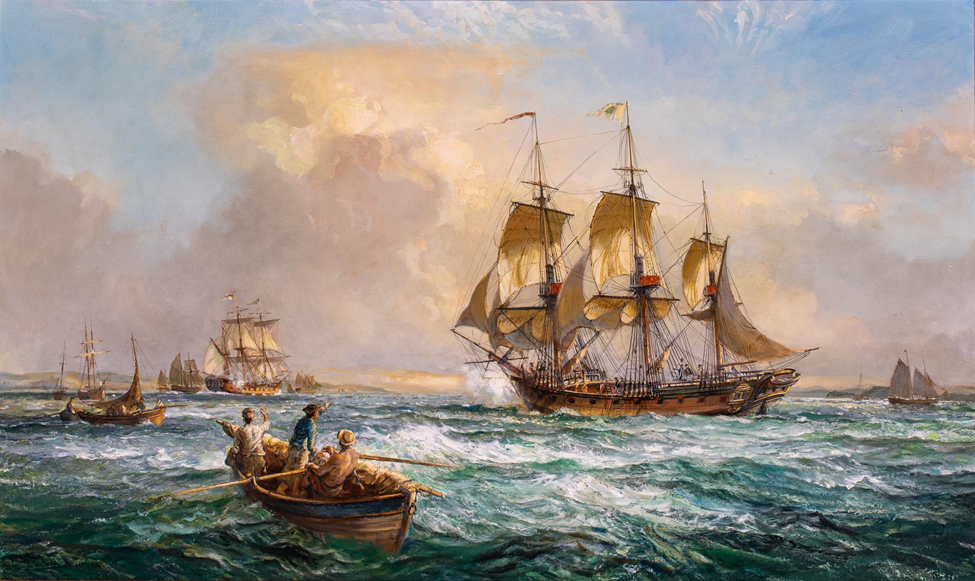
(Vallejo Image Galleries)
In the early evening of March 5, 1776, two armed boats left Annapolis to patrol the Chesapeake Bay. Captain John Pitt and Joseph Middleton were patrolling to prevent any British ships nearby from entering Maryland’s waters. As they patrolled, they discovered an alarming sight: three British warships heading directly towards Annapolis. Middleton and Pitt rushed off to the Maryland Council of Safety’s chambers in Annapolis to report the startling news.1 In the coming days, Maryland was tested for the first time in the growing Revolutionary conflict.
The American rebellion had become a full-scale war by the spring of 1776. In early March, the siege of British-held Boston was about to end. Hundreds of miles south in Philadelphia, the Declaration of Independence was only four months away. In Maryland, politicians worked hard to maintain Maryland’s isolation from the worst of the conflict. In Virginia, a raiding war had already begun. Only two months before, the town of Norfolk, Virginia, was bombarded, leading to the destruction of the town. Along with Norfolk’s destruction, British attacks and raids were carried out throughout the lower Chesapeake Bay, along with a blockade. 2
Participating in British operations in the lower Chesapeake was Captain Mathew Squire of the British Royal Navy. For several months, Squire’s vessel, the Otter, served as the headquarters of the exiled Virginia Governor, Lord Dunmore. From the Otter, British attacks and raids were launched on Patriot strongholds in the lower Chesapeake. By March, Squire had gained a reputation as a competent officer and ruthless raider of American shipping.3 Squire was heavily involved in the bombardment of Norfolk and an attempted attack on Hampton, Virginia. Though Squire’s area of operation had been centered on the lower Chesapeake, new intelligence pulled him northward into Maryland.
Yesterday marked the 250th anniversary of the first battles of the American Revolution. The Battles of Lexington and Concord were brutal and vicious. More than 40 American colonists were killed in the fighting. These were the first martyrs in the cause for American liberty. Here are the stories of some of those men who shed their blood on that fateful day for our freedom.
Jonathan Harrington was one of the few dozen men in the Lexington militia who stood on the Lexington Green when the first British troops arrived at sunrise on April 19, 1775. He lived with his wife and child in a home that was located on the Green. After a shot was fired, the British soldiers opened fire on the American militiamen. As they were dispersing, Harrington was shot through the chest. He crawled towards his house and died within sight of his home. Local legend says he crawled to his own doorstep and died at the feet of his wife and child.
Sign on the Harrington house which still stands in Lexington, MA today.
Isaac Davis was the captain of the Acton minutemen. The Acton minutemen marched more than 5 miles to Concord in the early morning hours of April 19. After seeing smoke from the town, the minutemen marched down towards the North Bridge and the British soldiers guarding the opposite side fired a volley at the minutemen. This volley was high and may have been a warning shot. The next volley was fired into the minutemen. Private Abner Hosmer was shot through the head and killed. Davis was shot through the chest, his blood splattering the men around him. Seconds later the American colonists were given the command to fire on British soldiers for the very first time.
The Acton Monument stands over the graves of Isaac Davis, Abner Hosmer, and James Hayward.
James Hayward was part of the Acton company that joined in the running battle back towards Boston. During the battle soldiers from both sides stopped to get water at local wells. At one point a British soldier went to the well by the Fiske house to get a drink of water. At the same time, Hayward was heading there too. The two saw each other and raised their muskets. The British soldier said, “You are a dead man!” Hayward replied, “So are you.” They both fired at the same time. The British soldier was killed instantly. Hayward was hit, with splinters of his powder horn going into his side. He died not long after.
The site of the Fiske well, where James Hayward and a British soldier died.
Jason Russell was a 58-year-old man living in the village of Metonomy (present day Arlington, Massachusetts) and was preparing to defend his home on the road back to Boston. People were telling him to leave the area, but Russell refused and exclaimed “An Englishman’s home is his castle!” As the British column came down the road, Russell and a dozen militiamen began to fire into redcoats. Unfortunately for Russell and the other militiamen, the British had deployed flankers to clear out many of the houses along the road. The colonists were taken by surprise and retreated into the house. Russell was unable to run and was bayonetted to death by the British troops on his front doorstep. The British entered the house and hand to hand fighting occurred inside the house. Two British soldiers and eleven militiamen were killed.
A painting depicting the death of Jason Russell at the Jason Russell House (Arlington Historical Society)
Jason Winship and Jabez Wyman decided to sit in the Cooper Tavern and have a drink. The fighting in Metonomy became extremely brutal. Even unarmed civilians got caught up in the carnage. As British arrived at the Cooper Tavern, the tavern owners fled into a cellar. Winship and Wyman did not stand a chance. The owners noted that: “the King’s regular troops under the command of General Gage, upon their return from blood and slaughter, which they had made at Lexington and Concord, fired more than one hundred bullets into the house where we dwell, through doors, and windows,…The two aged gentlemen [Winship and Wyman] were immediately most barbarously and inhumanly murdered by them, being stabbed through in many places, their heads mangled, skulls broke, and their brains out on the floor and walls of the house.”
Samuel Whittemore was a 78-year-old man who lived in Menotomy. He prepared to fight the British troops marching along the road. He carried a musket, two pistols and a sword. As some British soldiers moved to get Whittemore, he shot one with his musket, then killed two with his pistols and then drew his sword to fight them. The British soldiers shot off part of his face off, clubbed him and bayoneted him fourteen times, leaving him for dead. Amazingly, he survived and live for another eighteen years, dying at the ripe age of 96.
A monument for Smauel Whittemore in Arlington, MA.
One of the last people to die that day was 65-year-old militiaman James Miller. As the British were making it back to Charlestown, James Miller and some men fired into the retreating soldiers. British soldiers ran towards the militia. Miller’s compatriots fled and entreated him to do the same. Miller replied, “I am too old to run.” The British opened fire and killed Miller.
Today the remains of the men who were killed on Lexington Green now lie there under a monument that was erected in 1799, not long after the successful conclusion of the Revolutionary War. The epitaph on that monument still speaks to the heroism and valor of these first Americans to fall in the Revolutionary War:
“The Blood of these Martyrs, In the cause of God & their Country, Was the Cement of the Union of these States, then Colonies; & gave the spring to the spirit. Firmness And resolution of their Fellow Citizens. They rose as one man to revenge their brethren’s Blood and at the point of the sword to assert & Defend their native Rights. They nobly dar’d to be free!!”
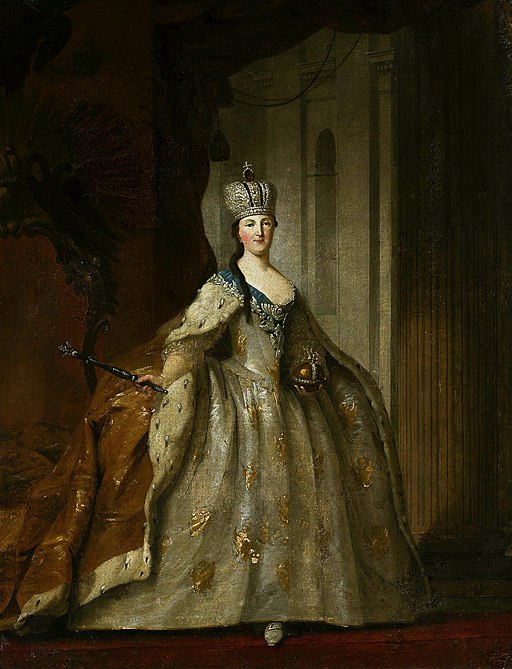
Catherine the Great By Ivan Argunov (Wikimedia Commons)
Catherine II, aka Catherine the Great, was one of the most dynamic and substantive monarchs of the eighteenth century. A wealth of contradictions characterized her reign. A reformer who corresponded regularly with the likes of Voltaire and Diderot, she was also a dedicated imperialist who divvyed up Poland in league with her neighbors and waged offensive wars to the south while colonizing as much of Siberia and Central Asia as she could. She seized power in a de facto coup, watched her rivals conveniently die, and embraced a Russian tradition of banishing unreliable or undesirable subjects, defined as those did not serve her interests, to Siberia. At the same time, she explicitly located the sovereignty of the nation among its people, sought to expand the number and classes of subjects with a role in administrative decision-making, and sincerely desired be seen as a what might be called a “democratic autocrat.”[1] So, one might expect Catherine’s Russia to have a mixed view of the American Revolution. As always, she was sure not to disappoint.
The years prior to Lexington and Concord were exhausting for Russia. In 1772, it completed the first partition of Poland in cooperation with Prussia and Austria. In 1774, it finally brought a six-year war with the Ottoman Empire to a successful resolution in the Treaty of Kuchuk-Kainarji, which expanded Russian territory in the south, giving it greater access to the Black Sea.[2] Throughout the period, Catherine dealt with a number of internal rebellions and uprisings built around phony claimants to her throne. By far the most dangerous was a Cossack uprising led by Emil Pugachev, who claimed to be Catherine’s deposed husband Peter III. He was caught at the end of 1774 and executed in 1775. When Britain’s North American colonies rebelled, it rated notice, but little attention in the Russian capital, St. Petersburg. Before too long Britain came calling, requesting 20,000 troops to suppress the rebellion. Catherine declined, but wrote a correspondent that she expected America to become independent in her lifetime.[3] Then her government turned toward its latest round of internal reform meant to improve the administration of its vast and growing territory. That might have been the end of it, but European politics intervened.




 Emerging Revolutionary War Era