Emerging Revolutionary War welcomes back guest historian Evan Portman
By the time Ralph Waldo Emerson immortalized the “shot heard round the world” in his 1836 “Concord Hymn”, the battles of Lexington and Concord had already achieved fame as the first engagement of the Revolutionary War. However, in the early twentieth century one West Virginia historian began to argue that the true “shot heard round the world” had occurred six months earlier on October 10, 1774, at the battle of Point Pleasant.
The battle was the culmination of Lord Dunmore’s War, a five-month campaign against the Shawnee and Mingo tribes in an effort to quell the violence along the Ohio frontier.[1] Virginia settlers had begun moving into the Ohio Country following the Treaty of Fort Stanwix, in which the Iroquois Confederacy ceded the territories of present-day Kentucky and West Virginia to the Colony of Virginia. However, the Shawnee had not been consulted regarding the treaty and claimed ancestral hunting rights to the region, responding with violent raids along the frontier to reclaim their land.[2] Virginia Colonial Governor John Murray, 4th Earl of Dunmore sanctioned the colonial militia to wage a campaign against the Native Americans after white settlers began reacting violently, themselves.[3]
Emerging Revolutionary War welcomes back guest historian Evan Portman
Most historians credit Ann Pamela Cunningham with kickstarting the historic preservation movement with her purchase of Mount Vernon in 1858. However, preservation of historic sites began long before the Mount Vernon Ladies’ Association. In fact, the storied walls of Fort Ticonderoga became the object of a preservation movement 38 years before the Ladies’ Association purchased George Washington’s ancestral home.
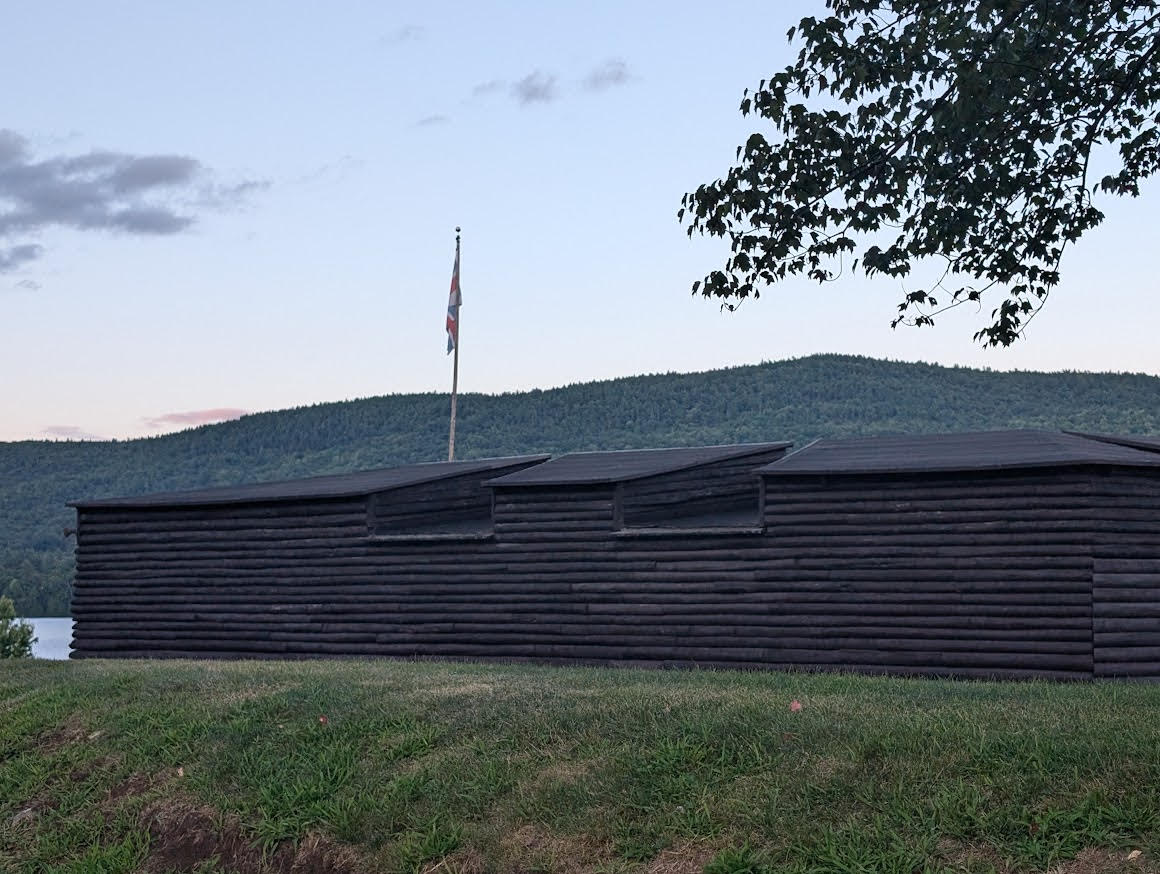
Fort Ticonderoga—known as the Gibraltar of North America—played an integral role in both the French and Indian War and the American Revolution. The fort was originally constructed by the French in 1755 on a portage known to the Iroquois as ticonderoga, meaning a “land between two waters.” Fort Carillon, as it was known to the French, stood strategically between Lake Champlain and Lake George, thereby controlling both the Hudson River Valley and St. Lawrence River Valley. On July 8, 1758, an outnumbered French army successfully defended the fort against British forces in the bloodiest battle of the French and Indian War.[1] However, the following year British General Jeffery Amherst captured the fort and renamed it Fort Ticonderoga.[2]
By the American Revolution, the fort had fallen into disrepair but was still guarded by a small British garrison. In 1775, it was the scene of one of the most famous dramas in American history. On May 10, Col. Benedict Arnold and Col. Ethan Allen led a combined force of the Green Mountain Boys and Massachusetts and Connecticut militiamen across Lake Champlain to capture the fort. “Come out you old Rat!” Allen famously cried to the fort’s commander, Capt. William Delaplace, and demanded he surrender the garrison “in the name of the Great Jehovah and the Continental Congress.”[3] Delaplace agreed, and Ticonderoga quickly fell into American hands.
Emerging Revolutionary War welcomes back guest historian Evan Portman
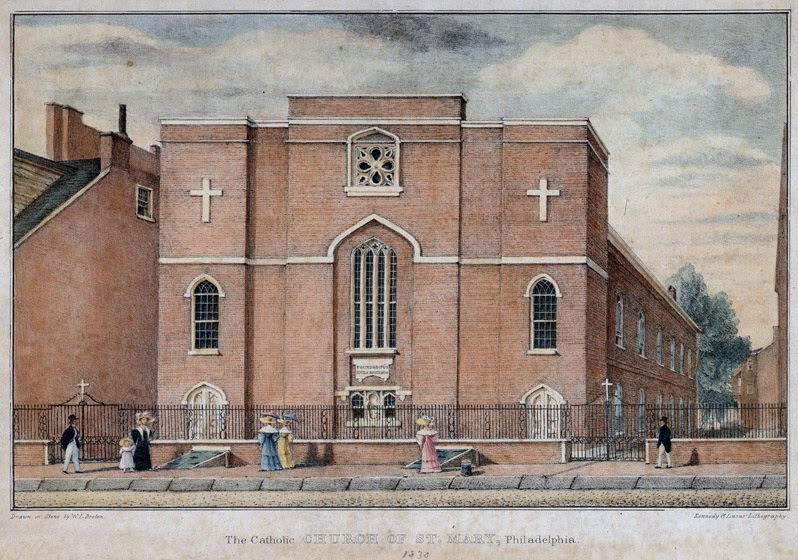
Two future presidents walk into a Catholic church.
No, that’s not the beginning of a bad historical joke. It’s what happened on October 9, 1774, when George Washington and John Adams wandered into Old St. Mary’s Catholic Church while serving as delegates to the First Continental Congress in Philadelphia.
In September 1774, delegates from twelve of the thirteen colonies convened in Philadelphia for the purpose of discussing a response to Parliament’s recent Intolerable Acts. But after a month of debating (and bickering), Adams wrote that “the Business of the Congress is tedious, beyond Expression.”[1] Seeking a break from the monotony, Adams and Washington ventured to one of the oldest Catholic churches in the colonies. Established in 1763 by parishioners of Old St. Joseph’s, St. Mary’s Church grew from the need for a Catholic cemetery.
“[L]ed by Curiosity and good Company I strolled away to Mother Church or rather Grandmother Church, I mean the Romish Chappell,” Adams wrote to his wife Abigail that day.[2] The church stood just a few blocks south of the Congress’s meeting place at Carpenters’ Hall and starkly contrast anything the Protestant Adams had seen before. A descendant of some of America’s early Puritans, Adams was raised in the Congregational church of Braintree, Massachusetts, where “unfettered daylight through clear window glass allowed for no dark or shadowed corners, no suggestion of mystery.”[3] Old St. Mary’s could not have been more different. Light poured through several stained-glass windows before a large, ornate altar, behind which hung a dramatic depiction of Christ’s passion while burning candles and incense lit the nave.
Adams’s puritanical upbringing taught him to abhor such pageantry in the house of the Lord. He looked with pity upon “the poor Wretches, fingering their Beads, chanting Latin, not a Word of which they understood, their Pater Nosters and Ave Maria’s.” Even “their holy Water—their Crossing themselves perpetually—their Bowing to the Name of Jesus, wherever they hear it” appalled the young lawyer from Boston.[4]
Despite his disdain, some elements of the mass impressed and even moved, Adams. He described the priest’s homily as a “good, short, moral Essay upon the Duty of Parents to their Children, founded in Justice and Charity, to take care of their Interests temporal and spiritual.” Its brevity stood in stark contrast to the long-winded sermons of the Great Awakening, with which Adams would likely have been familiar. Even the priest’s flashy garments were noteworthy to the future president. “The Dress of the Priest was rich with Lace—his Pulpit was Velvet and Gold,” Adams noted.[5]
But most noteworthy of all was the “Picture of our Saviour in a Frame of Marble over the Altar at full Length upon the Cross, in the Agonies, and the Blood dropping and streaming from his Wounds.” That combined with the organ music, which Adams described as “most sweetly and exquisitely” was enough to move him. “This Afternoons Entertainment was to me, most awfull and affecting,” he confessed. But in the eighteenth century, the word “awful” did not mean what it does today. Adams quite literally meant that he was “full of awe” in observing the mass. He was so moved, in fact, that he wondered how “Luther ever broke the spell” of Catholicism.[6]
Perhaps Adams’s experience that day, 250 years ago, is indicative of the Revolution at large, as it brought together men from disparate backgrounds and regions. As a young man in Braintree, Adams likely never imagined he could be moved by a “papist ceremony,” nor could he probably have imagined signing his name on a document securing independence from his former country. In this way, the American Revolution made fantasy a reality, and the impossible, possible.
[1]“John Adams to Abigail Adams, 9 October 1774,” Founders Online, National Archives, https://founders.archives.gov/documents/Adams/04-01-02-0111. [Original source: The Adams Papers, Adams Family Correspondence, vol. 1, December 1761– May 1776, ed. Lyman H. Butterfield. Cambridge, MA: Harvard University Press, 1963, pp. 166–167.]
[3] David McCullough, John Adams, (New York: Simon & Schuster, 2001), 84.
[4] “John Adams to Abigail Adams, 9 October 1774,” Founders Online, National Archives, https://founders.archives.gov/documents/Adams/04-01-02-0111. [Original source: The Adams Papers, Adams Family Correspondence, vol. 1, December 1761– May 1776, ed. Lyman H. Butterfield. Cambridge, MA: Harvard University Press, 1963, pp. 166–167.]
Emerging Revolutionary War welcomes guest historian Evan Portman
Overlooking the Grand Parade at Valley Forge National Historical Park is a statue almost as solid as the man it portrays. Baron von Steuben helped transform the American army into an effective and efficient fighting force in the winter of 1777-1778, but he also aided the country nearly a century and a half later. Yes, Baron von Steuben helped the United States through World War I—or at least the social turmoil on the home front.
Friedrich Wilhelm August Heinrich Ferdinand Steuben was born in Prussia (modern day Germany) in 1730 and served in the Prussian army through the Seven Years’ War. By 1775, Steuben had accrued a considerable amount of debt (despite his stature within the aristocracy), so he sought a foreign military appointment. Failing to catch the eye of the British, French, or Austrians, the Baron set his sights on the fledgling American government. Congress arranged for Steuben to be paid, depending on the outcome of the war, and sent him to the winter encampment at Valley Forge. There, he began drilling the Continental army and instituted better hygiene and sanitation practices. He also wrote a drill manual, which he published in 1779 as Regulations for the Order and Discipline of the Troops of the United States. After the encampment at Valley Forge, Steuben participated in the Southern Campaign of the Revolutionary War. After the Siege of Yorktown, Congress awarded the Baron a tract of land in New York where he died in 1794.