Holiday Kick-Off from Mt. Vernon….Place, Baltimore

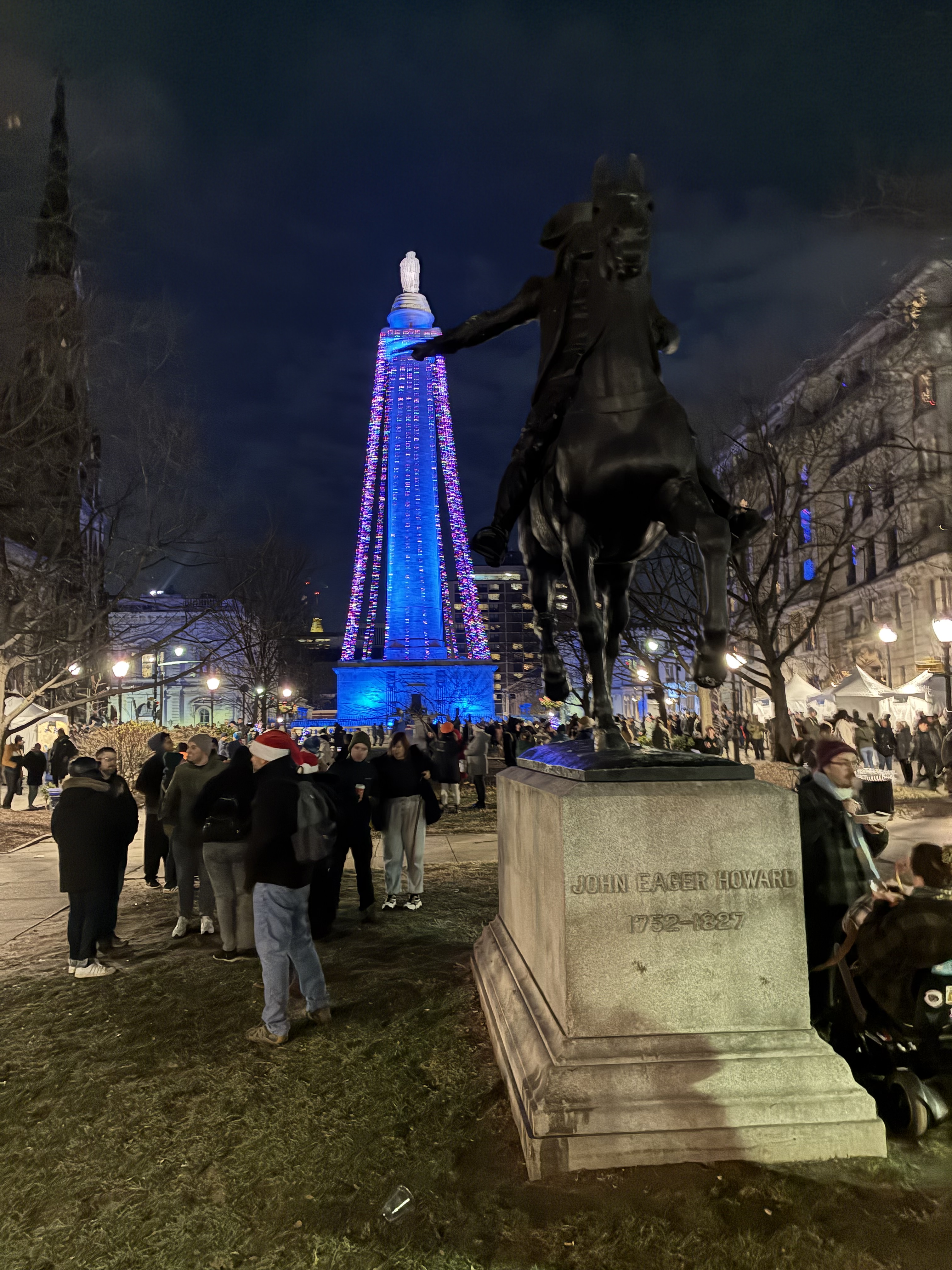
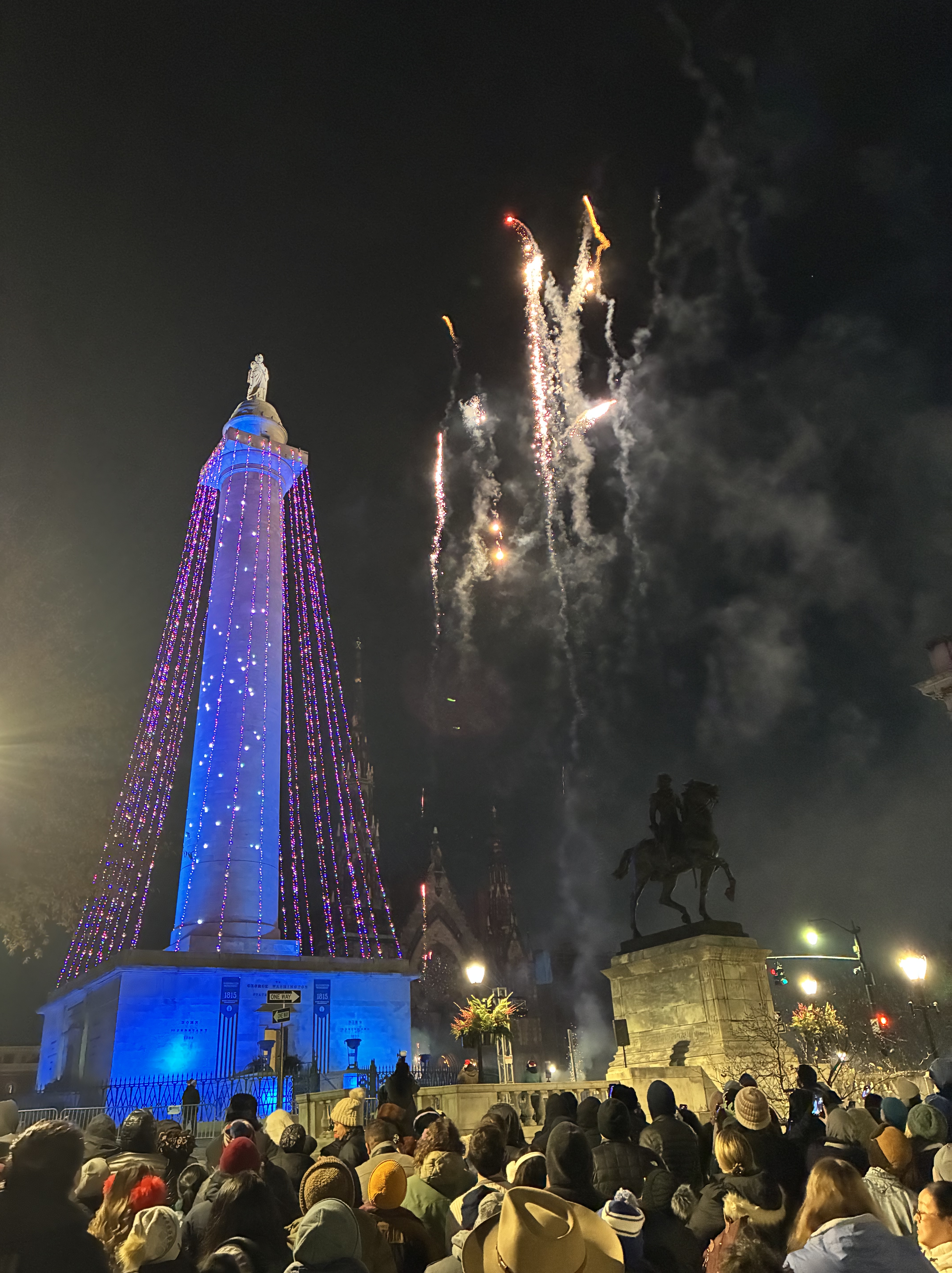
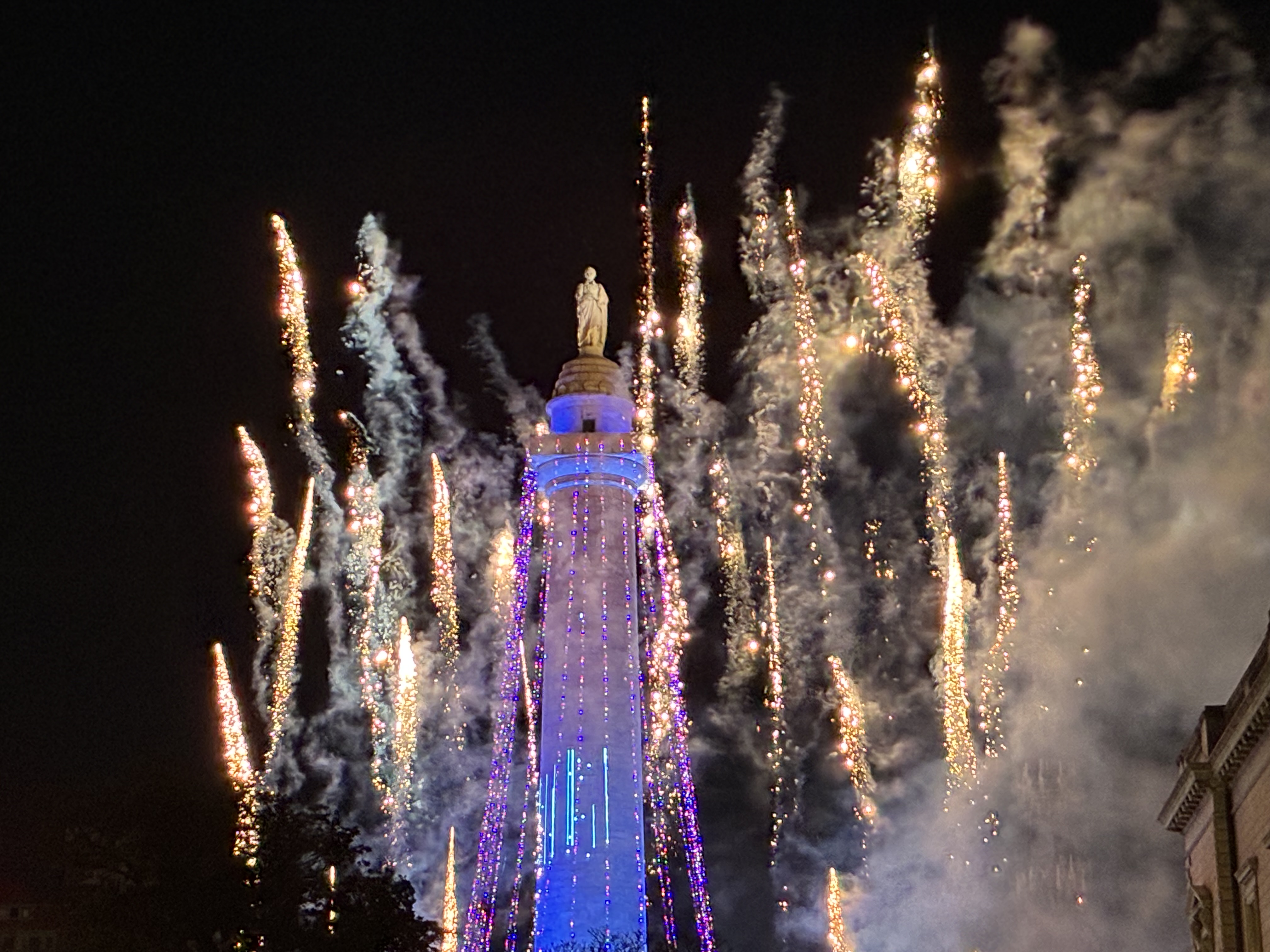
On the first Thursday of December, the unofficial kick-off to the holiday season takes place in Baltimore, Maryland. This year, on December 4, was the 54th year of the celebration. The 178-foot-tall George Washington Monument, the construction of which started on July 4, 1815, and was completed in 1829, is graced with lights and fireworks that light up the city sky about the figure of Washington.

On both sides of the Washington Monument stand two equestrian statues grace the grounds. One is of a local American Revolutionary War hero, John Eager Howard, born in Baltimore County in 1752. On the other side is honorary American, the Honorable Marquis de Lafayette.

If you peer to the left of the Howard equestrian statue photo, you see the spire of a Victorian Gothic church. Built in 1872, the church stands on the location of the Howard residence. On January 11, 1843, Francis Scott Key died there, at the age of 63.

If you celebrate, Emerging Revolutionary War hopes your holiday season kicks off grandly as well. If I may, if looking for a gift for that history enthusiast, check out the Emerging Revolutionary War store here. Or the Emerging Revolutionary War Series, here.
“Our Flag Was Still There…” Book Talk on “Rev War Revelry”

On September 14, 1814, United States forces defending Fort McHenry in Baltimore repelled the British attempt to capture the city. Flying defiantly over the brick parapets was a 30 x 42 -foot the following day, clearly seen by the British and one captive American, Francis Scott Key. Over 100 years later the poem Key began writing on September 15 became the national anthem of the United States of America. But, what about the flag that the military commander of Fort McHenry, Major George Armistead had made? Well, this iconic flag became a part of the Armistead family for almost the next century as well.

Now, historian Tom McMillan, who has written on another member of the Armistead family, returns with his latest publication, Our Flag Was Still There: The Star-Spangled Banner that Survived the British and 200 Years–and the Armistead Family Who Saved It. This fascinating read, tracing the flag and its intertwined connection with the Armistead family, will be the subject of this week’s “Rev War Revelry.” McMillan gave a bit of a teaser to entice you to listen in on Emerging Revolutionary War’s Facebook page Sunday at 7 p.m. EDT.

OUR FLAG WAS STILL THERE details the improbable two-hundred-year journey of the original Star-Spangled Banner — from Fort McHenry in 1814, when Francis Scott Key saw it, to the Smithsonian in the 21st century – thanks to three generations of an enduring military family, the Armistead’s, who defended, kept, hid, and ultimately donated the most famous flag in American history.”

We hope you grab your favorite beverage and tune in. The book is now available for purchase and Tom will have details on how to attain a copy!

“Rev War Roundtable with ERW” War of 1812

The War of 1812 is considered by some historians as the end of the American Revolutionary Era. From the conflict, the United States will find a war hero and future president, Andrew Jackson and a poem by lawyer Francis Scott Key that turns into our national anthem.

But, the origins of the war, the military actions that spread around the United States, from Louisiana to the nation’s capital, to the invasion of Canada, and on the high seas are largely overlooked. There are numerous reasons for this.

That, in part, is why, this Sunday, at 7pm EST, on ERW’s Facebook page, the next historian happy hour “Rev War Revelry” will be focused on this important conflict. Join ERW historian Phillip S. Greenwalt along with the following guest historians for an hour-ish discussion of the three-year war.

Joining Phill will be;

Dan Davis, of the American Battlefield Trust, who has lectured on Andrew Jackson and the Battle of New Orleans. He is also a full-time historian with Emerging Civil War.

Also, formerly of Fort McHenry National Monument and Historic Shrine, and now working for the National Park Service in the Washington D.C. area, guest historian Jim Bailey will be the second of three guest historians.

Leaving the best for last, okay pun intended, as all three guest historians are great. But in all seriousness, the third guest historian joining for this revelry will be George Best. He is a park ranger for the National Park Service at Harper’s Ferry National Historical Park and volunteers as the Communications Coordinator for the Friends of Maryland’s War of 1812.

We look forward to you joining with your thoughts, comments, and questions this Sunday on our Facebook page (there will be an event post for you to use as a reminder) as we discuss this three-year conflict that had reverberations for many years afterwards.