Major John Van Dyk and the Bones of Major John André. Part I

Emerging Revolutionary War welcomes historian and educator Jeffrey Collin Wilford to the blog. A brief biog is at the bottom of this post. A list of sources will be at the bottom of the concluding Part III.

Major John André and John Van Dyk: Continental Artillery Soldier 

Much has been written about the betrayal of America by Benedict Arnold. However, one small but candidly morbid fact buried in the story has not. It relates to the disposition of British Major John André’s remains as they lay in a wooden ossuary on a British mail ship on the banks of the Hudson River while awaiting their return to England in 1821. The only recorded recollection of this event was in a letter written by a 67-year-old former Revolutionary War soldier and published in a Virginia newspaper in 1825. This man also happened to be one of the four officers who escorted André to the gallows in Tappan, New York, on October 2, 1780. 

John Van Dyk lived a storied life, serving America as a militiaman, Continental Artillery soldier, customs officer, New York City assessor, and assistant alderman. He came from an old Dutch family that had settled in the original New Amsterdam colony, which would eventually become Manhattan. There is ample evidence that, in 1775, he was actively involved in significant acts of disobedience against British rule with other “Liberty Boys,” as the New York Sons of Liberty preferred to call themselves. 

One of these acts was stealing muskets and cannons from the Royal Armory and Fort George.  Under the encouragement of Isaac Sears and Marinus Willett,  he was one of a crowd of colonists who broke into the Royal Arsenal at City Hall on April 23, 1775, stealing  550 muskets, bayonets, and related munitions. The angry mob had been spurred to act by the attacks on their fellow countrymen the week previous at Lexington and Concord in Massachusetts. Every person who took a musket was required to sign for it, signaling a promise to return it if it was needed to fight against British occupation. That call came on July 4, 1775, when the New York Provincial Congress ordered them recalled to outfit newly commissioned  Colonel Alexander McDougall’s 1st New York Regiment. It was relayed that anyone who refused would be deemed an enemy of the state. In all, 434 muskets were returned. 

Exactly four months later, Captain John Van Dyk was one of sixty or so men who, under Liberty Boys Colonel John Lasher and Colonel John Lamb, executed the orders of the New York Provincial Congress to remove the cannon from Fort George at the southern tip of Manhattan and drag them back to the area of City Hall. With tensions high in the city, the state leaders feared they would be turned against the colonists if they were left in the hands of the British. One of the militia members assisting in the removal effort was 19-year-old King’s College student Alexander Hamilton of the Hearts of Oak independent militia. By this time, civil unrest had relegated the British colonial government to operating from naval ships anchored in New York Harbor, which made keeping the cannon secure from a more agitated population nearly impossible. 

Just before midnight on August 23, 1775, a skirmish ensued between  Lasher and Lamb’s men removing the cannon, and a British barge near the shore. It had been sent to monitor the rebels’ activity by Captain George Vandeput from the HMS Asia, a 64-gun British warship anchored near shore. Musket shots rang out, presumably started by the British, which resulted in the killing of a King’s soldier on the barge. As a result, the Asia turned broadside and opened fire with their cannons in a barrage on the city that lasted for three hours. A city whose population had already been diminished by the fear of a coming conflict, shrunk even further due to the terror experienced that night.  

John Van Dyk spent most of the next eight years as an officer in General Henry Knox’s artillery while under the command of Colonel John Lamb.  During the war, he saw action at Brooklyn, Harlem Heights, White Plains, Trenton, Brandywine, Germantown, Crosswicks Creek, Monmouth, and Short Hills. He was also at both Morristown winter encampments and Valley Forge. In 1780 he was captured by the British off the coast of New Jersey and confined on the prison ship HMS Jersey in Brooklyn before being released that summer.  

Van Dyk had spent months out of commission in late 1779 and early 1780 with what, according to his symptoms, was probably malaria or yellow fever.  He petitioned General Knox, who, in turn, appealed to General Washington for leave to recuperate. Making his way to West Point to meet with General Washington he was instructed by the Commander-in-Chief’s aide-de-camp to be evaluated by Dr. John Cochran, physician and surgeon general of the army of the Middle Department. On Cochran’s recommendation, General Washington wrote to President Samuel Huntington asking that the Continental Congress grant Van Dyk’s petition for an 8-month Furlow to sea to convalesce, which was common at the time as it was believed the fresh sea air was helpful to healing. Approved, it would take six months before he boarded the brig General Reed with a crew of 120 and 16 guns, a privateer out of Philadelphia commanded by  Samuel Davidson. Once aboard ship he was temporarily made a Lieutenant of Marines. 

Only two days into the voyage, on April 21, 1780, things took an immediate turn for the worse when they were intercepted and captured by the 28-gun HMS Iris and the 16-gun sloop HMS Vulture. The Iris was the former American warship USS Hancock, captured in July of 1777 and renamed by the British. Van Dyk was brought to Brooklyn and placed on the prison ship Jersey in Wallabout Bay, one of the most notorious and deadly places for holding American prisoners of war. Conditions were so poor that, while approximately 6,800 American soldiers died in battle during the Revolution, over 11,000 prisoners died on the Jersey alone! Fortunately for John Van Dyk, American officers were often traded off the Jersey for British officers who were in the custody of American forces. Within two months he was released and traveled to his temporary home of Elizabethtown, New Jersey to finish recuperating before rejoining Lamb’s artillery in Tappan, New York. 

John Van Dyk had experienced many horrors of war in the years and months leading up to the morning of September 21, 1780, when British Major John André, an Adjutant General to British General Sir Henry Clinton, left New York City and sailed up the Hudson River. This pivotal incident would brand one of Washington’s closest generals a traitor and lead to the death of the esteemed and well-liked André. Ironically, Major André traveled on the very same sloop that had assisted in the capture of Captain Van Dyk just six months earlier. 

Bio:

Jeffrey Wilford has been an educator in Maine for over 30 years where he holds certifications in history and science. He received a bachelor’s degree in communications with an emphasis in journalism from California State University – Fullerton and a master’s degree in education, teaching and learning, from the University of Maine. In addition to his career teaching, he has worked as a general assignment newspaper reporter and an assistant to the press secretary of former Maine Governor and US Congressman Joseph Brennen. He lives in Maine with his wife Nicolette Rolde Wilford.

“Rev War Roundtable with ERW” Brandywine Campaign

The largest, in terms of military forces deployed, engagement in the American Revolutionary War occurred on September 11, 1777 in southeastern Pennsylvania. The Battle of Brandywine was a pivotal moment in the British campaign that captured the patriot capital in Philadelphia. With the anniversary of the engagement happening the Friday before, the Emerging Revolutionary War crew will make this engagement and campaign the focal point of Sunday’s “Rev War Roundtable with ERW.”

Joining the “Rev War Revelry” this Sunday, at 7pm on Emerging Revolutionary War’s Facebook page will be Michael C. Harris, historian and author of Brandywine: A History of the Battle that Lost Philadelphia but Saved America, September 11, 1777, which was published and is available for purchase by Savas Beatie. Click here to order.

Besides authoring the history mentioned above, Harris has an upcoming release, on another important battle in Pennsylvania, Germantown, fought on October 4, 1777. Rumor on the street has it that he will be joining ERW at a future date to discuss this important battle and talk about his new book.

A bit of a background on Harris. He is a graduate of the University of Mary Washington and the American Military University. He has worked for the National Park Service in Fredericksburg, Virginia, Fort Mott State Park in New Jersey, and the Pennsylvania Historical and Museum Commission at Brandywine Battlefield. He has conducted tours and staff rides of many east coast battlefields. Michael is certified in secondary education and currently teaches in the Philadelphia region. He lives in Pennsylvania with his wife, Michelle and son, Nathanael.

Although the battle lost Philadelphia for the patriots, Harris does not hold back on the culprit for the setback:

“Washington failed the army, the army did not fail Washington.”

To hear the reasoning behind that emphatic quote we hope you join us this Sunday!

Thomas Blackburn: Forgotten Patriot

Emerging Revolutionary War is honored to share the post below by guest historian Kerry Mitchell

Thomas Jefferson, George Washington, Richard Henry Lee, George Mason, Patrick Henry…when thinking about the period before and during the American Revolution these names come up as some of the great Virginians who were involved in the founding of our nation. While these men were great on their own accounts, there were other Virginian men who helped shaped our nation. Thomas Blackburn of Prince William County is one of these who history tends to glance over even though during the 1760s and 1770s, he was an important figure in American history.

DSC_5537
Rippon Lodge in Prince William County, Virginia, home of Colonel Thomas Blackburn

Thomas was born in Prince William County around 1742 to Richard and Mary (nee Watts) Blackburn. Richard Blackburn was a native from Ripon, England who came over in the early 1700s and settled in Gloucester County, Virginia before moving to Prince William County in 1733. In addition to being a carpenter and farmer, Richard was involved in Prince William County politics and served as a Justice of the Peace. Not much is known about Thomas’s early childhood. He inherits his family home and farm, Rippon Lodge in 1760. That same year he marries Christian Scott with whom he has six children with.  By 1762, Thomas receives a captain’s commission from the governor. With the French and Indian War ending it is unclear to what extent he served. We do know that in September 1766 he was serving as a Justice of the Peace for Prince William County. In 1772, Thomas was elected to be one of the Prince William representatives to the House of Burgesses.

RL Interior Jan09 028
A photo of the interior of one of the rooms of Rippon Lodge

Thomas’s election to the House coincided with the brewing unrest brewing between the colonists and Great Britain. After the Boston Tea Party and Britain’s passage of the intolerable Acts, Thomas was amongst the group of members who drafted the resolution that would call for a day of prayer and fasting for the people of Boston.  Lord Dunmore believed the resolution was an insult to King George III and he dissolved the House on My 26th. Thomas was among the 22 ex-members who met at Raleigh Tavern and decided they would support a continental boycott of British goods. He went back to Prince William County to have the resolution passed by county leaders (which they did on June 6th). From 1774-1776, Thomas served in the first four Virginia conventions and involved himself in many committees dealing with the unrest. He was part of the committee offering George Washington the command of Virginia’s militia and as well as the committee with George Mason and Henry Lee II raising troops to defend Virginia. In the spring of 1776, Thomas lost his seat to attend the 5th Virginia Convention to Cuthbert Bullitt.

IMG_0093
Gravestone and D.A.R. marker for Colonel Thomas Blackburn

After losing his seat to Bullitt, Thomas was appointed as a Lt. Colonel of the 2nd Virginia State Regiment. After being passed over for a promotion, Thomas gave in his resignation on June 10, 1777. While he was out of the army officially, Thomas did not stay out of the fight for long. He rejoined the Virginia Militia as a volunteer. He fought at the battle of Germantown, Pennsylvania in October 1777. During this battle, he was wounded in the leg which ended his military career. He returned to Rippon Lodge in Woodbridge, Virginia to continue farming and entertaining his many friends. This included George Washington whom Thomas became related to through marriage when his daughter, Julia Ann, married George’s nephew, Bushrod Washington.  On July 7, 1807, Thomas passed away at Rippon Lodge where he is buried in the family cemetery.

Thomas Blackburb Obituary Virginia Gazette Aug 29th 1807
Thomas Blackburn Obituary, Virginia Gazette, August 29, 1807

*Originally from New York, Kerry Mitchell is currently the Historic Interpreter at Rippon Lodge Historic Site, part of Prince William County’s Historic Preservation Division. She has a B.A. in Historic Preservation from the University of Mary Washington, a M.A. in American History from George Mason University and a graduate certificate in Museum Collection Care and Management from The George Washington University. She has previously worked at the National Museum of the Marine Corps, Reston Historic Trust, and the Fire Island National Seashore.*

James Monroe at War

RevWarWednesdays-header


Part One

Emerging Revolutionary War is honored to welcome guest historian Scott H. Harris, Director of the James Monroe Museum.

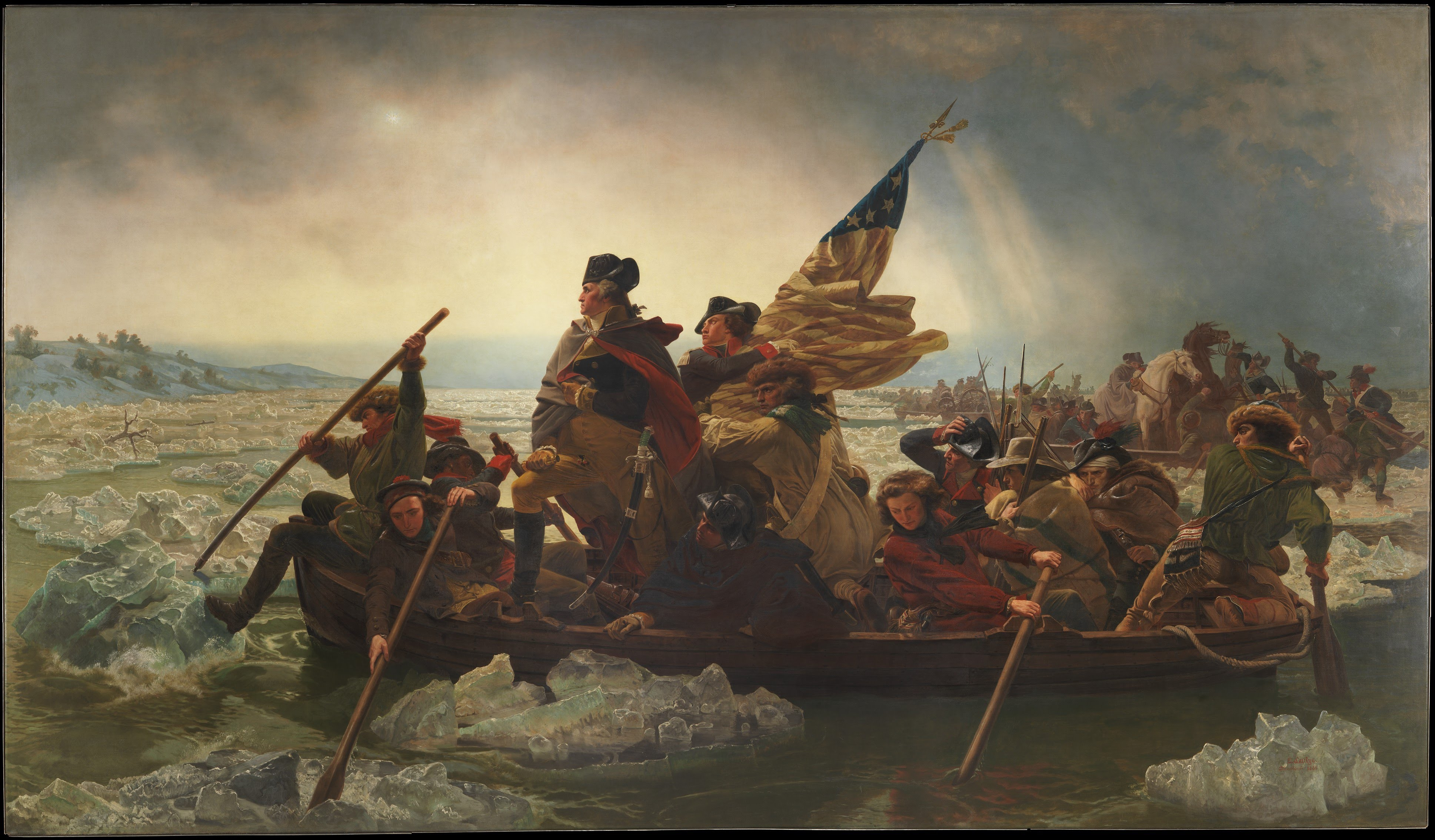
It is one of the great exploits of the American Revolution.  On the night of December 25, 1776, General George Washington led the Continental Army across the icy Delaware River to attack a Hessian garrison at Trenton, New Jersey.  Young Lieutenant James Monroe held the flag behind Washington as they were rowed across the freezing river (standing up).

Emanuel Gottlieb Leutze, Washington Crossing the Delaware.  Oil on canvas, 1851.  Only two figures in this fictitious image are identified—General George Washington and Lieutenant James Monroe (holding flag).
Emanuel Gottlieb Leutze, Washington Crossing the Delaware. Oil on canvas, 1851. Only two figures in this fictitious image are identified—General George Washington and Lieutenant James Monroe (holding flag).


Except, that’s not what happened.

Continue reading “James Monroe at War”