Emerging Revolutionary War is honored to welcome back historian Katie Turner Getty.
“Mr. Malcom, I hope you are not going to strike this boy with that stick.”[1]

The speaker was 31-year-old Boston shoemaker and Tea Party participant, George Robert Twelves Hewes. Hewes had been walking along Fore Street in Boston on the afternoon of January 25, 1774 when he came across 50-year-old Loyalist and Customs officer, John Malcom, furiously shaking a large, heavy cane at the head of a small boy.
Five weeks earlier, on December 16, 1773, Hewes had “dressed [himself] in the costume of an Indian, painted [his] face and hands with coal dust in the shop of a blacksmith”[2] and participated in the Tea Party. Appointed boatswain, he and his company boarded one of the three ships and proceeded to soak 342 chests of East India Company tea in Boston Harbor. After dumping the tea that night, the men “quietly retired to [their] several places of residence… No disorder took place… and the stillest night ensued that Boston had enjoyed for many months.”[3]
Hewes had encountered no trouble when destroying the tea that night. But on this frigid Tuesday afternoon in January, trouble had found him—and was brandishing a cane.
Malcom turned his attention from the small boy to the shoemaker and exclaimed, “You are an impertinent rascal! It is none of your business!”[4]
Undeterred, five-foot, one-inch Hewes further protested Malcom’s rough treatment of the boy. Malcom called Hewes a “vagabond” and further declared that Hewes “should not speak to a gentleman in the street.”[5]
Hewes replied that he was “neither a rascal nor a vagabond, and though a poor man, was in as good credit in town as [Malcom] was.”[6] The exchange between the two men became even more heated.
Malcom called Hewes a liar and Hewes then retorted, “be that as it will, I never was tarred and feathered any how.”[7]
Malcom, overcome with fury, then struck Hewes in the head with his heavy cane, opening a bloody gash in the shoemaker’s forehead and causing him to fall to the ground unconscious.
John Malcom was one of the few people in the American colonies who had been tarred and feathered. Before this night was through, he would earn the dubious distinction of having been tarred and feathered twice.

Malcom’s first encounter with a sticky suit of tar and feathers was in October of 1773 in Falmouth (now Portland, Maine). While working as a Customs officer, Malcom had overzealously seized a ship called the Brothers for not having a register. Once aboard the ship, he “heartily damned the sailors, menaced the mate, [and] threatened to sheath his sword in the bowels of any one who dared dispute his authority.”[8]
So enraged were local sailors by Malcom’s behavior, that he was “disarm’d of Sword, Cane, Hat & Wig”[9], tarred and feathered over his clothes, and paraded through the streets for about an hour before being released.
This episode was common knowledge in Boston. In a letter to the Earl of Dartmouth, Massachusetts Governor Thomas Hutchinson indicated that Malcom had complained to him on several occasions of “being hooted at in the Streets for having been tarred and feathered”[10] Clearly, the Boston populace was not sympathetic to Malcom. And after his assault on Hewes, they would become even less so.
When Hewes regained consciousness, he found himself surrounded by a crowd of onlookers who urged him to visit the prominent Boston physician, Dr. Joseph Warren, to have his wound treated. In the meantime, Malcom had “contrived to get a weapon in his hand and keep [the crowd] at bay, till he could flee to his house”[11] on Cross Street.
When Hewes visited Dr. Warren at his office on Hanover Street, the doctor made a cheerful comment relating to the fortuitous thickness of Hewes’s skull. He said, “you are the luckiest man I know of, to have such a skull—nothing else could have saved you.”[12]
Word of Malcom’s assault on Hewes had quickly spread through Boston and people had started gathering outside his house. Far from being cowed by the unfriendly crowd, Malcom “bullied the people”[13], slinging verbal taunts and threats. In response to jeers, Malcom shouted “You say I was tarred and feathered, and that it was not done in a proper manner, damn you let me see the man that dare do it better!”[14]
Even 243 years later, Malcom’s defiance of the crowd is astonishing. From inside his house, he ran his sword out through the window and inflicted a flesh wound on an unlucky bystander named Waddel. He threatened the crowd with pistols and proclaimed that he would receive a thirty pound reward for every person he killed[15]. The formidable Malcom was eventually removed from his house “amidst the huzzas of thousand[s]”[16] He was dragged on a sled to King Street, site of the Boston Massacre, and was stripped of his clothes.
In Falmouth, during his first tar and feathering in 1773, the tar was splashed onto his clothes. This time, Malcom’s clothing was torn off, exposing him to the frigid winter air. The tar was poured over his bare flesh. He was then transferred to a cart and gleefully hauled to various points across town.
Sixty years later, Hewes reflected upon the event in his biography. “Then they drove to Liberty Tree—to the gallows on the Neck—back to the Tree—to Butcher’s Hall again—to Charlestown Ferry—to Copp’s Hill—flogging the miserable wretch at every one of these places.”[17] Four hours later, he was unceremoniously deposited at the doorstep of his house, frostbitten and senseless.
The reader may feel a slight twinge of disappointment, or perhaps even a grudging respect, upon learning that throughout his ordeal, John Malcom comported himself with “Great Fortitude and Resolution”.[18] Malcom’s recovery was lengthy. When frostbite caused his tarred and feathered flesh to peel off in strips, Malcom packed the skin in a box to preserve it and present to the King as proof of his service and sufferings.[19]
In May, 1774 Malcom sailed for England (presumably with his box of tarred flesh and feathers). Once in England, Malcom embarked on a letter-writing campaign to request redress for all of the suffering and expense he endured in America in furtherance of his service to the King.
In 1776, Malcom wrote a letter to the Lords of the Treasury. In referencing the altercation with Hewes in Boston and his subsequent tarring and feathering, Malcom stated that in “endeavoring to do my Duty in getting the Tea landed, [he] was barbarously and inhumanely treated…[and] was obliged to quit America”.[20]
Also in the letter, he accused his former Customs supervisor in Falmouth, Francis Waldo, of various misdeeds. Waldo had strongly disagreed with Malcom’s seizure of the Brothers and the two had never reconciled.
Waldo’s ire is still palpable 240 years later as, in response, he meticulously dismantles Malcom’s claims in a letter to the Lords of the Treasury, point by painstaking point:
“Mr Malcom went to Boston and brought upon himself a second Taring [sic] and Feathering…which happened some time after the India Companys Teas were destroyed and was occasioned by his beating a Boy in the Street in such a manner as to raise a Mob”[21]
Many factors probably contributed to the second tarring and feathering of Malcom, but any efforts he might have made to land the tea were not among them. As Waldo pointed out, the tea had been destroyed over a month before Malcom was tarred. Malcom was already unpopular in town due to objectionable past actions such as the Brothers seizure. He was a particularly overzealous and aggressive Customs officer. And the man he assaulted was a Patriot and tea party participant.
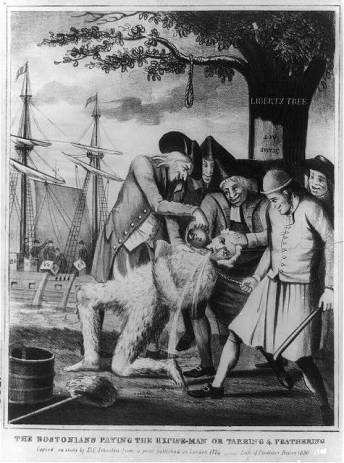
Additionally, Bostonians felt a simmering resentment toward the authorities. When some men tried to persuade the crowd to stop tormenting Malcom, they refused to relinquish him.[22] They believed the government would fail to punish him for his wrongs—assaulting the boy and Hewes, threatening the populace, and sticking Waddel with his sword. Instead, the crowd chose to maintain possession of Malcom and mete out the justice that they believed the government would not.
Malcom was in England barely a year before he demonstrated a desire to return to Boston. In a petition to the King, Malcom states that he “long[s] to be sent out to my Family in Boston and to my Business in the Customs in the Boston Government…I would Humbly Implore your Majesty let Me be soon sent from London to Boston…”[23]
In the end, Malcom was assigned to the Independent Company of Invalids at the Plymouth Garrison. He penned several more letters and petitions asking for additional compensation from the British government.
In 1782, the Commissioners on American Loyalist Claims reviewed his case and decided to allow him another 60 pounds per year on account of his having been tarred and feathered, but in no small part because “he appears to be in some degree insane.”[24]
Malcom lived out the rest of his days in England, passing away in 1788 at age 65. He never went back to Boston, nor ever saw his wife or children again.
Hewes lived to be 98 years old. In 1775, after war broke out, he escaped from Boston in a fishing boat and went to Wrentham, Massachusetts. He served in the militia until the end of the war. Eventually he moved to upstate New York. He was married for 70 years until his wife, Sally, passed away at the age of 87. By all accounts, he was lively and spry until the end. On the 4th of July, 1840, he was preparing to attend a celebration as a special veteran guest. On that day, George Robert Twelves Hewes stumbled while stepping into a carriage and suffered a serious injury. He died that November.
*Sources
[1] Boston-Gazette and Country Journal, 31 January 1774. The Annotated Newspapers of Harbottle Dorr Jr., Massachusetts Historical Society http://www.masshist.org/dorr/volume/4/sequence/522 Hereinafter cited as Boston-Gazette.
[2] A Citizen of New York [James Hawkes], A Retrospect of the Boston Tea-Party, with a Memoir of George R. T. Hewes, a Survivor of- the Little Band of Patriots Who Drowned the Tea in Boston Harbour in 1773 (New York: S. Bliss, printer, 1834), 38. https://archive.org/details/retrospectofbost00hawk Hereinafter cited as Hawkes.
[3] Ibid., 39-40.
[4] Boston-Gazette.
[5] Ibid.
[6] Boston-Gazette.
[7] Ibid.
[8] Boston-Gazette and Country Journal, 14 February 1774, quoted in Frank W.C. Hersey, Tar and Feathers: The Adventures of Captain John Malcom, reprinted from the Transactions of the Colonial Society of Massachusetts, volume XXXIV, (Boston: D.B. Updike, The Merrymount Press, 1943), 440.
[9] Boston-Gazette and Country-Journal, 15 November 1773, quoted in Hersey, 440.
[10] Governor Thomas Hutchinson letter to Earl of Dartmouth, 28 January 1774, quoted in Hersey, 448.
[11] A Bostonian [Benjamin Bussey Thatcher], Traits of the Tea Party; Being a Memoir of George R. T. Hewes, One of the Last of Its Survivors; With a History of That Transaction; Reminiscences of the Massacre, and the Siege, and Other Stories of Old Times (New York: Harper & Brothers, 1835), 128. https://archive.org/details/traitsteapartyb00thatgoog Hereinafter cited as Thatcher.
[12] Ibid., 132.
[13] Boston-Gazette.
[14] Ibid.
[15] Massachusetts Spy, 27 January 1774, quoted in Hersey, 444.
[16] Boston-Gazette.
[17] Thatcher, 131.
[18] John Rowe, Anne Rowe Cunningham, Edward Lilly Pierce, Letters and diary of John Rowe: Boston merchant, 1759-1762, 1764-1779, (Boston: W.B. Clark Co., 1903), 261.
[19] Hawkes, 35.
[20] Hersey, 442.
[21] Francis Waldo, letter to Lords of the Treasury, November 21, 1776, quoted in Hersey, 442.
[22] Massachusetts Spy, 26 January 1774, quoted in Hersey, 445.
[23] John Malcom, petition to King George the Third, January 12, 1775, quoted in Hersey, 463.
[24] Commissioners on American Loyalist Claims, Decision, as quoted in Hersey, 469.