

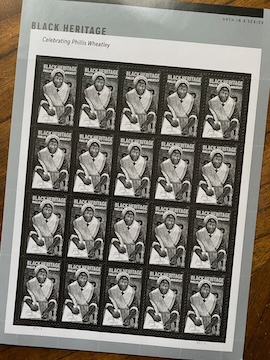
Postal Service Unveils Stamp Honoring Rev War-Era Poet Phillis Wheatley

The United States Postal Service has issued a new postage stamp honoring Phillis Wheatley, a Revolution-era poet who was the first author of African descent in the American Colonies to publish a book.

Unveiled at the Old South Meeting House in Boston on Thursday, Jan. 29, 2026, the Wheatley stamps was the 49th stamp in the Black Heritage series.

For more on Wheatley, I reached out the Boston Tea Party Ships and Museum. Cathryn Philippe is a living historian at the museum who portrays Wheatley—who, as it turned out, had an interesting connection to the Boston Tea Party. Cathryn was kind enough to spend some time chatting with me about Wheatley’s story:

(I first met Cathryn several years ago, while doing a virtual field trip in Boston for the American Battlefield Trust. I had the chance to visit the Boston Tea Party Ships and Museum and see Cathryn’s portrayal for myself. Take a look here.)

For more on the Phillis Wheatley stamp, we quote part of the Postal Service’s press release:

Continue reading “Postal Service Unveils Stamp Honoring Rev War-Era Poet Phillis Wheatley”

Phillis Wheatley: American Poet

Phyllis Wheatley Book Frontspiece
Title Page from Phillis Wheatley’s Book of Poetry

The American Revolution was loaded with contradictions, perhaps none more glaring than the notion of fighting for individual liberty while slavery was so deeply embedded in the rebelling colonies.  To truly understand the American Revolution, it’s necessary to wrestle with that reality.  The stories of some individuals help shed light on the experience of enslaved Americans during the war.

Phillis Wheatley was born in West Africa, likely in 1753, and then imported into the British colonies in 1761.  John Wheatley of Boston purchased her to assist his wife Susanna and daughter Mary as a house servant.  Like many slaves, she was given the last name of her owners; her first may have come from the name of the ship that brought her across the Atlantic.  Susanna and Mary noticed something in young Phillis and taught her to read and write, introducing her to the Bible and religion.  She published her first poem in 1767 and the 1770 poem “An Elegiac Poem, on the Death of the Celebrated Divine George Whitefield,” gave her some degree of fame.

Continue reading “Phillis Wheatley: American Poet”