

Emerging Revolutionary War welcomes guest historian Riley Sullivan, Professor of History at San Jacinto College in Houston, Texas.
While many might be familiar with famed engagements at places like Bunker Hill, Saratoga, and Yorktown during the Revolutionary War, few are familiar with the actions that took place near New London, Connecticut in September of 1781. However, for the people of Connecticut, the battles that took place near Groton Heights and New London have been immortalized as a campaign highlighted by treachery and massacre. Largely, this interpretation has been adopted due to the commander of the British forces who engaged in this raid, Benedict Arnold.
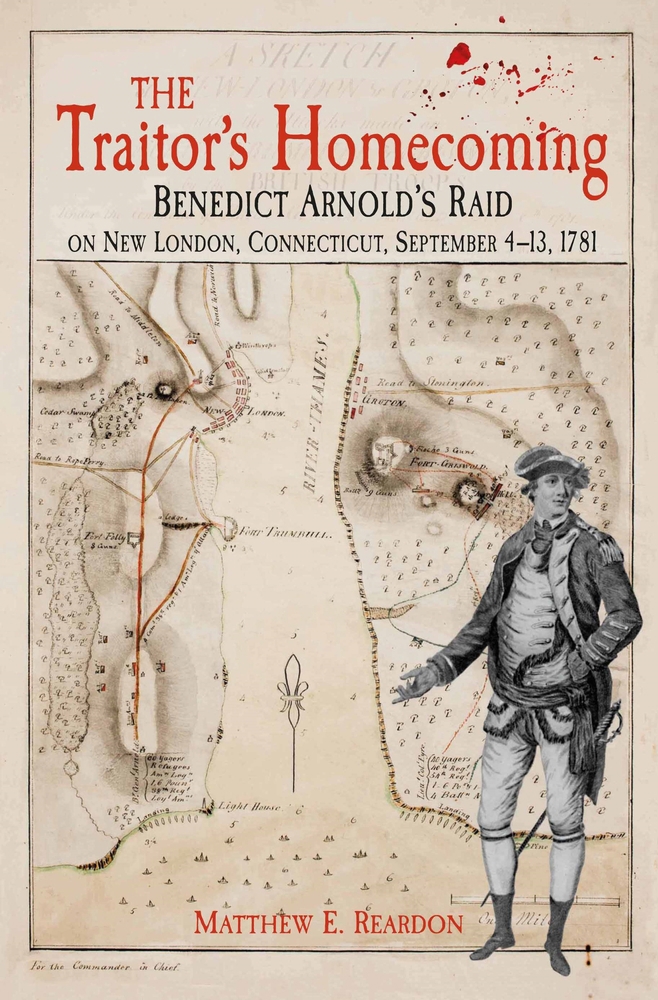
Perhaps no other name in American History brings about more scorn than that of Benedict Arnold. Having defected to the British cause late in the Revolutionary War, for Americans at the time–and even today–he is viewed as a modern day Judas. However, with such infamy ultimately comes much misinterpretation of this historical figure and the events he was involved in. In Matthew E. Reardon’s recent study The Traitor’s Homecoming, he attempts to undo much of this misinterpretation. Drawing on previously unused primary sources, Reardon constructs an engaging argument that challenges the traditional view of Arnold’s conduct in the New London raid.
To construct this narrative of the New London raid, Reardon attempts to place into context the setting of the New London raid. By this stage in the war, the conflict in New York had been a state of stalemate for the previous few years. However, with Generals Washington and Rochambeu’s combined Franco-American forces on the move, the British commander in the region, Henry Clinton—informed by faulty intelligence as Reardon demonstrated—was convinced that an attack on New York was imminent. As a result, to divert Washington’s attention away from a possible attack on New York, Clinton authorized Arnold to lead a contingent of British troops to attack the vulnerable Connecticut coastline.
New London made the ideal target for a British raid as it had been a hotbed for commerce and privateering for the Patriot cause. To conduct such a raid, Clinton turned to Arnold as he was both a native of Connecticut and familiar with the New London area. Largely only being contested by militia behind a number of forts that guarded approaches to both the town and the Thames River, Arnold’s combined force of Loyalists, Hessian Jaegers, and British regulars made quick work of the Patriot militia throughout the campaign. Even with New London in their hands, outside events–notably Clinton’s realization that Washington was moving on Cornwallis at Yorktown–led to Arnold having to relinquish his gains. However, with the high casualties suffered by both sides during the raid, coupled with the burning of much of the town, the events “cemented Benedict Arnold’s reputation for villainy.” (x)
When considering the traditional interpretation of Arnold’s raid on New London, Reardon makes it clear throughout his work that a “distorted interpretation” of the events had emerged (ix). From veterans to the Groton Battle Monument at Fort Griswold Battlefield State Park, the events that took place in Connecticut in 1781 have been enshrined as a massacre of Connecticut militia at the hands of Arnold. However, when looking at contemporary letters, diaries, and later pension records, Reardon demonstrates that there are some noticeable gaps within the traditional account of this campaign. In particular, when examining the death of Colonel William Ledyard–who was alleged to have been killed while attempting to surrender–Reardon concluded that through these sources, the traditional accounts accepted proved to be inconsistent with contemporary accounts of the campaign.
But, even with these inconsistencies, this is not to say that the fighting at Fort Griswold and the subsequent burning of New London was less than brutal. Reardon wrote that “the immediate reaction of the community was shock” and that “for many it was beyond comprehension.” (339) To no surprise, this sheer shock of the fighting coupled with Arnold’s involvement led to this distorted narrative of the campaign.
Through the examination of contemporary letters, diaries, and later pension applications, Reardon is able to reconstruct in great detail the events of Arnold’s New London raid and offer an unbiased narrative. By providing these fresh sources in The Traitor’s Homecoming, Reardon effectively builds on the existing literature of the subject and demonstrates how public perception can lead to the misinterpretation of historical events like that of the New London raid.
Details:
Matthew E. Reardon, The Traitor’s Homecoming: Benedict Arnold’s Raid on New London, Connecticut, September 4-13, 1781. Published by: Savas Beatie LLC. Summer 2024. 448 Pages.
*Check out Emerging Revolutionary War’s YouTube page as well for a “Rev War Revelry” interview with author Matthew E. Reardon.*
 Emerging Revolutionary War Era