

Marquis de Lafayette was a French aristocrat serving in the French army, and recently married, when the Revolution broke out in America. He followed events with interst, and was motivated to come and fight with the Americans.
He arrived in March, 1777, nineteen years old and eager. He immediately formed a friendship with Washington, and was an aide on his staff. In the meantime British forces had invaded Pennsylvania, intent on capturing Philadelphia. Washington’s army took a position behind Brandywine Creek, and the British attacked on September 11, 1777. British troops had flanked the Americans, and reinforcements were rushed to the threatened sector, making a stand on Birmingham Hill.
Eager to get to the fighting, Lafayette and a group of French officers rode to the unfolding battle at Birmingham Hill, arriving as the action was at its hottest. Approaching from the south, they rode up the Birmingham Road, and turned to the left, coming in behind the brown-coated troops of General Thomas Conway’s Pennsylvania brigade.
Chevalier Dubuysson, an aide with Lafayette, wrote of joining Conway’s troops: “The Marquis de Lafayette joined the later, where there were some Frenchmen. He dismounted and did his utmost to make the men charge with fixed bayonets.” Losses were mounting and some of the troops were breaking, but Lafayette “pushed them in the back to make them charge.”
Lafayette, endeavoring to rally the troops and lead counterattacks, wrote that eventually order broke down among the Pennsylvanians, and “confusion became extreme.” The young Frenchman tried to prevent them from breaking when a ball “passed through his leg.” Then, “the remaining forces gave way, and [he] was fortunate to be able to mount a horse, thanks to Gimat . . .” (his aide). With no other choice, Lafayette then joined in the withdrawal to the southeast.
Seventeen year-old Sergeant Andrew Wallace, a native of Chester County serving in the 9th Pennsylvania Regiment, came to the aid of Lafayette and assisted him off the field. Near Lafayette, another French officer, Captain Francois Louis de Fleury, has his horse shot from under him.
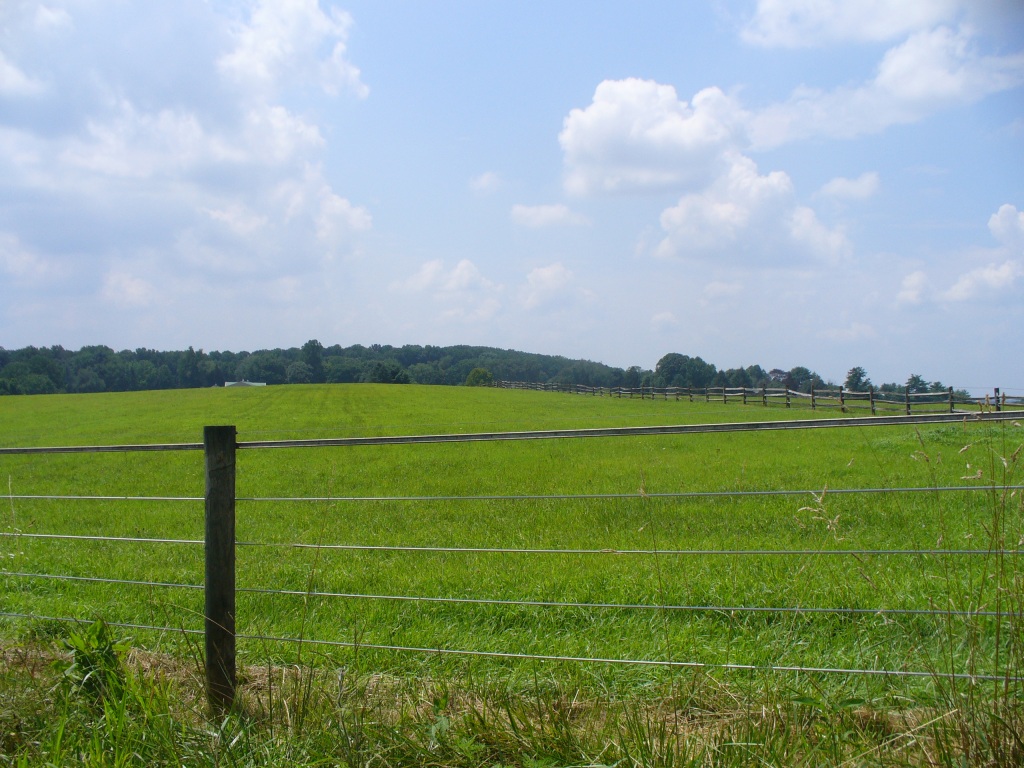
Royal Lockett, serving with the Virginia troops to the east, recalled later that he saw Lafayette wounded. Lockett must have been looking that way at the right moment to see the incident on the other side of Birmingham Road.
After the army retreated that evening, Lafayette made his way to the Moravian town of Bethlehem, where many of the wounded had been sent. It was thought to be out of reach of the British, and the civilians were willing to care for the wounded. Here he recuperated in the Beckel House. He rejoined the army two months later at Valley Forge.
Brandywine was Lafayette’s first battle and he always looked back fondly on his experiences there. He visited the site briefly in 1780 while on his way south. In his 1824 visit to the United States, he visited again and indicated where he was wounded along the crest of the hill.
Local interest grew in marking the battlefield, and on September 11, 1895, Chester County schoolchildren dedicated a marble monument to Lafayette, with five thousand attending the ceremony. Placed along Birmingham Road, it is not in the spot where he was actually wounded.
Why it was placed over a quarter mile away from the actual spot? Perhaps because the wounding site was in a farmer’s field, and along the road it was visible to people. An article about the dedication notes that it is the highest spot on the battlefield, and “visible from every part of the compass.”
Brandywine Day, September 11, 1895 was commemorated with speeches and an unveiling of the monument by the French consul. Local dignitaries, militia units, bands, and the governor all turned out along with throngs of people.

Another monument to Lafayette, and Polish General Casimir Pulaski, was dedicated at the nearby Lafayette Cemetery in 1900. Located next to the wartime Birmingham Meeting House, the cemetery was named in his honor. This monument was funded by local banker John G. Taylor, who had an ancestor in the battle and took a personal interest in commemorating it.

Readers wishing to know more about Brandywine should turn to the most exhaustive book on the battle, Michael Harris’ book, Brandywine.
 Emerging Revolutionary War Era
Sergeant Andrew Wallace was actually 47 years old when he carried Gen. Lafayette away from the battlefield for two miles to the farmhouse of James Kelting, and he was assisted by Sgt. Laurence Everhart of Maryland and possibly others.
Sgt. Andrew Wallace was a well known personage in his later life, he lived to be 105 years old and died in Manhattan, N.Y. on January 22, 1835. He was interred at The old St. Patrick Cathedral on Prince street and is supposedly buried in the crypt of Bishop John Connally in the basement of the church.
Sgt. Andrew Wallace served a total of 29 years and 8 months in the U.S. Army and was mustered out of service in New Orleans, LA. in 1811 by Gen. Wade Hampton after suffering a stroke.
Three Lodges of The Free Masons paid for his funeral and local newspapers of the time claimed that as many as 50,000 people watched his horse drawn hearse travel up an avenue from City Hall to the Cathedral.
LikeLike
Thanks Paul! I appreciate your information. Can you give me the source (s) for this? Thanks,
Bert
LikeLike
Bert Dunkerly:
Dear Mr. Dunkerly:
There are many periodicals and books online on Google books. A search for “Sgt. Andrew Wallace 1730 to 1835” will provide more references than you may wish to research.
If you want a copy of my personal research, you will need to email me at wordbox.juno@gmail.com . Your Comment above was dumped in my Spam folder and I just read it tonight. Sorry about that.
Andrew Wallace was 47 years old when he picked up Lafayette from the ground as the various forces were fleeing the battlefield. I believe that Wallace, having fought in a number of battles previously, knew what to do when he and Sgt. Everhart and a couple of other soldiers found Lafayette suffering from the wound to his buttocks. They picked him up and carried him to the farm house where the army surgeon was. Lafayette always made light of his wound, even telling his wife that it was simply a scratch, but he came close to dying from loss of blood. He was sent to recuperate near Reading Pa. for several months. By the way, the info that he was shot in the bottom was told by Andrew Wallace whenever he mentioned the story, which was anytime that he had someone to tell it to and he did that for the rest of his life. He lived to be 105 years old and is buried in the vault of Bishop John Connally in St. Patrick’s Old Cathedral on Prince Street in Manhattan. The Church officials won’t admit that he is there, but in 1900 the FreeMasons in New York published their book that covered their proceedings for the previous 75 years and the author tracked his burial to that Catholic Church. He was a Catholic and a Freemason and he stipulated that he wanted to be buried there and requested that the Freemasons perform their funeral rites at the church. That is why the church won’t admit that he is there.
I hope that this info continues to stimulate your interest, but if you want more from me, you will need to contact my email in the regular way.
Paul Mooney
wordbox.juno@gmail.com
LikeLike
Pingback: The Marquis de Lafayette was Washington's indispensable French commander