

On Friday, April 21, 1775, word arrived in New Haven, Connecticut, regarding the fighting at Lexington and Concord. The Revolutionary War had begun, and thousands of militiamen from Massachusetts and the surrounding colonies in New England were converging around Boston to lay siege to the British army bottled up in the city. The next day, New Haven’s militia unit, the Governor’s Second Company of Guards, or Second Company, Governor’s Foot Guards, prepared to march to Cambridge.
Garbed in “A scarlet coat of common length, the lapels, cuffs and collars of buff and trimmed with plain silver wash buttons, white linen vest, breeches and stockings, black half leggins and small, fashionable and narrow ruffled shirt,” the Foot Guards made for quite the appearance. At the head of the 65-man-strong company was Captain Benedict Arnold, a leading member in revolutionary New Haven.
Arnold, 34-years-old at the outbreak of the war, had not stood pat during the decade leading up to April 1775. He was a member of the Sons of Liberty, and on multiple occasions, led mobs against the pro-monarchy members of the community. His leadership and zeal were recognized in March 1775 when he was elected captain of the militia. Like so many other patriots throughout the colonies, the shots fired at Lexington and Concord on April 19 would catapult Arnold onto a path to glory, and unfortunately for the country, later treason.
When the news arrived in town the evening of April 21, fifty-eight members of the Foot Guards voted to march to the assistance of their New England brethren. The next morning, Captain Arnold assembled the men on the New Haven Green, where the powder house was located. The doors were locked, and the keys to the stores in possession of New Haven’s Selectmen. Just off the green, at the intersection of College and Chapel Streets, stood Beers Tavern, where the Selectmen were gathered and discussing the town’s response to the recently received news.
The Foot Guards positioned themselves outside the building, while Arnold banged on the door demanding the keys to the powder house. The Selectmen refused to turn them over until official orders arrived. “None but the Almighty God shall prevent my marching,” Arnold passionately assured them. His forceful persuasion worked. The storehouse was opened, and the militia retrieved the necessary ammunition, flints, and powder. Once equipped, Arnold led his men out of New Haven and began a three-day march to Cambridge to join the fight.
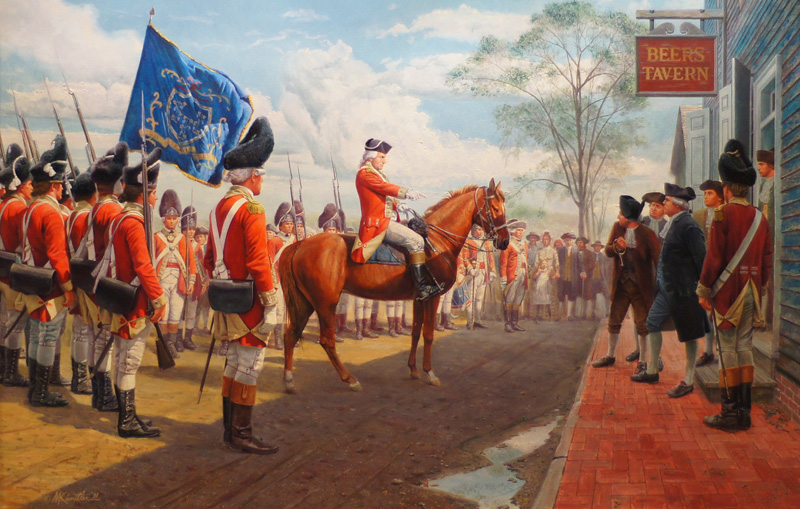
Idleness was not in Benedict Arnold’s nature, and upon arriving within the army’s camp, he approached the Massachusetts Committee of Safety with a proposal to lead an expedition against the British-held Ford Ticonderoga situated between Lake George and Lake Champlain in New York. The fort helped defend the crucial waterway system running north-south from Canada and housed cannon that could be vital to the patriot cause. The committee’s chairman, Dr. Joseph Warren, backed the plan and it was approved. On May 3, Arnold was promoted to colonel in the service of Massachusetts (not Connecticut) and was ordered to raise a force in western New England to accomplish the mission. The future hero of Saratoga and traitor to American liberty spurred his horse out of Cambridge and set his sights on taking “America’s Gibraltar.”


Here’s the only (I believe) primary source detailing the event from Private John Townsend who was a member of the company that day.
“That in the year 1774, he thinks in May, he enlisted in a company of Governors foot guard raised by authority of the Connecticut colony, and commanded by Benedict Arnold of…New Haven. [The] company hired two English deserters from the British troops, to drill them, and used to turn out summer and winter for drill two or three times a week under said deserters for drill, until the battle of Lexington and made a great degree of military proficiency: on hearing the intelligence & alarm of the battle of Lexington in April 1775…[the] company paraded on the public square in New Haven, and Capt. Arnold put the question to [the] company having about sixty-four men, our lieutenant [was] Jesse Leavenworth of…New Haven, and our ensign, who was Hezekiah Sabin Jr., of [New Haven], who there [was] willing to march on to the scene of battle, and all but about 15 or 20 gave their consent, and then Capt. Arnold marched the company round inviting the citizens to fall in such as were willing to march on to Massachusetts & many joined us[,] the whole number 90; this was the afternoon of Friday April 22d 1775, the company was dismissed to the [return] the next day for departure with knapsacks; on Saturday the 23d. it paraded, but was kept in suspense almost the whole day by the town authority doubting whether they would give the public ammunition to the company, and toward night took the ammunition by force. [We] took up our march near night & proceeded to Cambridge at a quick march, where the company arrived the next week to the number of about 90 men, and put itself under command of General [Artemas] Ward; the applicant recollects that Gen. [Israel] Putnam was also there; the company was quartered in the house of Lieutenant Governor [Thomas] Oliver; where it continued until Gen. Ward had acquired as he thought sufficient strength from the volunteers, when he discharged the company having left their families & businesses without any preparation for a long absence, and the company marched [for] New Haven in June seven weeks after it had started…having borne their whole expenses almost entirely themselves; thirteen in the same company afterwards went with Arnold to Canada the same year, Capt. Arnold and…thirteen remaining at Cambridge when the applicant and the rest of the company came home; the company when it went [to Massachusetts] took the lower road to Boston through Pomfret & Killingly Conn. & returned the upper road through Worcester & Springfield, a few days after the company returned, (about four he thinks) heard of the battle of Bunker Hill…”
LikeLike