

A time travel work of non-fiction to a foreign country are words usually not associated with a history of “the American Founding.” Yet that is exactly the intent of historian and author Joseph Ellis as he begins his exploration of this most important era of American history. Unlike those science-fiction journeys, this “trip will be different. Our tour will focus on the downside of the American founding.” (Pg. ix).
That downside is quickly explained by Ellis in his book The Great Contradiction: The Tragic Side of the American Founding. The past winner of a National Book Award for his work on the character of Thomas Jefferson, Ellis plans to “focus on two unquestionably horrific tragedies the founders oversaw: the failure to end slavery, and the failure to avoid Indian removal.” (Pg. ix).
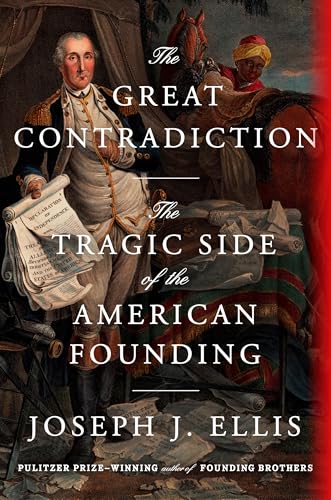
Let’s review how this seasoned historian fulfilled his tour outline. “Most of the achievements were unprecedented…” as the triumphant British colonies made “the United States the political model of the liberal state.” That is the truth, “but it is not the whole truth…” as Ellis explains, “there are two legacies of the founding era…and both qualify as enormous tragedies.” Combined, “these triumphal and tragic elements constitute the ingredients for an epic historical narrative.” Ellis’s tour will include this “coexistence of grandeur and failure, brilliance and blindness, grace and sin” in his attempt to counteract how the narrative has so long been written by historians, which is of the “either/or” persuasion (Pgs. 17-18).
Since his aim is to provide context for how the world of the founding generation is vastly different than the one that has congealed over time, Ellis quickly reorients the lodestar of that time. “As far as the American founding is concerned, it is a lie—or, if you prefer less disturbing language, a massive delusion. None of the prominent founders believed they were creating a democracy” (Pg. 17).
“The political lodestar for the revolutionary generation was not ‘the people’ but, rather, ‘the public,’ or public things” rather “the public interest was the long-term interest of the people…” (Pg. 17).
As he further develops his approach, Ellis provides parameters: “if the original sin of American history is slavery, and racism its toxic residue, the original sin for American historians is ‘presentism.” In other terms, utilizing 21st-century “political and moral values” as the criteria to assess those in the Revolutionary era (Pg. 18).
Although there are two tragedies, the role of slavery and the failure to provide a roadmap to extinction have more dedicated pages in this book than the plight of the Native Americans, and Ellis admits that early on. Discussing the saga of the potential to end slavery, the debates, factors, and ultimate outcome are propped up by astute analysis by Ellis, and uncovering primary sources to let the founders speak as often as possible. The failure to end the institution of slavery must be judged the greatest failure of the revolutionary generation.” The passing of Benjamin Franklin, the “Virginia Staddle”, and other near chances provide a fascinating, yet tragic, “what if” scenario that Ellis unpacks with brilliant prose. (Pg. 129).
The same can be said about the early republic and the relations with Native Americans, as “there is an almost irresistible urge to wonder if the story could have turned out differently.” The failure, though, once again, is frustrating. Part of that reason was the weakness of the Federal government and the inability to “impose its will on the state of Georgia and the white population” when facing the boundary of the Creek country. Although exceptional leadership by George Washington as president and Henry Knox as secretary of war, did formulate a treaty with the Creeks, due to the lack of strength and minuscule numbers in the United States Army, “at virtually every level—logistical, economic, political—there was not the remotest chance of implementing” the treaty. As the Federal government grew and the white population expanded, this scenario would transform somewhat—the Federal government gaining strength—but the conclusion for the Native Americans, sadly, was always the same. Loss of standing and loss of land and loss of ability to dictate terms or maintain their way of life (Pgs. 166-167).
Ellis addresses the questions that lie at America’s twisted roots and, with candor and deftness, successfully rises above the presentism that he highlighted as a curse for historians and history enthusiasts, especially of the current culture wars. This narrative is a must-read to understand these pivotal questions and ultimate failures of the early American republic, which even the “sharpest minds of the revolutionary generation” could not solve.
Book Information:
Alfred A. Knopf, New York, 2025, 226 pages, including images, bibliography, and index
$31.00
 Emerging Revolutionary War Era