Emerging Revolutionary War welcomes guest historian Joshua Shepherd
Mural of the action on November 4, 1791
For most history enthusiasts, a visit to a battlefield is simply a diversion that very often takes place during an annual vacation. But the pleasant surroundings of America’s historic parks belie the terrifying sights that greeted a battlefield’s first visitors.
On December 24, 1793, a detachment of American troops under the command of Major Henry Burbeck arrived at an insignificant knoll deep in the wilderness of present-day Ohio. Tasked with constructing a timber fortification on the site, the troops first had to attend to the unenviable task of clearing the remains of over six hundred men who had been killed there two years earlier. Burbeck reported that the battlefield “had a very melancholy appearance – nearly in the space of 350 yards lay 500 skull bones – 300 of which we buried.” Most of the skulls, it was reported, appeared to have been smashed by tomahawk blows.
Emerging Revolutionary War welcomes back guest historian Gabriel Neville.
Thirty years ago, Dutch Henderson was “stomping through the woods” near Lake Sinclair in central Georgia when he stumbled upon an old gravestone. Some might have thought it an odd spot for a grave, but Dutch knew the history of the area and it made sense. In fact, the setting told him the man six feet under had played an important role in American history.
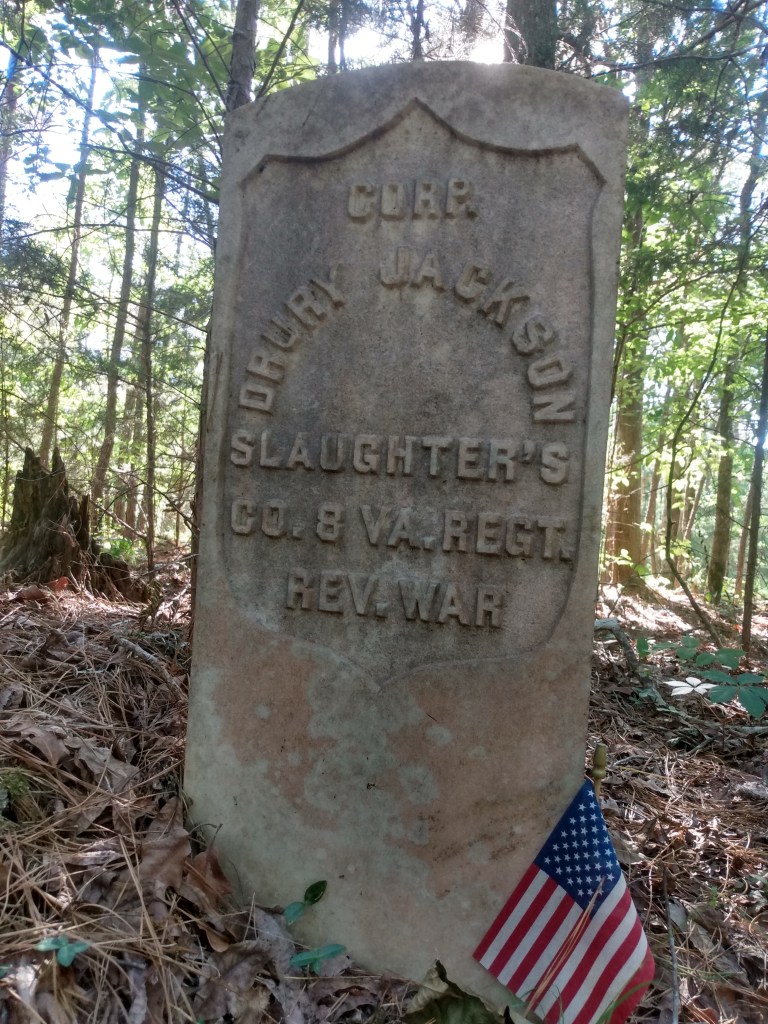
The inscription on the marker read: “CORP. DRURY JACKSON, SLAUGHTER’S CO. 8 VA. REGT. REV. WAR.” Why was this headstone for a Revolutionary War soldier all alone in the woods near a lake? Time changes things. Neither the lake nor the woods were there when Drury Jackson died. Back then the grave was on cleared ground overlooking the Oconee River. Depressions in the soil still reveal to the trained eye that Drury was buried in proper cemetery. The river became a lake in 1953 when it was dammed up to create a 45,000-kilowatt hydroelectric generating station. When Dutch found the grave, the cemetery had been neglected and reclaimed by nature. Today it is in a copse of trees surrounded by vacation homes.
The mysterious headstone for veteran Drury Jackson provides no dates to help us identify the man in the ground. (Dutch Henderson)
Dutch spends his free time studying local history and conducting archeology. He has made some important finds, including a string of frontier forts along what was once the “far” side of the Oconee. He’s pretty sure that Drury’s burial in that spot is an important clue to his life in the years following the Revolutionary War. From there, however, things get complicated.[1]
A genealogy site sporting a photo of the headstone tells us that Drury Jackson was born in Brunswick County, Virginia on February 2, 1745, married Lucy Dozier and then Nancy Ann Kennedy, and died in Wilkes County, Georgia before 1794. This seems possible, but Wilkes County is about seventy miles northeast of the grave. Another source tells us that Drury Jackson was born in 1767 in Franklin County, Tennessee, married Lucy B. Myrick, and died in Baldwin County, Georgia in 1823. This seems more likely, since the grave is in Baldwin County.
So, which of the two men is the right Drury Jackson? The easy assumption is that the stone properly belongs to the one who died nearby. The grave marker itself is of no help. It provides neither the date of his birth nor the date of his death. Moreover, it is the kind of marker that was issued after 1873 by the federal government for the graves of veterans of the Civil and Spanish-American wars (and the unmarked graves of veterans of earlier wars). It is clear that the marker was placed there long after the man’s death by descendants or others in the community.[2]
So, you have a relative that fought in the American Revolution and you want to know more… now what? Joining an organization, such as the Daughters of the American Revolution (DAR), is a lengthy and detail-oriented process. It takes patience and perseverance. Before beginning the process, I attended a research seminar hosted by the local chapter to learn about the specific requirements for applying. If you have any experience with records, the one consistent theme is that records do not consistently capture the same information. Some death records do not list birth-dates, birth records do not always list both parents, and worst-case scenario, many records can be lost, stolen or severely damaged.
As I mentioned in part 1, my grandmother provided me with a box of documents detailing the Bitely heritage. The materials she gave me was helpful for pointing my path forward, but it lacked the necessary vital records for completing the application. Luckily, each chapter has a registrar that guides you through finding the right resources and completing the paperwork accurately. The registrar in my chapter was a seasoned member of DAR and walked me step by step through the process. Together, we reviewed the documents from my box, made a family tree and contacted the Michigan vital records department for appropriate birth, death and marriage certificates for each generation between John and me. Thankfully, both New York and Michigan had the records I needed, in good condition and had the required information on them to meet DAR standards. If you hit a snag in the process, there’s an entire community of DAR women who are trained to help you through this. Reach out, we will help!
Here is a sample of the documents passed down to me in the family history box. This helped start the journey for learning more about my heritage.
Emerging Revolutionary War welcomes back guest historian Kate Bitely
Part 1
How much do you know about your great-great-great-great-great grandparents? Did your family pass on detailed stories of their past? Perhaps you took a DNA test like ‘23andMe,’ or maybe you know little if anything about your roots. Whatever the case may be, now is a great time to start the journey of learning about your familial past, as it might just lead you to an unexpected destination. For me, I grew up knowing my distant relative, John Biteley Sr., a New Yorker who come to the U.S. from Germany in the 1750’s. His American born son, John Biteley Jr., went on to serve as a patriot in the American Revolution. My grandfather, Ralph Bitely, always told us, “the Bitely’s were at Ticonderoga!” In 2010, my grandfather passed away. A few years after his death, my grandmother gave me a box filled with documents that detail the history of the Bitelys. This box would be the start of my journey back to the 18th century.
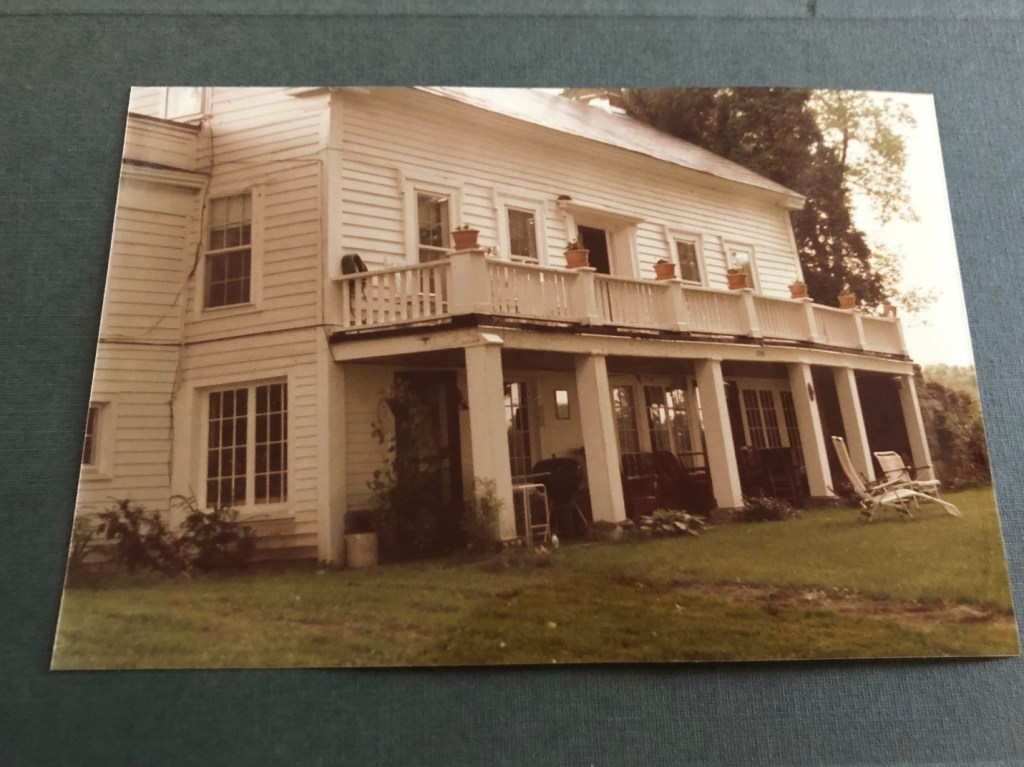
As I dug through the box a few years ago, I recall being filled with excitement as I learned about my family. They were farmers, predominately grape farmers to be exact. (My love for wine is clearly hereditary). As I dug deeper, I found a more modern picture of the “Bitely Homestead,” the home of John Biteley Sr., located in Saratoga County, NY. It was first built before the war around 1770, was burned down by Gen. John Burgoyne in 1777 and was rebuilt in 1779. Nearby remains a family cemetery where many of my relatives remain. While I have not been for a visit yet, I hope to make a trip soon when conditions are safe to do so.
Photo of the “Bitely Homestead” in Moreau, NY rebuilt in 1779 after the British burned down the original structure in 1777 found inside the box from my grandmother.Continue reading “Finding Your Patriot”→
Emerging Revolutionary War welcomes guest historian Darien Ashley.A short bio follows this post.
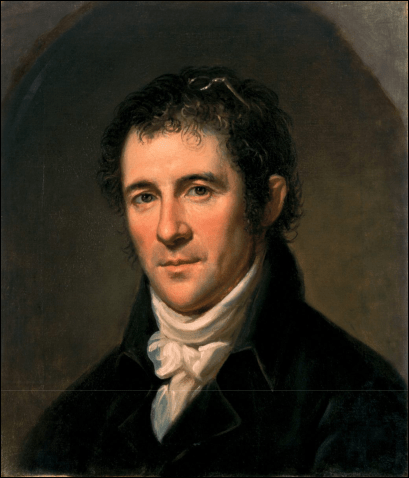
The best architecture is that which reflects clearly the ideals and activities of the people which inhabit it. This is true for both private dwellings and public buildings. The objects of architecture serve as a lasting testament to identity. These objects, once created, continue to shape minds long after the architect is gone. A nation’s capital city is a site where man can establish glorious structures which convey a sense of who the people are, where they came from, and where they intend to go. The United States Capitol building is a prime example of a structure that continues to inform American identity long after its architects have passed. This article serves as an investigation of the life of one of the most important architects of not only the Capitol, but of the nation itself, Benjamin Henry Latrobe.
Guests to the United States Capitol building often get a shock from the fact that one of its primary architects, Benjamin Henry Latrobe, was an Englishman. Indeed, the man who designed the hallowed, old halls of Congress hailed from a Moravian religious settlement located on the outskirts of Leeds, England. However, Latrobe himself would have objected to the label “Englishman”. Indeed, throughout his life, Latrobe referred to the United States as “his” country and was quick to point out that his mother, Anna Margaretta Antes, was born and raised in Pennsylvania. Latrobe’s father, Benjamin Henry Latrobe Sr., met Anna after she had been sent to London to finish her education. Both of Latrobe’s parents held prominent positions within the Moravian ministry and raised their children to follow in their example.
Emerging Revolutionary War welcomes back guest historian Vanessa Smiley
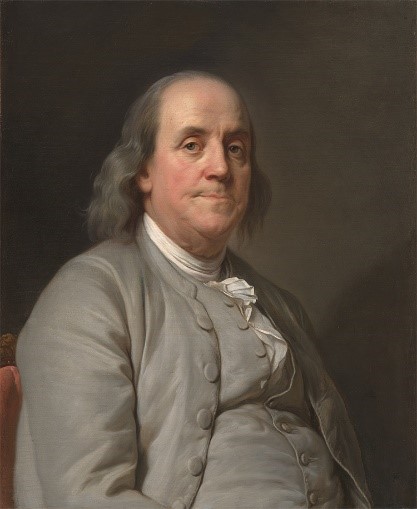
“Beer is living proof that God loves us and wants us to be happy.” – Benjamin Franklin, Poor Richard’s Almanack
Benjamin Franklin was one of many 18th century beer lovers. (Benjamin Franklin by Joseph Siffred Duplessis, c. 1785)
During the 18th century, Colonial society held three common beliefs about beer drinking:
Drinking beer was healthier than drinking water
Beer and its ingredients were a healthy supplement to the entire family’s diet
It was an accepted way to promote social discourse
A little different from today’s society, except for beer connoisseurs (such as the Emerging Revolutionary War folks), these beliefs were formed from the circumstances of the time.
Though a generation away from understanding the connection between boiling water and sanitation, most folks understood that water could make you deathly ill. And yet, ale and beer drinkers did not seem to have that same risk. They did not know it at the time, but the boiling process to make these alternative drinking options neutralized much of any tainted water’s ill effects. Therefore, many substituted beer, ale, and other alternatives such as hard cider over water, making these a major dietary staple in the colonies.
Emerging Revolutionary War welcomes historian Vanessa Smiley to the blog.
The thing about Ninety Six National Historic Site is that it’s unassuming exterior hides a wealth of history. It’s also nowhere near a major highway, meaning you have to want to get there if you’re thinking of visiting. And when you do get there, you will realize that there’s more history per acre than its demur entrance lets on. Located in the back country of South Carolina, Ninety Six has a history that speaks to the stories of Native Americans, the American frontier of the 18th century, and the American Revolution.
Entrance to the park (courtesy of Ninety Six NHS, NPS)
The site at Ninety Six holds a treasure trove of study on these subjects. Native American, mostly Cherokee, activity was heavy in the area long before European settlers arrived. One of the earliest backcountry trading posts, established by Robert Gouedy in 1759, made Ninety Six a hotbed of trading activity thanks to its location at the crossroads of twelve different roads and paths, linking the area to nearly all parts of the colonies.
Emerging Revolutionary War welcomes back guest historian Kevin Pawlak
Every quest for liberty has its first martyr. Two-hundred and fifty years ago this evening, the cause of American liberty gained its first five when British soldiers fired on a crowd of Bostonians in an event immortalized as the Boston Massacre.
Boston Massacre depiction
The first to fall at the end of the British muskets was Crispus Attucks, a mariner of mixed African and Native American heritage. Bostonians paraded Attucks’ remains alongside the four other victims to a common grave but Attucks’ popularity did not grow until the next century when abolitionists used him as a symbol of patriotism. Abolitionists emphasized and stretched Attucks’ role. To supporters of abolition, Attucks was a household name.
Emerging Revolutionary War welcomes guest historian Jon-Erik Gilot. A short bio is attached at the bottom of this post.
Though perhaps more widely known as the birthplace of West Virginia during the Civil War, Wheeling and its environs retains several significant sites associated with the Revolutionary War. The name itself is translated from the Delaware language meaning “place of the skull,” legend having that the severed head of a white settler was placed on a pole by local Native Americans as a warning to others to stay away.
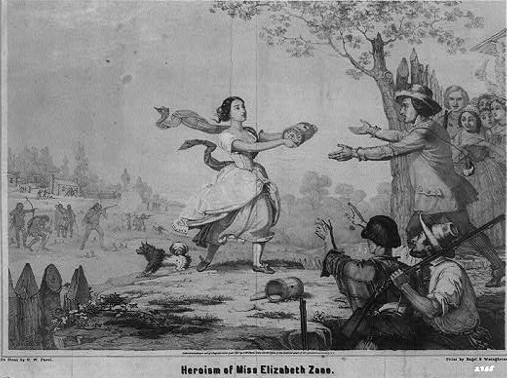
Betty Zane’s Run for Gunpowder during Second Battle of Fort Henry–1782 (image courtesy of Library of Congress)
Wheeling was founded in 1769 by Colonel Ebenezer Zane and his brothers Jonathan and Silas. Five years later in 1774 Fort Henry (originally called Fort Fincastle) was built overlooking the Ohio River to protect the growing numbers of settlers from attack. The fort was twice attacked during the Revolutionary War, first in 1777 and again on September 11 – 13, 1782, when a force of British loyalists (Butler’s Rangers) and Native Americans (under the command of outlaw Simon Girty) attacked the fort’s 47 defenders. The fort was besieged over two days, culminating in Betty Zane’s heroic run for gunpowder in a nearby cabin. The British and natives broke off the battle with the arrival of Virginia militia reinforcements. Fort Henry is acknowledged as one of the final battles of the Revolutionary War.
Emerging Revolutionary War welcomes guest historian Kevin Pawlak. A short bio follows the post below.
On May 25, 1775, the 62nd Regiment of Foot stood for review. The line of men, clad in their redcoats with buff facings, did not impress the reviewing officer. He called the regiment “very much drafted” and “very indifferent.” Despite the disparaging grade, in just over two years, the 62nd Foot commendably fought in one of the fiercest actions of the War for Independence.
John Anstruther courtesy of 62ndregiment.org
Scottish military man Lt. Col. John Anstruther led the 62nd Foot in the campaign of 1777. Anstruther faced no easy task; the 62nd was the junior British regiment in John Burgoyne’s army and most of its men were inexperienced in campaigning and battle. To make the situation even worse, roughly one-quarter of the 62nd Foot’s soldiers were German. Language barriers likely prevented complete cohesion within the unit. However, with a war on, nothing could be done to rectify the regiment’s defects as it marched south into New York.
Anstruther’s regiment was present for the operations around Fort Ticonderoga in early July 1777. After American forces abandoned the fort, the conglomerate and inexperienced 62nd remained behind to man Mount Independence overlooking Lake Champlain. As the rest of Burgoyne’s army continued campaigning, the men of the 62nd Foot spent time guarding themselves against rattlesnakes rather than the enemy. Their time came to rejoin the main army before the Battle of Saratoga commenced.







 Emerging Revolutionary War Era