Final, Final Resting Place

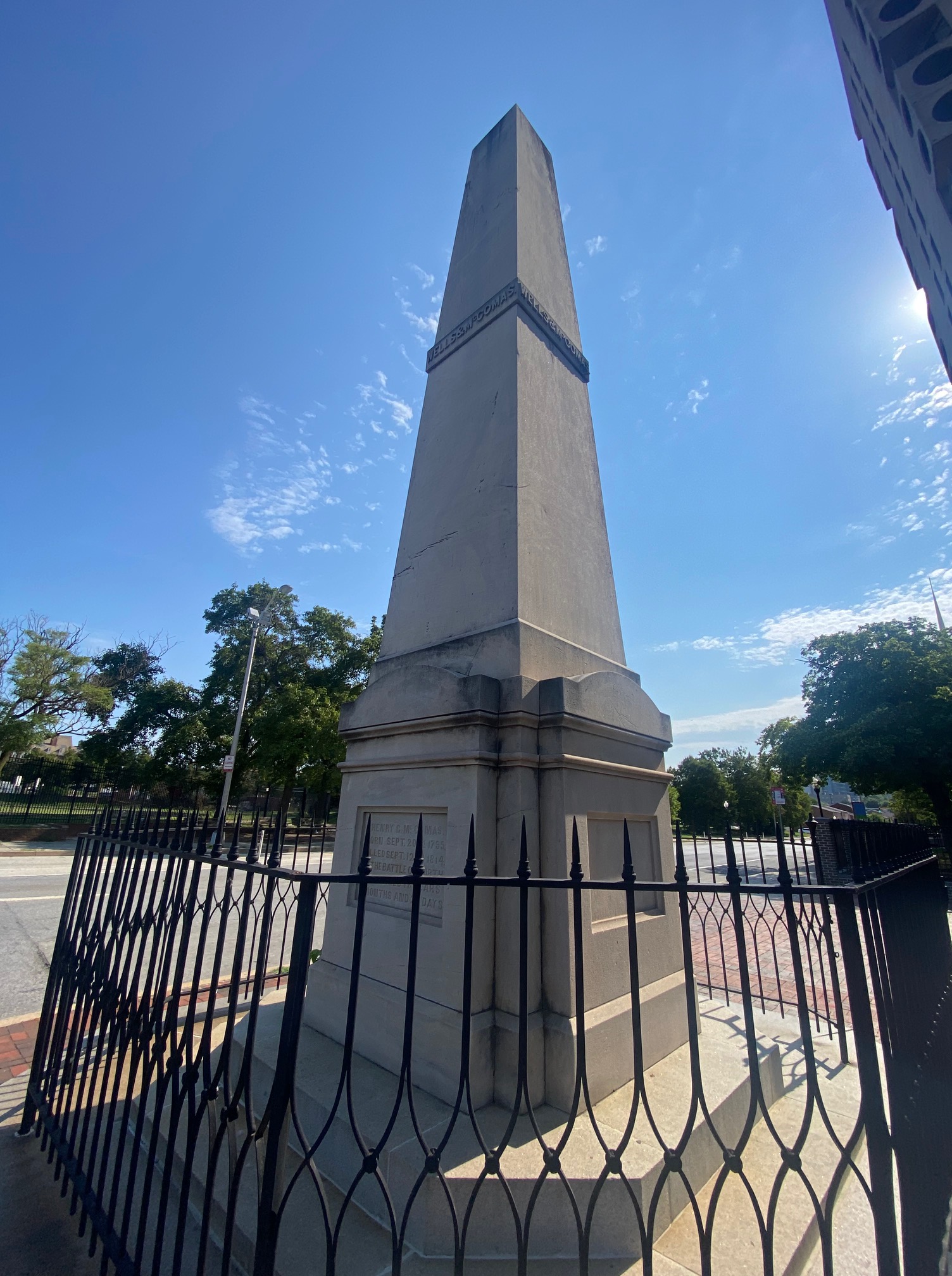
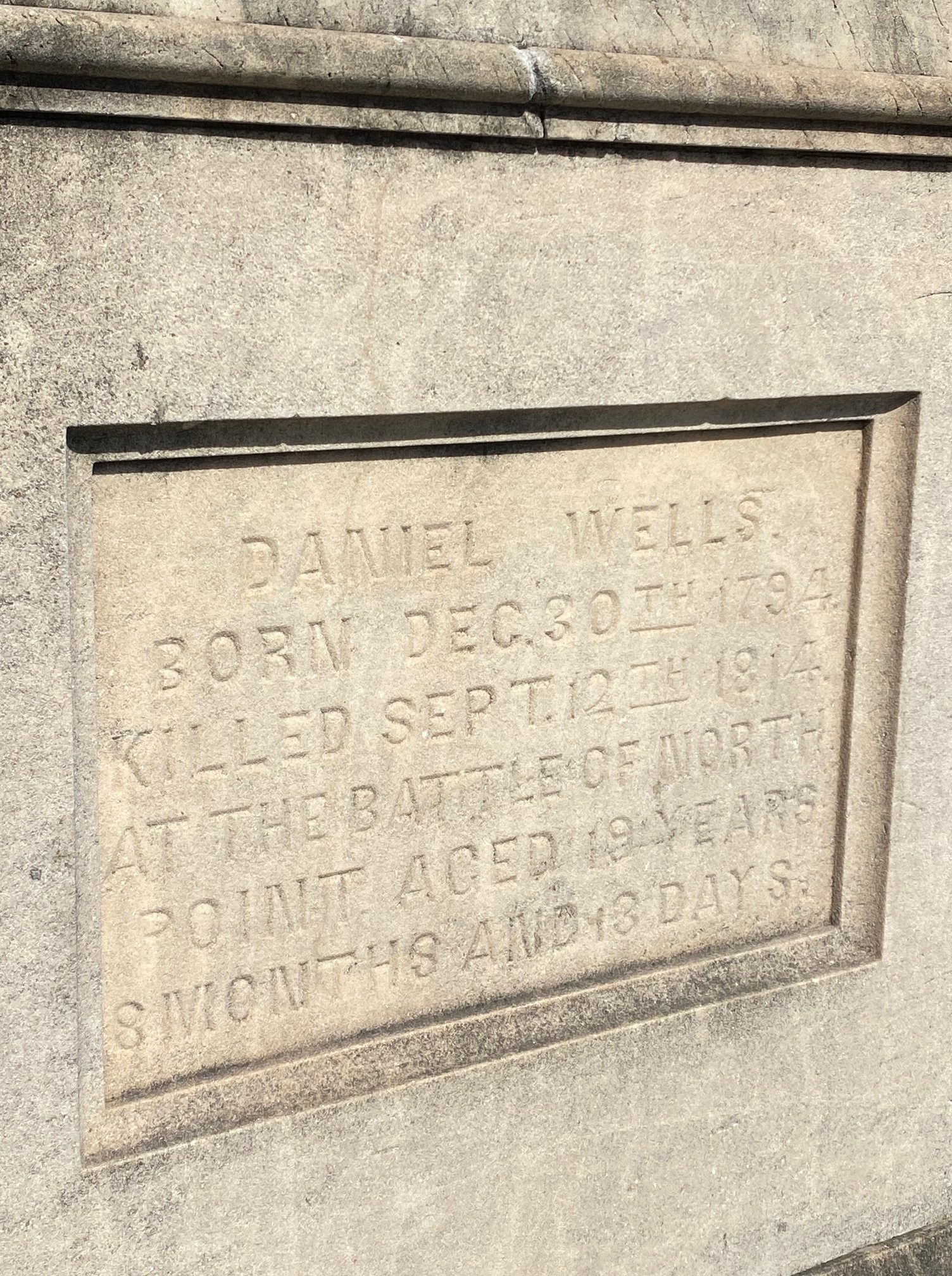
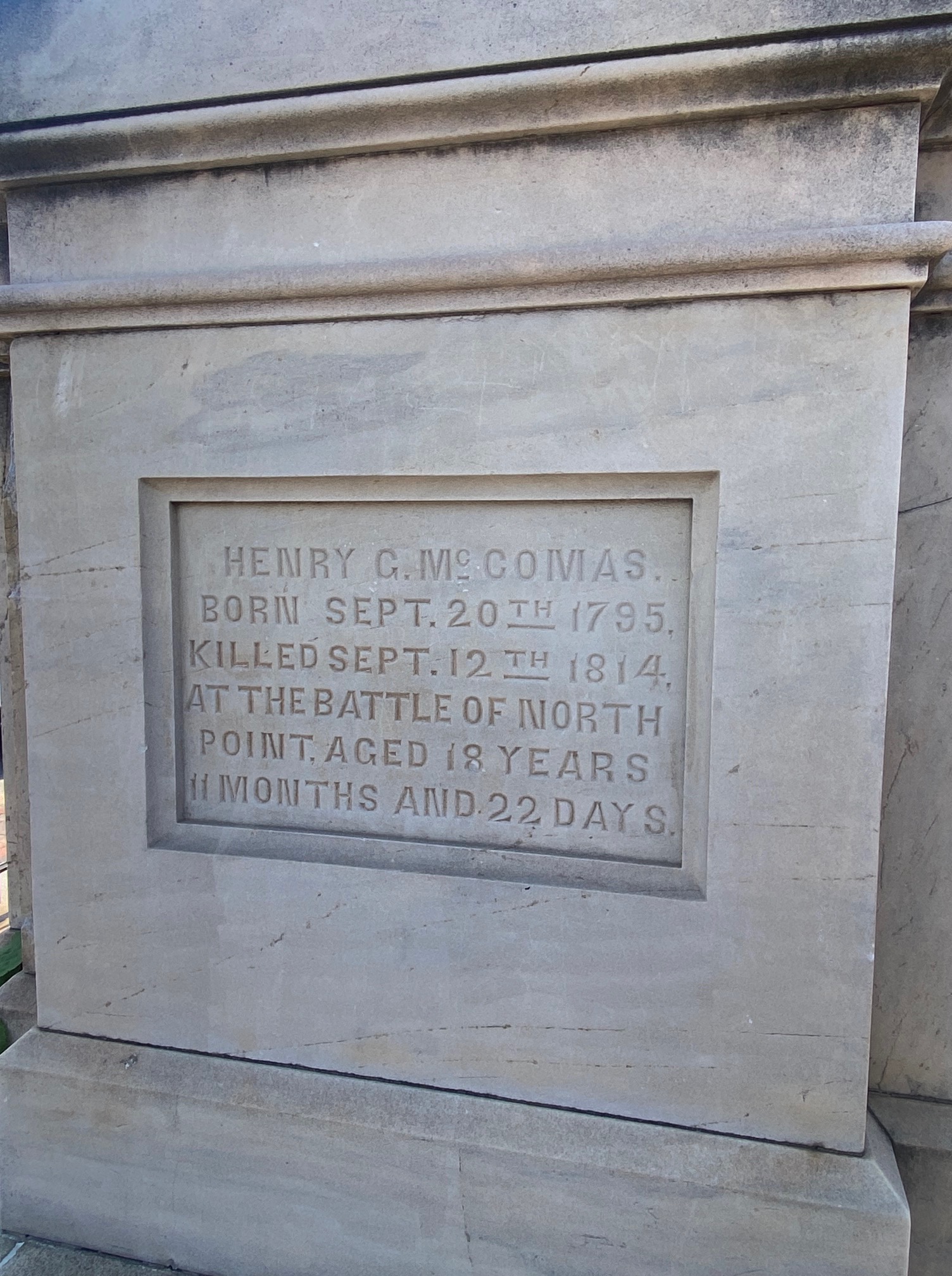
Situated along East Monument Street is a stone monument surrounded by a black iron fence. A wayside informational marker is placed right outside the fence. Underneath this monument rests the remains of Daniel Wells and Henry McComas. On September 12, 1814, one of their firearms changed the entire scope of the Battle of North Point, part of the Chesapeake Bay Campaign during the War of 1812.

Both young militia members, sent to the frontlines to skirmish and harass the approaching British infantry, fired a musket round that slammed through the left elbow and into the chest of Major General Robert Ross, British land commander, mortally wounding him. Both Wells and McComas, aged 19 and 18 respectively, would be killed during the day’s fighting. A third soldier, Aquila Randall, also slain that day, has his own small monument and crediting him with firing the fateful shot.

Although most historians credit either Wells or McComas. Both soldiers were reinterred here, the second time their remains had been moved, in 1858 when the monument was completed and a funeral song and dramatic play rounded out the day’s commemoration.

The site is part of the Star-Spangled Banner National Historic Trail. To learn more about the trail, click here.

On this date…The Jay Treaty

On this date in history…

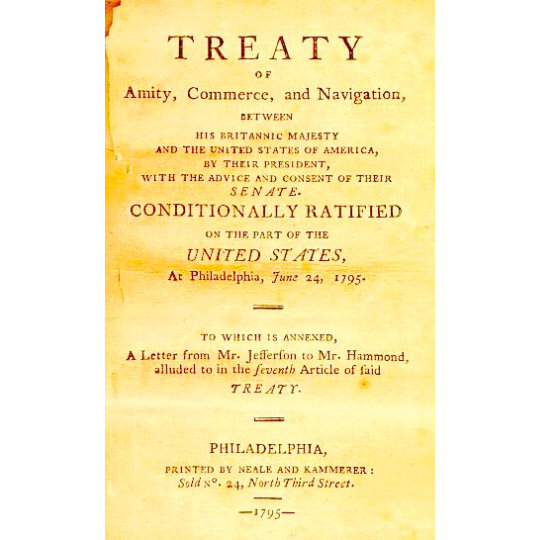
On November 19, 1794, John Jay, representing George Washington’s administration, affixed his signature to a document bearing his name in history. The Jay Treaty. Although the official name of the pact was “The Treaty of Amity, Commerce, and Navigation, Between His Britannic Majesty and the United States of America.”

The treaty’s aim was to resolve outstanding issues from the conclusion of the American Revolutionary War and facilitate economic trade. Although some of the clauses were not fulfilled completely and another war, the War of 1812, erupted because of it, the treaty did serve a purpose. The agreement ushered in a decade of trade between the two countries and gave the fledgling nation a chance to gain footing, a major concern for George Washington, as first president. The treaty also cemented the promise that Great Britain would vacate the forts in the Northwest Territory and agreed to arbitration on the boundary between Canada and the United States and the pre-American Revolutionary War debt.

Yet, the treaty was divisive. Even Jay remarked that he could find his way in the dead of night by the illumination of his own effigy. The treaty angered the French as that country was amid its revolutionary throes, and bitterly divided the nation. Out of it came the separation into two political parties, the Federalists, who supported the treaty, and the Democratic-Republicans who stood opposed to it.

The treaty was ratified by the Senate on June 24, 1795, with an exact two-thirds majority, 20 to 10 along with being passed by William Pitt the Younger, prime minister of Great Britain and his government, and took effect on February 29, 1796.

Historian Joseph Ellis wrote that the Jay Treaty was “a shrewd bargain for the United States” and “a precocious preview of the Monroe Doctrine.” As one of Washington’s most fervent wishes, the treaty “postponed war with England until America was economically and politically more capable of fighting one.”

“…To a Gentleman in Philadephia”

Fredericktown, Maryland, August 1, 1775, a gentleman on business wrote to his contact in Philadelphia the following observation of a company of volunteers answering the call to head north to Boston to join what would become the Continental Army

“Notwithstanding the urgency of my business, I have been detained three days in this place by an occurrence truly agreeable. I have had the happiness of seeing Captain Michael Cresap marching at the head of a formidable company of upwards of 130 men, form the mountains and backwoods, painted like Indians, armed with tomahawks and rifles and dressed in hunting shirts and moccasins, and though some of them had travelled near eight hundred miles from the banks of the Ohio, they seemed to walk light an easy and not with less spirit than at the first hour of their march. Health and vigour, after what they had undergone, declared them to be intimate with hardships and familiar with danger. Joy and satisfaction, were visible in the crowd that met them. Had Lord North been present, and been assured that the brave leader could raise thousands of such to defend his country, what think you, would not the hatchet and block had intruded upon his mind? I had an opportunity of attending the Captain during his stay in Town, and watched the behavior of his men, and the manner in which he treated them; for it seems that all who go out to war under him do not only pay the most willing obedience to him as their commander, but in every instance of distress look up to him as their friend or father. A great part of his time was spent in listening to and relieving their wants, without any apparent sense of fatigue and trouble. When complaints were before him he determined with kindness and spirit, and on every occasion condescended to please without losing is dignity.”

esterday the Company were supplied with a small quantity of powder from the magazine, which wanted airing, and was not good for rifles ; in the evening, however, they were drawn out to show the gentlemen of the town their dexterity at shooting. A clap board, with a mark the size of a dollar, was put up ; they began to fire at it off band, and the bystanders were surprised, few shots being made that were not close to or in the paper. When they had shot for a time in this way, some lay on their backs, some on their breast or side, others ran twenty or thirty steps, and firing, appeared to be equally certain of the mark. With this performance the company were more than satisfied, when a young man took up a board in his hand, not by the end, but by the side, and holding it up, his brother walked to the distance, and very coolly shot into the white ; laying down bis rifle, he took the board, and holding it as it was held before, the second brother shot as the former had done. By this exercise I was more astonished than pleased. But will you believe me, when I tell you, that one of the men took the board, and placing it between hia legs, stood with his back to the tree while another drove the centre. What wonld a regular army of considerable strength in the forests of America do with one thousand of these men, who want nothing to preserve their health and courage but water from the spring, with a little parched corn, with what they can easily procure in hunting ; and who wrapped in their blankets, in the damp of night, would choose the shade of a tree for their covering, and the earth for their bed.”

Although a depiction of the 1st Maryland at Guilford C.H in 1781 some of these men are dressed similar to the riflemen mentioned above (wikipedia)

*Account is in “Papers Relating Chiefly To the Maryland Line During the Revolution” Thomas Balch, editor. pgs. 6-7.

War of 1812 – 210 Years Ago (and Change)

First, thank you all for understanding with the technical difficulties of yesterday’s potential Facebook Live.

Over this past weekend, the 210th anniversary of the Battle of Bladensburg and the Burning of Washington by British troops took place. In a potential future tour, I was scouting out locations around our nation’s capital that are connected with the year 1814. Although some of the sites have been rebuilt, some of the history is preserved in museums, and one of the places is still occupied by the president of the United States, there is still a lot of history underfoot related to the War of 1812.

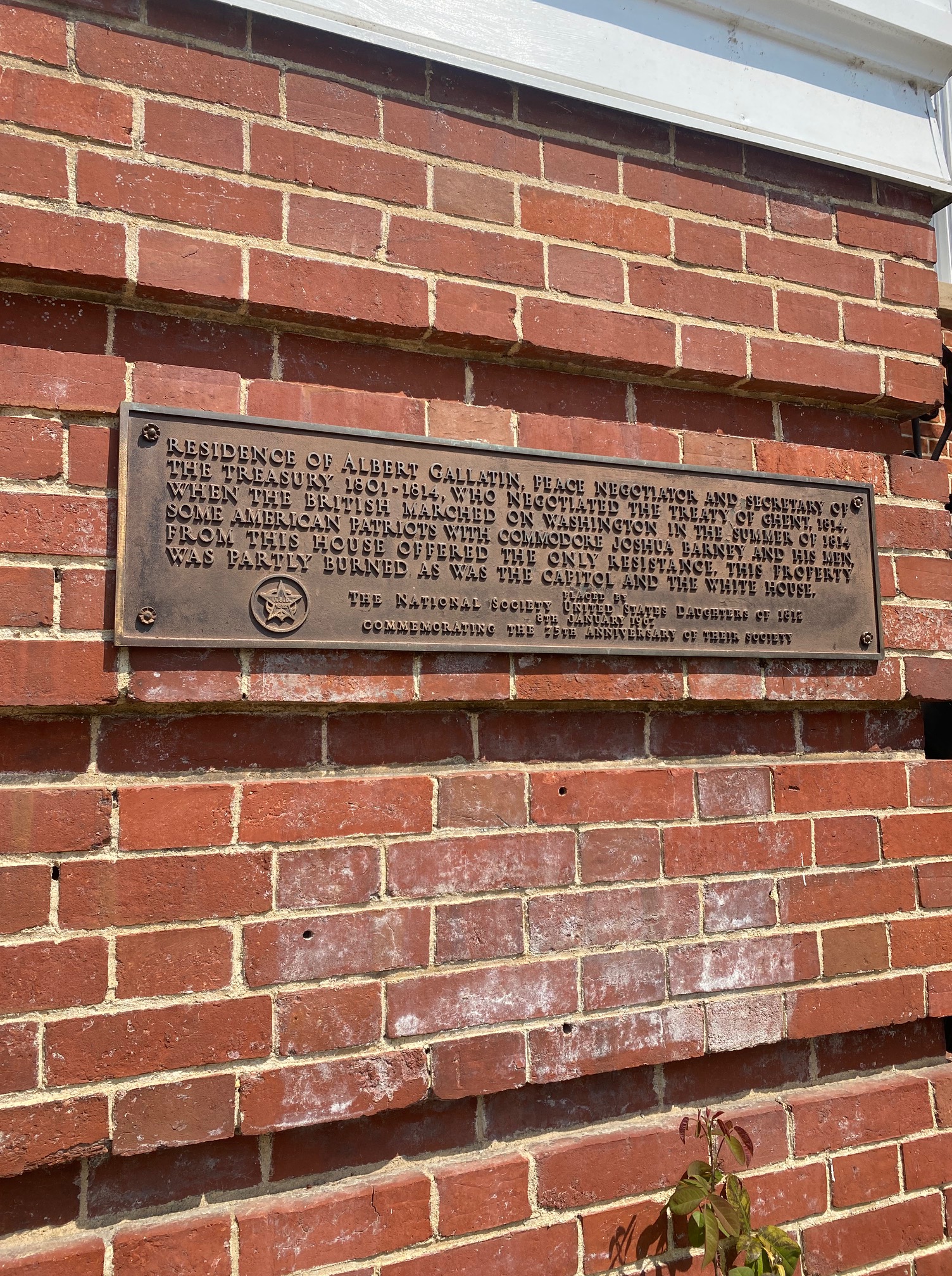
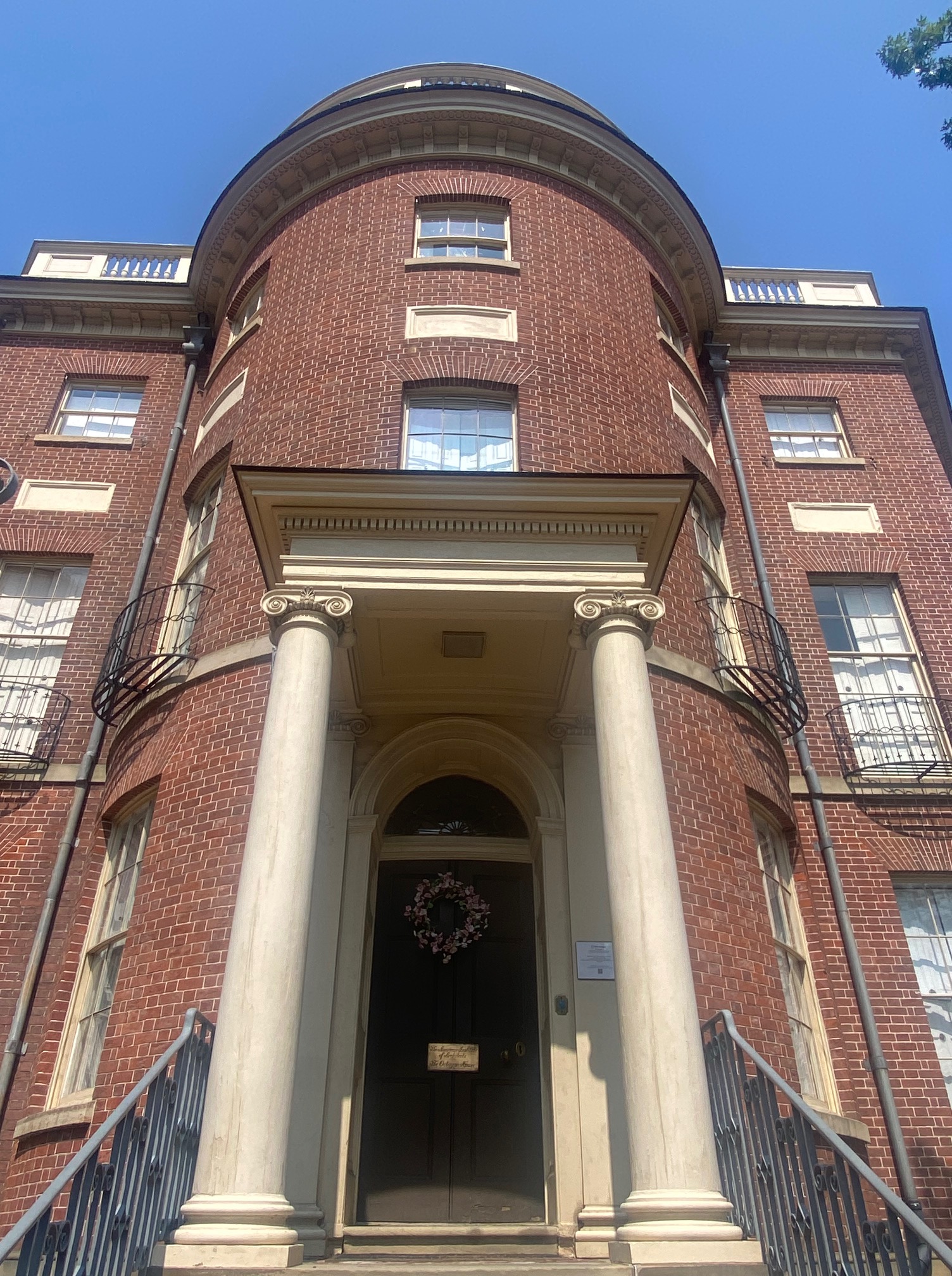
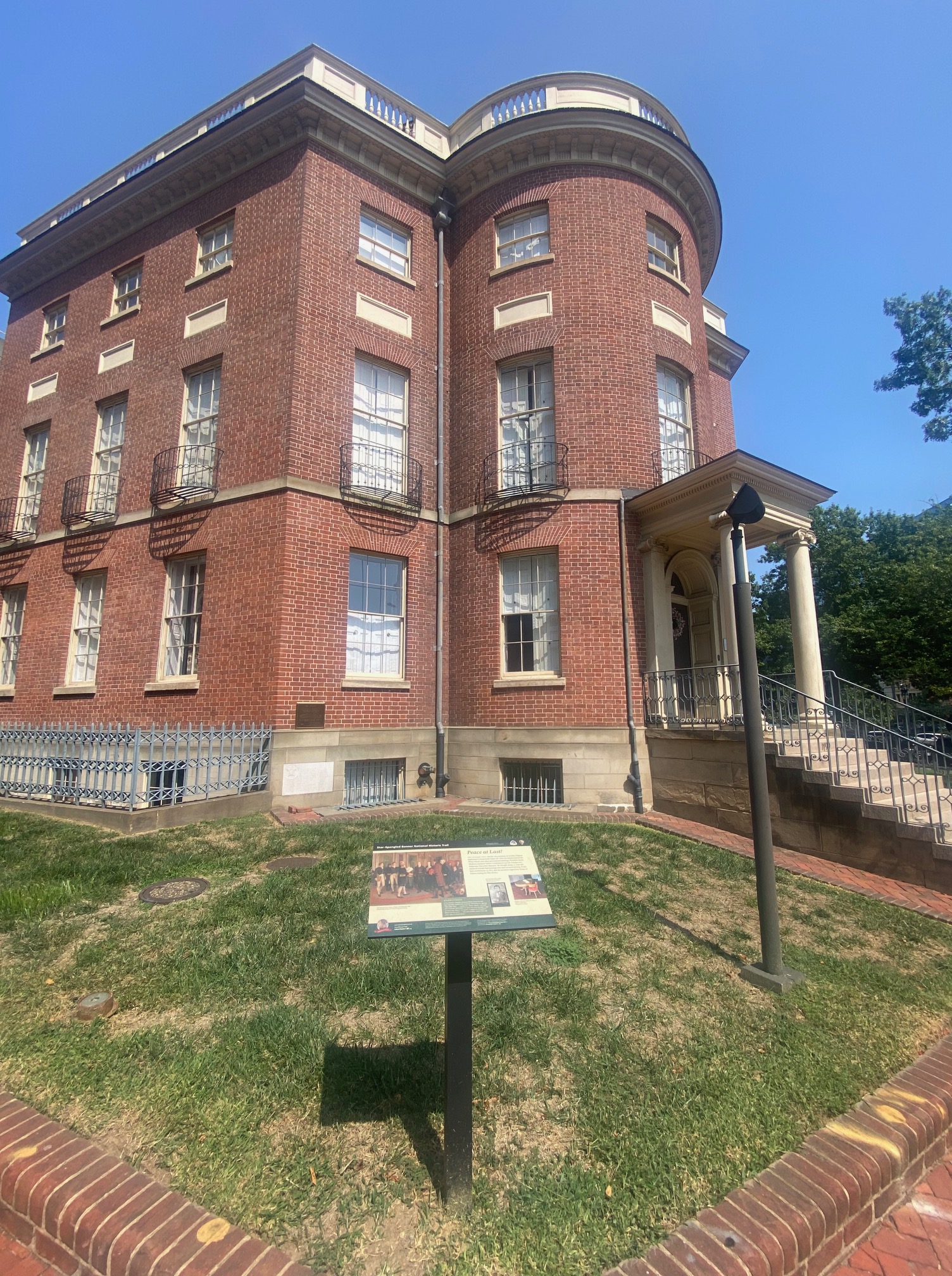
Some of that history is below. Robert Sewall built a house sometime between 1800 on 2nd and Maryland Avenue Northeast but with an inheritance from an uncle’s passing moved to southern Maryland. He rented the property to Albert Gallatin, who would serve as treasury secretary under both Presidents Thomas Jefferson and James Madison. In 1813, Gallatin left to become one of the United States peace commissioners in Ghent, Belgium charged with negotiating a treaty to end the War of 1812. William Sewall, Robert’s son, took responsibility for the house at that point. William served with Commodore Joshua Barney during the War of 1812 and records do not indicate he ever lived at the residence.

During the British march into the city, a group of Barney’s men took refuge in the residence and fired shots at the enemy column. Two British soldiers were killed and the horse of Major General Robert Ross was also struck. Ross ordered men into the structure to clear the snipers but not finding the culprits, the infantrymen burnt the property in retaliation. This would be the only private property burnt during the British incursion into Washington.

The property remained in the Sewall family, the house was rebuilt in 1820 and is now the Belmont-Paul Women’s Equality National Monument, a unit of the National Park Service.

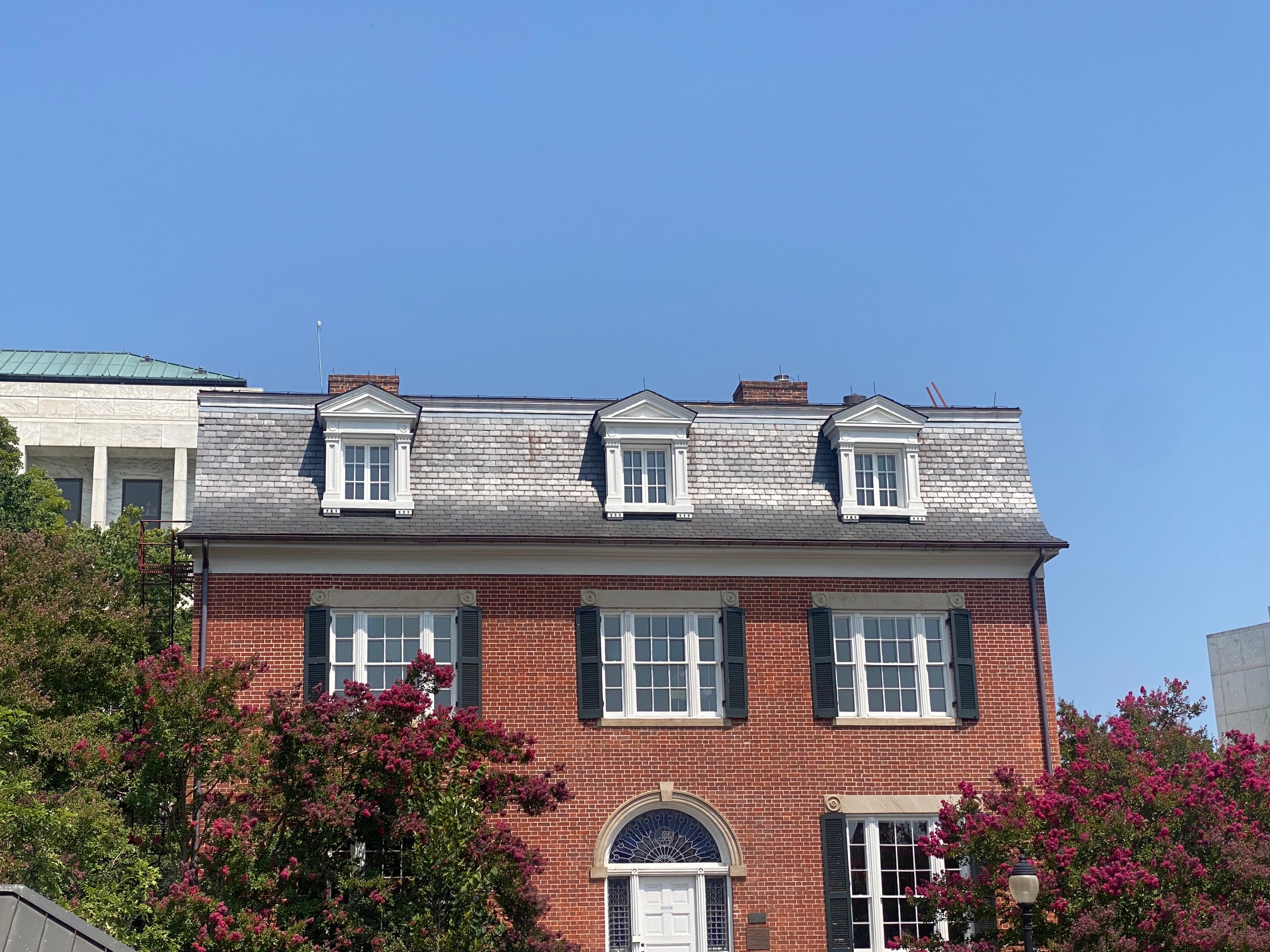
After returning to Washington, the Madison’s took residence here, in the house of John Tayloe III. On September 8, 1814, the Madison family moved in and in an upstairs room, the president received the peace treaty negotiated in Ghent, Belgium. He ratified the treaty in the upstairs study on February 17, 1815. When the Madison family vacated the quarters, six months after moving in, Tayloe received $500 in rent from their stay.

Washington’s First Headquarters

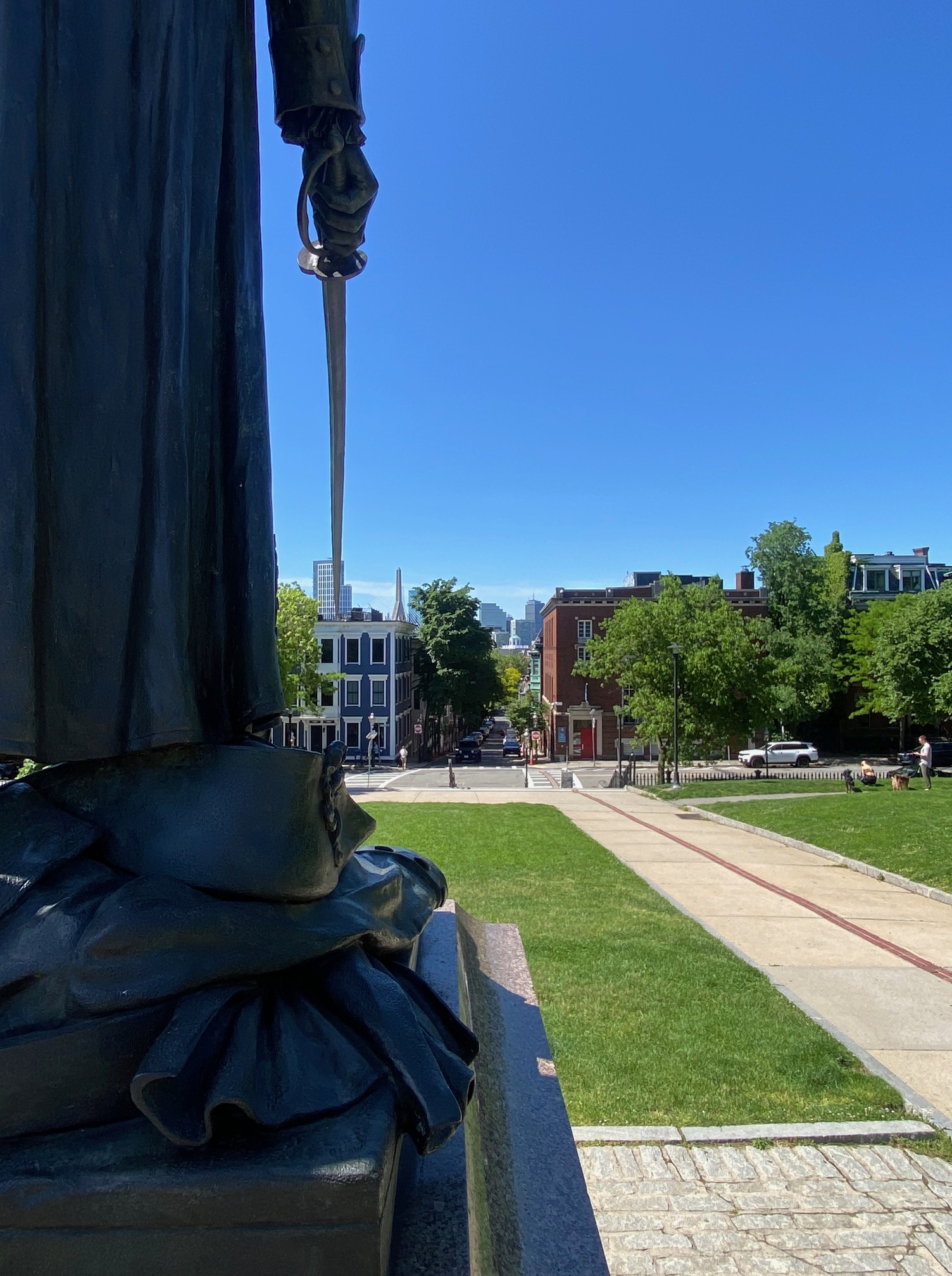
On June 15, 1775, George Washington was appointed by the Second Continental Congress as commander-in-chief of the Continental Army. Approximately a month later he rode into Cambridge, Massachusetts, to the house below, to assume command over that army. After he met the officers at Jonathan Hastings House near Harvard College campus, learning about operations and the siege. He was then directed toward an opulent residence standing about a mile away. Named the Vassall-Craigie-Longfellow residence, this place would become the focal point of the effort against the British in Boston. Washington moved in. He spent the next nine months in residence, overseeing the Siege of Boston and the British evacuation.

From this house, Washington began putting his footprints on the army and met some of the officers that became instrumental in securing American independence. This included the Rhode Islander Nathanael Greene and Massachusetts native and bookseller Henry Knox among others. Martha Washington, in December 1775, traveled over 440 miles from Mount Vernon to Cambridge to winter with her husband in this house. The making of Washington, the general, started here.

The power of place.

Today, the house preserved by the National Park Service today can be toured, click here for information.

War!

On this date, in 1812, President James Madison, the fourth president of the United States of America, signed declared war on Great Britain, to go into effect the next day. This is the date Madison signed the measure into law, after sending it to Congress on June 1.

The wording, in its entirety, is below:

BY THE PRESIDENT OF THE UNITED STATES OF AMERICA
A PROCLAMATION
Whereas the Congress of the United States, by virtue of the constituted authority vested in them, have declared by their act bearing date the 18th day of the present month that war exists between the United Kingdom of Great Britain and Ireland and the dependencies thereof and the United States of America and their Territories:
Now, therefore, I, James Madison, President of the United States of America, do hereby proclaim the same to all whom it may concern; and I do specially enjoin on all persons holding offices, civil or military, under the authority of the United States that they be vigilant and zealous in discharging the duties respectively incident thereto; and I do moreover exhort all the good people of the United States, as they love their country, as they value the precious heritage derived from the virtue and valor of their fathers, as they feel the wrongs which have forced on them the last resort of injured nations, and as they consult the best means under the blessing of Divine Providence of abridging its calamities, that they exert themselves in preserving order, in promoting concord, in maintaining the authority and efficacy of the laws, and in supporting and invigorating all the measures which may be adopted by the constituted authorities for obtaining a speedy, a just, and an honorable peace.
In testimony whereof I have hereunto set my hand and caused the seal of the United States to be affixed to these presents. Done at the city of Washington, the 19th day of June, 1812, and of the Independence of the United States the thirty-sixth. By the President:
JAMES MADISON.
JAMES MONROE,
Secretary of State.

*Transcript courtesy of the Miller Center at the University of Virginia.*

The Great Butter Rebellion

Yes, this was a protest in Massachusetts in 1766.

No, “butter” is not a typo in the title.

Yes, this may be the first college student protest recorded in what became the United States of America.

No, this was not just about butter or butter substitutes.

At Harvard College, in 1766, three students, all seniors at the institution, Asa Dunbar, Daniel Johnson, and Thomas Hodgson had had enough of the lack of fresh food being served to the student body. Dunbar, who may be best known as the grandfather of Henry David Thoreau, led the protest, stating that the butter served by the college was “stinketh” and he incited the student body to reject this rancid fare by jumping onto his chair and yelling

“Behold our butter stinketh! Give us therefore butter that stinketh not!”

Dunbar faced disciplinary action, being punished for insubordination and instigating a potential riot. After he received his punishment, the student body enacted another protest, by walking out of the hall, cheering loudly in Harvard Yard, and continuing into Cambridge to dine instead. To give some credit to the college, the adminstration acknowledged the butter ws rancid. With restrictions due to economic difficulties the availability of fresh food was limited however.

As Massachusetts moved closer to open rebellion in their remonstrances against British Parliament and the British crown their example was mirrored by the student body of Harvard. After a month of impassed including “insulting proceedings” the royal governor of Massachusetts, Sir Francis Bernard personally addressed the student body in the chapel on campus and the protests and insubordination of the student body concluded.

A depiction of a student protest
courtesy of The Harvard Gazette

Concluding, with a Butter Rebellion, a Tea Party, what food or drink would the colonists focus on next? For me, I think I will sip my Samuel Adams brew. Leave the butter and tea to the Massachusettans.

(Yes, I know that Samuel Adams beer was not around at the time of the American Revolution but I thought it was fitting. And beer and history go together anyways right?)

Sources:

Butter rebellion

Harvard’s long-ago student risings

Spread The Word: Butter Has An Epic Backstory

“Rev War Revelry” Battle of Bunker Hill and Memory with Dr. Paul Lockhart

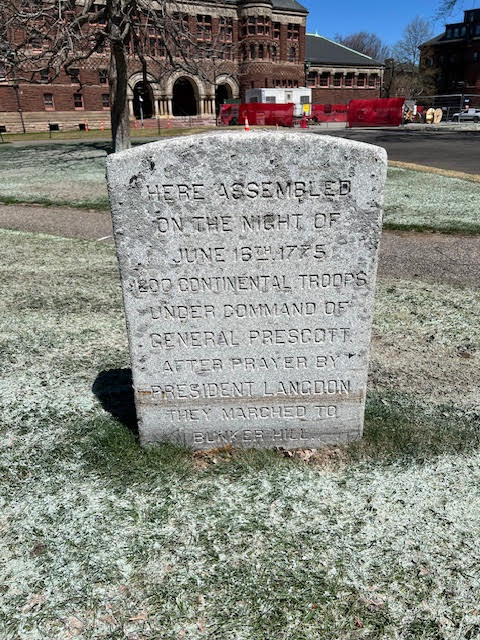
The Battle of Bunker Hill is routinely mentioned in the pantheon of memorable American military victories. Although myths of the engagement have obscured some of the history, much like the smoke of battle, the patriot victory on June 17, 1775, was another pivotal moment in the early stages of what became the American Revolutionary War.

To discuss the engagement, ramifications, and interpretation of the battle, Emerging Revolutionary War welcomes historian Dr. Paul Douglas Lockhart, Professor of History at Wright State and author of “The Whites of Their Eyes, Bunker Hill, the First American Army, and the Emergence of George Washington.” A full biography of Dr. Lockhart, including his other works, is at the bottom of this post.

As a teaser, this may be the first time in “Rev War Revelry” history that we mention Artemas Ward, who according to Dr. Lockhart is the “unsung hero of the battle (and indeed of 1775).” Come hear why! And full disclosure, I agree.

We hope you can join us on Sunday, January 21 at 7 p.m. EDT on Emerging Revolutionary War’s Facebook page for the next installment of the popular “Rev War Revelry.” Be ready to ask questions as you sip your favorite beverage during this historian happy hour.

Biography of Dr. Lockhart

“Paul Douglas Lockhart is Professor of History at Wright State University in Dayton, Ohio, where he has taught since earning his PhD in 1989. A native of Poughkeepsie, New York, Lockhart completed the PhD at Purdue University, where he studied military history with the late Gunther Rothenberg, the renowned Napoleonic scholar, and early modern European history with Charles Ingrao. He has seven single-author books to his credit. Four of them deal with the history of Scandinavia during the “Age of Greatness,” including Denmark, 1513-1660: The Rise and Decline of a Renaissance Monarchy, published by Oxford University Press in 2007. He is probably better known for his books on military history: The Drillmaster of Valley Forge: The Baron de Steuben and the Making of the American Army (2008), The Whites of Their Eyes: Bunker Hill, The First American Army, and the Emergence of George Washington (2011), and most recently his study of the parallel evolution of warfare and firearms: Firepower: How Weapons Shaped Warfare (2021). Wright State has awarded him the Brage Golding Distinguished Professorship and the Trustees’ Award for Faculty Excellence, the University’s highest academic honor. The Ohio Academy of History named him Distinguished Historian for 2020-21, and in 2021 he was elected to membership in The Royal Society for Danish History for his contributions to the history of Denmark, an honor rarely accorded to foreigners. He lives in Centerville, Ohio, with his family.”

Book Review: “A Republic of Scoundrels” edited by David Head & Timothy C. Hemmis

In an age where the names of Franklin, Jefferson, and Washington are household, the names of Wilkinson, Kemper, and Bowles seem to be consigned to the fringes of histories of the early American republic. With the formation of the fledgling United States of America, both the honorable and not-so-honorable helped shape the direction of expansion, and diplomacy, and reinforce societal values of the 18th and early 19th centuries. This collection of essays is akin to watching a true crime television documentary.

With a collection of essays, editors David Head and Timothy C. Hemmis, historians, and biographers provide snippets into the lives of these scoundrels of the early Republic. A few of the names are well known, including Benedict Arnold and Aaron Burr, a few will conjure up memories from the fringes of other histories, such as James Wilkinson, whereas others have escaped the main avenues of historical exploration. Throughout the various essays, “this collection seeks to reexamine the Founding generation” to “replace the hagiography of the Founding Fathers with something more realistic” (pg. xx).

First, an examination of the word “scoundrel” is needed. According to usage at the time and the 1755 dictionary of Samuel Johnson’s authoring, that word meant “a mean rascal; a low petty villain” (pg. xiii). Through 12 individuals, the various authors explain how each earned the moniker “scoundrel” and how that affected the development of the United States. Especially interesting was the role of various individuals in Western expansion and the domino effect on international diplomacy. Individuals such as Aaron Burr and James Wilkinson are better known but Philip Nolan and Thomas Green are not so much.

Others, such as Benedict Arnold and Charles Lee get a fresh look from two great Revolutionary-era historians, James Kirby Martin and Mark Edward Lender. Included in those discussed, William Augustus Bowles and Diego de Gardeoqui show how international actors played prominent roles in providing heartburn to the national government. One theme, the west and south of the original thirteen states provided the arena for scheming, opportunity, and risk.

In conclusion, the editors examine three main reasons a study like this is important, that the “unintended result of the American Revolution” was “many men decided they had their own ideas about what was important” (pg. 266). Secondly, the “vital importance of the American West as a zone of territorial expansion, economic opportunity, and foreign intrigue” and lastly simply “early America was…a time and place for scoundrels…” (pgs. 267-268).

Overall this essay-comprised book is a fun, fresh read that looks at those scoundrels that sought an opportunity to change the landscape of the early American republic and potentially change the course of United States history. Who does not like to read about plots, scheming, and resultant escapades?  

Publisher: Pegasus Books, December 2023

368 pages, including images

Galloway’s Foreshadowing

Joseph Galloway is best known as one of the preeminent and prominent Loyalists who remained in the American colonies through the majority of the American Revolution. Prior to the colonies declaring independence, especially during the First Continental Congress, Galloway was active in the debates that decided the path forward. Besides attending and being active in the discussions in Philadelphia he penned a pamphlet entitled A Candid Examination of the Mutual Claims of Great Britain and the Colonies.

Within the pages, he called African American slavery “the dangerous enemy within” and the “natural weakness” of the soon-to-be Southern states. If a division ensued, Galloway predicted that,

“If the colonies happen to vie and try their reciprocal strength with each other, the political force of the Northern Colonies will soon destroy the opulent force of the Southern.”

Furthermore, Galloway pointed to the colonies/states of Georgia, Maryland, North and South Carolina, and Virginia as vulnerable because of the institution of slavery. In a conflict without the overarching guidance by Great Britain, the division between Northern and Southern colonies/states would lead to a domestic civil war and the possibility that African American slaves would join the Northern effort in vanquishing their former owners.

Although Galloway was writing to prop support for remaining loyal to the British crown he foreshadowed accurately the rift that plagued the independent United States. In laying out his views, Galloway quite succinctly predicted what would happen in 78 years after independence was won by the United States.

Galloway left Philadelphia when the British evacuated the city in 1778 and left for England where he would position himself in a leading role for loyalists in exiles. He never returned to the United States. His succinct prediction of the future though proved eerily accurate.

Sources:

Disunion Among Ourselves, The Perilous Politics of the American Revolution by Eli Merritt

University of Michigan, Evans Early American Imprint Collection, click here for the link.