On January 3, 1777, George Washington’s forces struck the British outside the town of Princeton, New Jersey. The battle culminated a ten-day period that would be crucial to the survival and eventual victory of American independence.
As Emerging Revolutionary War builds up to the first annual bus tour of the Trenton and Princeton in November, this “Rev War Revelry” will provide some of the background of this engagement. Joining Emerging Revolutionary War on this installment of the “Revelry” will be historian and Princeton Battlefield History Educator Will Krakower.
Join us, this Sunday, at 7pm EST on our Facebook page for this great discussion on the Battle of Princeton and the history around it.
In the spring of 1778, General George Washington chose Major General Nathanael Greene to be the quartermaster general of the Continental army, replacing General Thomas Mifflin who had resigned the previous November. Greene was hesitant and wrote the quote that graces the title of this post. He was leery of giving up a field command to take a thankless job that faced a mountain of difficulties and was more administrative. From the start of his tenure in this important post, Greene brought about effective change. His never ending responsibilities included allocating resources, installing the right people into positions, and untangling contracts, transportation woes, and developing a concept, such as supply depots on potential campaign routes were vast improvements over what his predecessor accomplished.
Nathanael Greene
Greene though yearned to return to an active field command and through his close connection to Washington along with his due diligence as quartermaster, he was assigned command in the southern theater. His assignment was to replace Major General Horatio Gates as the head of Continental forces after the latter’s defeat at Camden, South Carolina in August 1780. Greene’s role in this position is well-documented and outside the scope of this post. One of the decisions he made, early on in his tenure as commander, paid huge dividends and is usually relegated to a passing few lines in most histories of the southern campaigns. What Greene wrote years earlier about “quartermaster in history” the quote that gives this piece its title, holds true in this instance as well.
On December 4, 1780, Greene wrote to Edward Carrington, then on assignment scouting the rivers and topography through North Carolina and southern Virginia, offering him a new assignment; that of quartermaster general for the southern army. After finishing his surveying of the rivers and water transportation, Carrington was ordered to head toward Greene’s forces, bringing supplies that had been gathered with him as well.
This decision, to place an officer of the caliber of Edward Carrington, in that position was a wise move. One that passes largely unheralded. A decision, though, that ultimately leads to success and eventual victory. In this case the momentous “Race to the Dan” that saved Continental forces, fatigued Lord Charles Cornwallis’ British forces, and played an early role in the latter’s move toward Virginia.
As soon as one reads the title of this post, I am willing to bet a handful of names pop into your mind. This initial thought is most likely followed by a quick passing of puzzlement that the “Father of Modern Military History” would most likely been after the era of the American Revolution. More closely connected with the French Revolution or Prussia or even later after the unification of Germany in the 19th century.
None of those thoughts land on what European historians contend is the “Father of Modern Military History.” Bear with me a moment though before you click off this post. Have you ever browsed the aisles of Barnes and Noble? Of course you have, history enthusiasts tend to be book enthusiasts. A few weeks back that is what I was doing over my weekend. I strayed too far, however, and left the “United States History” section and ventured into the “World History” section. Ever done that?
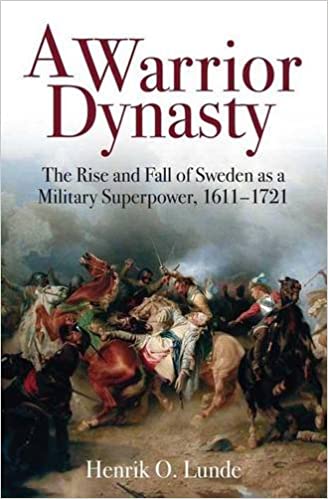
That is when this book caught my eye, “A Warrior Dynasty, The Rise and Fall of Sweden as a Military Superpower, 1611-1721.” I can safely say, I knew exactly nada about Sweden and their era of being a “military superpower.” So, I figured I would take the plunge. One more book in the personal library cannot hurt right?
After an introduction outlining the need for a book of this history in English and a brief overview of Sweden up to the 17th century, the author, who happens to reside in Southwest Florida now, introduced me to the monarch of Sweden. In addition to being the king, he was the greatest military mind in Europe during this time frame of the Thirty Years War.
Gustav II Adolf or his Latinized name, Gustavus Adolphus. He served as King of Sweden from 1611 to 1632, when he was killed in action and was the primary reason that Sweden rose to such military prominence during this time frame. After his premature death he was posthumously given the title Gustav Adolfden store which translated means Gustavus Adolphus the Great by the Riksdag, the Swedish Parliament.
Besides the other title he earned posthumously, “Father of Modern Military History.” Why is he deserving of this title? Let’s examine.
On this date, in 1778, the Continental army, under the command of General George Washington broke winter camp and began the spring campaign. Their objective was to catch the British army, under Sir Henry Clinton, retreating across New Jersey to the safety of New York City.
Nine days later, in the last major action in the northern theater, Washington’s forces would engage their adversary in the Battle of Monmouth. The army that fought this engagement in one of the hottest recorded days of any battle in American history, was a much improved military organization. Not perfect but much improved from the force that marched into Valley Forge six months prior.
During that half-year, from December 19 to June 19, the army saw an improved quartermaster department, the formation of a military handbook and tactical training, and the news that a powerful European nation had agreed to become allies in the quest for American independence.
Much is made of turning points or the critical importance of an event so I do not want to retread that argument here. However, what happened at Valley Forge was significant in the path to eventual American victory and the formation of the United States of America.
There is an old saying that even the greatest fiction writers cannot envision a story that is unbelievable as actual events can be. Or to sum it up more succinctly, a coincidence. After delays due to the pandemic, the latest volume of the Emerging Revolutionary War Series was released, in time for the 243rd anniversary of the end of the winter cantonment at Valley Forge.
The book is authored by yours truly and can be found via the publisher’s website by clicking here or through your favorite bookseller or by emailing Emerging Revolutionary War.
Then follow in the footsteps of Washington’s forces to Monmouth.
Writing over thirty years after the fact, Henry “Light Horse Harry” Lee summed up the events of February 14, 1780 with the line, “Thus ended, on the night of the 14th of February, this long, arduous, and eventful retreat” (190). Upon hearing of General Nathanael Greene’s exploits in this movement, General George Washington wrote, “You may be assured that your Retreat before Lord Cornwallis is highly applauded by all Ranks and reflects much honor on your military Abilities.” (198).
What Lee would remember as “eventful” and Washington and fellow military ranks “highly applauded” is remembered today as the “Race to the Dan.” This retrograde movement, undertaken by Greene’s forces from South Carolina to the Dan River in southern Virginia, is sandwiched between the engagements at the Battle of Cowpens in January 1781 and the British pyrrhic victory at Guilford Court House in March 1781. Yet, this retreat may be on the turning points in the southern theater that led the British, under Lord Charles Cornwallis to his eventual demise at Yorktown in October 1781.
Great historians, such as John Buchanan is his monumental work The Road to Guilford Court House have covered with broad strokes this period of time but a dedicated study was much needed in the historiography of the American Revolution. Insert Andrew Waters, writer, editor, and conservationist, whose name may be familiar from previous works such as The Quaker and the Gamecock: Nathanael Greene, Thomas Sumter, and the War for the Soul of the South. His latest book, To The End of the World, Nathanael Greene, Charles Cornwallis, and the Race to the Dan, captures this important military movement while providing an expose on the leadership of Greene woven in. The title of the book is pulled from a quote by Brigadier General Charles O’Hara, Cornwallis’s second-in-command during this campaign. With a background in land conservation with a focus on river corridors and watersheds, Waters found a connection with Greene, who studied the various waterways—or ordered subordinates—to study the various rivers, to better understand the topography for military campaigns.
After a stint in Salisbury, North Carolina, Waters became fascinated with the Race to the Dan story and decided to plunge in to understanding this period of the American Revolution. He found that “the Race to the Dan is a remarkable tale, fit for cinema or an epic novel, and not only for its accounts of four narrow escapes across its four rivers” (xv). He was drawn “to its story” (xx) and any reader of the book is the beneficiary of that discovery.
Along with weaving in the innate leadership qualities of Greene, Waters brings to light the importance of military leaders not as well-known such as William Lee Davidson, William R. Davie, and Edward Carrington with more household names of Lee, Daniel Morgan, and Otho Holland Williams. Throw in the names of Cornwallis, O’Hara, and Banastre Tarleton, and the pantheon of American Revolutionary personas is complete.
In this approximate month-long retreat, Greene saved the American Revolution in the southern theater and set in motion the events that led to the climactic victory at Yorktown. Waters, with his 2020 publication, has now helped save the story of the Race to the Dan from its unintended lapse into obscurity.
Information:
Published: 2020 (Westholme Publishing)
264 pages, including index, footnotes, images, and maps
During the winter encampment at Valley Forge, as thousands of men huddled around drafty wooden cabins, with dwindling supplies, and battled boredom and disease, a relief effort was organized hundreds of miles away.
George Washington, ensconced at the Potts House in the heart of the Valley Forge encampment, was very aware of the dire straights that his forces were exposed to. Throughout the winter he sent missives, directly and through intermediaries, discreetly asking for more aid, for supplies, for changes to military bureaucracy. He even consented to a delegation of congressmen to visit Valley Forge and see first-hand the situation in the winter of 1777-1778.
In a proverbial sense, he did not leave any stone unturned to try and ease the plight of his forces or continue to stay abreast of British designs, less than twenty-miles away in Philadelphia, Pennsylvania.
After hearing of the contributions of the Oneidas and Tuscaroras at the Battle of Oriskany in New York, Washington sent a letter of invitation for the Native Americans to visit his army. Approximately 50 warriors along with supplies made the few hundred mile journey from upstate New York to eastern Pennsylvania. They left their villages on April 25 and arrived on May 15,1778 in Valley Forge. The leaders of the Oneida party dined with Washington. Five days later some of the warriors participated in the engagement at Barren Hill under the Marquis de Lafayette. Six of the warriors gave their life in service to their ally.
In 2007 historian Joseph T. Glatthaar published a book about the Oneidas and their contributions to the American victory in the war. The title, in part, is Forgotten Allies. A fitting testament to the service and sacrifice this tribe underwent in their partnership with the fledgling American nation.
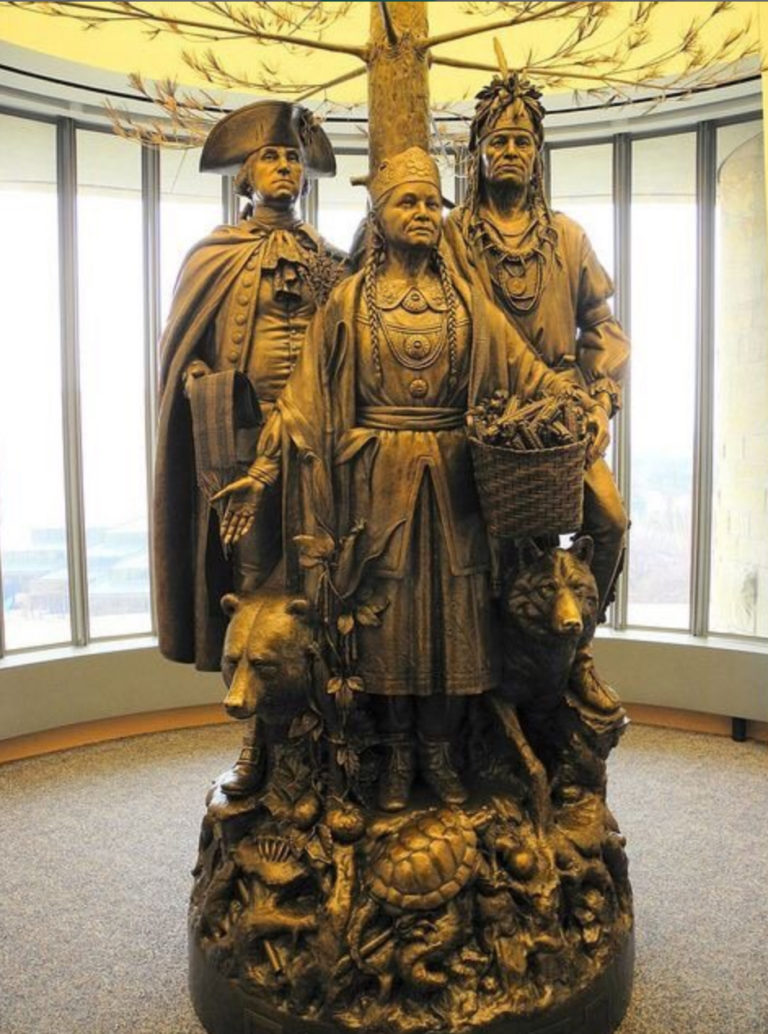
In 2004 a sculpture was completed of Polly Cooper, Chief Skenandoah, and George Washington (courtesy of King of Prussia Historical Society)
If the Oneidas were the “forgotten allies” than in the winter encampment at Valley Forge there was a forgotten woman that tramped south with her fellow Oneidas. Her name was Polly Cooper.
Along with the warriors, whom Washington wanted to serve as scouts, the Oneidas brought much needed supplies, including bushels of white corn. While the leaders dined at the Potts House, Cooper established a de-facto cooking show. She handed out the white corn to the soldiers and taught them how to use husks to make soup and ground grain to make it palatable.
This much needed food sources, along with an improved supply chain under quartermaster Nathanael Greene rounded out the bleak winter with the glimmer of hope for better supplies in the upcoming campaign season.
The Oneida, including Polly Cooper for her services, refused any and all payment. Friends help friends in need is what the Oneida told Washington and his officers. However, a tradition exists in the history of the Oneida nation. That story, passed down orally from generation to generation, highlights that Marth Washington, in her gratitude for what Polly Cooper did for the rank-and-file of the Continental army, presented the Oneida heroine with a shawl and bonnet.
Another account reads that Cooper was gifted a black shawl that she saw for sale in a store window. The Continental Congress appropriated the money for the clothing item and gifted it as their thanks to her. This shawl is still in the ownership of her descendants and has been loaned to the Oneida cultural center from time to time.
The black shawl that Polly Cooper received for her services to the Continental Army at Valley Forge (courtesy of the Oneida Indian Nation http://www.oneidaindiannation.org)
On the morning of August 27, 1780 there was a knock on the door of the Charleston, South Carolina residence of Christopher Gadsden, lieutenant governor of South Carolina. He had stayed when the city capitulated to British forces in May. Gadsden had represented the civil government and handed the city over to the British commander, Sir Henry Clinton. He was released on parole.
Christopher Gadsden
Now, approximately three months later, Clinton was back in New York, and the new British commander Lord Charles Cornwallis had reneged on the parole agreement. Along with another 20 civil officers, Gadsden was led through the town to the docks to a waiting ship, set to sail for St. Augustine in British East Florida.
Upon arrival in the oldest city in European North America, Gadsden was given the opportunity by Governor Tonyn to avoid incarceration in Florida. This is when the 56-year old patriot probably uttered the phrase below.
“I gave my parole once, and it has been shamefully violated by the British Government: I shall not give another to people on whom no faith can be reposed.”
With that decision, Gadsden landed himself in Castillo de San Marcos the large coquina stone fortress that stood guard over St. Augustine. Not only was the South Carolinian kept in a cell, he was kept in solitary confinement for the next 42 weeks!
Upon his release in September 1781, Gadsden and the rest of the civil prisoners were sent by merchant vessel to Philadelphia. Gadsden wasted no time in hurrying southward to South Carolina and a return to the state House of Representatives. He served in various political roles, although he had to decline the governorship because of the affects of his imprisonment. He died in 1805. A grandson, James Gadsden would give his name to the Gadsden Purchase.
Gadsden was held in the cell to the right (author photo)
Today one can visit Castillo de San Marcos, a national park unit within the National Park Service. When touring the Castillo you can view the cell where Gadsden spent his solitary confinement and read the accompanying exhibits.
Merriam-Webster’s two two definitions of inspiration are “an aspiring agent or influence” and “the quality or state of being influenced.” Being a military historian that has spent a portion of his graduate school and adult life studying the American Revolution, there are a multiple examples of people, events, or circumstances that would fit that Merriam-Webster definition.
The 56-men who affixed a signature to the Declaration of Independence in the summer of 1776 and the gravity of what that meant.
Thomas Paine’s The American Crisis comes to mind during the bleak December 1776 days as George Washington’s army hurriedly moved through New Jersey.
George Washington’s personal heroics, at Princeton in January of 1777 and Monmouth Court House in June 1778, defying his own personal demise to rally the troops he led.
The tales of suffering, at Valley Forge, Morristown, and through the heat of a Carolinas campaign by the common soldier, many whose names are lost to history.
Recently, I have been looking for inspiration, I think most of us are, with how 2020 ended and the beginning of 2021, but this post is not about straying into current politics, viewpoints, or stances on the pandemic. This is more personal.
The pandemic has afforded me the opportunity to read more, as I am sure my fellow history enthusiasts and bookophiles can relate to. Those readings reawakened a question I tried to tackle as a graduate student a decade ago at George Mason University.
What inspired the men from Maryland to fight for American independence?
Or more accurately:
What did not inspire the men from Maryland to fight for American independence?
I ruled out pay, patriotism (at the start), and other tangible benefits. I gleaned from some of the primary sources that have survived, the chance to create a new life, for the soldiers themselves or their loved ones at home was a major motivator to serve. Family was the spark of inspiration.
On this date, that is something I can really relate to. My father, who will be celebrating his 71st trip around the sun, is battling dementia. He will know that this date, February 8, is his birthday, but will struggle to remember anything else. Yet, he was surprised to see his name in a book recently, one that I sent to him, one that I had helped in the editorial process. To see him reading it, cherishing it, and tearing up with happiness at the simple recognition of his name and mine, is an inspiration to myself.
So, he was and is an inspiration, half the duo of sparking my passion of American history (any guesses on the other half)?
What or who is your inspiration as we enter the second month of 2021?
Happy Birthday Dad, from the history enthusiast you helped create.
If curious, he is reading A Handsome Flogging: The Battle of Monmouth, June 28,1778 by William R. Griffith IV
If you are from a certain geographical area of the United States the title of this post is a saying you have heard numerous times. Heck, you may even use it yourself. I’ll admit that I have found usage of this American style vernacular a few instances in my lifetime.
Did you know that there is one version that connects the popular saying to a figure in American history and has its origin dating back into the 18th century?
While reading a history of Osceola, I came across the mention of Benjamin Hawkins and as many of you know, did some internet research, consulted other books on the Seminoles, Creeks, and other Native Americans and the research took off from there. This is just a brief overview of Hawkins and his possible, albeit tenuous, connection to this saying.
A possible first mention of the saying above is attributed to Hawkins, whose name probably does not ring a bell for a large segment of people, historians included. Hawkins, born in North Carolina on August 15, 1754 into a family of six, was a gifted individual who attended the College of New Jersey, now known as Princeton University with an aptitude for linguistics, which apparently including learning Native American dialects.
When thirteen North American colonies rebelled against the British crown, the future state of Florida was not part of that movement. In fact, the settled part of the future 27th state of the United States was partitioned into East and West Florida. Both colonies also declined an invitation to send delegates to the Continental Congress.
East & West Florida colonies
West Florida, spanned from slightly east of Pensacola, which was the capital, across to Louisiana and included parts of modern Alabama, Louisiana, Florida, and Mississippi. East Florida, spanned the rest of northern Florida from the Apalachicola River to the Atlantic seaboard and down the peninsula. The capital was located at St. Augustine, founded in 1565 by the Spanish.
During the American Revolution, both East and West Florida would play a role as the rebellion spread into a world conflict, bringing into the fighting the European nations of France and Spain. In East Florida, St. Augustine would send north British soldiers to assist in operations in Georgia and South Carolina and also house American prisoners, including three Signers of the Declaration of Independence; Arthur Middleton, Edward Rutledge, and Thomas Heyward, Jr. Other prisoners, both Americans and French were also confined to the town too.








 Emerging Revolutionary War Era