

“…and the Acceptance of Congress, become the Seat of the Government of the United States.” The Creation of Washington, D.C.

There has been a lot of discussion recently (and over the past few decades) on Washington, D.C.’s ability to self rule and representation. Washington (the city within the District of Columbia) is one of a kind Federal District created explicitly by the Constitution. The creation and future authority of the District was very purposeful by the founders. The authority to create a federal district was established in the U.S. Constitution. Article I, Section 8, Clause 17 states:

“To exercise exclusive Legislation in all Cases whatsoever, over such District (not exceeding ten Miles square) as may, by Cession of particular States, and the Acceptance of Congress, become the Seat of the Government of the United States.”

This clause explicitly grants Congress the power to establish a federal district and to exercise complete legislative control over it. The reasoning behind this provision was to prevent any single state from having undue influence over the national government. The framers of the Constitution wanted to ensure that the federal government had an autonomous and secure location from which to operate, free from state-level political pressures.

The need of a capital under Congressional control was highlighted in the Pennsylvania Mutiny of 1783. On June 20 1783 when a group of nearly 400 soldiers from the Continental Army, frustrated over unpaid wages and poor treatment, marched to Philadelphia and surrounded the Pennsylvania State House (now Independence Hall), where the Congress was meeting.

The soldiers demanded immediate payment and redress for their grievances, creating a volatile situation. The Pennsylvania government, sympathetic to the mutineers, failed to act decisively to protect Congress. As a result, Congress fled to Princeton, New Jersey, marking the first and only time the U.S. government was forced to relocate due to domestic unrest.
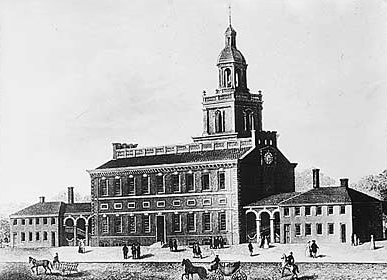
Pennsylvania State House, early home of the United States Congress

The mutiny underscored the weakness of the Articles of Confederation, particularly the lack of a control Congress had over its on own capital. Also, without a standing national army to maintain order, Congress relied on the state militias. Which proved to fail them in 1783.

Selecting the location for the new nation’s capital became a contentious issue. Different regions of the country had competing interests. Northern states, particularly those with economic centers like Philadelphia and New York, wanted the capital in their territory, while Southern states, particularly Virginia and Maryland, wanted it further south.

The final compromise, known as the Residence Act of 1790, resulted from negotiations between Alexander Hamilton and Thomas Jefferson, brokered by President George Washington. As part of the deal, the federal government assumed the war debts of the states, and in exchange, the capital would be located along the Potomac River, on land donated by Virginia and Maryland (near George Washington’s own Mount Vernon).

Washington, D.C., was officially established in 1791, and Congress first convened there in 1800. The land included portions of Maryland and Virginia, although the Virginia section (Arlington and Alexandria) was retroceded to the state in 1846.
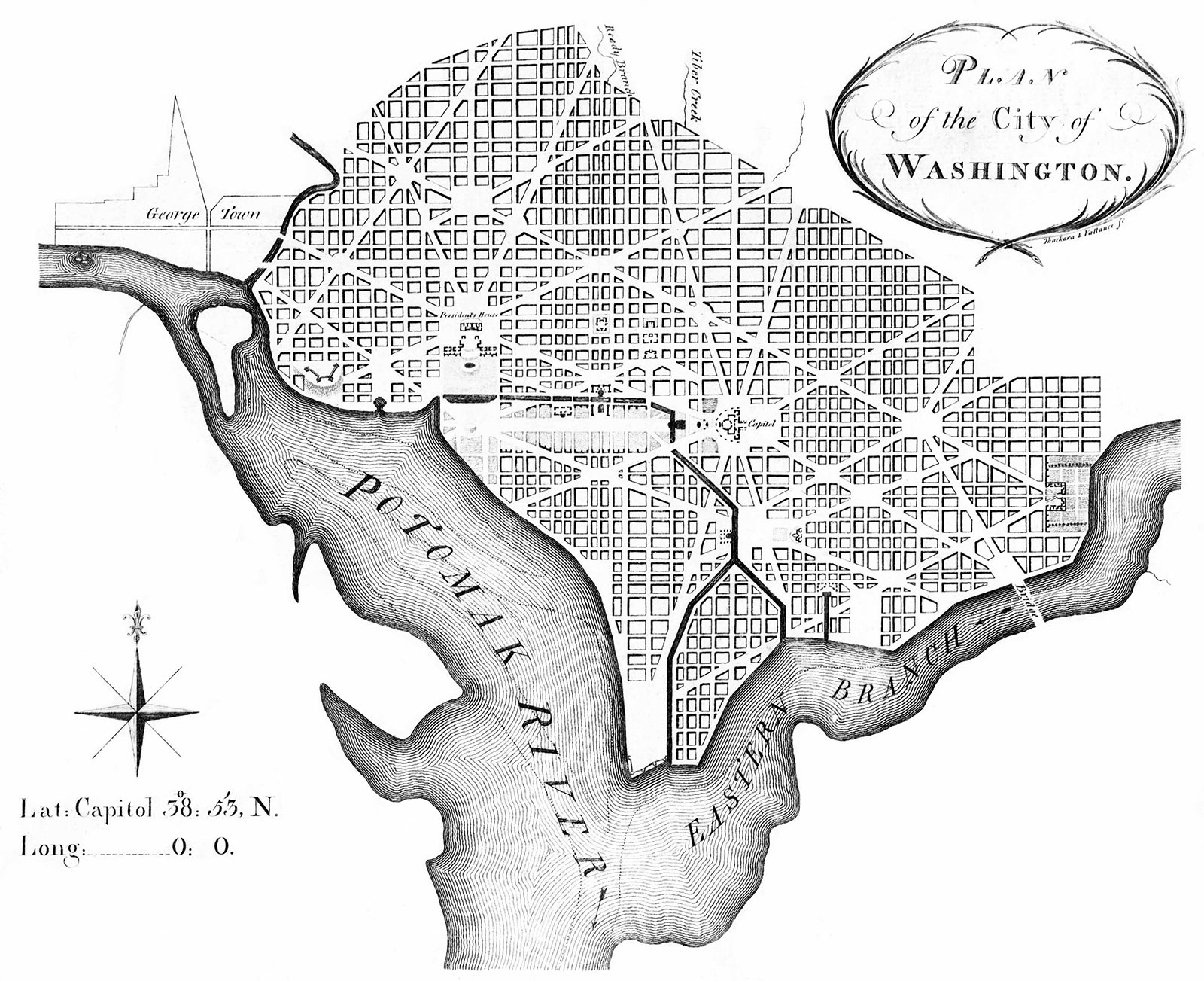
1792 plan of the City of Washington, in the District of Columbia by Pierre Charles L’Enfant

One of the primary reasons for creating Washington, D.C. as a federal district was to ensure neutrality. If the capital were located within a state, that state might wield excessive influence over the Federal government. The founders sought to prevent any potential conflicts of interest and ensure no state could claim privileged status or exert undue pressure on national affairs.

As a federal district, Washington, D.C., is directly governed by Congress. Unlike states, which have their own constitutions and legislative powers, the district’s governance structure is determined entirely by federal law. Over the years, this has led to ongoing debates about the representation and rights of D.C. residents. Today the city has an elected Mayor and City Council that manages the city’s affairs, but this authority is granted solely at the will of Congress. The debate over home rule and representation goes on, but the founding of a Federal District is rooted in a historic lesson learned by the early Congress.

On Ending Slavery: George Washington to John Mercer

Sitting down to write on September 9, 1786 from Mount Vernon, George Washington addresses his letter to Virginian, veteran of the late revolution, and plantation owner John Francis Mercer. Mercer’s family had strong ties to Virginia and the Washington family, John’s father was Washington’s attorney for many years during the eighteenth-century. Even though John had married, moved, and settled in Maryland, the two continued to correspond, although this most recent response by Washington took much longer usual. When Mercer’s letter arrived to Mount Vernon several weeks earlier, Washington was able to do little as he was fighting a “fever.” Now, he sat down to reply, and although there were many topics on his mind in which he wished to discuss with Mercer, Washington’s feelings toward slavery were first on his mind.

Read more: On Ending Slavery: George Washington to John Mercer

At the time Washington composed his thoughts to Mercer, particularly on his plan to never purchase another slave, Washington owned approximately 277 slaves. Yet, he expressed his desire to slavery abolished through the gradual abolition of slavery. Washington was a man of principle, displayed time and again during the war, and his aversion to the institution only grew as Washington the man grew as well. And, his was not alone. Many founders of era, including many from the upper South, looked for gradual solutions to ending the institution, despite the modern historical narrative. In the end, Washington ensured the emancipation of his slaves following his wife’s death in his will.

Gov. John F. Mercer, circa 1803.

Mount Vernon 9th. Sep 1786

Dear Sir,

Your favor of the 20th. ulto. did not reach me till about the first inst. – It found me in a fever, from which I am now but sufficiently recovered to attend to business. – I mention this to shew that I had it not in my power to give an answer to your propositions sooner. –

With respect to the first. I never mean (unless some particular circumstances should compel me to it) to possess another slave by purchase; it being among my first wishes to see some plan adopted by, [inserted: The Legislature by] which slavery in this Country may be abolished by slow, sure, & imperceptable degrees. – With respect to the 2d., I never did, nor never intend to purchase a military certificate; – I see no difference it makes with you (if it is one of the funds allotted for the discharge of my claim) who the the purchaser is [2] is. – If the depreciation is 3 for 1 only, you will have it in your power whilst you are at the receipt of Custom – Richmond – where it is said the great regulator of this business (Greaves) resides, to convert them into specie at that rate. – If the difference is more, there would be no propriety, if I inclined to deal in them at all, in my taking them at that exchange.

I shall rely on your promise of Two hundred pounds in five Weeks from the date of your letter. – It will enable me to pay the work men which have been employed abt. this house all the Spring & Summer, (some of whom are here still). – But there are two debts which press hard upon me. One of which, if there is no other resource, I must sell land or negroes to discharge. – It is owing to Govr. Clinton of New York, who was so obliging as to borrow, & become my security for £2500 to answer some calls of mine. – This sum was to be returned in twelve [3] twelve months from the conclusion of the Peace. – For the remains of it [struck: this sum], about Eight hundred pounds york Cy. I am now paying an interest of Seven prCt.; but the high interest (tho’ more than any estate can bear) I should not regard, if my credit was not at stake to comply with the conditions of the loan. – The other debt tho’ I know the person to whom it is due wants it, and I am equally anxious to pay it, might be put of a while longer. – This sum is larger than the other

I am. Dr Sir

Yr. Most Obedt. Hble Sert

Go: Washington

(Letter courtesy the Gilder Lehrman Collection)

Signers in St. Michael’s Churchyard

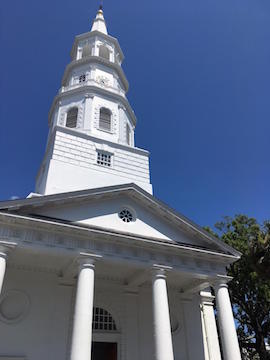
St. MichaelsWhile Charleston, South Carolina, absolutely overflows with history dating all the way back to colonial times, I had the chance to explore a particularly historic churchyard recently. St. Michael’s Episcopal Church sits on the corner of Meeting Street and Broad Street, and tucked into its small graveyard are not one but two signers of the U.S. Constitution: Charles Cotesworth Pinckney and John Rutledge.
“Their years of public service, 1762-1825, saw both State and Nation well on the road to greatness,” says a plaque on the wall outside the churchyard.  Continue reading “Signers in St. Michael’s Churchyard”

Summer Lecture on Summer of 1787

This past July I had the pleasure to attend and present at the American Battlefield Trust Teacher Institute. One of the keynote speakers was David O. Steward, the author of Summer of 1787: The Men Who Invented the Constitution. During his talk, there were a few points that stuck out to me and I share them with you.summer of 1787 stewart

  • 72 elected, 55 attended, and 35 delegates were probably there all summer.
  • Out of the 55 that attended, 39 affixed their signatures to the document

In reference to George Washington, Stewart candidly remarked he had “more influence by keeping his mouth shut” almost as if by his calm, quiet demeanor, he was displaying that “I trust in you and I’ll try and make it work” with whatever the delegates designed in that hot and stuffy room in Philadelphia.  Continue reading “Summer Lecture on Summer of 1787”