Remembering John and Abigail (part one)

RevWarWednesdays-header

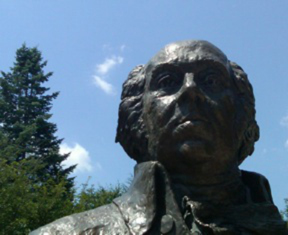
AdamsStatueFacePart one of two

When Abigail Adams died in late October, 1818, her husband, John, brokenhearted, said, “I wish I could lie down beside her and die, too.”

Today, the two are entombed side by side, along with their son John Quincy and his wife, Louisa Catherine, in a well-lit, whitewashed crypt beneath the United First Parish Church in Quincy, Mass. I’ve come here to pay my respects to the former presidents and first ladies, but mostly I’m here to say thanks to John, and to remember him because he worried he’d be forgotten. Continue reading “Remembering John and Abigail (part one)”

Henry Shrapnel – “The Modern Archimedes”

RevWarWednesdays-header


His last name jumps off the page, much like the term shrapnel usually does when leaving an artillery piece.

“Shrapnel” as defined by Merriam-Webster Dictionary is “a projectile that consists of a case provided with a powder charge and a large number of usually lead balls that is exploded in flight” or more simply “bomb, mine, or shell fragments.”

Either definition brings to mind images of death, destruction, maiming, and killing for any military historian.

Henry Shrapnel
Henry Shrapnel

Yet, why is it attributed to Henry Shrapnel?  Continue reading “Henry Shrapnel – “The Modern Archimedes””

Robert “King” Carter and the Father of our Country – Connecting the Dots of History

A lot of understanding history is understanding connections. Making relevant connections

Robert "King" Carter
Robert “King” Carter

and interpreting those connections to people. Recently I played a part in curating a new exhibit at the Manassas Museum. This exhibit “A Virginia Aristocracy: The Carters of Virginia” focuses on the Carter family in Virginia and their vast influence. Beginning with Robert “King” Carter, the Carters amassed great wealth and land in Virginia. The Carters were one of the leading families in colonial Virginia and their influence was felt all the way up to the Civil War.

As I was leading an exhibit talk last weekend, I started to make some of those connections that I love to share with the public. One that I knew about, but didn’t really contextualize until talking to a small group was how the Carters influenced the course of American history. In a way beyond their ancestry to future U.S. Presidents, but in a connection that “King” Carter never intended.

Continue reading “Robert “King” Carter and the Father of our Country – Connecting the Dots of History”

“Potentially Momentous”

RevWarWednesdays-header


Last week, Michael Harris wrote about the Battle of Brandywine and in his conclusion mentioned his excellent history on this important battle in the American Revolution.

While reading his work, I came across the account of Captain Patrick Ferguson.

Captain (Major) Patrick Ferguson

Harris describes it as one of the most “potentially momentous” non-incidents of the entire American Revolution.

I agree with him.

After reading the following, would you? Continue reading ““Potentially Momentous””

ERW Weekender: The Brandywine Battlefield: A History & Visiting the Field

RevWarWednesdays-header


Emerging Revolutionary War and Revolutionary War Wednesday is pleased to welcome guest historian and author Michael C. Harris this week. 

The Battle of Brandywine was fought on September 11, 1777.  Visiting the battlefield to commemorate what took place there began just three years later.  On his way to Virginia in 1780, the Marquis de Lafayette made a point of stopping for day at the battlefield where he was wounded and giving a tour to the officers that were travelling with him.  An older Lafayette returned in 1825 during his celebrated 15-month tour of America.

However, it would not be until after the American Civil War during the golden age of preservation that any kind of markers or monuments began to appear around the ten-square-mile landscape.  During the 1877 centennial, artillery pieces were placed to mark the fighting near Sandy Hollow.  Eighteen years later, a monument was dedicated along Birmingham Road supposedly marking the spot where Lafayette was wounded.  Had Lafayette been alive, he would have been able to put out the error in location.

Continue reading “ERW Weekender: The Brandywine Battlefield: A History & Visiting the Field”

Jefferson: Self-governance and “the field of knowledge”

RevWarWednesdays-header

tjmonticellostatueThe final part in a four-part series

“The field of knowledge,” said Thomas Jefferson, “is the common prosperity of all mankind.”

Jefferson’s words are inscribed in big bold letters in the entryway of Monticello’s visitor center. They’re written in architectural perpetuity in Jefferson’s “academical village,” the University of Virginia. They’re enshrined in the very concept of democracy.

“Whenever the people are well-informed, they can be trusted with their own government,” Jefferson said. Knowledge enables self-determination. Continue reading “Jefferson: Self-governance and “the field of knowledge””

Mercer’s Grenadier Militia

RevWarWednesdays-headerThis is part two in the series by guest historian Drew Gruber. For part one, click here.

On the morning of October 3, 1781, British Colonels Tarleton and Thomas Dundas led another expedition north towards Gloucester Courthouse and away from the protection of their fortifications at Gloucester Point. Their command that day included some of the most renowned fighting men then in service. Cavalry and mounted infantry from Tarleton’s own British Legion, combined with a detachment of Colonel Simcoe’s Queen’s Rangers, elements of the 17th Dragoons, men from the 23rd Regiment (Royal Welch Fusiliers), German Jaegers and part of the 80th Regiment of Foot provided an impressive host for their American and French adversaries. Captain Johann Ewald, commander of the Jaegers commented after the war that he was sent out with “one hundred horse of Simcoe’s and the remainder of the jagers and rangers, which amounted to only sixty man in order to take a position between Seawell’s planatation and Seawall’s Ordinary. I was to form a chain there to protect a foraging of Indian corn.”[1]

Continue reading “Mercer’s Grenadier Militia”

Mercer’s Grenadier Militia

RevWarWednesdays-header


Emerging Revolutionary War and Revolutionary War Wednesday is pleased to welcome back guest historian Drew Gruber.

Part 1

When we think about American militia during the Revolutionary War, the image of an untrained rifle-toting citizen turned soldier comes to mind. This stereotype of the American soldier, popularized by movies like The Patriot is not completely false but such generalizations should give us pause and inspire us to investigate the roll of American militia, independent companies, and ‘irregular’ troops a bit closer. For example, how was it that on October 3, 1781 a group of Virginia militiamen defeated an elite British force? The story of Lieutenant Colonel John Mercer’s Grenadier Militia during the battle at Seawell’s Ordinary has been told and retold since 1781, however the formation of this illustrious group is often ignored and deserves a closer look. Continue reading “Mercer’s Grenadier Militia”

“They Fought Because They Would Not Be Slaves”

RevWarWednesdays-headerRevolutionary War Wednesday and Emerging Revolutionary War is pleased to welcome guest historian Mark Maloy this week. 

African-Americans fought for the Americans during the Revolutionary War, right?  Many of us remember learning about Crispus Attucks dying during the Boston Massacre or have heard the oft-repeated saying that the Continental Army was the last integrated American army until the Korean War.

In this lithograph published in 1855, Crispus Attucks is portrayed front and center.  Crispus Attucks was lauded as the first martyr in the War for Independence much from the insistence of abolitionists like William C. Nell.  A Crispus Attucks Day was created in Boston in 1858 and a memorial placed for him and the other victims on Boston Common after the Civil War.  Despite all this, according to John Adams (who defended the British soldiers in court), Attucks was a rabble-rouser who actually helped precipitate the massacre.
In this lithograph published in 1855, Crispus Attucks is portrayed front and center. Crispus Attucks was lauded as the first martyr in the War for Independence much from the insistence of abolitionists like William C. Nell. A Crispus Attucks Day was created in Boston in 1858 and a memorial placed for him and the other victims on Boston Common after the Civil War. Despite all this, according to John Adams (who defended the British soldiers in court), Attucks was a rabble-rouser who actually helped precipitate the massacre.

Continue reading ““They Fought Because They Would Not Be Slaves””

ERW Weekender – Yorktown

RevWarWednesdays-header


Rev War Wednesday and Emerging Revolutionary War is pleased to welcome guest historian Kate Gruber. 

Let me guess– you are a Rev War Nerd who is the best friend of/dating/married to a Civil War Nut.

I recognize the symptoms. You have often thought that the third person in your relationship might just be Shelby Foote.  Hardtack is just not something you can get voluntarily excited about. The idea of blue and grey is not nearly as appealing as red and blue. You have been dragged to Gettysburg when you really wanted to check out Valley Forge.

Friends, you are not alone. I myself am a Nerd married to a Nut, and I am here to tell you that your problems might just be solved by spending some quality time in historic Yorktown, Virginia. Continue reading “ERW Weekender – Yorktown”