Looking Back to Cowpens: William J. Hardee and the Battle of Averasboro

Lieutenant General William J. Hardee.

After abandoning Fayetteville, North Carolina to Maj. Gen. William T. Sherman’s army group, Lieutenant General William J. Hardee withdrew his corps north of the city. Hardee had ordered the Clarendon Bridge over the Cape Fear River destroyed, removing the possibility of a vigorous pursuit by the Federals. The situation for the Confederates, however, remained dire. Hardee’s immediate superior, Gen. Joseph Johnston, was in the process of assembling a makeshift army to delay Sherman’s advance. By the middle of March, the forces that Johnston hoped to consolidate were still scattered throughout the state. More time would be needed for the Confederates to rendezvous. Since Hardee’s corps was naturally positioned to contest the enemy as they left Fayetteville, it would fall to him to engage Sherman once he resumed his march. The veteran officer would prove to be more than equal to the task.

Continue reading “Looking Back to Cowpens: William J. Hardee and the Battle of Averasboro”

“Remember the Ladies”

RevWarWednesdays-header


March is Women’s History Month, a time to reflect on the many contributions women have contributed in our country. At George Washington Birthplace National Monument, our social media policy for the month has been to highlight important women to the history of the National Park Service and/or to George Washington’s life.

By writing the history text and developing what images to use for these posts, I thought I would take this example and expand it to include two other women that played integral parts in the American Revolutionary movement.

Abigail Adams and Mercy Otis Warren. Continue reading ““Remember the Ladies””

Lexington Part II – “Our troops advanced towards them, without any intention of injuring them.” Who Fired First at Lexington?

RevWarWednesdays-header


Battle of Lexington, Engraved 1874

The above words were written by Lt. Col. Francis Smith in his official report to General Thomas Gage. Smith, in command of the British expedition to Concord recently returned from what would be the opening salvo of rebellion. Smith wanted to be clear that he never intended to start bloodshed. In the days afterwards, the Massachusetts militia made it clear that they intended to lay the blame at the “regulars.” As soon as the British returned to Boston, the war of words began on who fired the first shot to begin a worldwide war. The British column that was led by Smith was sent from Boston to capture supplies reportedly stored at nearby Concord.  To get to Concord, the British would have to march through Lexington.  Due to a complex warning system, the local militia in Lexington were mustered and called to arms.  Captain John  Parker and his minutemen were lined up on the Lexington green in two rows, facing the road to Cambridge and the Lexington meetinghouse. The road south of the green headed to Concord, and Parker had his mean assembled on the northern portion of the green, away from the Concord road.

Continue reading “Lexington Part II – “Our troops advanced towards them, without any intention of injuring them.” Who Fired First at Lexington?”

George Washington Remembers

RevWarWednesdays-header

Today, we are pleased to welcome guest author Bert Dunkerly.

WashingtonGeneral George Washington looks back at us from marble statues or stiff paintings with a grim-faced and determined look. Known for his dignity, resolve, and sound leadership, he seems cold and reserved. Yet he was also quite sentimental. In the midst of a campaign, with a massive British invasion force set to descend on him at New York City in July, 1776, Washington paused to pen these words: “I did not let the Anniversary of the 3rd or 9th of this Inst pas[s] of[f] without a grateful remembrance of the escape we had at the Meadows and on the Banks of the Monogahela. [T]he same Providence that protected us upon those occasions will, I hope, continue his Mercies, and make us happy instruments in restoring Peace & liberty to this once favour’d, but now distressed Country”.

Continue reading “George Washington Remembers”

Revolutionary Memory

RevWarWednesdays-header

Today, we are pleased to welcome guest authors Drew and Kate Gruber.

Fort Moultrie, Charleston Harbor by A. Vizitelly c.1861. Courtesy of the Library of Congress.

“There appears to be a romantic desire urging the South Carolinians to have possession of this work, which was so nobly defended by their ancestors in 1776…” wrote Major Robert Anderson from Fort Moultrie on November 28, 1860, less than five months before the first shots of the American Civil War. Many historians of American history have looked upon the Civil War as a continuation of the American Revolution. Looking back today, the similarities are not hard to see. According to historian Peter S. Carmichael, confederates “proclaimed their nation to be the keeper of America’s revolutionary heritage.”[1] Similarly, James McPherson notes that “Union volunteers invoked the legacy of the Founding Fathers…if disunion destroyed this nation, the generation of 1861 would prove unworthy of the heritage of republican liberty.”[2] This idea was not lost on Civil War soldiers, and their own connection to the ideals of the American Revolution grew even stronger when their marches and battles brought them close to, and even directly on, the landscapes and landmarks sacred to the memory of the American Revolution—soldiers were quick to identify the cause of the Revolution as their own. As soldiers converged on Mount Vernon, Williamsburg, and Yorktown, the connections they made to the revolutionary past of these locations strengthened their own resolve.

Continue reading “Revolutionary Memory”

Committees of Correspondence = 18th Century Social Media?

RevWarWednesdays-header

Information. Communication. Solidarity. Linkage. Friendship. Point-of-view. Identity. Current Events.

These words describe reasons in the 20th century why people joined and continue to join social media platforms, especially Facebook.

Approximately 240 years before Facebook was launched in February 2004, the first major attempt at achieving all the proponents above was the job function of the various Committees of Correspondence established in the thirteen American Colonies. Continue reading “Committees of Correspondence = 18th Century Social Media?”

Announcing Revolutionary War Wednesdays!

RevWarWednesdays-header

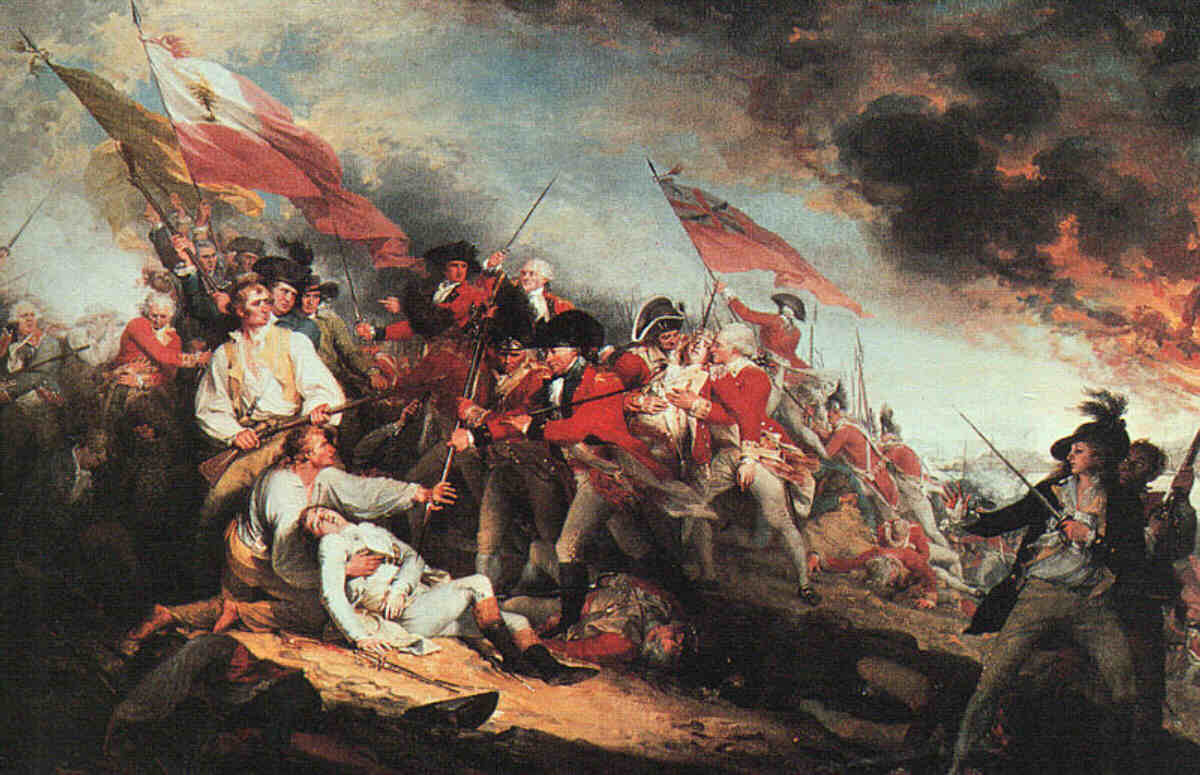
The Battle of Breed's Hill
The Battle of Breed’s Hill


History can resemble the peeling of an onion. There are multiple layers, each one resting on top of each other and, when peeled back, can provoke an emotion—anger, happiness, empathy, or a score of others. Like an onion, that can often provoke tears.
ECW’s Phillip Greenwalt offers an example. “On a recent trip to Gettysburg, Pennsylvania—a place steeped in American Civil War history—I stumbled upon some early 20th century history in a place I would have never expected,” he says. “A short distance down the Emmitsburg Pike from the spot where Major General George Pickett’s Confederate division charged across on its way to Cemetery Ridge, I stood reading about Camp Colt, a military installation used for tank training prior to deployment of tank corps soldiers in World War I.”

And, of course, President Dwight D. Eisenhower’s post-presidential farm sits just a mile or so to the southwest of that same spot.

Just as there are multiple layers of history at Gettysburg, Emerging Civil War is about to embark on another onion-peeling adventure. After much thought and discussion, we are excited to announce the launch of “Revolutionary War Wednesdays.”

Continue reading “Announcing Revolutionary War Wednesdays!”