Where An Army Was Born

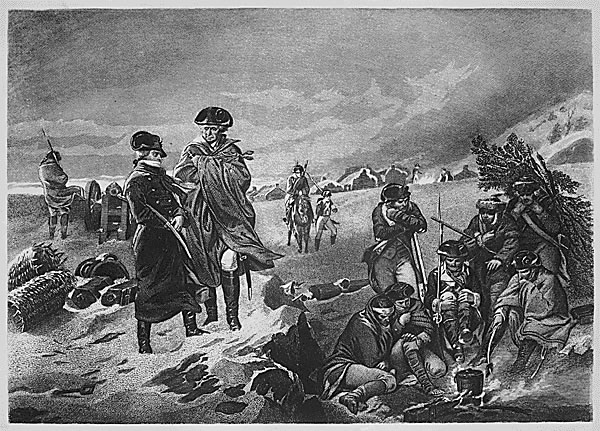
When most Americans think of Valley Forge the image of a cold, harsh and bleak winter landscape tends to spring to mind.  They remember from their history books that this was the place where Gen. George Washington’s rag-tag Continental Army suffered greatly from the harsh elements.  While Pennsylvania winters are rarely mild, the winter of 1777-1778 was not as harsh as what the army would later endure at Morristown, NJ.  What truly plagued Washington’s army that winter at the Forge was a want of supplies:  food, medicine, blankets, shoes, clothing, etc…  If there was ever a time in the life of this army when the boys could have called it quits, when they could have disbanded and just gone home…..then Valley Forge would have been the place for it.

National Memorial Arch

I took my family to visit Valley Forge National Historical Park near the Schuylkill River, west of Philadelphia not long ago.  Out of season, of course.  It was a warm day in July when the five of us meandered through the little visitor’s center and museum and then drove along the park roads trying to take in everything this immense site had to offer.  Entertaining three teenagers packed in a minivan isn’t always the easiest thing to do on a history tour but they seemed impressed with the National Memorial Arch, standing majestically alone on its green hilltop.

My attention, not surprisingly, was drawn to the restored cabins where the soldiers spent their winter days and nights and by the beautiful stone Potts House in which Washington lived and, along with his military “family”, used as headquarters.  But this trip would prove to be an eye-opener for me.

Restored Cabins
Restored Cabins

As we cruised along the park roads, through beautiful rolling hills, we came upon what is called The Grand Parade.  It’s a large, grassy, open field bordered by trees that stands nearly in the center of the park.  At first glance it appears no different than any other large, grassy, open field bordered by trees, but there is something extra special about this one.  For this was the scene where, some 238 years ago, Washington’s regiments and battalions marched and drilled during that long winter.

Baron Von Steuben
Baron Von Steuben

Standing on one side of the field is a statue; the man who’s responsibility it would become to train these men in the European military fashion.  Friedrich Wilhelm August Heinrich Ferdinand Steuben, known as Baron von Steuben, came to America on the recommendation of none other than Benjamin Franklin.  He was a veteran of the Prussian Army, he said; had attained the rank of Lieutenant General and served directly under the military genius Frederick the Great.  At Valley Forge that winter, he would serve as a volunteer and would be appointed temporary Inspector General.  As the historical record would later show, Steuben did serve as aide-de-camp to Frederick the Great but never attained a rank higher than that of captain.  While his claim to rank and privilege was questionable at best and downright false at worst, Baron van Steuben would nonetheless prove invaluable to the United States.  As an officer of the Prussian Army, he had the knowledge and skill necessary for training men in the art of war.  He was the right man, for the right job, at just the right time.

The Baron spoke not a word of English; his orders had to be translated, but the manual of training he would compose was such that it turned a hungry, tattered, exhausted mass of farm boys and mechanics into a well-disciplined fighting force.  He would mold them into an army.

Potts House
Potts House

Unlike his British counterparts, George Washington  was never to have a fully veteran army.   Indeed, there were some men who served for the duration of the war but, by and large, enlistments expired and men returned to their homes, farms and families.  But because of the training provided by this somewhat eccentric European who spoke and swore in German, the soldiers of the Army of the United States would go on to match the best in the world.  On the field at Monmouth Courthouse in 1780, these men would prove their mettle.  While the initial attack stalled, due mainly to poor leadership, the defensive position they would establish, under the watchful eye of their Commander-In-Chief, would prove the worth of their training.  These lads stood off the best army in the world.  And it all came together right here, on The Grand Parade at Valley Forge.

The Grand Parade
The Grand Parade

As I stood beside that statue on a warm day in July and gazed out on this wide open space, in my mind’s eye I could see those boys drilling; first by squad, then by company, then by regiment.  I could see it all unfolding before me on this unassuming field.  It looks like any other field you may pass on a drive in the country, but this field is where the war would change for the United States.  This field, by God, was the birthplace of the American Army.

ERW Weekender – In the Footsteps of Young George Washington

General Edward Braddock's grave, near Fort Necessity
General Edward Braddock’s grave, near Fort Necessity

Recently myself and two other Emerging Rev War authors took a trek to the mountains of western Virginia, Maryland and Pennsylvania to follow in the footsteps of George Washington in 1754-1758.  Washington played a significant role in the beginning of the French and Indian War.  These were the developmental years for Washington, here he learned lessons of leadership, military command and gained the experience that earned him the future Commander in Chief of the Continental Army in 1775.


Rebuilt cabin from Fort Cumberland

One of the best ways to follow in the footsteps of Washington during this time period is to   start in Cumberland, MD.  Here, Fort Cumberland served as the stepping off point for many expeditions to the frontier.  Today, the fort is gone but the location is well marked and interpreted.  The City of Cumberland has established a walking trail and outlined the boundaries of the fort.  Also, a restored cabin interprets Washington’s time at Fort Cumberland.  From here, one can easily follow the famous “Braddock Road” by taking Rt. 40 west (the National Road).

Washington's "fort" at Fort Necessity National Battlefield
Washington’s “fort” at Fort Necessity National Battlefield

A must see site along Braddock’s Road is Fort Necessity National Battlefield Park.  Here the young and inexperienced George Washington found himself in July 1754 surrounded by French and their Native American allies.  As one gazes across the ‘Great Meadows” and see the small fort Washington built, one has to ask themselves “what was HE thinking?!”  The newly built visitor center and museum is excellent and worth the small fee.  The park preserves the site of the July 1754 battle, portions of the original Braddock Road and the early 19th century Mount Washington Tavern (that was built along the old National Road).  Nearby is Braddock’s Grave (buried after the disaster near Fort Pitt where he was mortally wounded).  Further north is Jumonville Glen.  Of all the places I have been, this place represents the most pristine historic spot.  Here in June 1754, Washington started the French and Indian War.  When one views the spot today, it is easy to take yourself back to 1754 and there is a real sense of history here.  Here Washington led his first command, here Washington set the stage that would lead him to command the Continental Army in 1775.


The Church Brew Works

The Fort Pitt Museum, now managed by the Heinz History Center, provides a great timeline and history of the “forks of the Ohio” and also includes a rotating exhibit space.  Since we had followed the route of Braddock all the way from Cumberland, Maryland we decided to visit North Braddock, PA.  Here is where the French and Indians virtually destroyed the British force sent to capture Fort Duquesne under General Edward Braddock (Washington served as one of his aides).  The battlefield is gone today to major development in the early 20th centuries with local steel mills.  Unfortunately for the town, the collapse of the steel industry has left this once thriving town very much depressed.  But, one new bright spot is the Braddock’s Battlefield History Center.   Finally the story of Braddock and the battle along the Monongahela is being told.  The museum is worth a visit and the building is a testament to the efforts of an all volunteer organization led by Robert T. Messner.  While in Pittsburgh, a great place for a bite to eat or drink, a visit to Church Brew Works.  This local brew pub/restaurant is located in a former 1902 Roman Catholic Church.  The food and beer are excellent.

Fort Pitt blockhouse, only remaining structure from Fort Pitt
Outline of the French Fort Duquesne, with the Forks of the Ohio in the distance


The Braddock's Battlefield Visitor Center
The Braddock’s Battlefield Visitor Center
This Washington Statue is near where the British were attacked
This statue of Washington is near where the British were attacked by the French near Fort Pitt


The Bushy Run Battlefield is a hidden gem near the historic “Forbes Road” (modern day Rt. 30).  This much over looked battle of “Pontiac’s War” between the British and Native American warriors is well preserved and interpreted through great museum exhibits.

Bushy Run Battlefield
Bushy Run Battlefield, where the British made their “Flour Bag Fort”
New monument at Bushy Run Battlefield


Finally, the highlight of the trip was Fort Ligonier.  I have read about the fort and the historic site, but was pleasantly surprised by what I consider THE best museum on the French and Indian War.  The museum attached to the reconstructed fort has a full exhibit on the history of Fort Ligonier and also a large exhibit on the entire French and Indian War.   Artifacts range from Prussian firearms to Indian chain mail armor (yes, from Delhi, India!).  All nations that fought in this “first” world war are represented.  It is an exhibit that one would not expect at a small historic site.  The reconstructed fort itself is an excellent representation of 18th century fortifications.  The fort is fully interpreted, with all the buildings recreated on their original locations.  If you are within 100 miles of Ligonier, PA…this is a MUST see museum/historic site.

Fort Ligonier
Fort Ligonier
Fort Ligonier
Fort Ligonier


For more information to take your own “French and Indian War Trek”, see the websites below.

Braddock Road: braddockroadpa.org

Fort Necessity/Jumonville Glen:  http://www.nps.gov/fone

Fort Pitt Museum:  http://www.heinzhistorycenter.org/fort-pitt

Braddock’s Battlefield Visitor Center: http://www.braddocksbattlefield.com

The Church Brew Works: www.churchbrew.com

Bushy Run Battlefield:  http://www.bushyrunbattlefield.com

Fort Ligonier:  http://www.fortligonier.org


Greatest Leaders of the American Revolution You Have Never Heard Of

Part One 

When I was completing my graduate degree in American history from George Mason University a few years back, I took on the challenge of trying to examine the motivations of American soldiers during the American Revolutionary War.

The basis was to examine, “why they fought” if I can borrow a line used frequently by Civil War scholars and historians.

Being a native Marylander, I narrowed my focus on soldiers from that colony/state.

Yet, I was struck by the continued emergence of one name in particular and this gentleman became a focal point of mine.

This gentleman became through the war and could not be ignored with any mention of Maryland and her patriotic citizenry’s service in the war. His name is Otho Holland Williams.

Otho Holland Williams

First a little background on Otho Holland Williams. Otho Williams’ early life mirrors that of many early American colonists. His parents, Joseph and Prudence Holland Williams were born and married in Wales before emigrating to the colonies and settling in Prince George’s County, Maryland.

Otho was born on March 1, 1749, one of eight children. The following year the family moved to western Maryland, settling near the mouth of Conococheauge Creek in Frederick County. Life on the frontiers of the British North American colonies could be rough and hard and before Otho reached adulthood, he lost his father. However, he showed enough promise and potential to be entrusted by a brother-in-law to a clerk position in Frederick County. Showing his ability to grasp a new skill, the young Williams rose to be given “final charge” of the clerk’s office before moving on to a clerk position in the larger town of Baltimore at age eighteen in 1757.

In Baltimore, Williams continued to enhance his reputation and business prospects. After seventeen years in the spiraling, busy port town situated on the Chesapeake Bay, Williams moved back to more familiar grounds in Frederick in 1774. With the move, he entered into the merchant trade, overseeing commercial enterprises in the growing town. Williams was building a respectable life and he would have been considered a gentleman.

However, nothing truly remarkable had happened to cause this ordinary British colonist in Maryland to be remembered by history. Events transpiring on both sides of the Atlantic Ocean soon reared an opportunity for Williams to change that.

Otho Holland Williams now 26 years of age, at the direction of the Committee of Observation of Frederick County, Md, on the 21st of June, 1775, would have heard of a letter from the Delegates of Maryland asking for the formation of two companies of “expert Riflemen to be raised” to join the army near Boston.

The gist of that correspondence is below:

“A letter from the Delegates of Maryland, and a resolve of the Congress enclosed therein, were read, requiring two companies of expert Riflemen to be furnished by this County, to join the army near Boston, to be there employed as Light-Infantry, under the command of the Chief officer of that Army

In the second company, Williams was elected one of three lieutenants and within the month was marching north to join the army, arriving in Cambridge in 22 days, marching over 550 miles, which needless to say gave a great first impression on the military officers and one that the future Commander-in-Chief George Washington would realize in New York.

George Washington was using this house as his headquarters when Williams and the Maryland riflemen arrived after a 550 mile trek to report for duty (courtesy of Mt. Vernon)
George Washington was using this house as his headquarters when Williams and the Maryland riflemen arrived after a 550 mile trek to report for duty
(courtesy of Mt. Vernon)

In January 1776, Capt. Price, of the rifle company, was promoted to major in Col. William Smallwood’s Maryland Regiment. The gentleman who replaced Price was Williams who succeeded him as captain. Williams’ star continued to rise and in June 1776 was appointed major in Colonel Hugh Stephenson’s newly organized rifle regiment. He was still a major in November when he saw action in New York.

While other Marylanders serving valiantly but unsuccessfully in the opening engagements of the battles around New York City, further the Hudson River stood Fort Washington and stationed there was the rifle company that Otho Williams was a member of.

Upriver from New York City the Americans had constructed two forts on either side of the Hudson River. On the island of Manhattan stood Fort Washington, named in honor of the commander-in-chief of the Continental Army. On the other bluff, stood Fort Lee named in honor of Charles Lee, a major general in the American army that had overseen the defense of New York City prior to the Continental Army’s arrival. Nathanael Greene, the very capable American general convinced General Washington that his namesake fort could be held and although of a different opinion initially, Washington relented to his subordinate. The decision would have dire consequences for Williams and the men in the rifle regiment.

Before discussing the role of Williams and his gallant band of riflemen in the defense of Fort Washington, one fact that cannot be looked over is the rapid rise that Williams had undertaken. The mere fact that a young boy, with no prior military experience, could rise to the rank of major was truly exceptional.

To rise to that similar rank in the British army would depend more on family prestige and the ability to pay the price for the commission. That this was not the case in the American army was a sign of the difference in ideals and make-up of the military. The American colonies were revolting against the aristocratic regime of Great Britain, so to imitate their promotion mechanisms would seem out of place with the republican ideals espoused by the aspiring new republic. Furthermore, the ability to navigate the command structure with the added benefit of superior’s being promoted or more morbid, die, allowed Williams to rise.

However, the previous mentioned attribute only tell a portion of the career so far of Williams. His commitment and perseverance to the cause had been duly noted and he would soon show the coolness and battlefield leadership that would cement his rise through the officer ranks.

Battle of Fort Washington, 1776

Williams commanded men of the rifle company occupied a portion of the outlying trenches that surrounded the fort because of a very grave insight the defenses in the environs of Fort Washington could not accommodate the number of American defenders. In their exposed position, the men from Maryland and Virginia would come into contact with their British and Hessian counterparts in the opening stages of the conflict on November 16, 1776. The action commenced in the morning and would be an all-day, drawn out conflict, the epitome of a “fight to the death” type battle. Part of the reason the affair turned out to be so relentless and bloody was the fact that the Americans had refused to surrender the fort initially and the ensuing action could quite possibly result in the British and their allies showing no quarter if the Americans suffered defeat.

History does not depict whether the men with Williams and under the command of Colonel Rawlings knew this fact, but what they did know was that they had been given an assignment to defend the fort and the men from Virginia and Maryland were prepared to do just that.

Map of Battle of Fort Washington (courtesy of Wiki)
Map of Battle of Fort Washington
(courtesy of Wiki)

Unfortunately, after facing overwhelming odds and the collapse of other sections of the American lines, Williams and his men were forced to fall back from their exposed positions. During the action Colonel Rawlings received a severe wound to the leg, resulting in a fracture of the bone. Serving as second in command, Williams assumed command of the rifle regiment, continuing to show his unwillingness to yield the field even after suffering a severe groin wound.

With the wound and the collapse of the American lines, he did not command for long. The survivors of the regiment, along with the rest of the fort’s garrison, surrendered to the British and German forces.

After the conflict, a Hessian survivor remarked about attacking the Maryland riflemen, in which Williams was most likely in command of; that “he had a hard time of it.” Another enemy soldier noted the inordinate number of wounded. Official casualty reports, listed 2,780 Americans, including Williams, as prisoners of war, and another 149 were killed and wounded. The British lost 458 killed, wounded, and missing during the day long fight.

Williams was a prisoner of war.

The Last and Crowning Battle

Yorktown Day Patriotic Exercises in front of the Victory Monument in Yorktown, Virginia, Colonial National Historic Park Photo.
Yorktown Day Patriotic Exercises in front of the Victory Monument in Yorktown, Virginia.   Photo: Colonial National Historic Park

Today marks the ultimate “this day in history.” It’s Yorktown Day!

On October 19, 1781, General Cornwallis surrendered his army to General Washington at Yorktown, Virginia, after a long and debilitating siege. The very first Yorktown Day, however, actually saw Cornwallis absent from the event. On the morning of the 19th Cornwallis signed capitulation documents and sent them back to Washington. That afternoon, when the official surrender ceremony was to take place, Cornwallis failed to show. On the very first Yorktown Day, British General Charles O’Hara surrendered his sword to General Benjamin Lincoln.

Nevertheless, it was with zeal and jubilation that the news of the British surrender reached Congress, who immediately agreed that the date and the site should be memorialized for posterity. Just ten days after the surrender, on October 29, 1781 Congress passed a resolution “that the United States, in Congress assembled, will cause to be erected at York, in Virginia, a marble column, adorned with the emblems of the alliance…and inscribed with a succinct narrative of the surrender of Earl Cornwallis to his excellency, General Washington, Commander-in-Chief of the combined forces of America and France…”[1]

Time passed however, and Congress failed to make good on their resolution to erect a formal monument at the site. When the Marquis de Lafayette visited the site of the siege on Yorktown Day 1824, it was not a grand marble column that greeted him, but a grouping of wooden obelisks marking locations of redoubts and the scene of the British surrender. Lafayette’s experience of Yorktown Day was a grand jubilee of remembrance, reflection, and pomp and circumstance, and the real monument to American liberty on display that day was Lafayette himself, along with the throng of veterans who turned out to greet him.[2]

As the first centennial celebration of Yorktown Day loomed in the hearts and minds of Americans, attention returned to Congress’s 100-year old promise of erecting a permanent memorial at Yorktown. The renewed cries came from Boston, another revolutionary city, when in 1875 the mayor supported a unanimous petition “asking that Congress (will) fulfill its pledge to erect at Yorktown, Virginia, a marble column commemorative of the last and crowning battle of the Revolution.”[3] In 1880 Congress again took up the mantle, and

Original architectural drawing showing the Yorktown Monument nearing completion, with scaffolding still in place. Richard Morris Hunt, 1884. Library of Congress.

accepted a design by architects R. M. Hunt and Henry Van Brunt and sculptor J.Q.A. Ward, who endeavored to remain true to the original century old stipulation that the monument be a column, and surrounded it in classical symbolism. The cornerstone for the monument was laid during Yorktown Day festivities in 1881—the centennial Yorktown Day commemoration.

Yorktown Day is as robust and ceremonial today as it was in 1781, 1824, and 1881. The day often includes wreath laying and commemorations, visits from dignitaries and special guests, and a throng of enthusiastic history buffs, veterans, and families from far and wide celebrating “the last and crowning battle” of the American Revolution.

How are you celebrating Yorktown Day?

Artillery firing at the Yorktown Victory Center, a museum of the American Revolution administered by the Jamestown-Yorktown Foundation. Jamestown-Yorktown Foundation photo.
Artillery firing at the Yorktown Victory Center, a museum of the American Revolution administered by the Jamestown-Yorktown Foundation. Photo: Jamestown-Yorktown Foundation

[1] As quoted in A Full History of the Monument Erected by the U.S. Government to Commemorate the Close of the Revolutionary War, At Yorktown, October 19th, 1781. Being a Narrative of its Inception, Construction, Completion, and Official Examination (Philadelphia, 1890), pg 15.

[2] For more on Lafayette’s visit to Yorktown in October 1824, see Thomas A. Chambers, Memories of War: Visiting Battlegrounds and Bonefields in the Early American Republic (Ithaca, 2012).

[3] Congressional Record: Containing the Proceedings and Debates of the Forty-Fourth Congress, First Session; Also Special Session of the Senate, Volume IV (Washington, D.C., 1876), pg. 401.