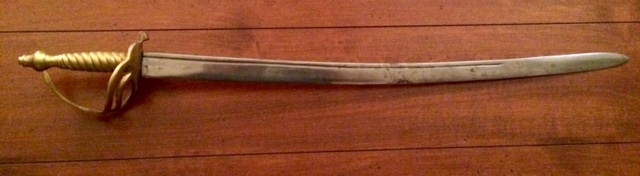
A good friend, knowing my interest in military history brought me a very unique artifact, which led me to discover more about where this piece of history originated from. Here is what I discovered.
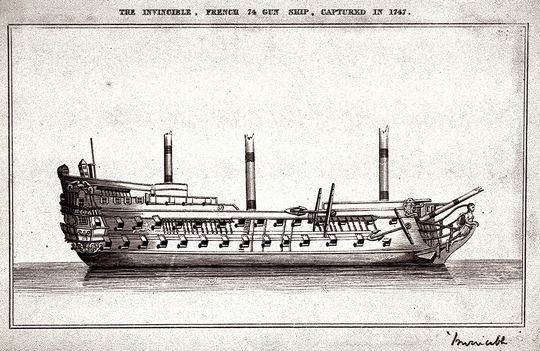
Launched in 1741 by the French as L’Invincible, this 74-gun French ship of line was captured by the British during the First Battle of Cape Finisterre on May 14, 1747.
The engagement during the War of the Austrian Sucession, was a five-hour engagement in the Atlantic Ocean, off the coast of northwest Spain. The British admiral, George Anson struck the 30-ship convoy of the French, which was under the command of Admiral de la Jonquiere and captured four ships of the line. One of those ships of the line was the L’Invincible.
The L’Invincible sacrificed itself to allow some of the convoy to escape and tried in vain to fend off six British warships.
A depiction of L’Invincible after being captured by the British in 1747
Given its more Anglicized name; HMS Invincible, the ship’s design was larger than the usual 74-gun vessels of the time. Her greater draft and lower center of gravity allowed her to carry much more sail. This allowed the ship to gain more speed.
Altogether her design helped revolutionize British warship making as she was the first 74-gun ship in the British Navy. By the time of the crucial Battle of Trafalgar in 1805, over three-fourths of the entire British Navy were line ships toting 74-guns.
In February 1758 while part of a large sailing of warships and transports, the HMS Invincible that left from St. Helens Roads near the Isle of Wight in England. The ship struck Horse Tail Sandbank and got stuck. Yet with the rising tide she was able to free herself.
Unfortunately, fate had it in for the ship, as the wind suddenly changed direction and increased in intensity and she dragged her anchor on the sandbank. A failed attempt to lighten her cargo and load of armament and putting her under full sail did not work either. She was marooned on the sandbar and began to take on water.
For the next three days, the majority of her cannons and stores were removed and on February 22, 1758 she rolled onto her side and was lost.
HMS Invincible laid wrecked, covered, and largely forgotten until the 20th century, when in May 1979 a local fisherman snagged his nets on the timbers. Local divers found more of the ship and has been investigated and parts recovered ever since.
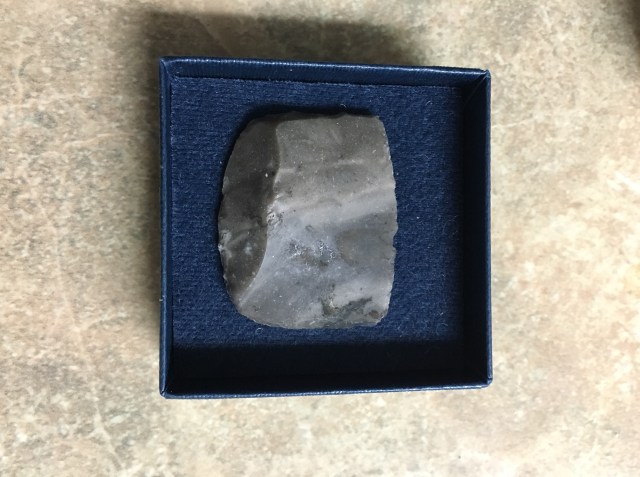
One of the interesting finds was the experimental flintlocks of the cannons of the HMS Invincible. Rather large, the nicely knapped flints were believed to be used in the canon locks. Canon locks and subsequent flints among the gunnery stores were considered a “unique find.”
A “Large Wedge Type Gun Flint” from the HMS Invincible (author collection)
Fore more information about the ship, the wreck, and the discovery, check out Brian Lavery’s The Royal Navy’s First Invincible. Link to the book via Amazon is here.
Numerous biographies grace the shelves of book stores, museum shops, and the personal libraries of American Revolutionary Era history enthusiasts. Yet, until 2015, not a single dedicated biography was written about an extraordinary American general that rose from the ranks during the war to assume such a lofty position by the successful conclusion of the conflict.
That unintentional omission has now been filled with the excellently detailed oriented and primary source driven biography entitled Otho Holland Williams in the American Revolution by John Beakes. The author is a graduate of the United States Naval Academy in Annapolis, Maryland and a resident of Ellicott City, Maryland.
I had a chance to interview the author via email and one of the questions I asked him was if there was one takeaway you wanted your readers or those interested in the book to know, what would it be? His answer is below and sums up the importance of Williams and soldiers like him:
“Otho Holland Williams was a vibrant, healthy young man with distinctive intellectual gifts and leadership capabilities when he joined the army at age 26 in 1775. Had there been no War of Independence, he might well have lived a long life enjoying the family relationships that he cherished so deeply, and have risen to a position of prominence and wealth.
Instead, Williams died at age 45, spitting up blood and much weakened in body and spirit from the tuberculosis that he had contacted while a prisoner-of-war in New York after the Battle of Fort Washington.
We owe much to the young men like Williams who gave so much in the fight for our nation’s independence, and yet he is largely forgotten.
Here, truly, was a life laid in sacrifice on the altar of our freedom.”
This biography is part of an ongoing effort by The Nautical and Aviation Publishing Company of America to publish a biography on the chief lieutenants that served under and with George Washington and were instrumental in winning American Independence. Previous volumes in the series include titles on John Eager Howard and Henry “Light-Horse” Lee. The series is entitled, “George Washington’s Best Officers Book Series” and definitely worth the read for the enthusiastic and/or serious student of the American Revolution.
So, why was Otho Holland Williams chosen as the third installment? I asked the author and his response is below;
“Otho Holland Williams kept appearing in all of the key moments of the story of the war in the South, but always tantalizingly just beneath the surface, hidden in the shadow of larger figures like Nathanael Greene and Daniel Morgan. Williams was a compelling writer, and his descriptions of battles like Camden and Eutaw Springs are superbly written and deeply insightful observations of a first-hand participant. His leadership of the Screening Force during the Race to the Dan displayed combat leadership skills of the first order, but his life story was largely untold.”
Furthermore, the reader will glean that Williams is the quintessential depiction of the American soldier, rising from the ranks to one of the top positions in the Southern theater by war’s end. The process, superbly told by Beakes, winds the reader from the early days of the revolutionary movement in western Maryland to the Siege of Boston, to the defeats of the New York Campaign. Those achievements and setbacks combined to give Williams the invaluable training as a military officer. For Williams, like a majority of the men who would hold rank in the American forces;
“Military knowledge and experience were scant commodities in the colonies at the start of the Revolutionary War, and young men like Howard, Lee and Williams joined the army in their twenties with virtually no prior military experience. There were no institutions such as military academies, officer candidate schools, or ROTC to help them learn. They read all the available military literature. They observed leaders like Washington, and took in the written guidance that he provided, often in General Orders, for how to develop into effective officers. And most importantly, they learned by experience in the daily rigor of military discipline and in their various combat engagements.
Starting with such “bare bones” learning opportunities, in the short years between 1775 and 1780, when the Southern Campaigns began, these young officers had become exceptional military leaders, and the army that they led was as fine a combat organization as any on earth. It is a story of grit and determination and persistence that brought these young civilians to such a high state of military capability.”
During this early part of the war, Williams also became a prisoner-of-war after the fall of Fort Washington during the New York Campaign of 1776. After being exchanged, Williams would feel the affects of his imprisonment which would eventually cause his death in 1794 from tuberculosis.
Yet Williams, like many other junior officers, are still worth studying in history, as Beakes claims, because,
“With the resources available today, we have a powerful opportunity to take a fresh look at these stories. Unfortunately, our fresh look at original sources sometimes reveals that writers along the way have perpetuated false information, sometimes from honest mistakes, but also sometimes from blatant political motives.
We have an important opportunity to correct the record. Stories like those of Otho Holland Williams give readers a look at the War of Independence from the front-lines and from ground level, a perspective that fills out and enriches the more strategic insights of the well-known works on the Founders.”
This book, like two previous volumes in the series, is definitely a worthy addition to any avid reader of the American Revolutionary Era. If these great in-depth biographies already grace your private library, don’t worry there is more biographies in the works. Beakes is currently working on research for a volume on Baron de Kalb.
Stay tuned and enjoy the read!
*Book Information*
Publisher: The Nautical and Aviation Publishing Company of America
Published Date: November 5, 2015
346 pages, including appendices, bibliography, notes, and index
Click here to view the website where further information, including how to purchase the book, is available.
Emerging Revolutionary War welcomes guest historian Robert “Bert” Dunkerly to the blog as the author of this post.
It is well known that German troops (commonly called Hessians) fought alongside the British during the war. One of the more intriguing questions of the Revolution remains; how did they communicate? At any given time, German units could comprise from one third to one half of the larger British armies. They were also present in equal numbers in smaller detachments.
French was a common language that many European officers would have known, and there is evidence that German and English officers communicated in French during campaigns. The language barrier also impacted daily army operations. For example, Georg Pausch of the Hesse-Hanau Artillery requested an English officer who spoke German for a court martial. Yet most of that procedure was conducted in French.
Written orders from General Phillips in Montreal in 1777 to Hessian Artillery units were given in French, suggesting that this was commonly done in these calm, routine situations.
It wasn’t a perfect system but it worked well enough. Adjutant General Major Bauermister of Hesse-Cassel, for example, notes that the English spoke poor French, when communicating with them. Yet what about among small units like companies or battalions?
Re-enactors portraying the Hesse Kassel Jaeger KorpsWould mediocre command of a language suffice for communication in combat situations? Often small groups of British and German troops operated together on patrols or raids. Marching to Freeman’s Farm (Saratoga) in 1777 was a column that included Germans on the left, English on the right, and English troops as flankers. Such situations required close coordination.
Other times they were side by side on battlefields, such as at the Battle of Guilford Courthouse in 1781, where the German Von Bose Regiment was aligned next to the British 71st Highland Regiment. Close coordination in these cases was essential.
Still another example is from Brandywine, where Captain Johann Ewald wrote that in the army’s advance, were 60 jaegers on foot, fifteen mounted jaegers, a company of Highlanders, and a company of British light infantry. All these troops worked in tandem to protect the army from ambush and clear the way for the advance. Yet Ewald was silent on how they did so.
Captain Ewald, also wrote of his experiences in Virginia, where, in the advance on Richmond, small numbers of troops were interspersed. They marched into the town in this order: Jaegers, British dragoons, more jaegers, and British Light Infantry. There are dozens of other examples.
Despite the many instances of German and British units mingling, there is precious little documentary evidence of how officers, or the common soldiers, communicated. Perhaps they used a combination of French, translators who spoke either English or German, and hand signals or other agreed- upon methods.
Timing and clarity are key in close quarters combat, there is no chance to second guess in an ambush or a raid. There were likely instances of misunderstanding that may have led to mistakes and even led to friendly fire incidents.
Of the many accounts this author has researched, only a few mention how they communicated. Perhaps it was something so mundane, or so well understood, that they saw no need to comment on it in their writings. It is hoped that further research will shed light on this question.
In May of 1768, six years before a column of their peers would march out for Concord, a British Army regiment embarked for North America to relieve the 15th Regiment on duty in Canada. These soldiers crossing the Atlantic would not see home again for the next seventeen years, many never would at all. In their nearly two decades abroad, these soldiers would participate in raids and expeditions ranging from the Mohawk Valley to present-day St. Louis; center-stage in the political and military game on the frontier of the American Revolution. These soldiers were the men of the 8th, or King’s, Regiment of Foot.
The 8th was one of the British Army’s most senior regiments, being formed in 1685 as the “Princess Anne of Denmark’s Regiment of Foot” during the Monmouth Rebellion. The regiment went on to serve illustriously during the first Jacobite Rising. Winning the favor of King George I, they earned his namesake and were granted “royal” status in 1716. The regiment saw combat in the War of Austrian Succession, and also played a crucial part in the 1746 Battle of Culloden in another Jacobite rebellion.
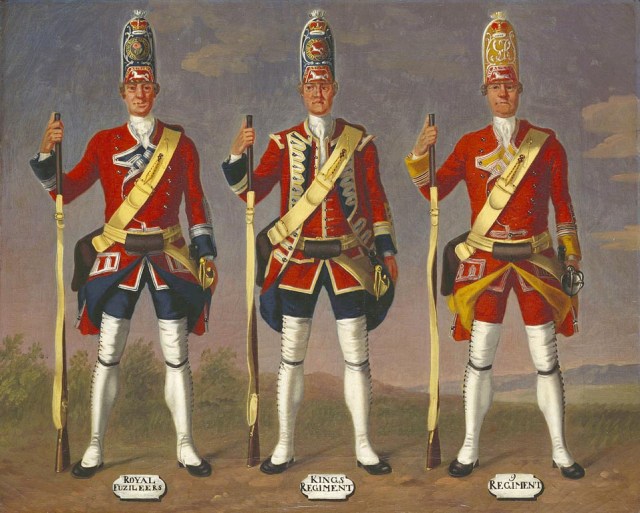
Grenadiers of the 7th, 8th, and 9th Regiments of Foot. Painted by David Morier, ca. 1751-1760
In 1751, the army numbered its regiments by seniority, thus the King’s also became known as the 8th. The newly-named 8th Regiment again saw action, this time during the Seven Years’ War. After enjoying a dignified service record for almost a century in Europe, the regiment was on its way to honor itself for the first time on another continent – North America.
The regiment arrived in the summer of 1768 in the St. Lawrence River, landing at the Isle of Orleans. The regiment then deployed to Quebec, Montreal, St. John’s, Fort Chambly, and the surrounding posts. After six years of duty in Canada, the regiment was reassigned. This time, the regiment was to relieve the 10th Regiment deployed to the “Upper Posts,” a string of fortifications and outposts from Oswego to Detroit that protected the interior of the continent.
The 10th, probably eager to leave the frontier and return to England, was rerouted to Boston where tensions were rising. Although nobody knew it yet, the 10th would soon take part in the march to Lexington and Concord on that fateful April morning. While the 10th sailed toward their destiny, the 8th settled into their new home in the wilderness.
The companies of the King’s were spread out much like the order of the “line of battle,” the traditional model for organizing companies on the European battlefield. However, instead of companies packed tightly together on one field, the companies were dispersed over some 400 miles. One of the regiment’s two flank companies, the light infantry company, garrisoned Oswegatchie on the banks of the St. Lawrence. The other flank company, the grenadier company, and one of the eight battalion companies garrisoned the westernmost post at Fort Michilimackinac where British civilization ended and the wilderness began. The remaining seven battalion companies garrisoned the major hubs of British trade on the Great Lakes, Fort Niagara (four) and Detroit (three).
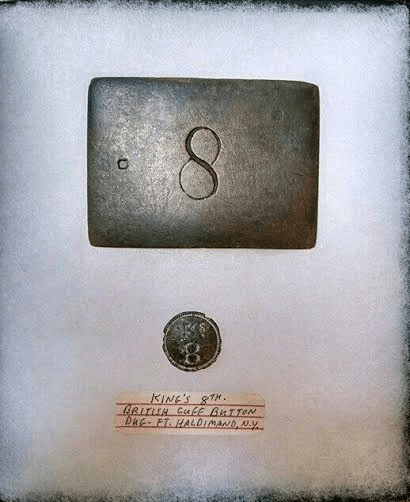
A belt plate and button of the 8th Regiment of Foot. Notice the “Ks” as an abbreviation for “King’s” on the button.
As the winter of 1774/75 slowly passed, the men of the King’s most likely made every attempt to escape the harsh winters on the Great Lakes by their fires, unknowing of the blaze that would come in the spring and engulf their world for the next eight years.
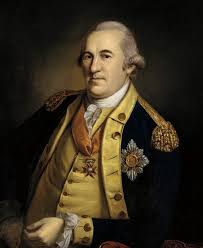
On February 23, 1778, Baron Friedrich Wilhelm von Steuben arrived at the Continental Army encampment at Valley Forge. He quickly ingratiated himself with George Washington and the commanding general’s cadre of staff officers. John Laurens would write a fortnight later;
Baron von Steuben
“The Baron Steuben has had the fortune to please uncommonly….All the genl officers who have seen him, are prepossessed in his favor, and conceive highly of his abilities… The General [Washington] seems to have a very good opinion of him, and thinks he might be usefully employed in the office of inspector general…”
Steuben would assume the “acting” inspector general position three days after John Laurens penned the above letter, on March 12, 1778. Five days later, Steuben’s plan to train the Continental Army was approved by Washington. The transformation could begin.
Who was this “acting” soon-to-be permanent inspector general of the Continental Army? Steuben was born on September 17, 1730 in the Duchy of Magdeburg, in what is now eastern Germany. He journeyed with his father at age 14 on his first military campaign and joined the military at the young age of 17.
The last thirteen years before coming to America he had served in an administrative capacity for the Furst Josef Friedrich Wilhelm of Hohenzollern-Hechingen and was made a baron in 1771.
The baron arrived on American soil on December 1, 1777 and two months later arrived in York, Pennsylvania where he met with the Continental Congress on February 5, 1778. He found his way quickly to Washington’s encampment at Valley Forge.
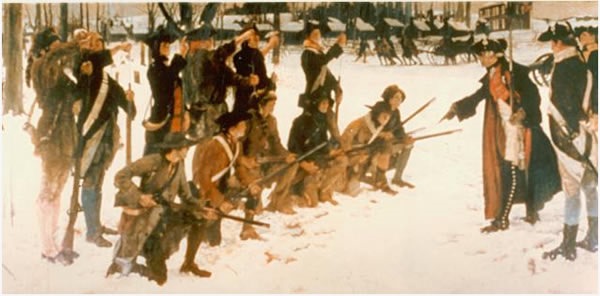
On March 19, 1778, the first squad of men from the Continental Army undertook their first lesson with the baron. After learning the English words needed, von Steuben tasked each soldier of the 100 man squad to mirror him. The selected squad would follow the different maneuvers while listening to the baron “singing out the cadence.” While the squad went through their drills, another selected squad of onlookers studied the movements and then carried the drills to others.
Edwin Austin Abbey painting of von Steuben and the drilling of American soldiers at Valley Forge
The baron’s unique training regimens showed almost instant results, as von Steuben attested within a fortnight of the start of training. The soldiers “were perfect in their manual exercise; had acquired a military air; and knew how to march, to form column, to deploy, and to execute some little maneuvers with admirable precision.”
By the end of March, with Washington’s blessing, the entire army went under the drill regimen as instructed by von Steuben. The Prussian “acting” inspector general put his mark on all aspects of camp life as evidenced by the routine the soldiers adhered to while becoming acquainted with the manual of arms. “At nine a.m….new commands explained to each regiment at parade, then practice. By late afternoon, regiments were practicing by brigades.”
When a soldier fumbled a maneuver or the squad was not crisply moving through the drills, the baron’s temper would get the best of him and he would unleash a slew of epithets that was a unique blend of French and German with a few words of English sprinkled in for good measure.
The silver lining in these outbursts occurred when the baron would politely and calmy ask one of his assistant to translate into English the curse word of the moment. A light-hearted moment came when von Stueben asked his translator one time to, “come and swear for me in English, these fellows won’t do what I bid them.”
However, von Steuben won the trust of his trainees, as he instilled a sense of pride, of soldierly bearing, and when he did have his outbursts, those moments just underscored his similarities to the men he was training. As one biographer accurately summed up these occasions, the outbursts “humanized him” in the eyes of the rank-and-file.
There was one little secret that only the baron and his small staff were privy too; von Steuben was making up the drill and routine practices employed each day as he went along!
After the drilling of that day was completed and the baron snatched a quick bite to eat, von Steuben was off to his quarters where he scribbled out the lessons to be taught the following day.
Along with drill, camp life even improved, as von Steuben mandated changes that improved camp sanitation, which in turn, reduced sickness among the rank and file. By the end of the encampment, von Steuben controlled, according to historian Herman O. Benninghoff II, “the Valley Forge soldier’s introduction to command and control.”
On April 1, 1778, John Laurens wrote to his father and president of the Continental Congress, Henry Laurens about the major impact of von Steuben.
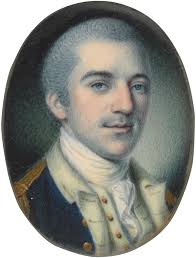
John Laurens, aide to George Washington during the Valley Forge encampment
“Baron Steuben is making sensible progress with our soldiers. The officers seem to have a high opinion of him…It would enchant you to see the enlivened scene [of camp at Valley Forge]…If Mr. [Sir William] Howe opens the campaign with his usual deliberation, we shall be infinitely better prepared to meet him than we have ever.”
By May 1778 a Board of War member, a committee formed by the Continental Congress the previous year, wrote to a fellow board member the following lines, “America will be under lasting Obligations to the Baron Steuben as the Father of it. He is much respected by the Officers and beloved by the Soldiers themselves…I am astonished at the Progress he has made with the Troops.”
A fitting compliment came from the pen of George Washington who wrote to von Steuben near the end of the encampment at Valley Forge that “the army has derived every advantage from the institution under you, that could be expected in so short a time.”
Before von Steuben could finish the drilling of the soldiery that winter, the British stirred from their perch in Philadelphia and the lessons on the snowy plains of Valley Forge would be put to the test.
“You slander my family. With God’s help I’ll dance in your blood you course, Presbyterian fellow!” Shortly after these angry words were shouted, a man lay dead on the floor of an out-of-the-way tavern in what was then Cumberland County, Virginia. Now a mere footnote in our local history, to be sure, but at the time this event and what would follow was one of the most talked-about sensations of the day.
It was June 1766 and the dead man was a transplanted Scotsman; a merchant and landowner by the name of Robert Routledge. He had lived in Virginia for only a short time. It was rumored he’d ridden with Charles Stuart, “Bonnie Prince Charlie” in Scotland in 1745. By the 1760’s he seemed to be making his way in the world of Virginia but apparently to the chagrin of some of the more established men of the colony who saw him as nothing more than a common upstart. One man in particular would play an important role in this tale. His name was Colonel John Chiswell and it would be at the point of his own sword that Robert Routledge would meet his violent end.
Chiswell was born at Scotchtown in Hanover County. A member of the Virginia elite from birth, by 1766 he was living in a beautiful home in the capital city of Williamsburg. Due to a string of poor investments, though, Col. Chiswell found himself deeply in debt. He did, however, own an interest in a lead mine venture in the New River Valley, in the western portion of the colony. By all accounts, Chiswell was a rather arrogant man and accustomed to giving orders. In June 1766, he and some companions were riding east from the mines, heading for Williamsburg and home.
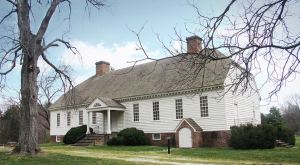
Mosby Tavern
While slowly meandering through Cumberland County along what was then called the Middle Road (now US Route 60) the party decided to stop for the night at a road-side establishment, Mosby Tavern. Built by Benjamin Mosby in 1740, the tavern was well-known to westward bound travelers of the day. In the 19th Century the place would also be familiar to Benjamin Mosby’s kinsman, the Confederate guerrilla chieftain John Singleton Mosby. Privately owned, the old tavern still stands along Route 60 in what is now Powhatan County.
The story goes that Mr. Routledge and Col. Chiswell knew one another. Not companions by any stretch but they certainly were acquainted. Later that evening in Mosby’s taproom both men dined separately with friends and downed numerous tankards of Rum. And, as is normally the case, the alcohol soon began to take effect as the evening wore on. From the eyewitness accounts we know that Col. Chiswell, in his jubilance regarding the hoped-for success of his lead mine enterprise, became a little loud and boisterous. He began to swear or to “utter certain oaths”, happy in the prospects of his impending wealth.
Apparently Robert Routledge took umbrage at the remarks and took the colonel to task for “swearing and talking as you do among such good company”. To Col. Chiswell, Routledge was certainly not a member of the Virginia gentry. He was a commoner, an upstart and certainly no one to correct his speech or instruct him on the proper discourse of a gentleman. Tempers began to flare and soon the men were standing in the middle of the taproom, on legs made wobbly from the drink. Routledge suddenly raised his tankard and threw liquor onto the face and clothes of Chiswell. The Virginian exploded in a rage and called for his sword. He ordered Routledge to depart from the room! “You are not worthy to appear in such company. If you do not get out immediately I’ll kill you!
What happened next is a bit murky and accounts from those present that evening tend to differ. Some say that Routledge, in a spirit of friendship, attempted to assuage the anger of the man standing before him. He moved forward, his arms raised in hopes of placating Chiswell. In response, they say Col. Chiswell ran Routledge through with his sword, murdering the Scotsman in cold blood.
But John Chiswell would tell a different tale. It was his claim that Routledge was drunk, which he most likely was, and in moving towards him apparently stumbled over his own feet. Stumbling forward, according to Chiswell, Routledge accidently fell onto the colonel’s sword! It was not murder, he claimed, but purely a tragic accident.
John Chiswell was arrested and later remanded to the General Court in Williamsburg for trial. In cases of possible homicide, it was not the court’s custom to grant bond (bail). However, three of the court’s justices took an interest in the question of bond. After questioning Colonel Chiswell and the Cumberland bailiff who escorted him to Williamsburg, and discussing the matter with the eminent legal minds of the colony, including George Wythe, the justices determined that bond should be granted and Col. John Chiswell was allowed to await his day in court in the comfort of his own home.
This case promised to be the “Trial of the Century”. It was known and discussed throughout the colony and especially so in Williamsburg. Many residents there considered the episode to be scandalous. They believed a wealthy man was getting away with murder. It was so scandalous that for months local newspapers printed stories accusing the justices of showing partiality to an arrogant, wealthy man due only to his social status. Chiswell was under de facto house arrest as crowds gathered daily in front of his home in protest. The fact that the justices in this case, William Byrd, III, Presley Thornton, and John Blair, were all companions and even business associates of the accused, only made matters worse.
Chiswell-Bucktrout House
Mysteriously in October 1766, before the case could come to trial, Col. John Chiswell was found dead in his home. It was suspected that, not having the strength to endure the scandal and the scrutiny of his fellow citizens, Chiswell took his own life. The coroner’s report, however, simply stated that John Chiswell died from “nervous fits, owing to a constant uneasiness of the mind.” It should be noted that the Coroner was also a companion of Col. Chiswell.
With suicide suspected, the Chiswell family was not allowed to bury the deceased colonel in the graveyard at Bruton Parish Church in Williamsburg. Instead, the body was taken by cart to the place of his birth, back to Scotchtown in Hanover County. The colonel’s daughter was abiding there at the time. But John Chiswell would not rest in peace even after arriving at the beautiful home he knew as a child, or not yet anyway. Fearing that he had possibly posed his own death as a means of avoiding trial and the gallows, the family and friends of Robert Routledge gathered in the yard of Scotchtown and awaited the arrival of the body. They insisted the coffin be opened, much to the heart-felt agony of the widow, so that the body could be positively identified as that of Col. Chiswell. It was so identified; as a matter of fact, one of the men there that day and who recognized the visage of Chiswell was the future owner of Scotchtown himself, Patrick Henry. Mr. Henry noted afterwards that the skin on the face of Chiswell had turned black, a sure sign of arsenic.
Scotchtown
It was a scandalous and sensational story and certainly the “OJ Simpson Case” of its day. Most people of colonial Virginia knew of it and yet, today, the story is not very well known at all. How many other stories like this one are out there, waiting to be discovered?
Most Americans take time to reflect on the meaning of independence and the sacrifice of the founding generation of Americans around the 4th of July or on their summer vacations visiting Colonial Williamsburg, Independence Hall, or Boston’s Freedom Trail. However, the story of the American Revolution is best told in the freezing days of winter. As the mid-Atlantic region of the United States hunkers down for snow, it does well to remember what was the absolute worst winter in the 18th century: the “hard winter” of 1779-1780.
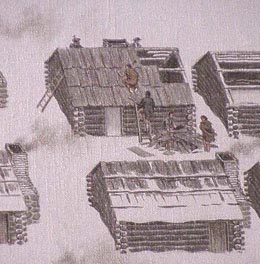
The army had to construct their winter quarters with a foot of snow already on the ground.
The winter that year was bad. Over the course of the winter, New Jersey had twenty six snowstorms and six of those were blizzards! Every saltwater inlet from North Carolina to Canada froze over completely. In fact, New York Harbor froze over with ice so thick that British soldiers were able to march from Manhattan to Staten Island.
George Washington decided to place his army at Morristown, New Jersey for winter quarters. When they arrived at the encampment site in November 1779 there was already a foot of snow on the ground. Some snowfalls dropped more than four feet of snow with snow drifts over six feet. The temperature only made it above freezing a couple times in the whole winter. Officers remembered ink freezing in their quill pens and one surgeon recorded that “we experienced one of the most tremendous snowstorms ever remembered; no man could endure its violence many minutes without danger to his life. … When the storm subsided, the snow was from four to six feet deep, obscuring the very traces of the roads by covering fences that lined them.”
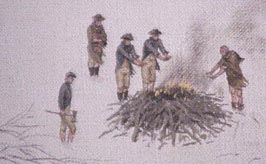
Soldiers attempting to stay warm in the worst winter of the 18th century.
Because of the severity of the winter, provisioning almost 10,000 soldiers was nearly impossible. A soldier in the Connecticut Line, Joseph Plumb Martin remembered “We were absolutely literally starved; – I do solemnly declare that I did not put a single morsel of victuals into my mouth for four days and as many nights, except for a little black birch bark which I gnawed off a stick of wood, if that can be called victuals. I saw several of the men roast their old shoes and eat them, and I was afterward informed by one of the officer’s waiters, that some of the officers killed and ate a favorite little dog that belonged to one of them.”
Even General Washington noted after the winter that “The oldest people now living in this Country do not remember so hard a winter as the one we are now emerging from. In a word the severity of the frost exceeded anything of the kind that had ever been experienced in this climate before.” This came from the man who had suffered the terrible winter of 1776-1777 when his army had to cross an ice-choked Delaware River and who had witnessed thousands of his men die in the freezing winter of 1777-1778 at Valley Forge.
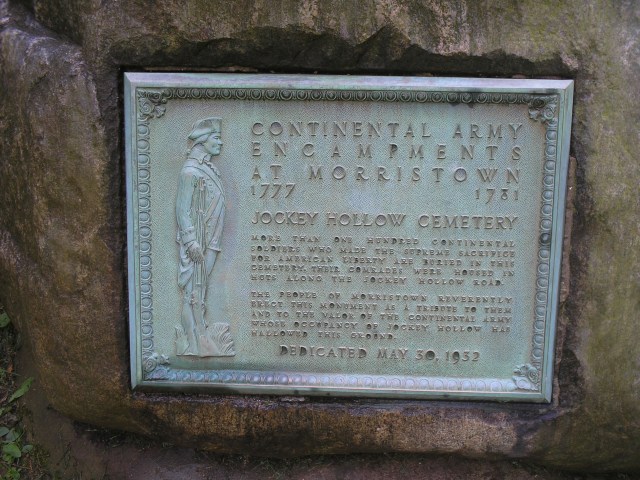
Marker for the men who didn’t survive the winter of 1779-1780.
Despite the severity of this “hard winter” in 1779-1780 at Morristown, Americans tend to think that Valley Forge was the worst winter of the war. This probably has to do with the fact more soldiers died of disease at Valley Forge than at Morristown. While about 2,000 soldiers perished at Valley Forge, ‘only’ about 100 died at Morristown. Also, the Continental army underwent an amazing transformation at Valley Forge, becoming a professional army. The Morristown encampment, however, resulted in angry and hungry soldiers causing a mutiny that had to be put down. Joseph Plumb Martin remembered how he and his fellow soldiers were “venting our spleen at our country and government, then at our officers, and then at ourselves for our imbecility in staying there and starving in detail for an ungrateful people who did not care what became of us, so they could enjoy themselves while we were keeping a cruel enemy from them.”
So this winter, as you dig out your driveway or your car over the next few days, take a moment and imagine what the soldiers in Washington’s army had to endure at Morristown in 1779-1780. Next time you are in New Jersey or New York City make a point to visit the site of that encampment preserved by the National Park Service. Visiting on a cold day will give you a small taste of the elements they endured. These soldiers’ dedication to duty helped keep the light of liberty alive through an extremely “hard winter.”
A fisherman by trade before the war, the savior of the American Continental Army during the war on two occasions, and returned to civilian life with personal, physical, and economic hardships because of the war.
John Glover
That one line could simply sum up John Glover of Marblehead, Massachusetts. Unfortunately, Glover has received scant attention; a few lines here, a page in this publication, or a reference in passing when talking about the engagements around New York or the Crossing of the Delaware.
Daniel Glover is more than well deserving of the epithet, “one of the greatest leaders of the American Revolution you have never heard of.”
Born on November 5, 1732 in what is now Danvers, Massachusetts, where he lived until the death of his father when he was just four years old. His mother Tabitha Bacon Glover moved young Daniel to Marblehead, on the coast of Massachusetts where he would apprentice, when he came of age, as a shoemaker. He eventually looked toward the sea and made a living as a merchant.
Daniel became well-entrenched in Marblehead society, he joined the local militia in 1759 and entered politics, aligning himself with the Whig party in 1760. By the time of the first shots on the Green of Lexington and the North Bridge at Concord, Glover was a colonel of militia in the Marblehead Regiment.
Although his regiment made the march to Boston and took part in the siege, Glover was away on detached duty when the Battle of Bunker (Breed’s Hill) was fought. When George Washington rode into Cambridge, Massachusetts and assumed command of the American forces, Glover lost his headquarters. A product of Glover’s fine taste, the Marblehead sailor had picked the home of a loyalist as his own command post. Washington chose the mansion, which now is a national historic site, as his own. Yet, a company of Glover’s Marblehead soldiers was also chosen to be the guard of Washington’s new headquarters.
Showing his importance and marshaling his background in shipping, Glover donated one of his own ships, the Hannah, named after his spouse, to build a hodgepodge navy for use by the Americans. One of the ships that made this volunteer navy actually captured a British ship, the brig HMS Nancy in which held as its cargo, 2,000 muskets, 30,000 rounds of artillery ammunition, and one brass mortar amongst other crucial military supplies much in need by Washington’s army.
After the siege of Boston was lifted with the evacuation of the British, Glover, with the rest of the Continental Army, headed south to New York City where another campaign and another chance to show his worth to the cause awaited.
On the night of August 29 and into the early morning hours of August 30, Colonel Glover and his able Marblehead regiment sailed the majority of Washington’s forces from Brooklyn across the East River to safety. Altogether, approximately 9,000 soldiers, plus artillery and supplies escaped from under British General Sir William Howe’s command. With Marylanders under Lord William Stirling launching ferocious rear-guard suicidal charges, Glover’s men saved Washington’s army that late August night.
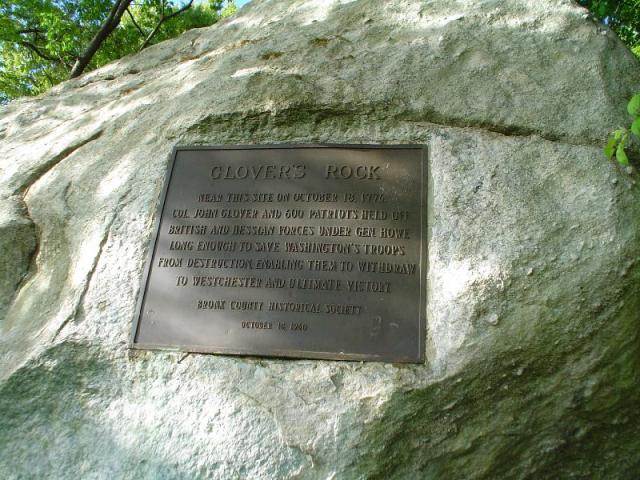
A month and a half later, on October 18th, Glover’s Brigade of Massachusetts soldiers held off a large contingent of British and Hessian mercenaries as Washington’s army retreated to safety. With approximately 750 men at his disposal, Glover’s rearguard action held over 4,000 enemy soldiers from threatening the retreat of the American forces.
Glover’s Rock, commemorating the action at Pell’s Point
Showing his humility, Glover would write about seeing the enemy come ashore before the engagement at Pell’s Point, that his first inkling was to give “a thousand worlds to have General [Charles] Lee or some other experienced officer present.” Luckily for the Americans, Glover did not get his wish and led admirably.
Glover’s command stuck with Washington’s forces during their retreat across New Jersey and into Pennsylvania and eventually to the banks of the Delaware River. In the prelude to the pivotal “Crossing of the Delaware” the former Marblehead sailors and their 43-year old commander would prove crucial.
To complete the surprise, Washington had to get his men across the ice-clogged Delaware River and to Trenton, New Jersey. Washington laid his eyes on Glover and outlined his thoughts and the big issue at hand; how to ferry his men across?
The response to his commander in chief was simple; to “not be troubled about that, as his boys could manage it.” Another primary account said that Glover and his command showed “perseverance…accomplished what at first seemed impossible.”
With Washington’s daring plan and Glover’s practicality, the “impossible” happened and the Americans scored a cause rallying victory at Trenton on December 26, 1776 and another equally important victory at Princeton, New Jersey on January 3, 1777.
After these winter battles, Glover went home to care for his gravely ill wife, Hannah, but there was nothing he could do. After a year long struggle, Hannah died on November 13, 1778 leaving John with eight children, including the oldest John who was a captain in his father’s Marblehead regiment.
While at home, George Washington petitioned the Continental Congress to promote Glover to brigadier general. Congress agreed and on February 21, 1777 the former Marblehead merchant became a general in the Continental Army.
When Glover returned to active duty, he was given the task of escorting the British and Hessian prisoners captured at the Battle of Saratoga and also took part in the unsuccessful attempt to expel the British from Newport, Rhode Island in 1778.
The end of the war saw him still in service in the Hudson Highlands where most notably he was on the board of officers that sentenced British spy Major John Andre to death. At the very end of the war, on September 30, 1783, Glover received a brevet to major general.
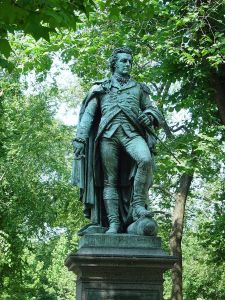
John Glover Statue Commonwealth Avenue, Boston
With the war over, Glover and his second wife, Francis Fosdick resided in Marblehead. However, Glover’s health and family were devastated by the war. Glover’s health was impaired by years of hard campaigning, including struggling with malaria in 1777. He lost his first wife Hannah during the war and his oldest son, John, disappeared as a prisoner-of-war while being transported over the Atlantic Ocean. Even his pre-war career, as a merchant, was greatly impacted by the seven-year conflict.
Glover rebounded as best he could and did serve in a few political positions, including in the Massachusetts State Legislature and as a Selectman for Marblehead. One highlight of the post-war years was when President George Washington stopped over in Marblehead and was entertained by his former subordinate.
On January 30, 1797, Glover passed away from hepatitis at the age of 64 and became one of the greatest leaders of the American Revolution you have never heard of.
In the lowest depths of one of the coldest winters in the American Revolution, the Continental Army uncovered the dedication that the core of the military movement had.
Suffering was beyond comparison.
The cause was supply, the crux of many an army before and after the Revolutionary War. The issue started from the top, the quartermaster general position.
“The lack of a competent, effective quartermaster general for the period from October 10, 1777 to May 2, 1778 threatened the Continental Army’s existence more than the enemy” wrote author and historian Herman O. Benninghoff, II.
His bold proclamation is chillingly on-point.
That time frame coincided with the approximately same length of time George Washington’s forces were at Valley Forge.
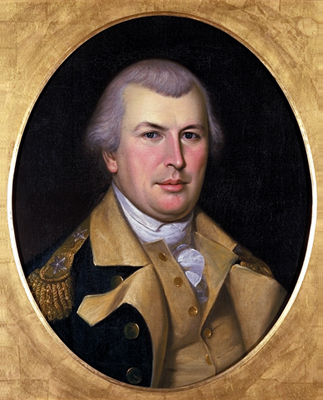
Nathanael Greene would become Quartermaster General in March 1778 during the encampment at Valley Forge
On January 5, 1778, Nathanael Greene, who would soon be tapped as quartermaster general of the Continental Army, wrote to fellow officer General Alexander McDougall;
“The troops are worn out with fatigue, badly fed, and almost naked. There are and have been thousands of the Army without shoes for months past. It is difficult to get sufficient supplies to cloath the Army at large.”
Moving directly to Valley Forge from active campaigning, the soldiers arrived with their supplies in a deplorable condition. Shoes had been torn to shreds with the long marches and many of the men had nothing but rags to wrap feet in. Shortly after arriving, the army numbered approximately 12,000 men under arms, yet 4,000 of these men, 1/3rd of Washington’s entire force, was deemed “unfit for duty” because a lack of supplies.
Another 1,100 would desert because of the horrid conditions of the winter encampment; no food, no pay, and barely clothes to keep warm.
Another 2,000 died of disease, including typhus, pneumonia, and other “camp fevers” which categorized a whole assortment of various ailments. Medicine was almost non-existent and lack of proper sanitation played a major role as well.
A delegate to the Confederation Congress was informed by an informant in Valley Forge that “a great portion of the soldiers are in a very suffering condition for want of necessary clothing, and totally unfit for duty.”
The suffering of the soldiers for a want of simple, basic clothing, becomes even more painful with the following realization by John Marshall, serving as an officer at Valley Forge, and the same Marshall who would become the Supreme Court Justice.
“In a desert which supplies not the means of subsistence, or in a garrison where food is unattainable, courage, patriotism, and habits of discipline, enable the soldier…..but to perish in a country abounding with provisions, requires something more than fortitude.”
One artist’s depiction of what the encampment at Valley Forge looked like
That is what is most astonishing, that there were surpluses to be attained, but Continental currency had depreciated to the point that by late 1777 and early 1778 it was at an exchange rate of four Continental dollars to one dollar of hard specie. By 1779 that ratio would be 30 to 1.
To further complicate matters, the Continental Army did not even have the wagons to gather the materials. In mid-February, a report from camp to Henry Laurens, president of the Confederate Congress, deplored of the “want of Waggons & the like.”
Out of the depths of this despair, where cries of “No Meat, No Meat” rent the air as soldiers voice their frustration, came a self-proclaimed baron.
This man would leave a lasting impression on the make-up of the army, second only to George Washington.
His assessment of the army upon his arrival amazed him, the “fortitude of the common soldiers and that no army in Europe would hold together and endure under such deprivations of food and clothing and shelter.”
That prognosis shows the depth of commitment that boiled in the hearts of the dedicated survivors of the cold, hunger, and privations of Valley Forge.
The army was ready to be molded and with his arrival, Baron Friedrich Wilhelm von Steuben would turn out to be the right guy at the right juncture in time. The Continental Army, held together by George Washington, would be transformed by this new inspector general.
Valley Forge would be the elixir of change for the army and the revolution.
Washington Crossing the Delaware, by Emanuel Gottlieb Leutze The Metropolitan Museum of Art, http://www.metmuseum.org
One of the iconic images of the Revolutionary War is Emanuel Gottlieb Leutze’s 1851 painting, Washington Crossing the Delaware. It is the night of December 25, 1776. The Continental Army is being transported across the Delaware River to attack a Hessian garrison at Trenton, New Jersey, some nine miles to the south. In the foreground, anonymous men (and possibly one woman) of varying nationalities and races row an overloaded boat across the river, pushing great slabs of ice out of the way. Two of the boat’s occupants are not anonymous: General George Washington, standing resolutely near the bow, and young Lieutenant James Monroe, holding the stars and stripes.
Leutze’s painting is glorious–and wrong in almost every detail. The river resembles the Rhine more than the Delaware; the boat is too small and of inaccurate design; there is too much light for what was a night crossing; Washington did not cross standing up; the stars and stripes had not yet been adopted by the Continental Congress; and James Monroe was not holding the flag, not in the boat, and not even present with the army.
He was already across the river, and he was busy.
Washington’s plan for a surprise attack on Trenton was a risky attempt to reverse the sagging fortunes of the Patriot cause. During the summer of 1776 British forces, including Hessian mercenaries, had driven the Continental Army from New York across New Jersey and into Buck’s County, Pennsylvania. Expired enlistments and outright desertion had thinned the American ranks, and many of those who remained were despondent. Washington gambled that a successful attack against an isolated British outpost would boost the army’s morale and stiffen the resolve of Congress and the people.
Three Hessian regiments, comprising about 1,400 men, were stationed at Trenton under the command of Colonel Johann Rall (also spelled Rahl). Washington planned to bring 2,400 Continental soldiers across the river overnight at McKonkey’s Ferry, march to Trenton, and attack before dawn. Two other elements of the army were part of the plan. A 1,900-man force under Colonel John Cadwalader would make a diversionary attack against British troops at Bordentown, New Jersey. General James Ewing would lead 700 men across the Delaware at Trenton Ferry, control the bridge over Assunpink Creek, and intercept any Hessian troops retreating from Trenton. Bad weather prevented both of these deployments, meaning that everything would depend on the main body’s effort. The army’s password for the evening was “Victory or Death.”
Washington’s plan included sending a small detachment of troops over the Delaware first to secure the army’s route of march. James Monroe was with this contingent. In his autobiography (written in the third person late in life and not completed before his death), Monroe described the mission:
The command of the vanguard, consisting of 50 men, was given to Captain William Washington, of the Third Virginia Regiment . . . Lieutenant Monroe promptly offered his services to act as a subaltern under him, which was promptly accepted. On the 25th of December, 1776, they passed the Delaware in front of the army, in the dusk of the evening, at [McKonkey’s] ferry, 10 miles above Trenton, and hastened to a point, about one and one-half miles from it, at which the road by which they descended intersected that which led from Trenton to Princeton, for the purpose, in obedience of orders, of cutting off all communication between them and from the country to Trenton.
Monroe noted that the night was “tempestuous,” and that snow was falling. While manning their post, the detachment was accosted by a local resident who thought the Continentals were British troops. Describing the incident many years later at a White House dinner during his presidency, Monroe recalled that the man, whose name was John Riker, was “determined in his manner and very profane.” Upon learning that the soldiers were Americans, he brought food from his house and said to Monroe, “I know something is to be done, and I am going with you. I am a doctor, and I may help some poor fellow.” Dr. Riker proved remarkably prescient.
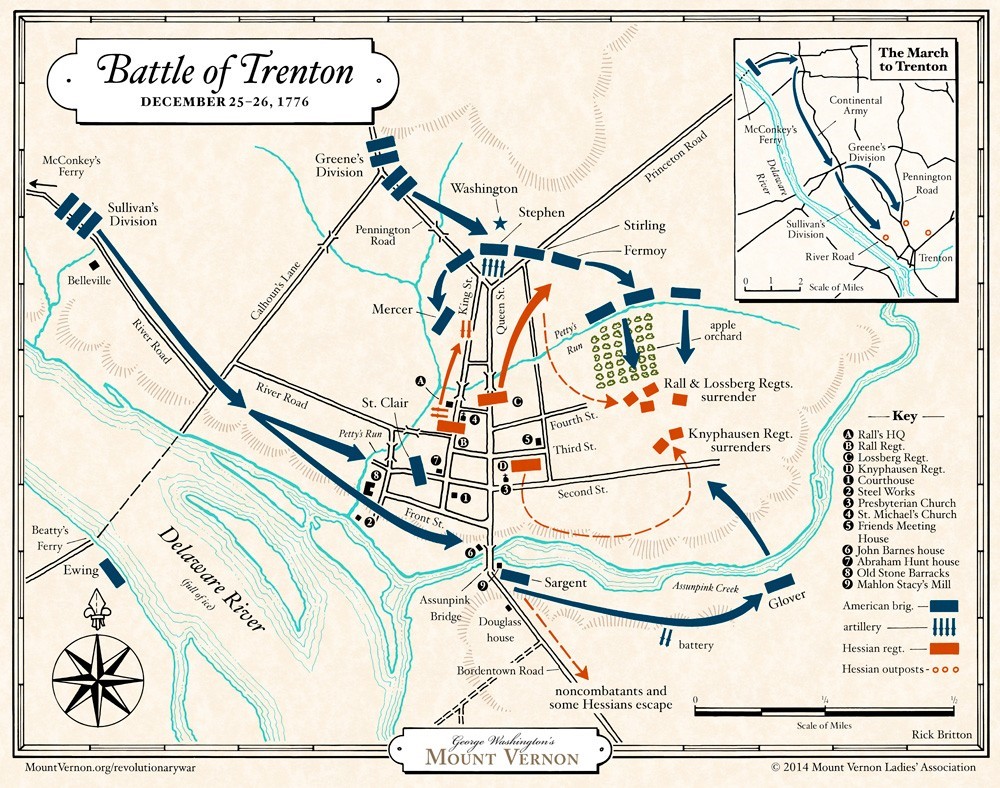
Battle of Trenton map courtesy George Washington’s Mount Vernon
The main army’s river crossing and march to Trenton took longer than planned, meaning that the attack would occur well after sunup. Outside the town Washington divided his force, sending a division commanded by Major General Nathaniel Greene to attack from the north while the other, led by Major General John Sullivan, attacked from the south. At 8:00 AM the assault began, and here we return to Monroe’s account from his autobiography:
Captain Washington then moved forward with the vanguard in front, attacked the enemy’s picket, shot down the commanding officer, and drove it before him. A general alarm then took place among the troops in town. The drums were beat to arms, and two cannon were placed in the main street to bear on the head of our column as it entered. Captain Washington rushed forward, attacked, and put the troops around the cannon to flight, and took possession of them. Moving on afterwards, he received a severe wound and was taken from the field. The command then devolved upon Lieutenant Monroe, who attacked in like manner at the head of the corps, and was shot down by a musket ball which passed through his breast and shoulder. He was also carried from the field.
The Capture of the Hessians at Trenton December 26 1776, by John Trumbull (Yale University Art Gallery) (James Monroe lies wounded on the ground at left center)
Monroe was brought to the same room where William Washington lay, and their wounds were dressed by the army’s surgeon general and Dr. John Riker. Riker’s prediction of helping “some poor fellow” came true as he repaired a damaged artery in Monroe’s shoulder. What neither man realized at the time was that the intrepid physician had saved the life of a future president.
George Washington’s gamble in initiating the Battle of Trenton paid off. The victory was complete, and came at a surprisingly small cost in terms of American casualties. Two enlisted men froze to death during the nighttime march, and two were wounded in combat. The only losses among officers were the nonfatal wounds sustained by William Washington and James Monroe. Washington followed up his success at Trenton with another at Princeton on January 3, 1777, where the Continental Army proved that it could prevail over regular British troops.
The best commentary upon James Monroe’s performance at Trenton, and his Revolutionary War service generally, comes from no less an authority than George Washington. Writing to an acquaintance in 1779, Washington noted Monroe’s “zeal he discovered by entering the service at an early period, the character he supported in his regiment, and the manner in which he distinguished himself at Trenton, where he received a wound.” The general concluded that James Monroe had “in every instance maintained the reputation of a brave, active, and sensible officer.”
Scott H. Harris is the Executive Directors of the James Monroe Museum in Fredericksburg, Virginia. Harris became director of the James Monroe Museum and Memorial Library in July 2011, following ten years as director of the New Market Battlefield State Historical Park (administered by Virginia Military Institute). From 1988 to 2001, Scott was the first curator of the Manassas Museum and later director of historic resources for the City of Manassas, Virginia. Prior to his work in Manassas, he was a consulting historian with the Association for the Preservation of Virginia Antiquities in Richmond and an historical interpreter with the Colonial Williamsburg Foundation. He has been a board member of the New Market Area Chamber of Commerce, Prince William County/Manassas Convention and Visitors Bureau, Shenandoah Valley Travel Association, and Virginia Civil War Trails, Inc. He is a past president of the Virginia Association of Museums and serves as a peer reviewer for the Museum Assessment and Accreditation programs of the American Association of Museums.
Scott received his BA with honors in History and Historic Preservation from the University of Mary Washington in 1983. In 1988, he received an MA in History and Museum Administration from the College of William and Mary. Scott is also a graduate of the Seminar for Historical Administration, the nation’s oldest advanced museum professional development program.




![030_30[1]](https://emergingrevolutionarywar.org/wp-content/uploads/2016/02/030_301.jpg?w=640)







 Emerging Revolutionary War Era