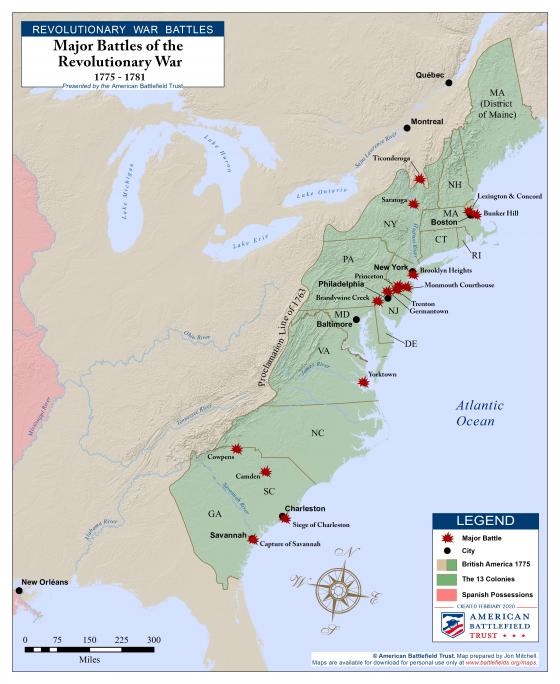
Lexington and/or Concord or both? Same question, Trenton or Princeton or both? Guilford Court House? Yorktown Battlefield? Ask any historian or history enthusiast of the American Revolutionary War period what their favorite battlefield is and you may get one of the places above. Or some other hallowed ground.
This Sunday, at 7 p.m. EDT, join Emerging Revolutionary War on our Facebook page for a panel discussion on our favorite battlefields of the American Revolution. Discussion will also include the successes, pitfalls, or failure of preservation and what one can see or not see at these sites. We look forward to a lively conversation and your comments on what is the battlefield of choice.
During a recent trip following VA Militia Colonel George Rogers Clark and his Illinois Campaign, my brother and I stopped off at the Tippecanoe Battlefield Interpretive Center in the appropriately-named Battlefield, Indiana, not far from Lafayette. The battlefield park encompasses the site of a clash between American soldiers and a multinational coalition of Native Americans led by Tecumseh and his brother Tenskwatawa, more widely known as “The Prophet.” It is a gem of a battlefield from America’s founding era. The Treaty of Paris ceded British “authority” over the Northwest Territory to the new United States. Of course, it did so without consulting the Native Americans who actually lived there. That imposition of a European concept naturally led to resistance and involved the United States in some of its earliest wars as a country, notably the War for the Northwest Territory during the Washington Administration and then Tecumseh’s resistance movement and the War of 1812, in which Native Americans in the area primarily sided with the British. Like St. Clair’s Defeat (1791), the Battle of Fallen Timbers (1794), and the Battle on the Thames (1813), Tippecanoe (1811) became a milestone among those conflicts.
Harrison Monument at Tippecanoe in Battlefield, IN. The hilltop stretches into the distance. Some of the trees visible were present during the battle, but are dying from the afflictions that affect aging trees.
Concerned by growing nativist sentiment and alliances among the Indians from several different tribes, Indiana Territorial Governor William Henry Harrison led nearly 1,000 infantry, militia, and cavalry north from Vincennes to a growing Indian Settlement known as Prophetstown established by the Shawnee leaders Tecumseh and the Prophet. Expecting a parlay with Tenskwatawa on November 7, Harrison made camp on a hill near Tippecanoe creek the night of November 6, 1811. Tecumseh, an experienced war captain and diplomat, was away from Prophetstown at the time, leaving his brother nominally in charge, although various war captains and chiefs from tribes interested in The Prophet’s message were at Prophetstown as well.



 Emerging Revolutionary War Era