“Brave, Meritorious, Unrewarded Kirkwood”: Unrecognized Valor in the Continental Army

Emerging Revolutionary War welcomes back guest historian Ben Powers

If the Medal of Honor had existed during the American Revolution, which American soldiers might have received it? This is the kind of counterfactual question some of my history professors might eschew, but exactly the kind of thing I’ll debate endlessly with my pals over a burger after a day roaming a battlefield. As today is Medal of Honor Day, it’s appropriate that I share why I believe that, had the Medal of Honor existed at the time of the Revolution, there is no finer candidate for the honor than Delaware’s Robert Kirkwood.

Introduction

     I recently found myself on a Zoom call with two colleagues, discussing various aspects of the American Revolution, and the conversation turned to a trip one of them planned to take to Delaware to do some research. I immediately responded with “The Blue Hens!”, thinking of the First Delaware Regiment, and followed up by asking if he had heard of Kirkwood. My friend said he had not, thus launching me into a rundown of Captain Kirkwood’s impressive combat record. I concluded with my assessment that Kirkwood was the Continental Army’s answer to World War Two Medal of Honor recipient Audie Murphy.

     The Kirkwood/Murphy comparison is the kind of shorthand line that comes up in casual conversations about the War for Independence, a hyperbolic way of saying that a man was an excellent combat leader. But even after our call ended, the comparison stayed with me. Kirkwood had been in the fight from nearly the beginning, starting with the battles around New York City in 1776, and he had fought through to Eutaw Springs, SC, in 1781. Murphy likewise had seen hard campaigning from North Africa to Germany. Murphy had earned nine battle stars on his campaign ribbon. Had a similar honor been available to Kirkwood, he would have received six campaign stars, as the US Army classifies Revolutionary War campaigns, and he deserved at least three more. The more I thought about it, the more convinced I became that Kirkwood deserved a Medal of Honor.

The Medal of Honor

     The Medal of Honor is the United States’ highest award for valor, reserved for acts of conspicuous gallantry in armed conflict performed at the risk of life above and beyond the call of duty. In other words, if a recipient had not performed the act, their conduct would not have been considered dereliction of duty. The decoration has been awarded fewer than 3,600 times since its inception in 1861, during the American Civil War. Conservatively, 41 million people have served in the United States military since the American Revolution, making Medal of Honor recipients 0.01% of all American veterans. To say the Medal of Honor is awarded sparingly is an understatement. Approval for the award of the medal requires extensive corroboration from witnesses and multiple levels of review to meet a standard of proof “beyond a reasonable doubt.” Audie Murphy received his Medal of Honor for single-handedly holding off an enemy infantry company in an action near Holtzwihr, France, in 1945. Did Kirkwood meet a similar standard of bravery during the American Revolution?

Historiography

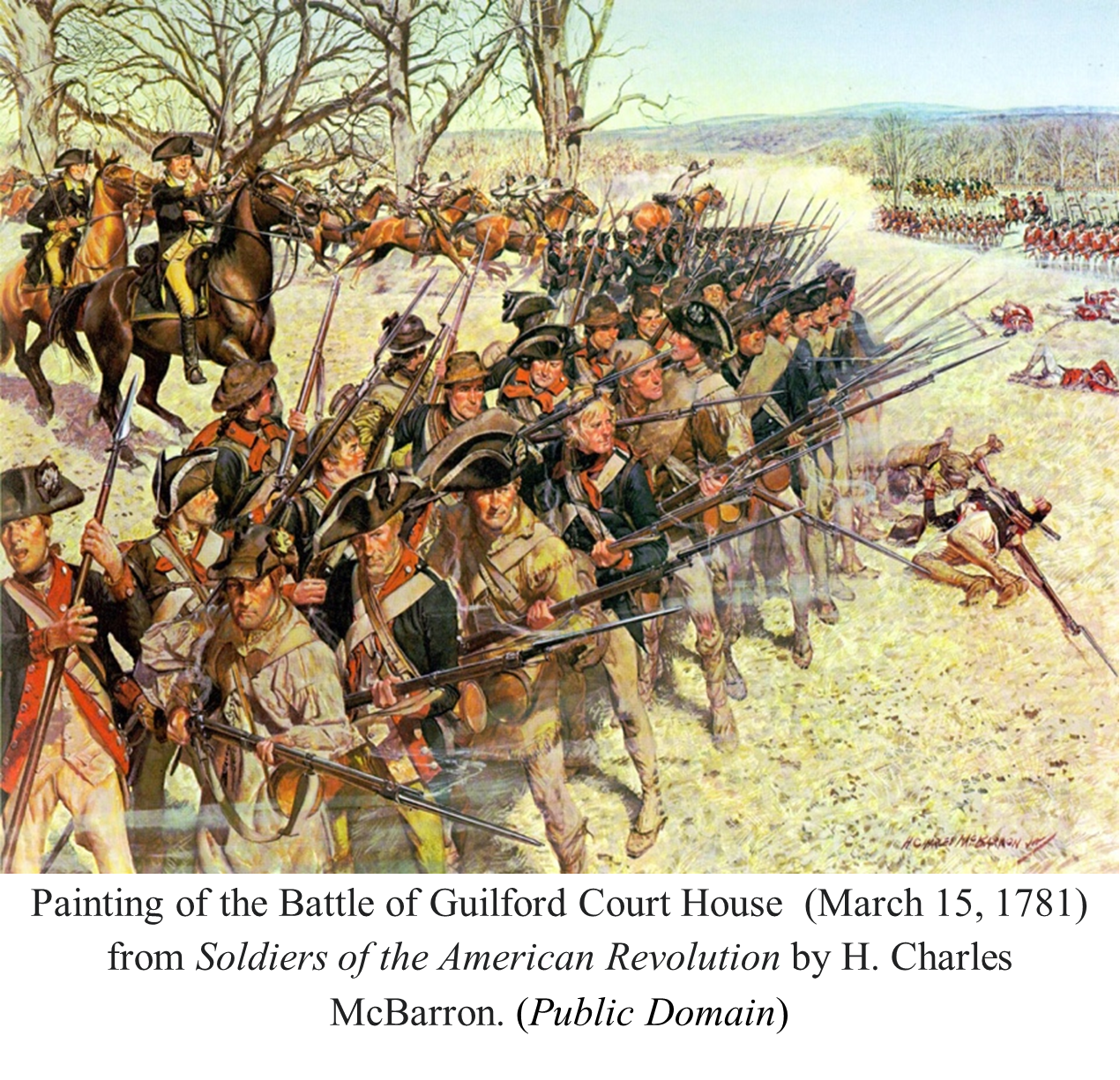
     The most distinctive element of Kirkwood’s service is the fact that he was in it for the duration. Name a major engagement, and there is a good chance he was there. Long Island and White Plains in 1776? He’s there. The Philadelphia Campaign in ’77? Check. Likewise with Monmouth in ’78. When the Delaware Continentals moved to the southern theater in 1780, Kirkwood marched with them. From Camden to Eutaw Springs, he is in every major fight in South Carolina from 1780 to 1781. For all that service, Kirkwood was not a self-promoter. He participated in decisive fighting under Daniel Morgan at Cowpens on January 17, 1781, fighting with the Continentals against Banestre Tarleton. His journal entry recording the day’s events simply reads, “Defeated Tarleton”. Descriptions of Kirkwood’s combat exploits are sparse. So, how to go about determining his eligibility for the nation’s highest valor award?

Continue reading ““Brave, Meritorious, Unrewarded Kirkwood”: Unrecognized Valor in the Continental Army”

The Attack and Defense of the Chew House: British Professionalism at Germantown

Emerging Revolutionary War welcomes back guest historian Ben Powers. Bio follows the article.

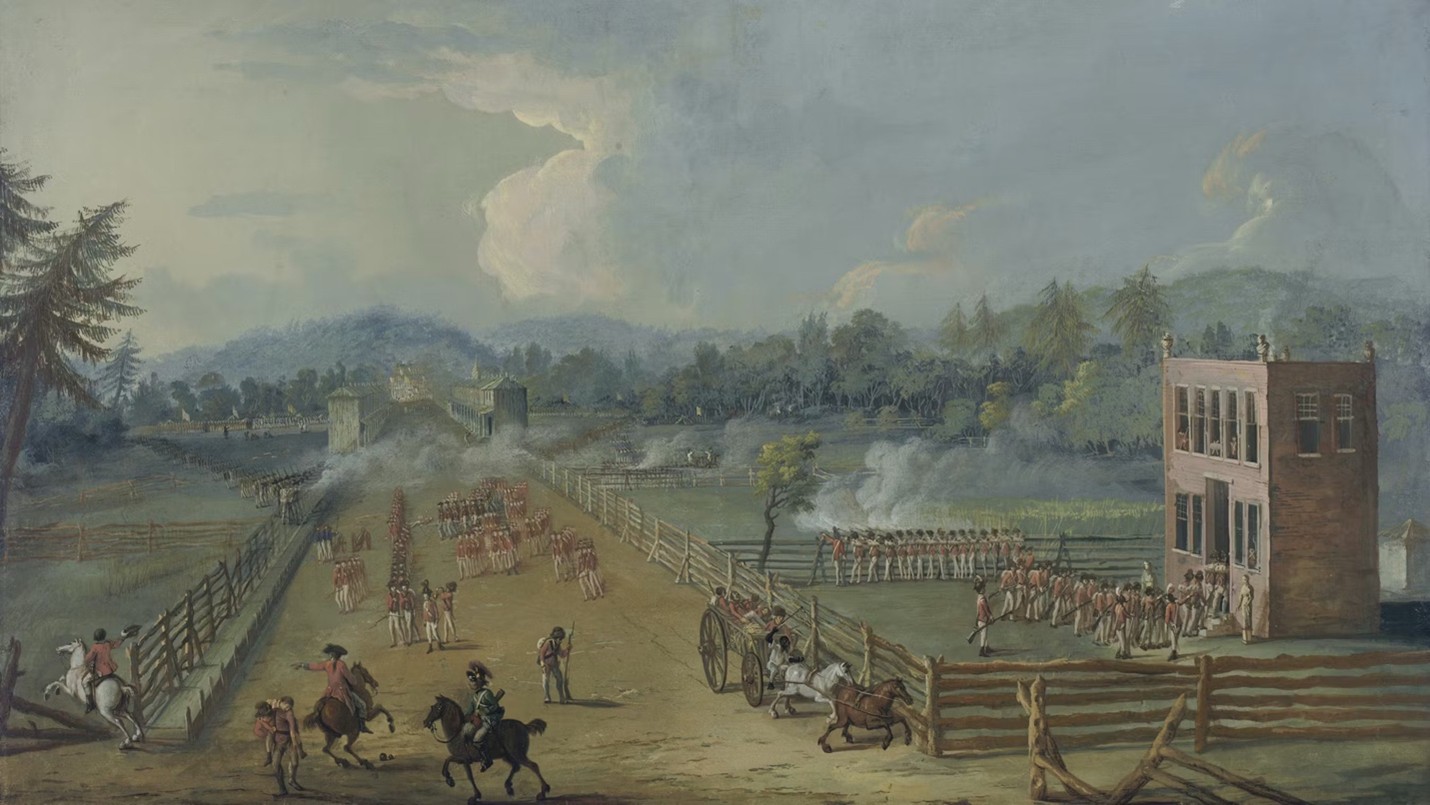
Battle of Germantown
Painted by Xavier della Gatta, 1782
https://www.amrevmuseum.org/collection/battle-of-germantown

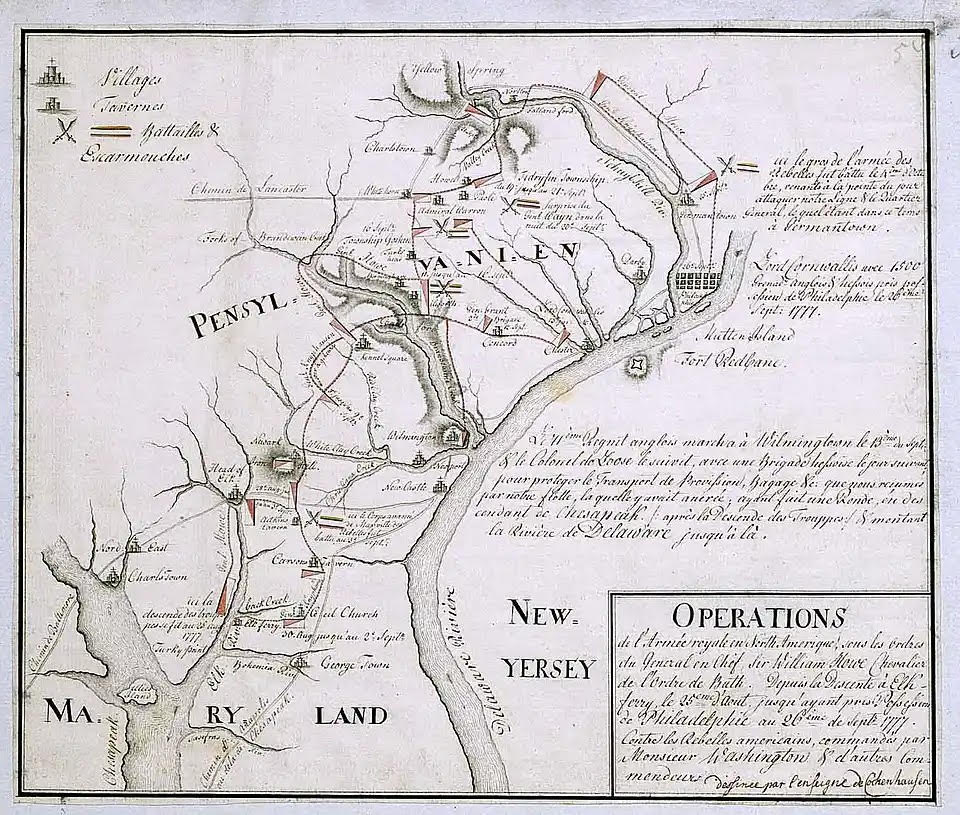
     Was the Battle of Germantown an American failure or a British success? Did the Continental Army lose due to an overly complicated plan, environmental factors such as fog, and poorly applied military judgment, or was the British Army’s resistance a decisive factor? The defense of the Chew House demonstrates that the British were professional, tenacious, and courageous, rather than the fortunate recipients of the fruits of an American blunder. Led by Lieutenant Colonel Thomas Musgrave, the men of the 40th Regiment of Foot established a strongpoint that disrupted American momentum and derailed the attack. Musgrave and the 40th Regiment of Foot transformed the Chew House into an obstacle that delayed the American advance long enough for British forces to reform and counterattack. This episode reveals the significance of British leadership and discipline under severe conditions, thereby reframing the context of the Battle of Germantown.¹

     Germantown occurred at a time when the Continental Army was undergoing a transformation from an amateur to a professional military. American officers engaged in self-directed study of “books upon martial science” and were known to carry such texts among their baggage and haversacks when on campaign.² In this manner, Continental officers sought to emulate their European counterparts.³ One officer known to have made a detailed study of the art and science of war was Washington’s Chief of Artillery, Henry Knox.⁴ At the time of Germantown, the officers of the Continental Army had been at war for over two years and had learned many practical lessons; however, many officers, including Washington, continued to hold Knox’s auto-didactic military education in high esteem. The gap between knowing theory and its practical application would become apparent, to the detriment of the Continentals, at Germantown.

     In contrast, the British Army officer corps had been fully engaged in a minor military enlightenment through the latter half of the eighteenth century. While British officers engaged in self-study programs similar to Knox’s, they could more readily share the results of their study within an established army, comparing and contrasting ideas and adopting best practices.⁵ The British Army was able to synthesize the best practices from both theory and combat experience into regulations that informed the training and operational deployment of all its formations.⁶

     Early interpretations of the battle frequently emphasized confusion and poor execution, particularly the American decision to attack the Chew House. Yet the battle was “very much more than a contest… for the possession of a country house.” More recent scholarship describes the plan for the attack on Germantown as a sophisticated maneuvering scheme that nearly succeeded. Its subsequent failure owes more to British action than American incompetence.

Continue reading “The Attack and Defense of the Chew House: British Professionalism at Germantown”

Nathaniel Greene: Washington’s Strategist or Pioneering Operational Artist

Emerging Revolutionary War welcomes guest historian Ben Powers

Introduction

   Nathaniel Greene is renowned for leading the Southern Department during the American Revolution, achieving significant strategic results against Lords Cornwallis and Rawdon, even though he lost several battles. Historian Theodore Thayer called him “the strategist of the American Revolution.”[1] Greene carefully planned his army’s movements to maximize maneuverability, chose to fight in situations with roughly equal numbers, strengthened support from auxiliary and irregular forces, and put the British in increasingly worse positions. His main goal was to keep his army active—success meant staying in the field and avoiding severe losses. This led Cornwallis to make decisions that resulted in his defeat at Yorktown, Virginia, in October 1781. Greene’s careful coordination of military actions to achieve strategic results hinted at what would later be called “operational art,” a concept later connected to leaders like Napoleon Bonaparte and Soviet theorists.[2] Greene’s skills showed the main elements of operational art, making him more than a strategist—he was an early example of an operational artist.

Some Definitions

  The “operational level of war” is a twentieth-century concept describing military activities between the tactical level (winning battles) and the strategic level (achieving national aims through armed force and other instruments of power). In current doctrine, tactics involve sequencing forces in time and space to accomplish missions like seizing terrain. Strategy is how national leaders and senior commanders use available means to achieve defined ends. The operational level connects these two, as theater commanders sequence campaigns to achieve strategic objectives, a concept relevant for analyzing Greene’s approach.

Continue reading “Nathaniel Greene: Washington’s Strategist or Pioneering Operational Artist”