We are excited to announce that ERW historians Rob Orrison and Mark Maloy will be leading a four day tour of Boston and sites associated with the opening of the American Revolution. Part of BGES’ Field University Program, this tour is part of a series of tours that BGES is hosting focusing on the American Revolution.
From the BGES website: “Long considered the “Cradle of the Revolution,” Boston, Massachusetts, was home to many of the era’s leading figures—Dr. Joseph Warren, Samuel Adams, Paul Revere, John Adams, and many more. Its streets and wharves fostered the revolutionary spirit that would ignite a continent. In December 1773, tensions escalated dramatically when dozens of Bostonians and others boarded three ships at Griffin’s Wharf and dumped East India Company tea into the harbor in defiance of the Tea Act. Parliament soon responded with the punitive “Intolerable Acts,” placing Massachusetts under military control.
The powder keg exploded on April 19, 1775, when British Regulars and American colonists clashed on Lexington Green, spilling the first blood of the American Revolution. That day, a running battle raged from Concord to Cambridge—an opening salvo immortalized as the “shot heard ‘round the world.”
Join us during this 250th anniversary year for a multi-exploration of Boston and the nearby villages of Lexington and Concord. We’ll visit the pivotal sites and relive the moments that launched the Revolution, concluding with the dramatic engagements along the now-famous Battle Road.”
To purchase tickets, visit: https://blueandgrayeducation.org/tours/cradle-of-the-revolution-boston-to-lexington-and-concord/ Blue and Gray Education Society is a 501c3 created in 1994 to promote understanding of battlefields and other historic sites through the conduct of field study tours and seminars. BGES has sponsored many education and interpretive focused projects across the country.
Following the initial skirmishes at Lexington and Concord on April 19, 1775, colonial militias from throughout New England converged around Boston, with the area of Cambridge and Roxbury serving as the epicenters of the camps. These New England militia effectively layed siege to the city where British General Thomas Gage concentrated after April 19th. The British, cut off from the countryside, relied heavily on supplies brought in by sea. At the same time, American forces were eager to secure resources and deny the British any additional supplies from nearby coastal areas.
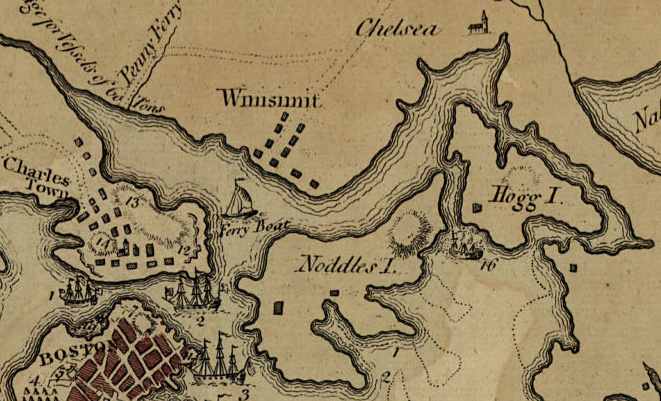
The location of the HMS Diana is marked with “16” on the map
One such resource-rich area was Noddle’s Island and Hog Island both located in Boston Harbor. These islands contained valuable livestock and hay, which the British had been attempting to secure to feed their troops and horses. American intelligence reported that the British were planning to remove these resources, prompting a proactive operation by the colonial forces to beat them to it.
In early May, Dr. Joseph Warren led a group inspecting the islands and recognized their imporance. As part of the Massachusetts Committee of Safety, Warren led the effort for a reslolution to be passed to either capture or destroy the supplies on the islands. On May 14th, the Committee stated “Resolved, as their opinion, that all the live stock be taken from Noddle’s Island and Hog Island, and from that part of Chelsea near the sea coast, and be driven back; and that the execution of this business be committed to the selectmen of the towns of Medford, Malden, Chelsea, and Lynn, and that they be supplied with such a number of men, as they shall need, from the regiments now at Medford.” Soon the commander of the New England army around Boston, General Artemas Ward, put a plan in motion to quickly strike both islands.
The American expedition was led by Colonel John Stark and Colonel Israel Putnam, both future generals in the Continental Army. The colonial forces, primarily composed of New Hampshire and Massachusetts militias, planned a nighttime amphibious raid to remove the livestock and destroy hay supplies that might benefit the British. On the night of May 27, colonial forces quietly moved onto Hog Island and began driving off livestock and burning haystacks. British forces, stationed in Boston and alerted to the colonial activity, responded by dispatching marines and the British schooner HMS Diana, a lightly armed but maneuverable vessel well-suited for operations in the shallow waters of the harbor.
As the colonists worked to transport livestock to the mainland, they encountered resistance from British marines who had landed on Noddle’s Island and began advancing toward their position. A sharp skirmish ensued, during which the American militia used the terrain to their advantage, fighting from behind trees, stone walls, and other natural cover. The colonial forces managed to repel the British marines, inflicting casualties and forcing a retreat.
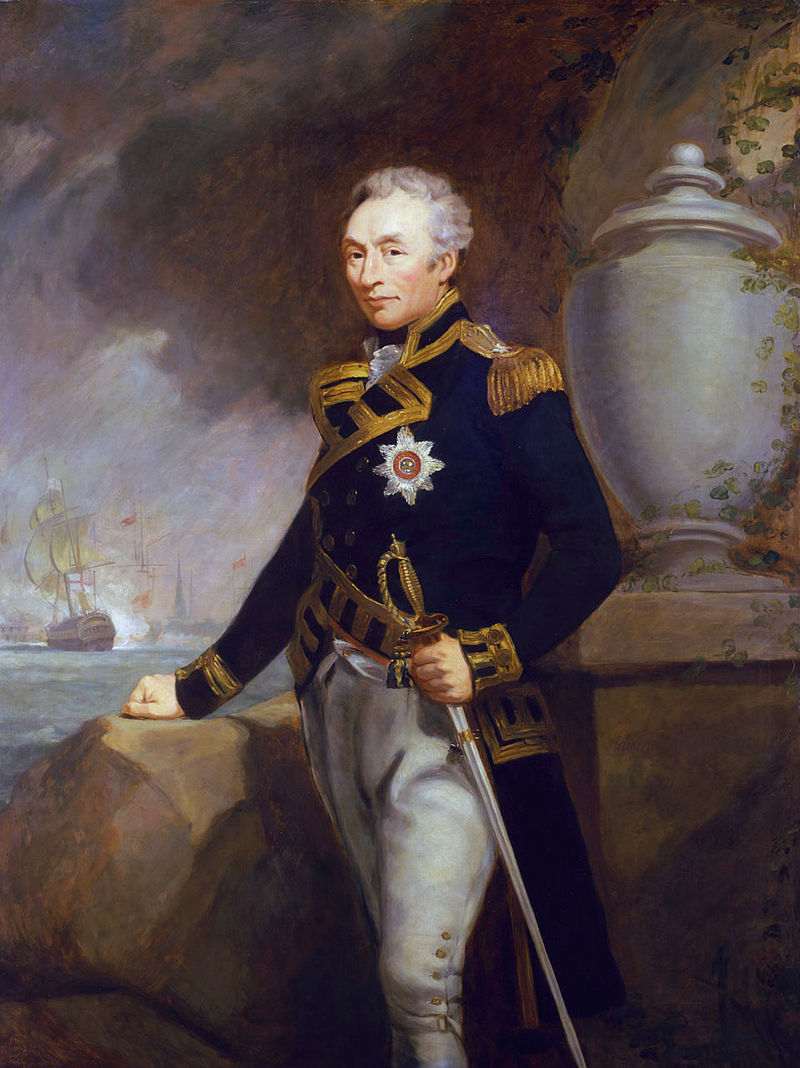
Lieutenant Thomas Graves (nephew of Vice Admiral Samuel Graves) commander of the HMS Diana. Shown in his rear admiral uniform in ca. 1801. Often confused with Lord Thomas Graves, British commander during the Battle of the Capes
The turning point of the engagement came with the involvement of the HMS Diana. The schooner attempted to support the marines by moving up the narrow Chelsea Creek to engage the colonial militia and cut off their withdrawal. However, as the tide receded and the ship ventured too far inland, it became grounded in the shallow, muddy waters.
Seeing an opportunity, the colonists brought up field artillery from shore and opened fire on the stranded vessel. Over the course of the battle, they subjected the Diana to intense musket and cannon fire. Unable to refloat the ship due to the falling tide and increasing colonial pressure, the British crew was forced to abandon it. American forces quickly boarded the vessel, stripped it of usable supplies, weaponry and its 76 foot mast, and then set it ablaze, destroying the schooner completely.
The Battle of Chelsea Creek resulted in a clear American victory, both strategically and psychologically. The destruction of the HMS Diana marked the first loss of a Royal Navy vessel in the Revolutionary War, dealing a symbolic blow to British morale. For the colonists, it was a tangible demonstration of their ability to challenge British authority not only on land but at sea.
Major General Israel Putnam said after the fight on Chelsea Creek “I wish we could have something of this kind to do every day,”
Tactically, the victory helped to solidify American control of the Boston-area islands and limited the British army’s ability to forage for supplies. This contributed to the worsening conditions inside besieged Boston and increased pressure on General Gage. The morale boost for the colonial militias was significant; it reinforced the notion that British troops and naval forces were not invincible and that well-coordinated militia operations could succeed.
In addition, the battle was notable for showcasing early instances of American military ingenuity and leadership. Figures like Israel Putnam and John Stark went on to distinguish themselves in later battles, and the ability of the militia to effectively coordinate a land-sea operation foreshadowed the more sophisticated tactics that would develop over the course of the war. A few months later on August 1st, the mast of the HMS Diana was raised on Prospect Hill as a liberty pole. A symbol that was seen by not just the Americans around Cambridge but also the British in Boston. This location was also where legend states that George Washington ordered the first American flag, the Grand Union, to be raised on January 1, 1776.
While over shadowed by Lexington, Concord, or Bunker Hill, the Battle of Chelsea Creek played a crucial role in the early war. It helped secure the outer perimeter of the Siege of Boston, denied the British critical supplies, and emboldened the colonial cause at a time when confidence was still fragile. The success of the operation, including the destruction of the Diana, offered a dramatic image of colonial resistance and ingenuity that resonated beyond New England.
Today, the location of Noddle’s and Hog Island are gone. Nineteenth century and modern infill has completely reshaped the area from mudflats and tidal marshes to buildable land. Modern day East Boston, Winthrop and Logan Airport cover the area. The community of Somerville contines to commemorate the raising of the Grand Union flag on January 1 Diana‘s mast with a flag raising ceremony. Though mostly forgotten, the fighting along Chelsea Creek continued to embolden men like Joseph Warren and Israel Putnam and encourage their agressiveness a few weeks later on the Charlestown peninsula.
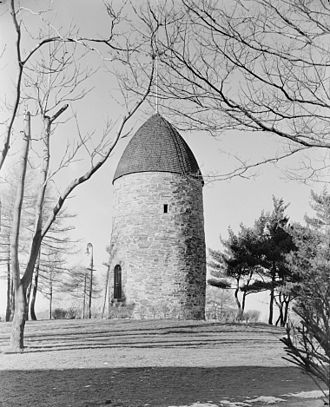
The Charlestown, now Somerville, Powder Magazinewas the focus of the September 1, 1774 Powder Alarm. The historic structure still stands today.
Join ERW this Sunday at 7pm as we welcome back historian and author J.L Bell. We will discuss the events in Boston and Massachusetts in 1774 after the passing of the now popularly called “Intolerable Acts” in response to the Boston Tea Party. A time of political, social and economic upheaval for everyone in the colony, the events that transpired had big impacts across all the colonies and set the stage for April 19, 1775. J.L. Bell is a renowned historian who operates a very comprehensive blog focused on Boston 1775 (https://boston1775.blogspot.com/ )
Grab a drink and sit back and learn about the events that rapidly progressed during 1774 towards warfare and bloodshed. J.L. Bell will provide a great insight into how things quickly deteriorated in Massachusetts and how that impacted all the colonies as a whole. Unlike previous revelries, this revelry will run live on our You Tube channel at: https://www.youtube.com/@emergingrevolutionarywar8217 . Due to new rules and regulations with Facebook, we can no longer stream our revelries live on Facebook. We hope that will change in the future. We will post the You Tube video to our Facebook page after the live broadcast. We hope to see you this Sunday, June 9, 2024 at 7pm on our You Tube Channel!
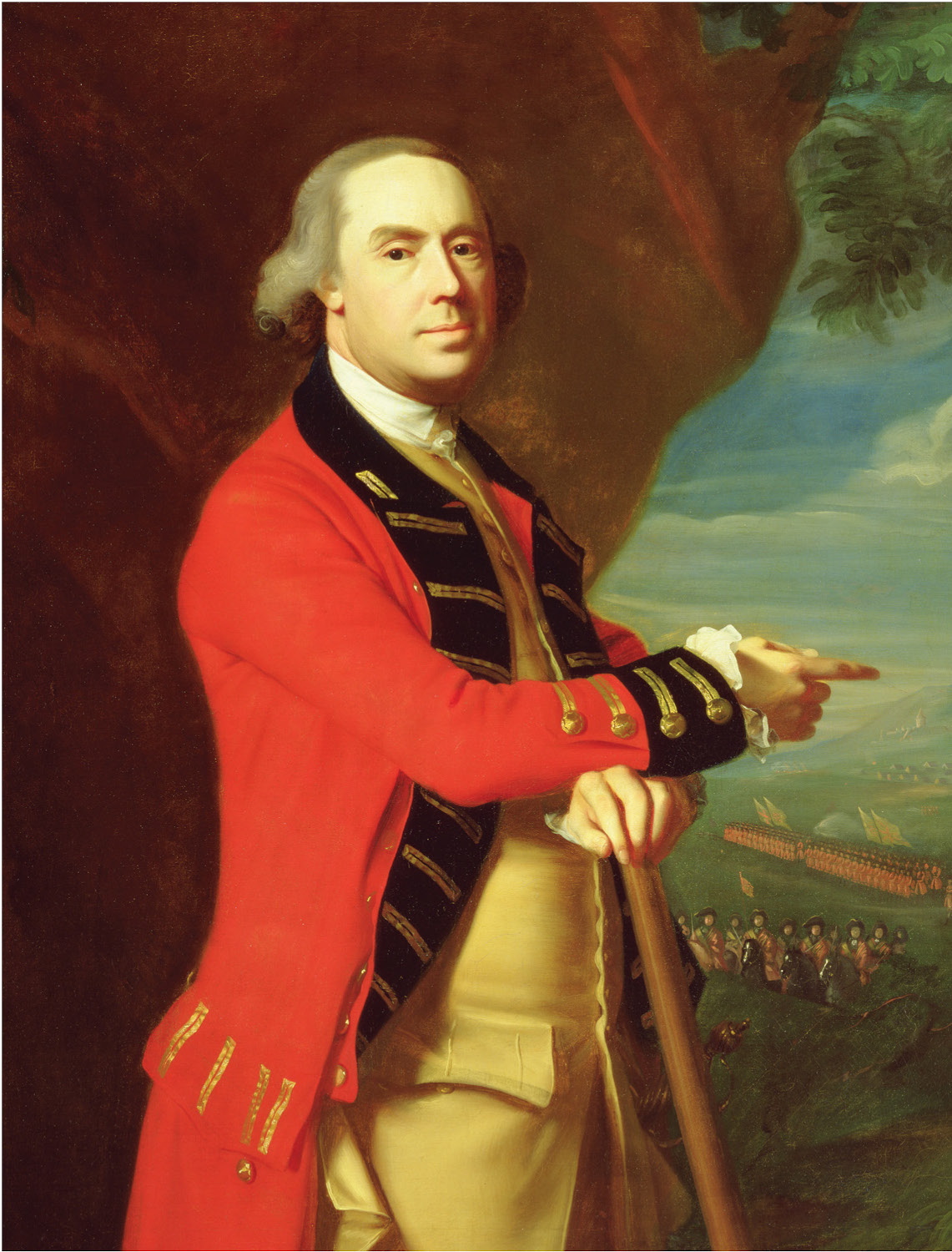
On May 13, 1774, the newly Royally appointed Governor of Massachusetts arrived in Boston. General (and now Governor) Thomas Gage was well known to the American colonists. Gage served as a Major in the 44th Regiment of Foot in the French and Indian War, most notably in the Battle of the Monongahela. When several of Gage’s officers fell, he took up temporary command of the 44th during the battle. During that time Gage got to know George Washington and both men respected each other. After the war, Gage received a promotion to Brigadier General and was appointed the military governor of Montreal.
Portrait of Thomas Gage by John Singleton Copley
Soon after, Gage became the commander in chief of all British forces in North America. He moved to New York city to administer the King’s forces in the American colonies. Gage’s popularity increased as he focused on creating peace with the Indian population along the new western border of the colonies through various treaties. Gage and his American born wife, Margaret, were well accepted into New York society. Gage always believed that the democratic spirit that pervaded the colonies were a threat to British rule. With many of the colonists accustomed to electing their own representation, he believed this created more division with the home country than making them British citizens. Gage had long believed that democracy was too rooted in colonial society. In 1772 he wrote “democracy is too prevalent in America.”
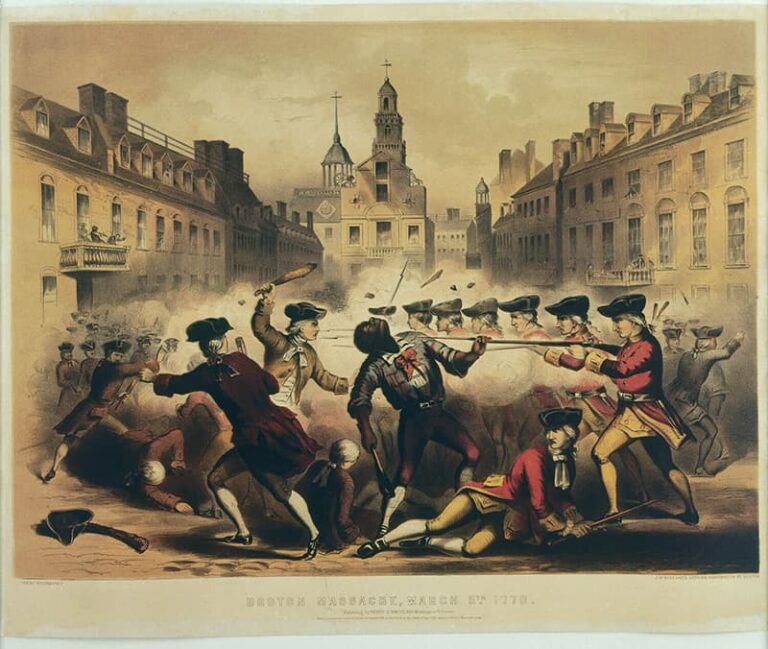
As tensions began to increase within the American colonies, Gage’s response exasperated the situation. He contracted many of the British military posts back to the colonial cities along the eastern seaboard (which in part led to the Boston Massacre in 1770). He believed a show of military strength would help put out the fires of discontent. Further, he concluded that the unrest was mostly pushed by a very small minority, not the vast majority of colonials. He underestimated how the masses would respond to his hard hand. Now Gage, who was in Great Britain when the news of the Boston Tea Party arrived, was seen as a great fit to handle the crisis in Boston. His military back ground and experience as a civil leader (and liked by many in the colonies) made him on paper an ideal candidate for Governor of Massachusetts in this unsettled time.
Many in Boston welcomed Gage when he arrived that May. Mostly because they had become so disenchanted with former Governor Thomas Hutchinson, who was completely not up to the task that faced him in 1773. The recently passed Boston Port Act (passed in March 1774, this act closed the port of Boston until the loss of the tea was paid for) grew tensions in Boston, but large segments of the population believed that those that destroyed the tea should pay for it. Soon, it was the next piece of news from Great Britain that shook the foundation of something the majority of Bay Staters took pride in, self-rule.
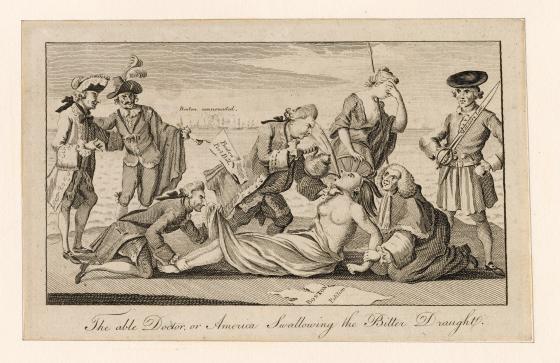
“The able doctor, or America swallowing the bitter draught,” 1774. This illustration depicts the British forcing a Native American woman (a symbol of the American colonies) to drink tea.
Word arrived of two new laws recently passed on May 20, 1774, Parliament passed the Massachusetts Government Act and Impartial Administration of Justice Act. These two acts were punitive in measure and sought to bring the colony under direct Royal control. The Government Act stated “Parliament passes this act turning the Massachusetts Council into a body of crown appointees“ (similar to other Royal colonies like Virginia) when up to then they were elected. Also, it restricted the traditional “town meeting” to just one a year. Town meetings were an essential local governing tool to not just govern localities but also to provide open communication across the colony. The Justice Act gave the governor the power to a trial to another colony or to Great Britain if he determined “that an indifferent trial cannot be had within the said province.” Judgment by one’s peers was a long-standing tradition in Massachusetts and in British law dating back to the Magna Carta. These measures essentially dissolved important aspects of the Massachusetts Charter of 1691.
Furthermore, Gage inflamed the situation more in Boston by bringing with him more British Regular troops. By the end of 1774, Gage had more than 4,000 soldiers in and around Boston. Gage could see the situation worsening but was unable to determine how to best deal with what confronted him. Whig leaders such as Dr. Joseph Warren, Paul Revere and Samuel Adams used these newly passed acts as proof that Great Britain was infringing on their rights and liberties. Using groups like the Sons of Liberty, Whig leaders began to gain great influence as many of the colonists began to turn against Great Britian. Soon many of these community organizations began to arm themselves and coordinate with the other colonies via committees of correspondence. Gage, feeling the situation was becoming dangerous wrote back to authorities in Great Britain “Affairs here are worse than even in the Time of the Stamp Act, I don’t mean in Boston, for throughout the Country. The New England Provinces…are I may say in Arms.” Events were beginning to build towards armed revolution, not just in Massachusetts, but across a more unified American colonies.
William L. Clements Library at the University of Michigan is now digitizing Gate’s papers with help from a grant of the National Endowment for the Humanities. Over the next year or so, this great resource on the colonial America will become accessible via the library’s website.
Emerging Revolutionary War is honored to welcome back historian Katie Turner Getty.
“Mr. Malcom, I hope you are not going to strike this boy with that stick.”[1]
George Robert Twelves Hewes portrait, entitled “The Centenarian” by Joseph G. Cole, 1835.
The speaker was 31-year-old Boston shoemaker and Tea Party participant, George Robert Twelves Hewes. Hewes had been walking along Fore Street in Boston on the afternoon of January 25, 1774 when he came across 50-year-old Loyalist and Customs officer, John Malcom, furiously shaking a large, heavy cane at the head of a small boy.
Five weeks earlier, on December 16, 1773, Hewes had “dressed [himself] in the costume of an Indian, painted [his] face and hands with coal dust in the shop of a blacksmith”[2] and participated in the Tea Party. Appointed boatswain, he and his company boarded one of the three ships and proceeded to soak 342 chests of East India Company tea in Boston Harbor. After dumping the tea that night, the men “quietly retired to [their] several places of residence… No disorder took place… and the stillest night ensued that Boston had enjoyed for many months.”[3]
Hewes had encountered no trouble when destroying the tea that night. But on this frigid Tuesday afternoon in January, trouble had found him—and was brandishing a cane.
Malcom turned his attention from the small boy to the shoemaker and exclaimed, “You are an impertinent rascal! It is none of your business!”[4]
Undeterred, five-foot, one-inch Hewes further protested Malcom’s rough treatment of the boy. Malcom called Hewes a “vagabond” and further declared that Hewes “should not speak to a gentleman in the street.”[5]
Hewes replied that he was “neither a rascal nor a vagabond, and though a poor man, was in as good credit in town as [Malcom] was.”[6] The exchange between the two men became even more heated.
Malcom called Hewes a liar and Hewes then retorted, “be that as it will, I never was tarred and feathered any how.”[7]
Malcom, overcome with fury, then struck Hewes in the head with his heavy cane, opening a bloody gash in the shoemaker’s forehead and causing him to fall to the ground unconscious.
John Malcom was one of the few people in the American colonies who had been tarred and feathered. Before this night was through, he would earn the dubious distinction of having been tarred and feathered twice.
“A New Method of Macarony Making, as Practised at Boston”, 1774.
Malcom’s first encounter with a sticky suit of tar and feathers was in October of 1773 in Falmouth (now Portland, Maine). While working as a Customs officer, Malcom had overzealously seized a ship called the Brothers for not having a register. Once aboard the ship, he “heartily damned the sailors, menaced the mate, [and] threatened to sheath his sword in the bowels of any one who dared dispute his authority.”[8]
So enraged were local sailors by Malcom’s behavior, that he was “disarm’d of Sword, Cane, Hat & Wig”[9], tarred and feathered over his clothes, and paraded through the streets for about an hour before being released.
This episode was common knowledge in Boston. In a letter to the Earl of Dartmouth, Massachusetts Governor Thomas Hutchinson indicated that Malcom had complained to him on several occasions of “being hooted at in the Streets for having been tarred and feathered”[10] Clearly, the Boston populace was not sympathetic to Malcom. And after his assault on Hewes, they would become even less so.
When Hewes regained consciousness, he found himself surrounded by a crowd of onlookers who urged him to visit the prominent Boston physician, Dr. Joseph Warren, to have his wound treated. In the meantime, Malcom had “contrived to get a weapon in his hand and keep [the crowd] at bay, till he could flee to his house”[11] on Cross Street.
When Hewes visited Dr. Warren at his office on Hanover Street, the doctor made a cheerful comment relating to the fortuitous thickness of Hewes’s skull. He said, “you are the luckiest man I know of, to have such a skull—nothing else could have saved you.”[12]
Word of Malcom’s assault on Hewes had quickly spread through Boston and people had started gathering outside his house. Far from being cowed by the unfriendly crowd, Malcom “bullied the people”[13], slinging verbal taunts and threats. In response to jeers, Malcom shouted “You say I was tarred and feathered, and that it was not done in a proper manner, damn you let me see the man that dare do it better!”[14]
Even 243 years later, Malcom’s defiance of the crowd is astonishing. From inside his house, he ran his sword out through the window and inflicted a flesh wound on an unlucky bystander named Waddel. He threatened the crowd with pistols and proclaimed that he would receive a thirty pound reward for every person he killed[15]. The formidable Malcom was eventually removed from his house “amidst the huzzas of thousand[s]”[16] He was dragged on a sled to King Street, site of the Boston Massacre, and was stripped of his clothes.
In Falmouth, during his first tar and feathering in 1773, the tar was splashed onto his clothes. This time, Malcom’s clothing was torn off, exposing him to the frigid winter air. The tar was poured over his bare flesh. He was then transferred to a cart and gleefully hauled to various points across town.
Sixty years later, Hewes reflected upon the event in his biography. “Then they drove to Liberty Tree—to the gallows on the Neck—back to the Tree—to Butcher’s Hall again—to Charlestown Ferry—to Copp’s Hill—flogging the miserable wretch at every one of these places.”[17] Four hours later, he was unceremoniously deposited at the doorstep of his house, frostbitten and senseless.
The reader may feel a slight twinge of disappointment, or perhaps even a grudging respect, upon learning that throughout his ordeal, John Malcom comported himself with “Great Fortitude and Resolution”.[18] Malcom’s recovery was lengthy. When frostbite caused his tarred and feathered flesh to peel off in strips, Malcom packed the skin in a box to preserve it and present to the King as proof of his service and sufferings.[19]
In May, 1774 Malcom sailed for England (presumably with his box of tarred flesh and feathers). Once in England, Malcom embarked on a letter-writing campaign to request redress for all of the suffering and expense he endured in America in furtherance of his service to the King.
In 1776, Malcom wrote a letter to the Lords of the Treasury. In referencing the altercation with Hewes in Boston and his subsequent tarring and feathering, Malcom stated that in “endeavoring to do my Duty in getting the Tea landed, [he] was barbarously and inhumanely treated…[and] was obliged to quit America”.[20]
Also in the letter, he accused his former Customs supervisor in Falmouth, Francis Waldo, of various misdeeds. Waldo had strongly disagreed with Malcom’s seizure of the Brothers and the two had never reconciled.
Waldo’s ire is still palpable 240 years later as, in response, he meticulously dismantles Malcom’s claims in a letter to the Lords of the Treasury, point by painstaking point:
“Mr Malcom went to Boston and brought upon himself a second Taring [sic] and Feathering…which happened some time after the India Companys Teas were destroyed and was occasioned by his beating a Boy in the Street in such a manner as to raise a Mob”[21]
Many factors probably contributed to the second tarring and feathering of Malcom, but any efforts he might have made to land the tea were not among them. As Waldo pointed out, the tea had been destroyed over a month before Malcom was tarred. Malcom was already unpopular in town due to objectionable past actions such as the Brothers seizure. He was a particularly overzealous and aggressive Customs officer. And the man he assaulted was a Patriot and tea party participant.
“Bostonian’s Paying the Excise-Man, or Tarring and Feathering”, attributed to Philip Dawe, London, 1774.
Additionally, Bostonians felt a simmering resentment toward the authorities. When some men tried to persuade the crowd to stop tormenting Malcom, they refused to relinquish him.[22] They believed the government would fail to punish him for his wrongs—assaulting the boy and Hewes, threatening the populace, and sticking Waddel with his sword. Instead, the crowd chose to maintain possession of Malcom and mete out the justice that they believed the government would not.
Malcom was in England barely a year before he demonstrated a desire to return to Boston. In a petition to the King, Malcom states that he “long[s] to be sent out to my Family in Boston and to my Business in the Customs in the Boston Government…I would Humbly Implore your Majesty let Me be soon sent from London to Boston…”[23]
In the end, Malcom was assigned to the Independent Company of Invalids at the Plymouth Garrison. He penned several more letters and petitions asking for additional compensation from the British government.
In 1782, the Commissioners on American Loyalist Claims reviewed his case and decided to allow him another 60 pounds per year on account of his having been tarred and feathered, but in no small part because “he appears to be in some degree insane.”[24]
Malcom lived out the rest of his days in England, passing away in 1788 at age 65. He never went back to Boston, nor ever saw his wife or children again.
Hewes lived to be 98 years old. In 1775, after war broke out, he escaped from Boston in a fishing boat and went to Wrentham, Massachusetts. He served in the militia until the end of the war. Eventually he moved to upstate New York. He was married for 70 years until his wife, Sally, passed away at the age of 87. By all accounts, he was lively and spry until the end. On the 4th of July, 1840, he was preparing to attend a celebration as a special veteran guest. On that day, George Robert Twelves Hewes stumbled while stepping into a carriage and suffered a serious injury. He died that November.
*Sources
[1]Boston-Gazette and Country Journal, 31 January 1774. The Annotated Newspapers of Harbottle Dorr Jr., Massachusetts Historical Society http://www.masshist.org/dorr/volume/4/sequence/522 Hereinafter cited as Boston-Gazette.
[2] A Citizen of New York [James Hawkes], A Retrospect of the Boston Tea-Party, with a Memoir of George R. T. Hewes, a Survivor of- the Little Band of Patriots Who Drowned the Tea in Boston Harbour in 1773 (New York: S. Bliss, printer, 1834), 38. https://archive.org/details/retrospectofbost00hawk Hereinafter cited as Hawkes.
[8] Boston-Gazette and Country Journal, 14 February 1774, quoted in Frank W.C. Hersey, Tar and Feathers: The Adventures of Captain John Malcom, reprinted from the Transactions of the Colonial Society of Massachusetts, volume XXXIV, (Boston: D.B. Updike, The Merrymount Press, 1943), 440.
[9] Boston-Gazette and Country-Journal, 15 November 1773, quoted in Hersey, 440.
[10] Governor Thomas Hutchinson letter to Earl of Dartmouth, 28 January 1774, quoted in Hersey, 448.
[11] A Bostonian [Benjamin Bussey Thatcher], Traits of the Tea Party; Being a Memoir of George R. T. Hewes, One of the Last of Its Survivors; With a History of That Transaction; Reminiscences of the Massacre, and the Siege, and Other Stories of Old Times (New York: Harper & Brothers, 1835), 128. https://archive.org/details/traitsteapartyb00thatgoog Hereinafter cited as Thatcher.
[18] John Rowe, Anne Rowe Cunningham, Edward Lilly Pierce, Letters and diary of John Rowe: Boston merchant, 1759-1762, 1764-1779, (Boston: W.B. Clark Co., 1903), 261.





 Emerging Revolutionary War Era