

“The Old Wagoner”

Part One

The last battle of the Revolutionary War was fought in 1951 in Winchester, Virginia. Daniel Morgan, the “Old Wagoner” or ‘Old Morgan” as he was known to his soldiers, was front and center of the maelstrom once again just as he was on many a battle field from Quebec to South Carolina during the War for Independence.

Daniel Morgan Statute in Winchester, Virginia (courtesy of Winchester Star)
Daniel Morgan Statute in Winchester, Virginia
(courtesy of Winchester Star)

Residents of Cowpens, South Carolina, a small town near Spartanburg named for Morgan’s dramatic and strategically critical victory of 1781, arrived in Winchester, Virginia to claim the earthly remains of their revered hero. Morgan’s grave was overgrown and in decrepit condition. In Winchester, only one out of forty people queried by the Carolinians knew who Morgan was. Armed with shovels, a mortician, and a letter of authorization from Morgan’s great-great granddaughter, the Carolinians showed up at Mount Hebron Cemetery to dig up the general, take him “home” and reinter him at the site of his greatest victory. There he could rest among a populace that revered his name and cherished his significant contributions toward American independence. However, word of the Carolinians’ attempted exhumation of Morgan quickly spread through town and a contingent of devoted local admirers quickly headed to Mt. Hebron to stop the Carolinians initiative. In the end, a court ruled that the “Old Wagoner” would remain interred at Mt. Hebron in Winchester. Not only did he stay, but this episode kindled a reverence for the General’s legacy and place in history among Winchester’s populace.

Seventeen year-old Daniel Morgan moved into the Shenandoah Valley in 1753, with nothing but sheer determination to carve out a life for himself in the rugged frontier of western Virginia. His early years are shrouded in mystery that Morgan himself kept secret from even his closest associates throughout his life. He was born of Welsh parentage in 1836 in Bucks County Pennsylvania or Hunterdon County, New Jersey, the fifth of seven children. It was a hard life of work on the family farmstead with no opportunity for even a rudimentary education. His time was spent chopping wood, hoeing fields and other taxing physical labor. His mother died when he was young, and his father remarried. A dispute with his father prompted the fiery Morgan to head west on the Great Wagon Road to Carlisle, Pennsylvania where he worked briefly during the winter of 1752-53, before continuing south to the Shenandoah.

Although Morgan lacked an education, the work on the family farm had hardened his six-foot, two-hundred pound frame into a powerful and muscular young man who was well suited for the physicality of life on the frontier. The blue-eyed youth initially obtained employment as a farm laborer in eastern Frederick County in what is now Clarke County. He worked hard and soon earned an offer of better employment. In spite of his youth, Morgan eared employment as the overseer of a saw mill where he learned to manage older and more experienced men, developing his leadership ability. Morgan’s energy and work ethic impressed Robert Burwell who offered Morgan a position as a teamster hauling valley produce across the Blue Ridge to Fredericksburg and other towns in the Virginia Piedmont and carrying badly needed supplies back to the frontier that was the Shenandoah Valley of the 1750’s.

Morgan enjoyed the freedom of the open road and in less than two years had earned enough money to buy his own team and Conestoga wagon. During this time, Morgan had become close friends with fellow teamster John “Captain Jack” Ashby, grandfather of the Virginia Civil War cavalryman. Ashby was noted for his “horsemanship, marksmanship and daring exploits.” Ashby taught Morgan to shoot, hunt, ride and live in the wilderness along the Blue Ridge.  The two men were kindred spirits and became good friends.

In 1755, the French and Indian War came to the Shenandoah Valley when British Maj. Gen. Edward Braddock’s column passed through the Winchester area on its way to wrest Fort Duquesne from the French at the “Forks of the Ohio,” now the site of Pittsburgh. Morgan signed on the haul supplies to Fort Cumberland in western Maryland and soon found himself as a teamster with the army, rolling into western Pennsylvania. When the French and Indians routed Braddock at the battle of the Monongahela in July, the teamsters emptied their wagons of supplies and carried wounded soldiers back to Fort Cumberland. At some point in this campaign, Morgan’s actions or words angered a British officer who violently chastised the young teamster and struck him with the flat of his sword. Morgan’s temper exploded, and the young wagoner knocked the officer out with one strong punch. A court martial sentenced Morgan to 500 lashes, a punishment that often killed its recipients. The stout Morgan endured the suffering and noted that the drummer miscounted and he had only received 499 lashes. He would proudly wear the scars suffered at the hands of the British for the rest of his life.

Depiction of Daniel Morgan on the frontier (courtesy of Fort Edwards)
Depiction of Daniel Morgan on the frontier
(courtesy of Fort Edwards)

With Braddock’s devastating defeat, the French and Indians went on the offensive raiding into western Virginia. Morgan enlisted in a Ranger Company commanded by his friend, “Captain Jack” Ashby. Morgan spent much of his time patrolling the wilds of the Allegheny Mountain posts of Hampshire County and building stockades to defend against the marauding French and Indians. On one occasion while carrying messages to one of the forts along with two other men, Indians waylaid his party at Hanging Rock on the Cacapon River, killing his comrades. They shot Morgan in the neck, but he raced away on his horse, narrowly escaping the tomahawk of a pursuing Indian. Morgan lost consciousness from blood loss, but luckily the horse had the path to fort ingrained in her memory and carried him back to safety. Morgan remained in the Ranger Company until Col. George Washington disbanded it in October. Morgan began a period of multiple pursuits. He sojourned himself in the wilds for several months trying his hand as a hunter. He likely spent time as a militiaman in Frederick County. By 1758, however, he almost instinctively returned to the open road, hauling wheat, tobacco and hemp across the Blue Ridge to eastern Virginia commercial centers such as Alexandria, Dumfries or Fredericksburg. In driving the wagons, Morgan had found his calling. The harsh life of the teamster suited his rough and tumble personality. He quickly gained a reputation as on the leading pugilists of the Shenandoah Valley. He could often be found at Berry’s Tavern in what is now Berryville but at the time was known as Battletown because of the constant brawling that occurred at the tavern. These were brutal affairs that included wrestling, punching, choking and gouging of eyes, but Morgan reigned as the champion. Although not always victorious, the stout teamster made sure there was a rematch which he usually won. In spite of his reputation for drinking and fighting, Morgan prospered as a successful teamster, even if his brawling occasionally landed him on the docket of the Frederick County Circuit Court. In 1762, he found love with Abigail Curry who became his common-law wife, introduced him to the Presbyterian religion and bore him two girls. At her request, he cut back on drinking and brawling. He also rented a tract of land began farming marketable crops. Morgan had finally found the good life he sought in the Valley of Virginia.

With talk of independence in the air in 1774, Morgan participated in Lord Dunmore’s War. He was part of a column that operated in the Wheeling, Virginia area. They attacked Indians along the Muskingum River in the Ohio Country and drove them off, but he did not participate in that war’s decisive action at Point Pleasant. As the war drew to a close, word of the troubles in Boston circulated among the men, and Morgan was among those who committed to solidarity with the Massachusetts patriots.

Part Two will cover Morgan in the opening years of the American Revolution, so check back next week.

A life-long student of military history, Scott C. Patchan is a graduate of James Madison University in the Shenandoah Valley. He is the author of many articles and books, includingThe Forgotten Fury: The Battle of Piedmont (1996),Shenandoah Summer: The 1864 Valley Campaign (2007), andSecond Manassas: Longstreet’s Attack and the Struggle for Chinn Ridge (2011).

Patchan serves as a Director on the board of the Kernstown Battlefield Association in Winchester, Virginia, and is a member of the Shenandoah Valley Battlefield Foundation’s Resource Protection Committee.

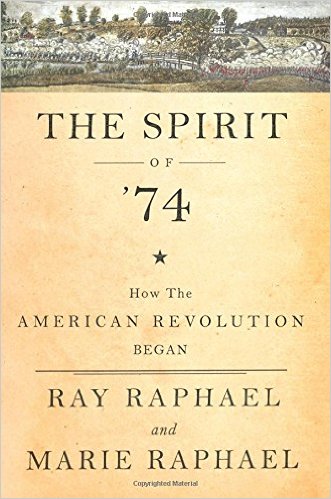
Review: The Spirit of ’74, How the American Revolution Began by Ray and Marie Raphael

ERW Book Reviews (1)Why did Boston’s act of political vandalism lead to a British military expedition against small towns in Massachusetts sixteen months later?

How, exactly did evolving political tensions result in actual warfare?

How did Lexington and Concord become, as Ralph Waldo Emerson wrote, “the shot heard around the world.”

The Spirit of '74, How the American Revolution Began by Ray Raphael and Marie Raphael
The Spirit of ’74, How the American Revolution Began by Ray Raphael and Marie Raphael

In a much-needed narrative, historians Ray and Marie Raphael fill in the movement toward those first shots at Lexington and Concord. In a primary source driven, easy to read history of that year before and leading up to 1775. However, “our story slows, pausing at additional markers that are often bypassed or slighted” (x).

Therein lies “only in a full telling is war a plausible outcome” (x).

The Raphael duo fluidly walks the reader through the build-up to that fateful April 1775 day. The book sheds light on developments in towns and counties across the colony of Massachusetts. A timeline in the beginning provides a good resource to remember the important dates as you read.

With the British response to the Boston Tea Party of December 1773, committed activists perceived that Britain had handed them a blueprint for disenfranchisement (44). What would be seen in the colony as the Coercive Acts, which, among other changes nullified the Charter of 1691 which colonists in Massachusetts held as sacrosanct. When the news of what the British government had did, which arrived in the harbor of Boston in May 1774 until the following April 1775, “resistance would mount, coalesce, and manifest itself in armed, relentless rebellion (44).

That coalescing would resemble an accordion, with Boston being one end and the countryside of Massachusetts the other end of the instrument. Both ends would reverberate the bellows as ideas, exchanges of opinions, passive and aggressive action, all marred the intervening months of 1774. Until as Abigail Adams wrote many months before April 1775, the”flame is kindled and like lightening it catches from soul to soul” (192).

The Raphael duo capture what the farmers in Berkshire set in motion, in accordance with capturing the attitude of townspeople in Worcester, Massachusetts at the same time. These various local uprisings, which put an emphasis on peaceful activities coalesced into the call for committees and eventually into the need for the Provincial Congress. This Congress acted as the de-facto governing body of Massachusetts in response to British measures to subdue and punish the intransigent rebels.

When viewed through the prism of the preceding years, what happened on the green of Lexington or the North Bridge at Concord becomes clearer as the pivot in which the simmering resentment in Massachusetts finally boiled over and led to the “shot heard around the world.”

Every once in a while a monograph is written that fills a necessary void in the field of early American Revolutionary history. This history is definitely one of those as it fills in that critical, yet overlooked, time period in the build-up to the fighting between British-American colonists and the redcoats that represented the mother country.

One cannot hope to understand the events of 1775 and beyond without knowing how the colonists of Massachusetts, so many that have unfortunately been lost to the passing of time, began the protests that led to independence, beginning in the years before.

Or as the authors more succinctly state; “and so begins a story we know” (214).


Book Information:

Publisher: The New Press, New York, NY

Pages: 219 pages plus acknowledgements, bibliography, index, and, timeline


“They Fought Because They Would Not Be Slaves”

RevWarWednesdays-headerRevolutionary War Wednesday and Emerging Revolutionary War is pleased to welcome guest historian Mark Maloy this week. 

African-Americans fought for the Americans during the Revolutionary War, right?  Many of us remember learning about Crispus Attucks dying during the Boston Massacre or have heard the oft-repeated saying that the Continental Army was the last integrated American army until the Korean War.

In this lithograph published in 1855, Crispus Attucks is portrayed front and center.  Crispus Attucks was lauded as the first martyr in the War for Independence much from the insistence of abolitionists like William C. Nell.  A Crispus Attucks Day was created in Boston in 1858 and a memorial placed for him and the other victims on Boston Common after the Civil War.  Despite all this, according to John Adams (who defended the British soldiers in court), Attucks was a rabble-rouser who actually helped precipitate the massacre.
In this lithograph published in 1855, Crispus Attucks is portrayed front and center. Crispus Attucks was lauded as the first martyr in the War for Independence much from the insistence of abolitionists like William C. Nell. A Crispus Attucks Day was created in Boston in 1858 and a memorial placed for him and the other victims on Boston Common after the Civil War. Despite all this, according to John Adams (who defended the British soldiers in court), Attucks was a rabble-rouser who actually helped precipitate the massacre.

Continue reading ““They Fought Because They Would Not Be Slaves””

“Our clocks are slow” L’Hermione, Lafayette and the Franco-American Alliance

RevWarWednesdays-header

unnamed
Marquis de Lafayette

With the visit of the L’Hermione to the east coast of the United States this summer, there has been a heightened interest in the Franco-American alliance that won the American Revolution.  The French rebuilt the L’Hermione not only for its beauty but also its historical significance.  Most importantly, its mission and the passenger it contained when it arrived in Boston in the fall of 1780.

The spring of 1780 was a low point in the American cause of independence.  Stagnation in the north between Washington and British commander General Sir Henry Clinton combined with devastating defeats in the Southern Theater caused low morale among the patriots.  Cornwallis had complete control over the Southern colonies and no standing American force seemed to be able to stop his movements.  Continue reading ““Our clocks are slow” L’Hermione, Lafayette and the Franco-American Alliance”

Inspired By the Americans

RevWarWednesdays-header

On December 16, 1773, in Boston, Massachusetts harbor, American colonists belonging to the Sons of Liberty stole aboard trade vessels anchored in the water. In protest to recently passed British legislation, the Native American dressed Sons of Liberty dumped 342 chests of tea into the water.

The Boston Tea Party became a prominent and well-known defiant act by the Americans on the road to the American Revolution.

Unbeknownst to the Adams, Warrens, and Hancock’s of the American Revolution, this particular form of protest–attacking the purse strings of the governing power–would resonate 75 years later, 3,284 miles, and one continent away. Continue reading “Inspired By the Americans”

240th Anniversary of the “Shot Heard Around the World”

Battle of Lexington, Engraved 1874

As we remember the events around Bennett Place this weekend, keep in mind our friends near Boston are commemorating another important anniversary.  Today marks the 240th anniversary of the battles of Lexington and Concord.  To read more about the events taking place at Minuteman National Park, the Lexington Historical Society and the Concord Historical Society our friend J.L. Bell’s “Boston 1775” blog is an excellent resource. You may visit his blog by following the link: http://boston1775.blogspot.com/

Thank you to everyone who has taken the time to read our Rev War Wednesday posts.  We hope shedding light on the events during the American Revolution gives more perspective to the events leading up to the American Civil War.

Another Anniversary to Commemorate Next Week

RevWarWednesdays-header

As we observe the beginning of the end of the American Civil War this week at Appomattox Court House, Virginia, another anniversary is just around the corner.

240 years and 10 days ago and approximately 630 miles the first shots of the American War of Independence was fired on Lexington Green on April 19, 1775.

Two events, two weeks in April. One commemorating the end of what some combatants at the time referred to as the Second American Revolution, whereas the other anniversary began the First American Revolution (if one sticks with that same theme).

So, as you finish your time tracing the last steps of the Confederate Army of Northern Virginia at Appomattox Court House head north and traverse the Battle Road between Boston, Lexington, and Concord.

Our friends at the national park, Minuteman National Historical Park have multiple events going on leading up to, through, and after the 19th of April.

Check out their events here; http://www.nps.gov/mima/planyourvisit/calendar.htm


The Most Fateful Decision of April 19, 1775

RevWarWednesdays-header


Lord Hugh Percy, the 2nd Duke of Northumberland and holding the rank of brigadier general commanded the relief brigade that was ordered out from Boston by Sir Thomas Gage after Lieutenant Colonel Francis Smith had sent back a messenger asking for reinforcements.

Little did Lord Percy realize at the time that by the late afternoon of April 19th, one quick decision saved the lives of countless British Redcoats and hundreds of American militia and minutemen. Continue reading “The Most Fateful Decision of April 19, 1775”

“Remember the Ladies”

RevWarWednesdays-header


March is Women’s History Month, a time to reflect on the many contributions women have contributed in our country. At George Washington Birthplace National Monument, our social media policy for the month has been to highlight important women to the history of the National Park Service and/or to George Washington’s life.

By writing the history text and developing what images to use for these posts, I thought I would take this example and expand it to include two other women that played integral parts in the American Revolutionary movement.

Abigail Adams and Mercy Otis Warren. Continue reading ““Remember the Ladies””

Lexington Part II – “Our troops advanced towards them, without any intention of injuring them.” Who Fired First at Lexington?

RevWarWednesdays-header


Battle of Lexington, Engraved 1874

The above words were written by Lt. Col. Francis Smith in his official report to General Thomas Gage. Smith, in command of the British expedition to Concord recently returned from what would be the opening salvo of rebellion. Smith wanted to be clear that he never intended to start bloodshed. In the days afterwards, the Massachusetts militia made it clear that they intended to lay the blame at the “regulars.” As soon as the British returned to Boston, the war of words began on who fired the first shot to begin a worldwide war. The British column that was led by Smith was sent from Boston to capture supplies reportedly stored at nearby Concord.  To get to Concord, the British would have to march through Lexington.  Due to a complex warning system, the local militia in Lexington were mustered and called to arms.  Captain John  Parker and his minutemen were lined up on the Lexington green in two rows, facing the road to Cambridge and the Lexington meetinghouse. The road south of the green headed to Concord, and Parker had his mean assembled on the northern portion of the green, away from the Concord road.

Continue reading “Lexington Part II – “Our troops advanced towards them, without any intention of injuring them.” Who Fired First at Lexington?”
