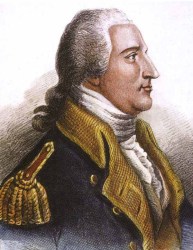
After turning coat, Benedict Arnold received a commission as a brigadier general in the British army as part of the deal that he made in order to betray his country.
In August 1781, George Washington decided to shift forces in order to attack the army of Lt. Gen. Lord Charles Cornwallis in Virginia. Washington began pulling troops from the New York area. Lt. Gen. Sir Henry Clinton, the British commander-in-chief in America, realized on September 2 that Washington’s tactics had deceived him, leaving him unable to mobilize quickly enough to help Cornwallis. Further, there was still a significant force of Continentals facing him in front of New York, and Clinton did not feel that he could detach troops to reinforce Cornwallis as a result.
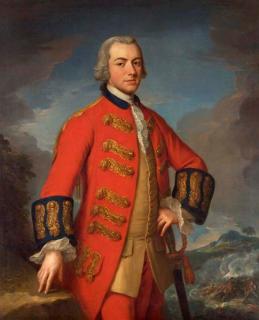
Instead, Clinton decided to launch a raid into Connecticut in the hope of forcing Washington to respond. Clinton intended that this be a raid, but he also recognized that New London could be used as a permanent base of operations into the interior of New England. Clinton appointed Arnold to command the raid because he was from Connecticut and knew the terrain.
Arnold commanded about 1,700 British solders, divided into two battalions. Lt. Col. Edmund Eyre commanded a battalion consisting of the 40th and 54th Regiments of Foot and Cortland Skinner’s New Jersey Volunteers, a Loyalist unit. Arnold himself commanded the other battalion, made up of the 38th Regiment of Foot and various Loyalist units, including the Loyal American Regiment and Arnold’s American Legion. Arnold also had about 100 Hessian Jägers, and three six-pound guns. This was a formidable force anchored by the three Regular regiments. Continue reading “The Battle of Groton Heights, September 6, 1781: The Fort Griswold Massacre”→
Recently, I had the chance to head to New England to take photos for an upcoming publication in the Emerging Revolutionary War Series. While thereI ventured to Salem, Massachusetts and New Castle, New Hampshire. Two great places filled with American history and also what could have been even more American history.
The shooting war that became the American Revolution began in Lexington and Concord, Massachusetts on April 19, 1775. Yet, these two places; Salem, Massachusetts and Fort William and Mary in New Hampshire, almost, caused the war to begin.
Here is what happened.
On December 14, 1774, local militia raided the British post garrisoned by six men at Fort William and Mary near Portsmouth, New Hampshire. Faced with over 400 militiamen the garrison proved obstinate and did not accept surrender and when faced with an assault, actually fired three cannon shots at the charging militia. Open combat ensued but no deaths occurred before the militia gained the fort.
Entrance to the fort, with the plaque commemorating the events in December 1774 to the right of the entrance.
During the afternoon, the militia would deprive the fort of over 100 barrels of precious gunpowder. By the next day, over 1,000 militiamen had arrived to lend support and within a few days, British General Thomas Gage had dispatched a small force on a British naval vessel but by the time they arrived, the commotion at Fort William and Mary had subsided.
Three months later and located approximately 50 miles south of Fort William and Mary is Salem where the following incident took place. Thomas Gage ordered 240 men of the 64th Foot Regiment under Lt. Col. Alexander Leslie on February 27, 1775 by water to the town. Upon arrival the force hovered off the coast waiting for the residents to attend their regular Sunday sermon. Soon after, the 64th Foot began to make the five mile march to Salem. A column of nearly 250 British regulars brought a lot of attention and soon riders were riding ahead to Salem to warn them of the approaching British. The men in Salem began to remove the cannon and hide them in the countryside. The main objective for Leslie was a blacksmith shop on the north side of the North River. Here is where it was reported that the ship cannons were being refitted for field use.
Historic Marker commemorating the spot of armed resistance at the Salem Bridge on February 27, 1775.
The issue at the river was a draw bridge was the only way across and as the British approached, several men raised the drawbridge so the British could not cross. By this time militia was on the opposite banks of the North River. An armed confrontation, one of many this winter, between colonials and Royal troops ensued. Leslie demand that the bridge be lowered so he could cross but the militia would not budge. Meanwhile, the cannons Leslie was looking for were being dispersed. Leslie threatened to fire on the militia, but Leslie’s senses got the best of him as he recognized hundreds of townspeople were now turned out and watching. He did not want to have blood on his hands this day. Plus the safety of his own men became in doubt as the day was getting long and he knew he had to extricate himself somehow.
Soon a local minister proposed a compromise, the bridge would be lowered and the British could cross and march to the blacksmith forge just a hundred yards beyond the bridge. If no cannon were found (which by now, they were all removed) then Leslie would turn around and march his men back to the ships on the shore. To Leslie, this was an honorable compromise as his orders were to cross the river and investigate the blacksmith forge and shop. Soon after the British crossed the North River, they re-crossed and marched back to their ships. Open rebellion was again thwarted. But a deadly precedent was set, the militia learned that the British did not intend to fire on them and such the bravery of each militia unit at each alarm was amplified.
Both of these affairs did not start the war. Both could have. We may never know why. But, what we do know is that they were example of how close the war was to starting. Lexington and Concord became the tipping point.
Emerging Revolutionary War is honored to welcome back guest historian David A. Powell.
When George Washington opened fire on a small party of Canadian militia commanded by Joseph Coulon de Villiers de Jumonville in May of 1754, he fired the first shots of what would eventually become the French and Indian War – and the Seven Years War across the rest of the globe. Many scholars have also acknowledged that this incident set the spark for what would become our own American Revolution.
Braddock’s Defeat: The Battle of the Monongahela and the Road to Revolution, by David Preston.
Of course, Washington intended none of those things; instead he was carrying out the British Crown’s policy of staking claim to and defending the Ohio Country, lately disputed between France and Britain. However, Jumonville’s death set irreversible forces in motion, not the least of which was the capture of Washington’s own company of Virginia Colonial Militia at Fort Necessity by a much larger French response in June of 1754.
The direct consequence of that encounter was the creation of a new British army, including two regiments of regulars and a train of artillery, rushed from Ireland and England to re-assert Crown control over the forks of the Ohio. Command of this new expedition fell to Major General Edward Braddock. Arriving in 1755, Braddock’s mission was to lead this new force from Fort Cumberland, in western Maryland, to the site of the French Fort Duquesne (present-day Pittsburgh.) That campaign ended in disaster on July 9, 1755 when Braddock’s column collided with a combined force of French and Indians just a dozen miles short of Duquesne, resulting in horrific British losses – including Braddock.
Not surprisingly, this story has been fertile ground for historians. Fine monographs have already been written on the campaign, as well as on the French and Indian War as a whole. Having a particular interest in the period, I have read a number of those works. Naturally, I was curious when I first heard of Dr. David Preston’s new book exploring the campaign.
Preston, a professor at the Citadel, has delivered a tremendous book. Combining new research and close analysis of previously known sources, he provides fresh new perspective on General Edward Braddock, his ill-fated expedition, and the French & Indians opposing him.
Preston finds that Braddock, far from being an unyielding martinet uninterested in either the “savages” or using Colonials, worked hard (if unsuccessfully) to bring Indian warriors into his force, and showed more respect for the colonial elements under his command than some previous historians have portrayed. A number of factors precluded Braddock’s success here, but it was not for want of trying.
Where Preston’s interpretation really shines is in exploring the French and Indian sides of the war. A new account of the battle, located in a French archive, casts new light on the French efforts to defend Fort Duquesne – a venture whose success was by no means a sure thing. Preston also explores the Indian Nations’ complex and diverse reasons for casting their support with the French, which was also not certain. Preston makes it clear that the French defense was in many ways based on fortuitous circumstances rather than planning, especially in regards to the timing of the campaign.
Preston’s detailed description of the battle in question on July 9 presents a clear and detailed exploration of the sequence events as far as they can be known; where the author speculates he notes that, and explains the basis of his interpretation. Above all, his narrative is well-written, exciting and drama-filled.
Preston also excels in his summation of the long-term impact of Braddock’s defeat, both on the fortunes of British North America in the two years following the battle (which ran from bad to disastrous) and on the longer term consequences: the development of light infantry and ranger tactics, leadership, and the growing rift between American colonials and England.
Students of both the Seven Years War in America and the American Revolution will want to read Braddock’s Defeat. Get your copy today.


 Instead, Clinton decided to launch a raid into Connecticut in the hope of forcing Washington to respond. Clinton intended that this be a raid, but he also recognized that New London could be used as a permanent base of operations into the interior of New England. Clinton appointed Arnold to command the raid because he was from Connecticut and knew the terrain.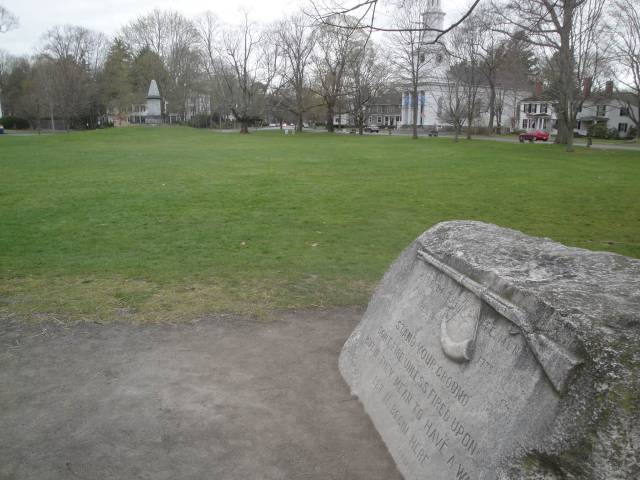


 Emerging Revolutionary War Era