

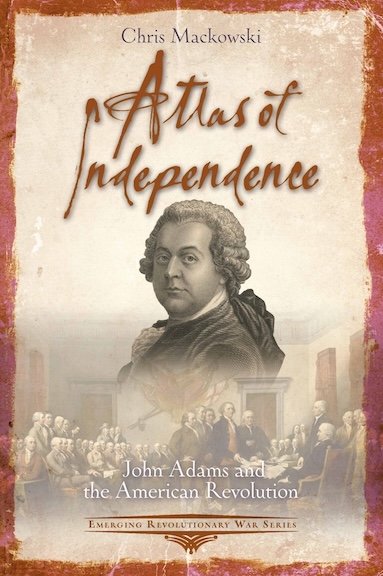
Atlas of Independence now available for pre-order!

The latest volume in the Emerging Revolutionary War Series is now available: Atlas of Independence: John Adams and the American Revolution. Publisher Savas Beatie is now offering exclusive signed copies available for pre-order. (Details here!)

As it happens, the publication of Atlas has origins deeply entwined with the origins of the Emerging Revolutionary War Series itself. One could easily argue that there would be no United States of America without John Adams; one could also argue there might not be an Emerging Civil War Series if not for Adams, either.

ERW started as “Rev War Wednesdays” on our sister blog, Emerging Civil War. Then we started up the ERW blog. Soon, co-founders Rob Orrison and Phill Greenwalt wanted to launch a book series similar to the Emerging Revolutionary War Series. The books would provide read-friendly overviews of important stories from the Revolutionary War era, with a focus on battles and leaders.

But how to start?

Rob and Phill approached me with the idea. I thought it was great. But at the time, I was underwater with projects (and, I guess, I still am!). I couldn’t take a direct hand in launching the series, but I did tell them I’d be glad to act in an advisory capacity…on one condition.

If we launched an Emerging Revolutionary War Series, I wanted to write a book about John Adams for the series.

I wasn’t sure when I’d be able to do it, but I wanted to plant my flag and stake my claim.

I’ve had a man-crush on Adams since first reading Joseph Ellis’s Pulitzer Prize-winning Founding Brothers, published in 2000. Ellis had a great fondness for Adams, which he readily admitted. It came across clearly in the book, and I found it infectious. Hooked by the bug, I turned to Ellis’s Passionate Sage: The Character and Legacy of John Adams, which painted a fascinating portrait of the lion in winter.

In 2001, David McCullough’s John Adams biography appeared. It, too, won the Pulitzer Prize. For Adams’s legacy, the book was a game-changer. It transcended history circles to become a cultural phenomenon all its own. It was an “It” book. It became a heady time to be an Adams fan.

My Adams journey led me through all sorts of readings and site visits. I got to know and love the Adams family. I grew to know and respect (but also bear a bit of a grudge toward) Adams’s opposite pole in the Revolution, Thomas Jefferson. I read letters and diaries and other primary sources. I became deeply steeped in the politics of the Independence movement. Most people know me as a Civil War writer, but this has been my other area of historical interest, my secret fascination.

Rob and Phill agreed to my one condition, and so we set out to start the new book series. Hannah Gordon, a former student of mine, came on as initial editor. Rob and Phill wrote about Lexington and Concord. The book series was underway!

It took my a while to get started on my Adams book, though. I have too many ideas for writing projects and not enough time. Not until 2021 did I get the decks cleared enough to start working on the book, but it proceeded in fits and starts as other projects and other ECW and ERW demands jockeyed for my time.

As a result, it took me almost exactly four years to write Atlas of Independence. (For me, that’s an incredibly long amount of time to write 50,000 words!) During that time, even as I worked on other projects, I kept reading John and Abigail’s correspondence with each other and with other people, familiarizing and re-familiarizing myself with the sources. It felt like extra time with treasured friends. The book and I are both better off for it.

I tried to present a fair and balanced account of Adams’s life during the Revolution, although, like Ellis, my fondness for Adams is apparent. I made sure to avoid the sort of hagiography Adams himself detested, though. History, he believed, should not fall victim to the weakness of romance, even if that’s the way people preferred to remember their history.

With the 250th anniversary of American Independence creeping up on me, I knew I had to get the book over the finish line. Adams was central to that story, and I did not want to miss the chance to tout his role. I buckled down last year and finished the manuscript, and the staff at Savas Beatie generously worked with me to get the book to press in time for the dawn of the anniversary year.

And so now here we are. Two hundred and fifty years ago, Adams was discovering the newly published pamphlet Common Sense; today, we get to discover the newly published Atlas of Independence.

 I hope you find John Adams to be excellent company. I certain have!


Signed copies of Atlas of Independence are available for pre-order from Savas Beatie for $16.95 plus shipping. Orders 1–100 will be personally signed; orders 101+ will come with an autographed book plate. Click here for details and to order your copy.
Reading Sam Adams…part 2

My recent comments about Stacy Schiff’s The Revolutionary Samuel Adams got me thinking about some of John Adams’s thoughts about his second cousin. In particular, John shared a neat story about Sam’s secretiveness—a problem that has bedeviled biographers, including Schiff, because Sam didn’t leave behind a trove of documentary evidence the way other Founders did.

“I have seen him . . .” said John, “in Philadelphia, when he was about to leave Congress, cut up with his scissors whole bundles of letters, into atoms that could never be reunited, and throw them out at the window, to be scattered by the winds. This was in summer, when he had no fire. In winter he threw whole handfuls into the fire. As we were on terms of perfect intimacy, I have joked him, perhaps rudely, upon his anxious caution. His answer was, ‘Whatever becomes of me, my friends shall never suffer by my negligence.’”[1]

John admired Sam, 13 years his senior, a great deal. The two were hardly acquainted growing up, but as John started off his legal career in Boston, Sam—a great cultivator of talent—pegged him as someone to develop. As tensions in Boston grew between the Sons of Liberty, British officials, and far-off Parliament, Sam brought John into the inner circle because of John’s sharp legal mind. The decision paved John’s eventual path to national politics.

“Mr. Adams was an original,” John said of Sam, saying he was “born and tempered a wedge of steel. . . .”[2]

In his common appearance, he was a plain, simple, decent citizen, of middling stature, dress and manners. He had an exquisite ear for music, and a charming voice, when he pleased to exert it.—Yet his ordinary speeches in town meetings, in the house of representatives and in congress, exhibited nothing extraordinary; but upon great occasions, when his deeper feelings were excited, he erected himself, or rather nature seemed to erect him, without the smallest symptom of affectation, into an upright dignity of figure and gesture, and gave a harmony to his voice, which made a strong impression on spectators and auditors, the more lasting for the purity, correctness and nervous elegance of his style.[3]

John spoke on several occasions of Sam’s “an air of dignity and majesty.” He admired Sam’s “harmonious voice and decisive tone” and his “self-recollection, a self-possession, a self-command, a presence of mind that was admired by every man present. . . .”[4] He also listed “his caution, his discretion, his ingenuity, his sagacity, his self-command, his presence of mind, and his intrepidity” as traits that “commanded the admiration” of friend and foe alike—friends who applauded him and foes who could not help but respect Sam Adams’s considerable populist powers.[5]

It is little doubt why John later said, “Without the character of Samuel Adams, the true history of the American Revolution can never be written.”[6]


[1] “From John Adams to William Tudor, Sr., 5 June 1813,” Founders Online, National Archives, https://founders.archives.gov/documents/Adams/99-02-02-6054. 

[2] “From John Adams to William Tudor, Sr., 5 June 1813,” Founders Online, National Archives, https://founders.archives.gov/documents/Adams/99-02-02-6054. 

[3] “From John Adams to William Tudor, Sr., 15 April 1818,” Founders Online, National Archives, https://founders.archives.gov/documents/Adams/99-02-02-6883.

[4] “From John Adams to William Tudor, Sr., 15 April 1818,” Founders Online, National Archives, https://founders.archives.gov/documents/Adams/99-02-02-6883.

[5] “From John Adams to Jedidiah Morse, 1 January 1816,” Founders Online, National Archives, https://founders.archives.gov/documents/Adams/99-02-02-6563. 

[6] “From John Adams to William Tudor, Sr., 15 April 1818,” Founders Online, National Archives, https://founders.archives.gov/documents/Adams/99-02-02-6883.

Reading Sam Adams…

I’m currently reading Stacy Schiff’s new biography The Revolutionary Samuel Adams. It’s a snappy-to-read, deeply researched book—all the more challenging to write because Sam Adams made careful effort not to leave much of a paper trail about himself.  

Schiff uses her introduction to sketch out this fundamental problem, and in doing so, she creates a compelling flash portrait of Adams that the rest of the book fleshes out. Adams the historiographical sphinx is well served by this portrait. Sam Adams simultaneously led from the front yet operated in the shadows, an apparent contradiction that Schiff nonetheless portrays fully and effectively. 

As the book goes on, Schiff manages to pull from a deep well of primary sources, even if there’s not a mountain from Sam himself. She handles those sources adroitly and comfortably, plucking this bit from here and that bit from there the way a conductor works an orchestra.  

The result is an admiring but not fawning portrait of Adams—a man without whom, said cousin John, “the true history of the American Revolution can never be written.”[1] 

Troubling to me in the text is that, in the late 1760s and early 1770s, the Adams-led Sons of Liberty often employed mob violence—real and threatened—to achieve their aims. Propaganda efforts were often tethered to reality by only thinnest of meager threads, if at all. Men were intimidated, bullied, tarred and feathered, humiliated, assaulted, and run out of town for opposing or even just disagreeing with them. Houses were ransacked. Livelihoods destroyed. Reputations ruined. I could not help but think of the Klan in the Reconstruction-era South—a comparison no-doubt tantamount to sacrilege when talking about a group of Bostonians popularly and fondly remembered as patriots.  

Yet Schiff merrily skates over such rough terrain, sharing vivid details about incidents without exploring the moral morass this tension suggests. Her hero acts in decidedly less-than-heroic ways, arguing that the ends justify the means. We as readers are left to ponder this ambiguity ourselves. Such work on the reader’s part isn’t a bad thing, but it does strike me as somewhat of an abdication on the biographer’s part when the rest of the narrative is so cheerfully pro-Adams. 

Overall, The Revolutionary Samuel Adams is an excellent work so far, and I highly recommend it for anyone who wants a fuller understanding of how the wheels of Revolution started turning—and who started them. 


[1]“From John Adams to William Tudor, Sr., 5 June 1813,” Founders Online, National Archives, https://founders.archives.gov/documents/Adams/99-02-02-6054.  

The “Valley Forge” Winter of the Army of the Potomac

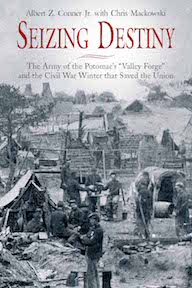
Layout 1Emerging Revolutionary War is pleased to present an excerpt from the forthcoming book Seizing Destiny: The Army of the Potomac’s ‘Valley Forge’ and the Civil War Winter that Saved the Union by Albert Conner, Jr., with Chris Mackowski, published by Savas Beatie. The book likens the AoP’s experience in Stafford County, Virginia, in the winter of 1862-63 to that of Washington’s army outside Philadelphia in the winter of 1777-78. The book contends that the AoP’s resurgence as a result of that winter represented the most significant non-battle turning point of the war. Seizing Destiny will be available the third week of March.

Dissatisfaction swept over the Army of the Potomac like a midwinter blizzard. Morale plummeted. Men grew bitter. Hope froze.

The chill was far worse than anything Rufus Dawes had seen back in Wisconsin, and it was only late December. The 24-year-old major of the 6th Wisconsin Infantry, born on the Fourth of July in 1838, had watched conditions worsen ever since the debacle in Fredericksburg earlier in the month. Major General Ambrose E. Burnside had led the army to its most lopsided defeat of the war thus far, and the ill winds began blustering shortly thereafter. The squall hit furiously, almost as soon as the army retreated across the Rappahannock River into Stafford County.

“The army seems to be overburdened with second rate men in high positions, from General Burnside down,” Dawes wrote. “Common place and whisky are too much in power for the most hopeful future. This winter is, indeed, the Valley Forge of the war.” Continue reading “The “Valley Forge” Winter of the Army of the Potomac”