Rev War Revelry: Kip’s Bay and Harlem Heights

Join us this Sunday at 7pm as we ERW authors and historians Dan Welch and Mark Maloy continue their 250th anniversary coverage of the New York Campaign. They’ll chat with us about the events following the Continentals retreat from Long Island, Nathan Hale, the Turtle, the Peace Conference, and of course the fighting at Kip’s Bay and Harlem Heights. Welch and Maloy’s new book, “Conquer or Die” will be available this fall. This Revelry will be LIVE on our Facebook and You Tube pages at 7pm.

Be sure to subscribe to our You Tube Channel for hundreds of hours of free content on the American Revolutionary Era! https://www.youtube.com/@emergingrevolutionarywar8217

The 1776 New York Campaign: 250 Years Later

The New York Campaign had been building for over year by August 1776. In July 1775, previous British commander of forces in America, Thomas Gage, had sent a request to his superiors to be allowed to leave Boston and begin a new campaign in New York. Following Lexington, Concord, and Bunker Hill, Gage’s force remained bottled up and besieged in and around Boston and Charleston. When word of approval of Gage’s plan reached Boston, so too did orders relieving him of command. Before he departed for England in October 1775, he met with his successor, William Howe, and greatly stressed the importance of moving the theater of war to New York. Howe would follow Gage’s preplanning and approval to the letter, including waiting until the spring to began the shift in the army’s base of operations. Howe’s timetable, however, was moved up after the arrival of Henry Knox’s artillery train and the placement of guns on Dorchester Heights. On March 17, 1776, Howe and 11,000 troops and Loyalist citizens sailed for Nova Scotia. Foreshadowing the British departure and the location of the next campaign in a letter written two days before they set sail, Col. Joseph Reed, later George Washington’s adjutant-general, correctly asserted, “If Howe should leave Boston, we expect he will make for New York; and, at all events, we look upon that as one of the scenes of the summer business.”

Meanwhile, George Washington also looked to New York as the next seat of this growing conflict. In January he sent Charles Lee to begin laying out a position for the Continental Army to take once it shifted southward from Boston. Not long after Lee arrived in February 1776 he assured the Committee of Safety that even though he could see no way to make New York into a “tenable fortification” he could make a position strong enough to be “a most advantageous field of battle” that would “cost the enemy many thousands of men to get possession of it.” Just two months later, on April 13, Washington and the Continental Army arrived.

The Continental Army commander had no other choice than to do what he could in New York. There was immense political pressure on Washington not to abandon it, the Congress believing it had high political and psychological value. Many in Congress believed abandoning it would demoralize the Patriot cause and swell the morale of the Loyalist population in the city and colony thereof. Furthermore, it was a central location along the Atlantic coast and a conduit of communication and supplies between New England and the southern colonies via the Hudson River. Furthermore, the Hudson River/Lake Champlain corridor remained a vital passage to Canada and the Great Lakes. New York was also a bustling economic hub, the second largest urban center in the colonies, with a port, shipbuilding, and deep-water harbor had immense naval and trade value. Widely considered as the “key to the continent,” Washington would have a difficult task defend the city, it’s deep water port, and the numerous navigable waterways; all reasons the British wanted to seize the city in their effort cutoff New England from the middle and southern colonies. Writing to his brother, John Augustine Washington, between May 31 and June 4, 1776, he confessed, “We expect a very bloody Summer of it at New York . . . & I am sorry to say that we are not, either in Men, or Arms, prepared for it.”

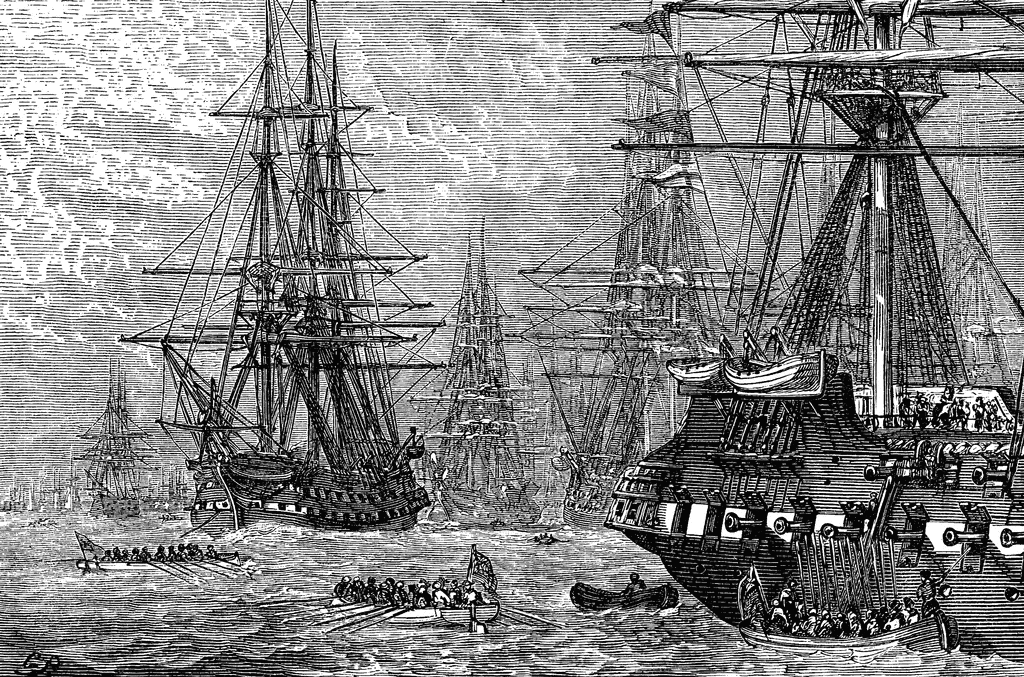
Finally, after several months of resupplying and refitting his army in Nova Scotia, William Howe and his command arrived on Staten Island, unopposed, in June 1776. Pvt. Daniel McCurtin, 1st Company of Maryland Rifles, recorded the British arrival, noting he saw, “the whole Bay was full of shipping as ever it could be. I declare that I thought all London was afloat.”Over the coming weeks he would be joined by his brother, Richard, with large numbers of reinforcements, ships, transports, supplies, and Hessians. Although the two brothers leaned into their role of peace commissioners, attempting to end this growing rebellion through pardons and not bloodshed in July, by August, with no peaceful resolution insight, military preparations moved forward.

On August 20, 1776, British troops began loading onto ships and transports from their Staten Island camps, and 250 years ago today, August 22, 1776, the first British troops landed on Long Island at Denyse’s Ferry. Howe had chosen this site for its richness and crops and plentiful livestock in which to supply his army. Still unsure of Howe’s intentions, and constantly worried about his flank and rear being turned by the British Navy, Washington had spread his army dangerously thin across several islands with waterways separating reinforcements should the need for them arise. Thus, on August 22, Washington only had 3,000 men, John Nixon and Nathaniel Heard’s brigades, and some Long Island militia in which to contest the landing. All they could really do was raise the alarm. By the end of the day 20,000 British troops were on Long Island. Only time would tell, at least for Washington, whether or not this would be Howe’s main push or simply a diversion to another beachhead and main strike.

Learn more about the 1776 New York Campaign with ERW’s forthcoming release, Conquer or Die: The 1776 New York Campaign, by Dan Welch and Mark Maloy. Pre-order here!

The Adams Book Club: “Atlas of Independence” by Chris Mackowski

Emerging Revolutionary War is pleased to partner with the Adams Memorial Foundation to share some reading about America’s “Founding Family.” The Foundation holds a monthly book club, hosted by Board President Jackie Cushman. In special arrangement with the Adams Memorial Foundation, ERW is sharing links to the first few conversations from that book club.

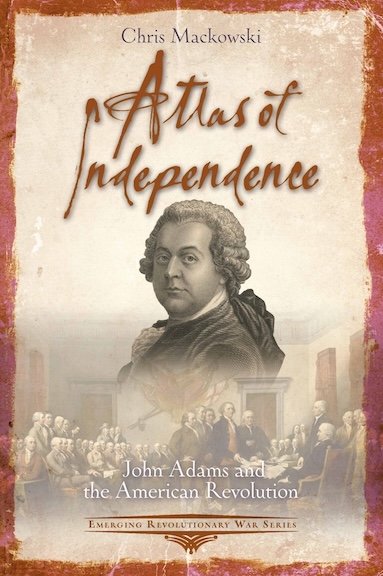
The next book highlighted in our series is Atlas of Independence: John Adams and the American Revolution by ERW’s own Chris Mackowski.

Continue reading “The Adams Book Club: “Atlas of Independence” by Chris Mackowski”

Atlas of Independence now available for pre-order!

The latest volume in the Emerging Revolutionary War Series is now available: Atlas of Independence: John Adams and the American Revolution. Publisher Savas Beatie is now offering exclusive signed copies available for pre-order. (Details here!)

As it happens, the publication of Atlas has origins deeply entwined with the origins of the Emerging Revolutionary War Series itself. One could easily argue that there would be no United States of America without John Adams; one could also argue there might not be an Emerging Civil War Series if not for Adams, either.

ERW started as “Rev War Wednesdays” on our sister blog, Emerging Civil War. Then we started up the ERW blog. Soon, co-founders Rob Orrison and Phill Greenwalt wanted to launch a book series similar to the Emerging Revolutionary War Series. The books would provide read-friendly overviews of important stories from the Revolutionary War era, with a focus on battles and leaders.

But how to start?

Rob and Phill approached me with the idea. I thought it was great. But at the time, I was underwater with projects (and, I guess, I still am!). I couldn’t take a direct hand in launching the series, but I did tell them I’d be glad to act in an advisory capacity…on one condition.

If we launched an Emerging Revolutionary War Series, I wanted to write a book about John Adams for the series.

I wasn’t sure when I’d be able to do it, but I wanted to plant my flag and stake my claim.

I’ve had a man-crush on Adams since first reading Joseph Ellis’s Pulitzer Prize-winning Founding Brothers, published in 2000. Ellis had a great fondness for Adams, which he readily admitted. It came across clearly in the book, and I found it infectious. Hooked by the bug, I turned to Ellis’s Passionate Sage: The Character and Legacy of John Adams, which painted a fascinating portrait of the lion in winter.

In 2001, David McCullough’s John Adams biography appeared. It, too, won the Pulitzer Prize. For Adams’s legacy, the book was a game-changer. It transcended history circles to become a cultural phenomenon all its own. It was an “It” book. It became a heady time to be an Adams fan.

My Adams journey led me through all sorts of readings and site visits. I got to know and love the Adams family. I grew to know and respect (but also bear a bit of a grudge toward) Adams’s opposite pole in the Revolution, Thomas Jefferson. I read letters and diaries and other primary sources. I became deeply steeped in the politics of the Independence movement. Most people know me as a Civil War writer, but this has been my other area of historical interest, my secret fascination.

Rob and Phill agreed to my one condition, and so we set out to start the new book series. Hannah Gordon, a former student of mine, came on as initial editor. Rob and Phill wrote about Lexington and Concord. The book series was underway!

It took my a while to get started on my Adams book, though. I have too many ideas for writing projects and not enough time. Not until 2021 did I get the decks cleared enough to start working on the book, but it proceeded in fits and starts as other projects and other ECW and ERW demands jockeyed for my time.

As a result, it took me almost exactly four years to write Atlas of Independence. (For me, that’s an incredibly long amount of time to write 50,000 words!) During that time, even as I worked on other projects, I kept reading John and Abigail’s correspondence with each other and with other people, familiarizing and re-familiarizing myself with the sources. It felt like extra time with treasured friends. The book and I are both better off for it.

I tried to present a fair and balanced account of Adams’s life during the Revolution, although, like Ellis, my fondness for Adams is apparent. I made sure to avoid the sort of hagiography Adams himself detested, though. History, he believed, should not fall victim to the weakness of romance, even if that’s the way people preferred to remember their history.

With the 250th anniversary of American Independence creeping up on me, I knew I had to get the book over the finish line. Adams was central to that story, and I did not want to miss the chance to tout his role. I buckled down last year and finished the manuscript, and the staff at Savas Beatie generously worked with me to get the book to press in time for the dawn of the anniversary year.

And so now here we are. Two hundred and fifty years ago, Adams was discovering the newly published pamphlet Common Sense; today, we get to discover the newly published Atlas of Independence.

 I hope you find John Adams to be excellent company. I certain have!


Signed copies of Atlas of Independence are available for pre-order from Savas Beatie for $16.95 plus shipping. Orders 1–100 will be personally signed; orders 101+ will come with an autographed book plate. Click here for details and to order your copy.


A New Look for <i>A Dear-Bought Victory</i>

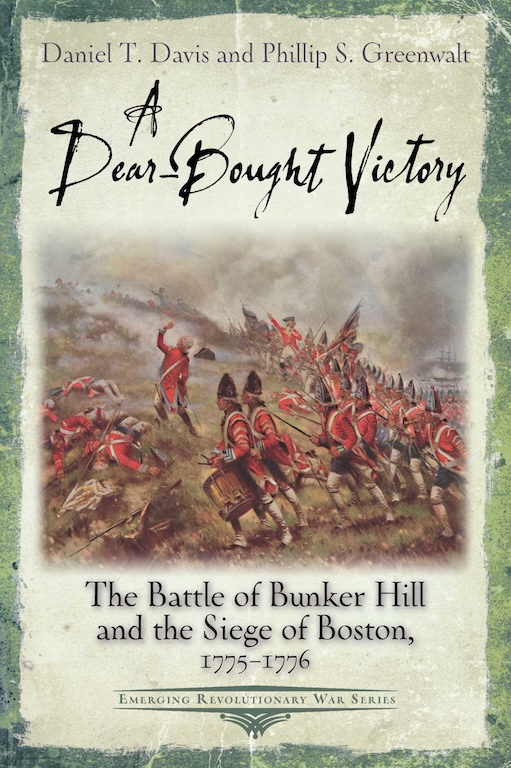
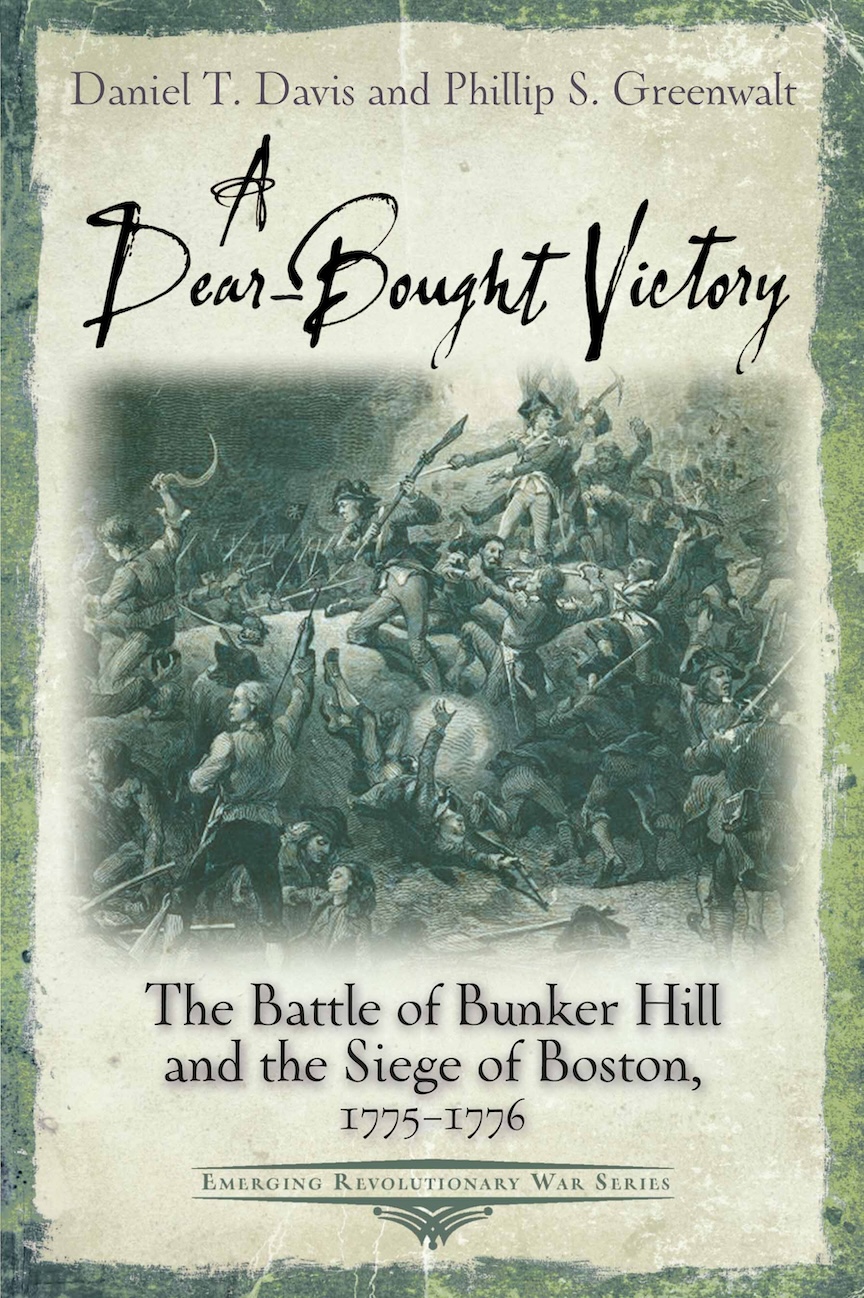
We’ve made an update to the cover of our upcoming book on the battle of Bunker Hill by Dan Davis and Phill Greenwalt. We thought you’d like a peek:

The previous cover design featured a woodcut that was obviously in the public domain–yet we couldn’t quite put our finger on it. That made us nervous enough to swap out the image!

The replacement image, which comes courtesy of the Library of Congress, was painted by E. Percy Moran around 1909. It shows the advance of British troops up the slope of Breed’s Hill, where they paid a heavy toll—indeed, a dear-bought victory.

We love the contrast between the red coats and the green design, which is much more eye-catching than the original cover. We hope you agree: this really pops!

Look for A Dear-Bought Victory: The Battle of Bunker Hill and the Siege of Boston by Daniel T. Davis and Phill Greenwalt coming in June 2026.

Coming Soon: A Dear-Bought Victory: The Battle of Bunker Hill and the Siege of Boston 1775-1776

We’re excited to share one of the 2026 new releases in the Emerging Revolutionary War Series. Published by Savas Beatie, a sneak peek, including the cover, is below.

About the Book:

“I wish we could sell them another hill at the same price we did Bunkers Hill,” Nathanael Greene wrote to the governor of Rhode Island after the battle of June 17, 1775.

Actually fought on Breed’s Hill outside Boston, Massachusetts, the battle of Bunker Hill proved a pyrrhic victory for British forces. Confident in their ability to overwhelm the New England militia that opposed them, long lines of neatly uniformed British infantry and marines swept uphill toward a quickly built earthen redoubt defended by a motely collection of farmers, shopkeepers, and tradesmen.

“Don’t fire until you see the whites of their eyes!” the colonials urged each other—or did they?

By the end of the fight, the British gained the summit and Colonial forces scattered. One of the patriot leaders, Dr. Joseph Warren, lay dead—one of the first martyrs of the American Revolution. But for the British, the scene was far, far worse: it would be the greatest number of casualties they would ever suffer in any battle of the American Revolution. As British General Henry Clinton commented afterward, “A few more such victories would have surely put an end to British dominion in America.”

The siege of Boston would continue, but the sobering lesson of Bunker Hill changed British strategy—as did the arrival soon thereafter of a new commander-in-chief of Continental forces: General George Washington.

In A Dear-Bought Victory, historians Daniel T. Davis and Phillip S. Greenwalt separate the facts from the myths as they take readers to the slopes of Breed’s Hill and along the Boston siege lines as they explore a battle that continues to hold a place in popular memory unlike few others.

About the Authors:

Daniel T. Davis is the Senior Education Manager at the American Battlefield Trust. He is a graduate of Longwood University with a bachelor’s degree in public history. Dan has worked as a Ranger/Historian at Appomattox Court House National Historical Park and Fredericksburg and Spotsylvania National Military Park. He is the author or co-author of numerous books on the American Civil War. This is his first co-authored book in the Emerging Revolutionary War Series. Dan is a native of Fredericksburg, Virginia.

Phillip S. Greenwalt is the co-founder of Emerging Revolutionary War and a full-time contributor to Emerging Civil War. He is a graduate of Wheeling Jesuit University with a bachelor’s degree in history along with graduate degrees in American History and International Studies and Leadership from George Mason University and Arizona State University, respectively. He is the author of co-author of seven books on the American Revolutionary and Civil Wars. Phill has worked for the National Park Service for the last 17 years at numerous natural and cultural sites. He is a native of Baltimore, Maryland.

August 15, 1780 – Horatio Gates, Thomas Sumter and the road to Camden

Major General Horatio Gates, “Hero of Saratoga” was tasked with saving the American effort in the south. Credit NPS

On August 15, Maj. Gen. Horatio Gates began to finalize his plans to move against Camden, SC. Gates, appointed as the new commander of the Southern Department the previous month, believed the British garrison in Camden was weak. Gates was receiving intelligence gathered by partisan commander Thomas Sumter who was acting in and around Camden. He informed Gates that the American army outnumbered the British post and that a large portion of the men at Camden were taken ill and not fit for duty (on this account, Sumter was correct). Sumter did not provide the intelligence that Lord Cornwallis was now in Camden with reinforcements and was taking personal command of the British force in Camden.

Modern day image of the area at Rugeley’s Mills, with modern day Flat Rock Road following the historic trace of the Great Wagon Road. Credit Rob Orrison

With this information, Gates felt confident in his ability to take on the British in Camden. He developed a plan that involved a three-part movement. He would leave his force south to Saunder’s Creek (about six miles north of Camden) and establish a strong defensive position. He also ordered Francis Marion and his men to the southeast. Gates wanted Marion to take command of the Williamsburg militia, watch the British movements, and destroy boats in the Santee River that a defeated Cornwallis might need to retreat from Camden to Charleston. The third prong he ordered a few days earlier on August 13. Gates, under the encouragement of Thomas Sumter, decided to send 100 Maryland Continentals and 300 Carolina militiamen (as well as two brass three pounders) to join Sumter and move down the western side of the Wateree. From this location Sumter could attack supplies and reinforcements going into Camden from Ninety Six to the west. Gates’s confidence was evident.

South Carolina militia Brig. Gen Thomas Sumter. Credit New York Public Library

As Gates made his final disposition to move south, Sumter’s militia along with his Continental detachment met some success west of Camden. The Wateree River flowed south just one mile west of Camden. Near the important Wateree Ferry that served the major route west from Camden, Loyalist Lt. Col. James Cary built a small fort on his farm near the ferry. Sumter was aware of the fort and decided to see if he could capture it. When Col. Thomas Taylor of Sumter’s command launched the attack, most of the defenders inside were asleep, and the others were deceived by Patriot militia dressed just like those occupying the fort. The Loyalists immediately surrendered. Sumter reported that his men killed 7 and captured 30 prisoners, including Cary. Also included in the loot were 38 wagons of supplies and nearly 300 head of cattle. After capturing Cary’s Fort, Sumter was also able to attack and capture a relief column from Ninety Six to Camden. Sumter’s spoils from this attack numbered nearly 70 prisoners and numerous wagons. Sumter also reaffirmed his earlier intelligence to Gates by writing that the British in Camden “do not exceed two thousand, and not as many as one thousand of the militia, who aregenerally sickly, and much dispirited.” Sumter’s intelligence, though not accurate, gave Gates encouragement on the upcoming movement toward Camden. At 10pm on August 15, Gates had his army on the road south towards Camden.

Gates was flush with optimism, at that same time Cornwallis had his army on the road north. Though the British forces were about half the size of Gates, they were more than Gates expected and consisted of some of the best men in the British army led by one of their most accomplished generals. Soon, due to a twist of fate, these two armies collided along the Great Wagon Road in the long life pine forest of South Carolina. The result was one of the worst days in the history of the United States Army.

Authors Rob Orrison and Mark Wilcox’s new book “All That Can Be Expected: The Battle of Camden and the British High Tide in the South, August 16, 1780” is due out August, 2023 and available at: https://www.savasbeatie.com/

Sir Henry Clinton’s Close Encounter

Emerging Revolutionary War welcomes the contribution of Eric Olsen, Park Ranger/Historian at Morristown National Historical Park

Military history tends to be a lot of “so and so’s” brigade advanced on the left wing, while “what’s his face’s” division withdrew.” Lots of movements of large faceless masses of soldiers. Personally, I prefer the little personal stories of individuals in the face of battle. Here is one such story from the battle of Monmouth in June 1778. 

Sir Henry Clinton

I recently ran across this little tidbit in a July 7, 1778, letter written by the Adjutant General of the Hessian forces in America, Major Carl Leopold Baumeister. He described an incident during the battle of Monmouth involving the British commander in chief, Sir Henry Clinton. “General Clinton in the thickest fire, was saved by one of his adjutants, Captain Sutherland, when a rebel colonel aimed at him, but missed. Captain Sutherland’s horse was wounded. Another adjutant, Lloyd, stabbed the colonel.”

The story sounded vaguely familiar. Then I recalled something I’d read written by a British officer named Thomas Anbury. He was a prisoner of war, part of Burgoyne’s captured “Convention Army.” Anbury and the other prisoners were being held near Charlottesville, Virginia. At a place called Jones’s Plantation, Anbury related the following story on May 12, 1779,

“A very singular circumstance took place in that battle [Monmouth], which fully marks the coolness and deliberation, though in the heat of action, of Sir Henry Clinton: As he was reconnoitering, with two of his Aide de Camps, at the short turning of two roads, they met with an American officer, exceedingly well mounted upon a black horse, who, upon discerning them, made a stop, and looked as if he wished to advance to speak to them, when one of Sir Henry Clinton’s Aid de Camps fired a pistol at him, and he instantly rode off. Sir Henry was much displeased at his Aide de Camp, and censured him for being so hasty, adding, he was confident that the man wished to speak to him, and perhaps, might have given intelligence that would have been very essential, remarking, that when he was in Germany last war, and reconnoitering with Prince Ferdinand, a man rode up in a familiar manner, and gave such intelligence as decided the fate of the day.”

To read more about the Battle of Monmouth, check out “A Handsome Flogging, the Battle of Monmouth, June 28, 1778 by William Griffith, part of the Emerging Revolutionary War Series.

Rev War Revelry Discusses NEW Emerging Rev War Book!

Charleston, South Carolina is one of the most beautiful and historic cities in the United States. Numerous sites, battlefields, and buildings from the period of the Revolution still exist.

Join us this Sunday at 7pm as we discuss ERW’s newest release “To The Last Extremity: The Battles for Charleston” by Mark Maloy. In To the Last Extremity: The Battles for Charleston, historian Mark Maloy not only recounts the Revolutionary War history of Charleston, he takes you to the places where the history actually happened. He shows you where the outnumbered patriots beat back the most powerful navy in the world, where soldiers bravely defended the city in 1779 and 1780, and where thousands suffered under occupation. Through it all, brave patriots were willing to defend the city and their liberty “to the last extremity.”

We will talk to Mark about his research, his favorite and most compelling stories and why this book is a “must have” for any history buff. Join us this Sunday, April 16 at 7pm on our Facebook page to join in on the conversation. As always, if you can not join us live you can catch the talk at any time on our You Tube or podcast channel.

The March in…on this date in 1777

Beginning on December 8, 1777, General George Washington and his Continental army left the environs of White Marsh to begin the movement toward their winter encampment. The rank-and-file crossed over the Schuylkill River and headed westward. Within three days the soldiers had trudged into an area called the Gulph on a December Thursday morning.

During this sojourn Washington wrote a a flurry of orders and letters, finally selecting Valley Forge. His reasoning was explained in the general orders for that day while also observing another delay in order to honor a day of fasting and thanksgiving decreed by the Continental Congress. Washington began that general order on December 17, 1777 by acknowledging the thousands of men that were braving the weather, lack of sustenance, and the rigors of the 1777 campaigning season.

“The Commander-in-Chief with the highest satisfaction expresses his thanks to the officers and soldiers for the fortitude and patience with which they have sustained the fatigues of the Campaign. Altho’ in some instances we unfortunately failed, yet upon the whole Heaven hath smiled on our Arms and crowned them with signal success; and we may upon the best grounds conclude, that by a spirited continuance of the measures necessary for our defence we shall finally obtain the end of our Warfare, Independence, Liberty and Peace.

The march resumed around 10 a.m. on December 19, a Friday, as the Continental army trudged out of the Gulph Mills area and on to their final destination for 1777; Valley Forge. The army would soon spread out to occupy over 7,800 acres of Pennsylvania countryside and spend the next six months resting, recuperating, surviving, and training.

To read more about the end of the 1777 campaign and the winter spent at Valley Forge, check out the book, by yours truly, Winter that Won the War, part of the Emerging Revolutionary War Series, published by Savas Beatie, LLC.