

(part three of five)
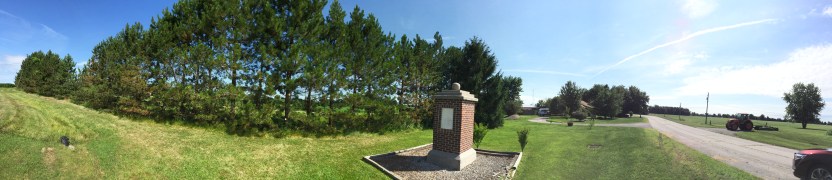
The expedition continued through thick forest until June 4, when it finally came upon a Wyandot town on the upper Sandusky after noon. It was abandoned to the surprise of Crawford’s guides.[i] (The Wyandot shifted from “Upper Sandusky,” which became known as “old town” and was above the modern town of Upper Sandusky to a new town of “Upper Sandusky,” which became known as Half-King’s town and was below the modern town of Upper Sandusky.) At this point, several men expressed their desire to return to the Ohio, complaining they were down to five days provisions.[ii] Crawford sent a reconnaissance party of about 40 men under Major Rose to the north, where the woods opened up into a gentle plain. Dr. Knight recalled, “there are a great many extensive plains in that country; The woods in general grow very thin, and free from brush and underwood; so that light horsemen may advance a considerable distance before an army without being much exposed to the enemy.”[iii] Indeed, northwestern Ohio was a gently rolling plain flattened by glaciers over a million years ago and covered in 1782 with knee- to waist-high grass, interrupted by an occasional grove of trees. The terrain rolls with small, gentle gulleys and hills rising in quick succession. The combination limited one’s ability to see great distances. It was perfect for the mounted force Crawford led, theoretically capable of moving quickly. But, the slow pace of the advance, the difficulty of terrain, poor availability of forage in the woods, and quality of the horses had worn the mounts out.[iv]
Continue reading “The Crawford Campaign, 1782: Battle on the Sandusky”
 Emerging Revolutionary War Era