A Tribute to Robert Treat Paine

The city of Boston, Massachusetts is steeped in American Revolutionary War history. The city has designed an entire trail–the “Freedom Trail”–a footpath that leads interested visitors around the city to the areas of most importance.

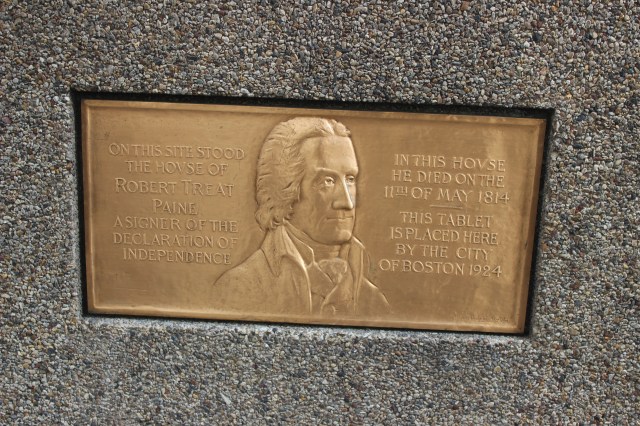
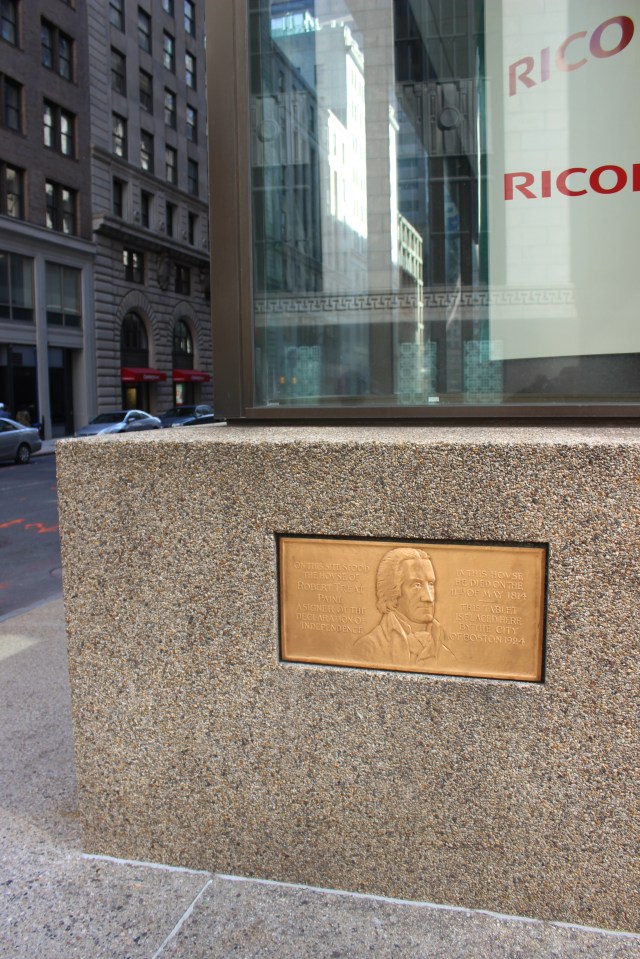
Yet, some history, is just, literally, stuck right on the walls of Boston. On the side of a modern office building, is situated the plaque below:
IMG_7075

One of the 56 men that affixed his signature to the Declaration of Independence, Paine was born in Boston on March 11, 1731 and was actually given a middle name, a family tribute. His family legacy was well-established in the colonies and Paine himself was counted as an early advocate for the patriotic cause.

Yet, like the more famous John Adams, Paine also was a lawyer and dedicated to the law and order. He was the second attorney, along with the aforementioned Adams, to represent the British soldiers in the “Boston Massacre” trial. He continued to hope for reconciliation, hoping when he ventured to the Second Continental Congress, that the resolve of the colonies would bring the British Parliament to negotiate. On that same vein, Paine also put his signature on the Olive Branch Petition–the final attempt by the colonies to reach King George III and give their side of the story. When the king outright rejected the petition and did not even lay eyes on the document, Paine saw there was no hope and firmly planted himself in the camp of those clamoring for independence.

He became a vocal and valuable member of the Continental Congress and signed the Declaration of Independence on August 2, 1776. Returning to Massachusetts near the end of 1776, he became the Speaker of the Massachusetts House of Representatives the following year. In 1780 he was a member of the committee that drafted the state constitution and as attorney general he prosecuted members of Shays’ Rebellion in 1787.

His last public role was a justice of the Massachusetts Supreme Court from 1790 until his retirement in 1804. He was 83 years old when he died in the house that the plaque mentions. He was buried in the Granary Burying Ground in his native Boston, Massachusetts.

Another great patriot of the American cause, whose last house where his last days were spent, has a lasting memorial for those to discover. So, many historical treasures are just hanging there, waiting to be discovered in Boston.
IMG_7076
Another view of the Robert Treat Paine plaque in Boston

Continue reading “A Tribute to Robert Treat Paine”

“Happy Independence Day”

Whether you are about to enjoy a firework display, finishing up a family barbecue, or enjoying this holiday in some other form, the historians here at Emerging Revolutionary War wish all our readers and fellow historians a “Happy Independence Day.”

For those protecting our country on this day, around the world, a big “thank you” to go along with this July 4th, to you as well.

But, let’s not forget the true meaning of this day. When, in 1776, in Philadelphia, Mr. John Hancock, as president of the Second Continental Congress, affixed his signature to the document below, which declared to the world the break from Great Britain.

DOI
Declaration of Independence

From the words of Richard Henry Lee, “Resolved, That These United Colonies are, and of right ought to be, free and independent states,” to the quill of Thomas Jefferson, “When in the course of human events it becomes necessary for one people to dissolve the political  bands which have connected them,” let us truly remember the history behind this day and the build-up to that fateful decision in Philadelphia.

Have a “Happy Independence Day.”


The Second of July’s Importance

This year, July 4th, which falls on a Monday, and will be celebrated as America’s Independence Day around the country. Americans remember that date, in 1776, as the day that John Hancock, as president of the Second Continental Congress, put quill to ink and then parchment, to affix his signature in a bold stroke at the bottom of the Declaration of Independence. Interestingly, only one other person signed their name to the document that day, secretary to the Second Continental Congress, Charles Thompson.

However, the important date to remember, is today, July 2. On this date in 1776, the Second Continental Congress will adopt Virginia delegate Richard Henry Lee’s resolution to declare independence from Great Britain. This document, crafted by another Virginia, Thomas Jefferson, was originally brought up for debate in June. By June 28th, Jefferson, chosen by a sub-committee to write the declaration, had presented it to Congress assembled in Philadelphia for review.

800px-Signing_of_Declaration_of_Independence_by_Armand-Dumaresq,_c1873
Artist Charles E. A. Dumaresq’s rendition of the Second Continental Congress signing the Declaration of Independence

Continue reading “The Second of July’s Importance”

Remembering John and Abigail (part two)

RevWarWednesdays-header

Abigail StatuePart two of two

“Remember the ladies,” Abigail Adams wrote in a letter to her husband during his service in the Continental Congress. And those words are how we now most often remember her: “Remember the ladies.”

And John did. He pined for her. His long public career—in the Continental Congress, as a minister in Europe, as vice president, as president—kept them apart for long stretches. They spent ten of their fifty-four years of marriage separated by war, by sea, by duty.

So they wrote—some 1200 letters in all. “My dearest friend,” he addressed her, and he meant it.

The lively correspondence between John and Abigail illuminates not only a great American love story but also a great political partnership. Among the company of great Founders, Abigail was the one forced to stay at home—by social convention and family duty—but she refused to be forgotten. Continue reading “Remembering John and Abigail (part two)”

Remembering John and Abigail (part one)

RevWarWednesdays-header

AdamsStatueFacePart one of two

When Abigail Adams died in late October, 1818, her husband, John, brokenhearted, said, “I wish I could lie down beside her and die, too.”

Today, the two are entombed side by side, along with their son John Quincy and his wife, Louisa Catherine, in a well-lit, whitewashed crypt beneath the United First Parish Church in Quincy, Mass. I’ve come here to pay my respects to the former presidents and first ladies, but mostly I’m here to say thanks to John, and to remember him because he worried he’d be forgotten. Continue reading “Remembering John and Abigail (part one)”

ERW Weekender – Yorktown

RevWarWednesdays-header


Rev War Wednesday and Emerging Revolutionary War is pleased to welcome guest historian Kate Gruber. 

Let me guess– you are a Rev War Nerd who is the best friend of/dating/married to a Civil War Nut.

I recognize the symptoms. You have often thought that the third person in your relationship might just be Shelby Foote.  Hardtack is just not something you can get voluntarily excited about. The idea of blue and grey is not nearly as appealing as red and blue. You have been dragged to Gettysburg when you really wanted to check out Valley Forge.

Friends, you are not alone. I myself am a Nerd married to a Nut, and I am here to tell you that your problems might just be solved by spending some quality time in historic Yorktown, Virginia. Continue reading “ERW Weekender – Yorktown”

Committees of Correspondence = 18th Century Social Media?

RevWarWednesdays-header

Information. Communication. Solidarity. Linkage. Friendship. Point-of-view. Identity. Current Events.

These words describe reasons in the 20th century why people joined and continue to join social media platforms, especially Facebook.

Approximately 240 years before Facebook was launched in February 2004, the first major attempt at achieving all the proponents above was the job function of the various Committees of Correspondence established in the thirteen American Colonies. Continue reading “Committees of Correspondence = 18th Century Social Media?”