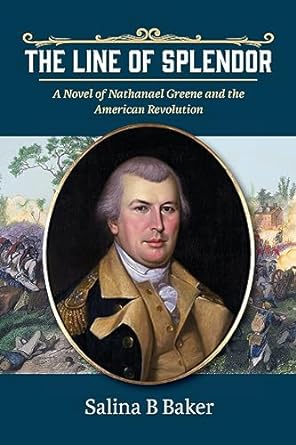
“The Line of Splendor” Guest Book Review

Emerging Revolutionary War welcomes guest historian Nicholas Benevento.

“The Line of Splendor: A Novel of Nathanael Greene and the American Revolution” is a historical novel written by Salina Baker.  In her novel, she brings to life a figure who deserves more fame and recognition for his pivotal role in the Revolution.  Nathanael Greene was a selfless general and leader who fought valiantly to defend his country and provide for his troops. He was a man who defied the odds and was placed in a position of power and leadership, a favorite of General George Washington.   He was a man willing to put everything on the line for the independence and freedom of the United States. 

Baker’s book picks up with Nathanael Greene’s life early in the 1770s when Nathanael is about the age of thirty.  At this time, there were growing tensions in the American Colonies with Mother England.  Shortly before the war broke out, Nathanael married his wife Caty in 1774, and Baker does a masterful job weaving their relationship into the story of his time in the war. 

Baker’s work is a fascinating depiction of Nathanael Greene and the American Revolution.  Readers of history often read facts and descriptions of events, which Baker provides.  But she also takes the reader into the thoughts and conversations of Nathanael Greene, as well as other key figures in his life.  Therefore, while this is a fiction novel, enthusiasts of this time period in American history would love this novel.  Baker weaves in the history of the war, while also providing us with dialogue and feelings of Nathanael.  Baker’s novel is a reminder to the reader that the generals and soldiers who fought in the Revolutionary War were not mythical figures who fought a war that would inevitably end in an American victory.  These were real men with real emotions carrying their insecurities and flaws, while experiencing the highs and many lows of the war.  Greene was central to many of the key battles early in the war, from the siege of Boston, to the debacle of New York, to the triumph of Washington’s crossing of the Delaware, to the trying times at Valley Forge.  Greene held a tremendous weight on his shoulders throughout the war, especially when he led the Southern Army late in the war during the Southern Campaign.  

Continue reading ““The Line of Splendor” Guest Book Review”

Book Review: “A Republic of Scoundrels” edited by David Head & Timothy C. Hemmis

In an age where the names of Franklin, Jefferson, and Washington are household, the names of Wilkinson, Kemper, and Bowles seem to be consigned to the fringes of histories of the early American republic. With the formation of the fledgling United States of America, both the honorable and not-so-honorable helped shape the direction of expansion, and diplomacy, and reinforce societal values of the 18th and early 19th centuries. This collection of essays is akin to watching a true crime television documentary.

With a collection of essays, editors David Head and Timothy C. Hemmis, historians, and biographers provide snippets into the lives of these scoundrels of the early Republic. A few of the names are well known, including Benedict Arnold and Aaron Burr, a few will conjure up memories from the fringes of other histories, such as James Wilkinson, whereas others have escaped the main avenues of historical exploration. Throughout the various essays, “this collection seeks to reexamine the Founding generation” to “replace the hagiography of the Founding Fathers with something more realistic” (pg. xx).

First, an examination of the word “scoundrel” is needed. According to usage at the time and the 1755 dictionary of Samuel Johnson’s authoring, that word meant “a mean rascal; a low petty villain” (pg. xiii). Through 12 individuals, the various authors explain how each earned the moniker “scoundrel” and how that affected the development of the United States. Especially interesting was the role of various individuals in Western expansion and the domino effect on international diplomacy. Individuals such as Aaron Burr and James Wilkinson are better known but Philip Nolan and Thomas Green are not so much.

Others, such as Benedict Arnold and Charles Lee get a fresh look from two great Revolutionary-era historians, James Kirby Martin and Mark Edward Lender. Included in those discussed, William Augustus Bowles and Diego de Gardeoqui show how international actors played prominent roles in providing heartburn to the national government. One theme, the west and south of the original thirteen states provided the arena for scheming, opportunity, and risk.

In conclusion, the editors examine three main reasons a study like this is important, that the “unintended result of the American Revolution” was “many men decided they had their own ideas about what was important” (pg. 266). Secondly, the “vital importance of the American West as a zone of territorial expansion, economic opportunity, and foreign intrigue” and lastly simply “early America was…a time and place for scoundrels…” (pgs. 267-268).

Overall this essay-comprised book is a fun, fresh read that looks at those scoundrels that sought an opportunity to change the landscape of the early American republic and potentially change the course of United States history. Who does not like to read about plots, scheming, and resultant escapades?  

Publisher: Pegasus Books, December 2023

368 pages, including images

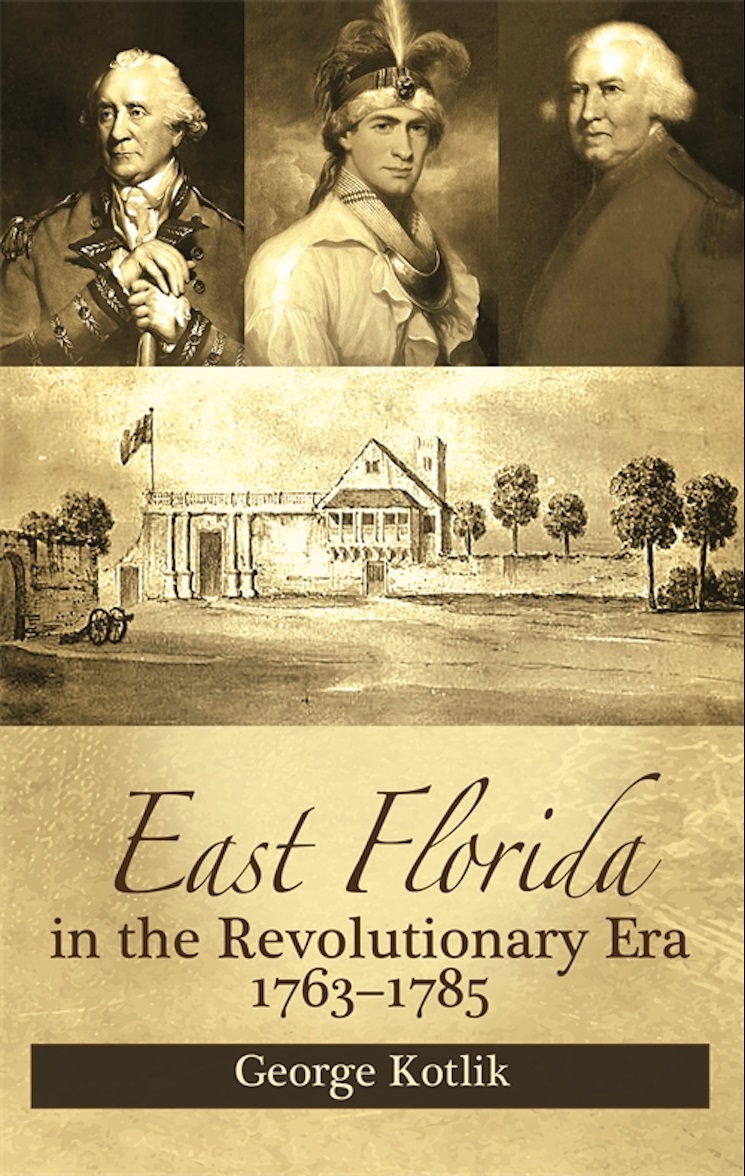
Review: “East Florida in the Revolutionary Era, 1763–1785” by George Kotlik

Thirteen of the Great Britain’s North American colonies moved toward independence in 1775, declaring the fact officially the following year with the issuance of the Declaration of Independence. Perched below these thirteen rebellious provinces was the colony of East Florida. Earned after the Seven Year’s War by Great Britain from Spain, the most populous city an oldest permanently established European metropolis was St. Augustine, which was also the capital of the colony. This colony, through the eight years of the American Revolutionary War, had a tenuous connection with their neighbors to the north. Largely forgotten in the pantheon of history describing this period, from the time of Britain gaining possession in 1763 through the end of the Revolutionary era in this historian’s estimation, in 1785.

Entitled, East Florida in the Revolutionary Era, 1763-1785 and penned by George Kotlik, a historian specializing in 18th century North American history, the publication offers “an accessible and detailed narrative of the East Florida during the American Revolution.” (pg. 8).

What ensues in the following pages is a brief yet complete overview of the military, political, social, and economic history within those years of East Florida. Some of the names in the pages are well known to enthusiasts of the American Revolutionary War era whereas others will be new names to add to the repertoire for further study. From Governor Patrick Tonyn, British general and last governor for England of East Florida to bringing attention to the William Augustus Bowles, a Maryland born Loyalist, sympathetic to the Muscogee Native Americans of East Florida who tried in vain from the last decade of the 18th century, to establish an independent state for the tribe, with British support. These are just two of the historical personas that Kotlik discusses in his narrative, the rest await you within the pages of the book!

Although no major military actions happened within the confines of the colony that does not mean the role of East Florida in relation to the American Revolution should not be marginalized. “Militias were raised, a general assembly was postponed, St. Augustine experienced a heightened British troop presence, planters between the St. Johns and St. Marys Rivers suffered at the hands of George raiding parties, and a constant threat of a Spanish or American invasion” all affected the psyches and lives of East Floridians. (pg. 104-105).

The hope from Kotlik is to provide the launching point for further discussion into the role of East Florida specifically and Florida in general during the revolutionary period. “Such a lack of coverage is a reminder for scholars to to emphasize East Florida’s presence in the war that made America.” (pg. 111). With this history in hand, Kotlik has provided the necessary overview for further exploration.

Publisher: NewSouth Books, University of Georgia Press, 2023
156 pages plus images

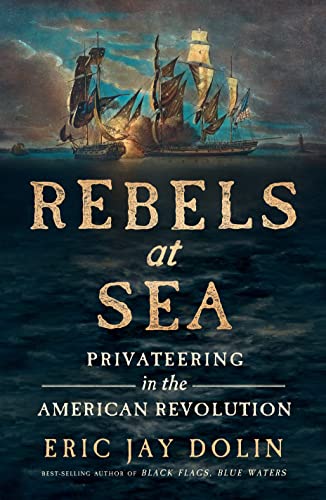
Review: Rebels at Sea, Privateering in the American Revolution by Eric Jay Doulin

“Many believed then and have believed since that privateering was a sideshow in the war” Furthermore, “privateering has long been given short shrift in general histories of the conflict, where privateers are treated as a minor theme if they are mentioned at all” [pg. xviii].

Best-selling maritime historian Erica Jay Dolin penned the two lines above in his introduction to his latest publication, Rebels at Sea, Privateering in the American Revolution. Building on previous works that covered specific aspects of “do succeed in showing how it [privateering] contributed to the American victory. But none of these books offers a comprehensive picture of the full extent of privateering” [xviii].

A bold statement to make, crafting a comprehensive picture “of the full extent of privateering” but that is exactly what Dolin does in his work. Starting with how individual colonies then states moved to outfitting vessels to begin preying on British maritime trade and on occasion Royal British Navy ships. The best tabulation of how much British maritime trade was affected during the American Revolution comes from John Bennett Jr. first secretary of Lloyd’s of London, the largest insurance marketplace at that time. He concluded that 3,386 British vessels were captured, only a 1,002 were recaptured or ransomed, which leaves a net gain of 2,384 that remained in enemy or American hands [pgs. 161-162].

Impactful.

The ensuing chapters after the introduction pivot the reader through the life of a privateersman, including the travails faced. He circles back to this in another chapter detailing the British response, including what imprisonment looked like; either in a British land jail or on the infamous Jersey prison ship in Wallabout Bay, New York. Keeping the narrative flowing, Doulin gives snippets on some of the greatest triumphs of American privateersman and some of the greatest tragedies to befall these sailors on the high seas. Tidbits of interesting information, for example, did you know that the future dentist of George Washington cut his teeth as a privateer? (Okay, pun intended).

Sandwiched in between is the role of the French, America’s steady ally, after 1777, and how that country and its ports helped American vessels. Lastly one of the other admirable additions to this text is the plethora of pictures Doulin was able to find and include. Having the visuals certainly enhances the public history side of this publication.

Overall, this is a great read on a lesser viewed subject of the American Revolution. However, what the privateers did enabled eventual American independence. As John Lehman, the secretary of the navy under President Ronald Reagan once wrote.

               “From the beginning of the American Revolution until the end of the War of
1812, America’s real naval advantage lay in its privateers. It has been said that
the battles of the American Revolution were fought on land, and independence
was won at sea. For this we have the enormous success of American privateers
to thank even more than the Continental Navy” [pg. xviii].

Individuals come to life in this narrative. The cat-and-mouse of life on the high seas comes to life in this book. Join Doulin in an adventure on the high seas and understand the role of privateers in securing American independence in the process. Enjoy!

Brief Book Review: Hero of Two Worlds, the Marquis de Lafayette in the Age of Revolution by Mike Duncan

Mike Duncan
Public Affairs Publishing
$30.00

I admit, I was skeptical when I saw the book on the bookshelf of my local bookstore and then again at the county library. Another biography on the Marquis de Lafayette? Was one truly needed? Four days later with the book finished and now laying beside me as I type this review I can emphatically say “yes” that this biography was needed about the most celebrated Frenchman in the history of the United States.

Having read previously a biography solely on Lafayette and another where a historian compared him as a revolutionary brother to Thomas Jefferson, I had a baseline knowledge of the marquis. Mike Duncan, popular history podcaster and New York Times-Bestselling Author provides a very readable, engaging biography that moves gracefully through Lafayette’s life, more graceful than supposedly the young Frenchman’s first dance at Versailles in front of Marie Antoinette.

After a brief but concise overview of the young Lafayettes’s formative years, Duncan dedicates the majority of the narrative of how the Frenchman became the “hero of two worlds.” From how he navigated his escape to America in 1777 to the ideals he brought back to France and his hopefulness for creating a better homeland. One of the values of Duncan’s work is his ability to find the inner workings of Lafayette’s demeanor and mindset. This is done by looking at his peers and their criticalness of how the Frenchman navigated the shifting sands of the turbulent French political scene from 1789 through the Napoleon era.

I greatly enjoyed the writing style and the blend of popular and academic historical scholarship that Duncan effortlessly moved between throughout the narrative. This work is definitely a must read for anyone looking for that introductory book about the Marquis de Lafayette. For those who have a little more foundational knowledge there may be limited new material but the primary sources from contemporaries adds a much-needed element of constructing the two worlds that Lafayette moved between.

To walk the footsteps of Lafayette at Valley Forge, join Emerging Revolutionary War in November for our Second Annual Emerging Revolutionary War Bus Tour. Click the “2022 Bus Tour” link on the black bar above to secure your ticket.

Review: American Rebels, How the Hancock, Adams, and Quincy Families Fanned the Flames of Revolution

Two of the above three last names are very familiar to even casual observers of American history. John Hancock, whose signature is readily apparent at the bottom of the Declaration of Independence, where it was joined by John Adams and Samuel Adams. Yet, that last name in the title, Quincy, may not be as obvious as should be at first glance.

What is remarkable about these last names? Besides, the simple fact that members with those three surnames played a major role in the road to revolution and surprisingly on both sides of the chasm of loyalties? All could trace their roots to a small town in Massachusetts; Braintree.

“The covenant of liberty that they shared would be sharpened by ambition and envy, polished through friendships and love, and fought for in a revolution fomented by these children of Braintree” (pg. 8).

In that town, from its first inhabiting European settlers, the spirit of questioning accepted decrees took root, matured, and blossomed. And until now, the intertwining vines of those family trees had not been put under the microscope of historic observation until the publication this year of American Rebels, How the Hancock, Adams,and Quincy Families Fanned the Flames of Revolution. Penned by Nina Sankovitch an Illinois native, author of several nonfiction works, and resident of New England, she effortlessly weaves the stories of these families into part biography, part family history, and part United States history. All parts equally important and very well written.

“Even as the fortunes of these children of Braintree diverged, their futures would bring them together again. A shared promise connected them, fostered by the history, the land, and the people of Braintree…” (pg. 8)

One of the highlights in the book is the emergence of the Quincy family into a popular history such as this. One of the unsung heroes of the road to revolution was Josiah Quincy Jr.

“As Reverend Hancock preached, the “solemn covenant….of their Liberty” was not obtained through faith alone but could only be realized through hard work performed by a community together. And this sacred covenant would be protected against any and all usurpers who attempted to take their liberty away.” (pg. 15).

Furthermore, Sankovitch brings to the forefront the role of women in the various families and their impact on the time. The best known is Abigail Adams who is the confidant and intellectual equal of her husband, John. Another is the aunt of John Hancock, Lydia, who constantly watches out for John’s place in society. She is the driving force that will bring to fruition the connection between the Quincy and Hancock families. Or Abigail Quincy, who had married Josiah Quincy, Jr., would never remarry but dedicated the rest of her days to raising their son and preserving his memory and contributions to the cause of America. The anguish of losing her beloved is quite evident:

“I have been told that time would wear out the greatest sorrow, but mine I find is still increasing. When it will have reached its summit, I know not.” (pg. 348).

Highlighted by the quote above, the author brings these historic personas and people to life, capturing the heartache, familial turmoil, ambition, and connections. Just as these families bred revolutionaries, there were sons that stayed loyal to the British crown, including a brother and brother-in-law of Josiah Quincy.

From weaving the families together, to connecting the threads of the evolution of political thought, and showing the personal strains of what the road to revolution looked like, Sankovitch has compiled an easily readable, insightful look into the 18th century world.

Enjoy!

*Book Information*

Publisher: St. Martin’s Press (March 2020)

Pages: 416

Interview with Tom Chaffin, author of Revolutionary Brothers, Thomas Jefferson, the Marquis de Lafayette, and the Friendship that Helped Forge Two Nations

Last week, Emerging Revolutionary War‘s Phillip S. Greenwalt wrote a review of the above mentioned book. To find that review click here. Recently, through email, Emerging Revolutionary War had a chance to interview the author. The questions and his responses are below.

Tom Chaffin, author
Continue reading “Interview with Tom Chaffin, author of Revolutionary Brothers, Thomas Jefferson, the Marquis de Lafayette, and the Friendship that Helped Forge Two Nations”

Review: Revolutionary Brothers, Thomas Jefferson, the Marquis de Lafayette, and the Friendship that Helped Forge Two Nations by Tom Chaffin

Thomas Jefferson, Marquis de Lafayette, two household names from the American Revolutionary War. One the author of Declaration of Independence and one of the great political minds of the era. The other, a Frenchman, enamored with the ideals of the rebelling colonies of British North America who risked a maritime crossing, was wounded at Brandywine, and served both on the field of battle and the international sphere to help achieve American independence.

That much is known about these two gentlemen, icons of history. How about their friendship, one that spanned decades and brought both men through times of personal and professional difficulties. Although years separated visits and both men were well into adulthood before making their respective acquaintance, the friendship helped cement the bond between countries, from aid during the American Revolution to a thankful nation celebrating the return of the Marquis in the mid-1820s.

This friendship has finally been captured in narrative form by historian Tom Chaffin, author of other historical works and biographies in a book published by St. Martin’s Press in 2019.

Continue reading “Review: Revolutionary Brothers, Thomas Jefferson, the Marquis de Lafayette, and the Friendship that Helped Forge Two Nations by Tom Chaffin”

Review: Rick Atkinson, The British Are Coming: The War for America, Lexington to Princeton, 1775-1777

Emerging Revolutionary War welcomes guest historian Joshua Shepherd to the blog who reviewed the book mentioned above. Short bio of Joshua is at the bottom of this post.

In recent years, there’s been a fortunate resurgence of interest in the Revolution and founding era. To meet the mounting demand for Revolutionary history, some of the nation’s most gifted popular authors have written highly successful volumes that cover the War for Independence and the Early Republic.

Some outstanding books have consequently gone to press, but, by and large, the publications have very often been biographies; occasionally, publishing houses introduce monographs that cover a single campaign. From professional circles, much of the new scholarly research focuses on the currently-vogue academic preference for social history. At least in recent decades, the relative paucity of military history has left an appreciable gap in the historiography of the Revolution. With the release of The British Are Coming, author Rick Atkinson has met a vital need for an up-to-date and comprehensive military history of the American Revolution.

Continue reading “Review: Rick Atkinson, The British Are Coming: The War for America, Lexington to Princeton, 1775-1777”

Author Interview & Review: Otho Holland Williams in the American Revolution by John Beakes

ERW Book Reviews (1)

Numerous biographies grace the shelves of book stores, museum shops, and the personal libraries of American Revolutionary Era history enthusiasts. Yet, until 2015, not a single dedicated biography was written about an extraordinary American general that rose from the ranks during the war to assume such a lofty position by the successful conclusion of the conflict.

That unintentional omission has now been filled with the excellently detailed oriented and primary source driven biography entitled Otho Holland Williams in the American Revolution by John Beakes. The author is a graduate of the United States Naval Academy in Annapolis, Maryland and a resident of Ellicott City, Maryland.

I had a chance to interview the author via email and one of the questions I asked him was if there was one takeaway you wanted your readers or those interested in the book to know, what would it be? His answer is below and sums up the importance of Williams and soldiers like him:

“Otho Holland Williams was a vibrant, healthy young man with distinctive intellectual gifts and leadership capabilities when he joined the army at age 26 in 1775.  Had there been no War of Independence, he might well have lived a long life enjoying the family relationships that he cherished so deeply, and have risen to a position of prominence and wealth.

Instead, Williams died at age 45, spitting up blood and much weakened in body and spirit from the tuberculosis that he had contacted while a prisoner-of-war in New York after the Battle of Fort Washington.

We owe much to the young men like Williams who gave so much in the fight for our nation’s independence, and yet he is largely forgotten.

Here, truly, was a life laid in sacrifice on the altar of our freedom.”

This biography is part of an ongoing effort by The Nautical and Aviation Publishing Company of America to publish a biography on the chief lieutenants that served under and with George Washington and were instrumental in winning American Independence. Previous volumes in the series include titles on John Eager Howard and Henry “Light-Horse” Lee. The series is entitled, “George Washington’s Best Officers Book Series” and definitely worth the read for the enthusiastic and/or serious student of the American Revolution.

otho-holland-williams-american-revolution

So, why was Otho Holland Williams chosen as the third installment? I asked the author and his response is below;

“Otho Holland Williams kept appearing in all of the key moments of the story of the war in the South, but always tantalizingly just beneath the surface, hidden in the shadow of larger figures like Nathanael Greene and Daniel Morgan.  Williams was a compelling writer, and his descriptions of battles like Camden and Eutaw Springs are superbly written and deeply insightful observations of a first-hand participant.  His leadership of the Screening Force during the Race to the Dan displayed combat leadership skills of the first order, but his life story was largely untold.”

Furthermore, the reader will glean that Williams is the quintessential depiction of the American soldier, rising from the ranks to one of the top positions in the Southern theater by war’s end. The process, superbly told by Beakes, winds the reader from the early days of the revolutionary movement in western Maryland to the Siege of Boston, to the defeats of the New York Campaign. Those achievements and setbacks combined to give Williams the invaluable training as a military officer. For Williams, like a majority of the men who would hold rank in the American forces;

“Military knowledge and experience were scant commodities in the colonies at the start of the Revolutionary War, and young men like Howard, Lee and Williams joined the army in their twenties with virtually no prior military experience.  There were no institutions such as military academies, officer candidate schools, or ROTC to help them learn.  They read all the available military literature.  They observed leaders like Washington, and took in the written guidance that he provided, often in General Orders, for how to develop into effective officers. And most importantly, they learned by experience in the daily rigor of military discipline and in their various combat engagements.  

Starting with such “bare bones” learning opportunities, in the short years between 1775 and 1780, when the Southern Campaigns began, these young officers had become exceptional military leaders, and the army that they led was as fine a combat organization as any on earth.  It is a story of grit and determination and persistence that brought these young civilians to such a high state of military capability.”

During this early part of the war, Williams also became a prisoner-of-war after the fall of Fort Washington during the New York Campaign of 1776. After being exchanged, Williams would feel the affects of his imprisonment which would eventually cause his death in 1794 from tuberculosis.

Yet Williams, like many other junior officers, are still worth studying in history, as Beakes claims, because,

“With the resources available today, we have a powerful opportunity to take a fresh look at these stories. Unfortunately, our fresh look at original sources sometimes reveals that writers along the way have perpetuated false information, sometimes from honest mistakes, but also sometimes from blatant political motives. 

We have an important opportunity to correct the record. Stories like those of Otho Holland Williams give readers a look at the War of Independence from the front-lines and from ground level, a perspective that fills out and enriches the more strategic insights of the well-known works on the Founders.”

This book, like two previous volumes in the series, is definitely a worthy addition to any avid reader of the American Revolutionary Era. If these great in-depth biographies already grace your private library, don’t worry there is more biographies in the works. Beakes is currently working on research for a volume on Baron de Kalb.

Stay tuned and enjoy the read!


*Book Information*

Publisher: The Nautical and Aviation Publishing Company of America
Published Date: November 5, 2015
346 pages, including appendices, bibliography, notes, and index

Click here to view the website where further information, including how to purchase the book, is available.