A Venezuelan Connection

Emerging Revolutionary War welcomes guest historian Dr. Nathan Provost

With the recent rumblings about Venezuela, it is important to remember that Venezuela’s independence began with a veteran of the American Revolutionary War. Francisco de Miranda was born on March 28, 1750, in Caracas, Venezuela. At the time, Venezuela and much of the Americas were under Spanish control. Born into a life of luxury, Miranda attended prestigious institutions of higher education, including the Royal and Pontifical University of Caracas. He later continued his education in Spain, eventually raising enough money to purchase his rank of Captain in the Princess Regiment. His first experience of combat was in North Africa against the Moors of North Africa. Upon returning to Spain, Miranda waited for another military operation to accompany. An ambitious young soldier, he sought adventure, wanting to see the world through military service. In 1780, Miranda reported to the Regiment of Aragorn; their destination was Havana, Cuba. Their objective was to concentrate with Major General Bernardo de Galvez’s men at Pensacola, Florida.
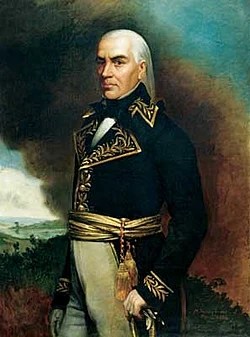
Francisco de Miranda

Spain was no ally of the recently independent United States; rather, their alliance with France was much more significant. After France entered the conflict following the American victory at Saratoga, Spain declared war on Great Britain in 1779. Spain had its own goals, hoping to reclaim territory in Florida lost during the Seven Years’ War. The Spanish were fortunate to possess a brilliant military officer, Bernardo de Galvez. He already captured what is now Baton Rouge, Louisiana, and Mobile, Alabama. All that was left was Pensacola on the Florida Coast. Galvez took several warships and many more transports filled with 3,701 men to lay siege to Pensacola, Florida. Inclement weather and Choctaw resistance interrupted their initial movements, but Galvez pressed on and established his army outside the walls. The number of troops was insufficient to make any headway against the British fortifications, despite the construction of a series of entrenchments and artillery positions. Then, on March 24, much-needed Spanish reinforcements arrived, among whom was Francisco Miranda. 

Upon landing, Miranda noted Galvez was there to meet them. Miranda observed several entrenchments already constructed, but a few hundred men were already out of commission since the siege began. Upon learning this information, he knew that Galvez desperately needed these reinforcements. It was not until April 24 that all the soldiers disembarked at Pensacola.  During the siege, Miranda personally inspected the siege lines and terrain and reported back on this reconnaissance to Galvez. Miranda and his men, entrenched outside the fort, often came under fire from the British artillery. There were also several skirmishes outside the breastworks in which the Spanish sustained some casualties. In one particular episode, Miranda and five companies of his men engaged in a firefight with some Native Americans. The fighting lasted roughly an hour and a half, with six of the Spanish wounded, but a Frenchman deserted the Natives and went over to the Spanish after the fight. In each of these skirmishes.

Continue reading “A Venezuelan Connection”
Standing on a Street Corner…

Now I know what you are thinking…the famous song by The Eagles. But, no.

IMG_1438
Corner where Fort Gatlin once stood, Gatlin Avenue is running left to right, South Summerlin is off the right of the photo. Historical marker sign on left side of photo, D.A.R stone marker across street (to the right of the Jeep in the driveway) 

Continuing a theme from the last post, military history in Orlando, I did find myself standing on a street corner, South Summerlin Avenue and Gaitlin Avenue. That is when I noticed the small stone marker, placed by the Daughters of the American Revolution. Placed next to a hedge, on the corner of a driveway, sits until recently, the only reminder of this former military installation. Around this fort sprung a small county that became the county seat of Orange County, Florida by 1856. Which grew into Orlando.

nov9
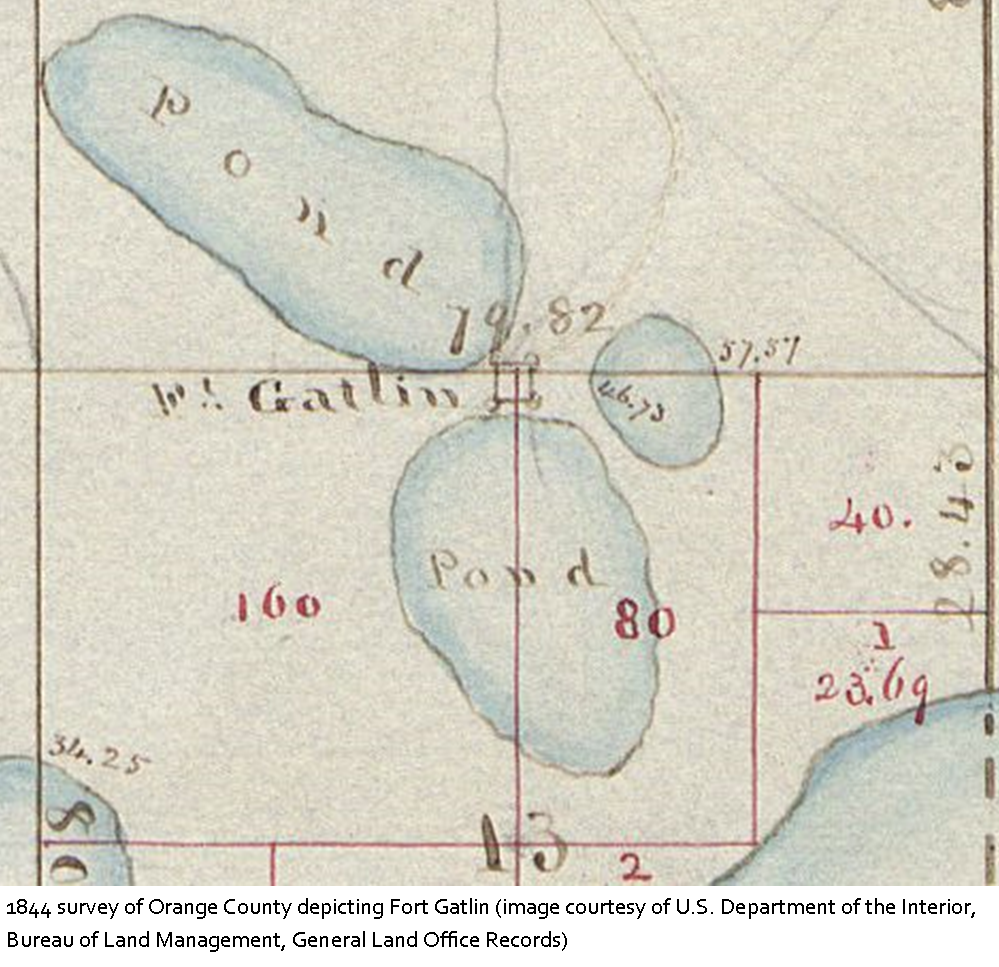
An 1844 survey of Orange County, depicting Fort Gatlin (courtesy of the Bureau of Land Management, General Land Office Records and The Florida Historical Society

Constructed on November 9, 1838, by Lieutenant Alexander Fanning and four companies of the 4th U.S. Artillery, the post was one of several built across the breadth of central Florida during the Second Seminole War. Named in honor of Dr. John S. Gatlin, who had been killed in Major Dade’s Massacre on December 28, 1835. After completing the post, which was situated on a rise that commanded three lakes, Lt. Fanning and three companies departed, leaving 1st Lieutenant F.E. Hunt.

After June 1839, the United States Army had abandoned the post, yet state militia continue to garrison the wooden ramparts. A brief return in October 1849 by the army led to it becoming an active post, briefly, until the soldiers left shortly thereafter.

IMG_1431
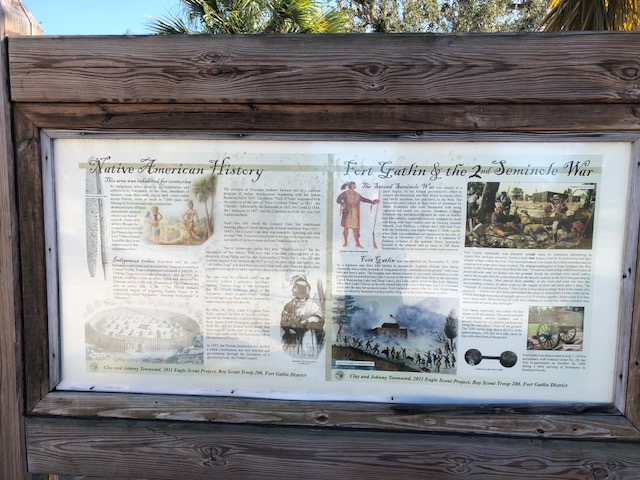
One side of informational panel of the Eagle Scout project for Fort Gatlin

Abandoned, besides the stone marker, until recently. A great Eagle Scout project produced a wooden two-panel history of Fort Gatlin, Native American history, early settlers, and the 2nd Seminole War. This stands on the same corner as the Florida historical marker and across the intersection from the Daughters of the American Revolution stone marker.

And standing for one day, a man on astreet corner, looking for history, a fine sight to see.


Revolutionary Era Connection in Orlando, Florida?

When one mentions the word “Orlando” what is the first thought to pop into your head?

Universal?

Or maybe two words; “Disney World or Walt Disney?”

In all likelihood, the name Francis Wayles Eppes, is not one of the people you would associate central Florida with. You may even be asking, who is Francis Wayles Eppes.

Eppes
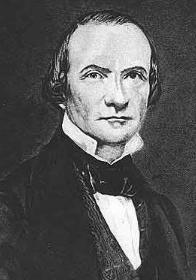
Francis Wayles Eppes

Born on September 20, 1801, Francis was the only surviving child of Thomas Jefferson’s daughter Maria and her husband, John Wayles Eppes. When his mother died in 1804, his grandfather, the third president of the United States at the time, took young Francis under his care and the child resided at Monticello, Jefferson’s Virginia estate.

As young Francis grew, he spent time at Poplar Forest, Jefferson’s estate near Lynchburg, Virginia, which was bequeathed to him by his grandfather after the grandson married Mary Elizabeth Randolph in 1822. Francis, prior to marriage, studied law at both Georgetown College and South Carolina College.

With the death of his father and grandfather within three years of each other; 1823 and 1826 respectively, Francis and his wife joined the movement south, leaving Virginia for sunny Florida.

Initially settling outside Tallahassee and was instrumental in the formation of one of the first Episcopalian churches in the Florida territory, when he donated $500 to a construction of St. John’s Episcopal Church. He was a vestrymen, delegate to the Episcopalian convention in Florida, and also secretary of the local diocese for many years.

After a long public service record in Tallahassee, including serving as intendant or mayor of the capital for a few terms and being an early proponent of a school of higher learning–Jefferson-esque–which became the precursor to Florida State University, Eppes relocated to central Florida in 1869.

Even in his 60’s, Eppes stayed active, becoming a citrus farmer and was part of the group that founded the Cathedral Church of St. Luke in Orlando, the first Episcopal church in the growing town.

IMG_1446
Eppes’s home in Orlando. Plaque on front porch reads; “Site and home of Francis Eppes Grandson of President Thomas Jefferson Original House Built in 1868 Marker Placed by Orlando Chapter NSDAR December 3, 1998”

A historian, writing about Eppes’s contributions of that era summarized the Virginian in the following words; “Through the 40’s, 50’s, and 60’s [1800s] there were few civic, religious, or educational affairs in which he did not have a prominent  part.”

On May 30, 1881, Francis Wayles Eppes passed away at his home and would be buried in Greenwood Cemetery. He was 79 years old.