Reflections of April 19, 1775

On this date, 241 years ago, the first salvo of what would become the American Revolutionary War, was fired on Lexington Green and North Bridge in Concord.

Historian John Galvin once wrote about the Battles of Lexington and Concord that they were the “least known of all American battles.” I never really understood what Galvin meant, as I had read extensively about April 19, 1775 and thought I understood the details of that day in history.

Yet, until this past weekend, when I spent the better part of four days touring the sites and walking the trails, talking to the historians around the towns, I did not realize how much more there is to what actually happened on that April day.

For starters, did you realize that Paul Revere did not go town-to-town calling out, “The British are Coming” to homesteads and roadside taverns? Instead, he was the catalyst that started a chain reaction of messengers and runners to different towns throughout the countryside that cast the alarm in a wide net.

He also would have told farmsteads and meetinghouses along the way that the “Regulars are Coming,” since the colonists still thought of themselves as British.

Or that the unofficial birth of the United States Army is attributed to the militia that followed Colonel James Barrett and Colonel John Buttrick down the hill toward the British at the North Bridge?

IMG_6903
The field where the militia under Colonel James Barrett and Colonel John Buttrick began their advance from toward the North Bridge. The militia would be coming toward us to descend toward the span.

That was the first time that men, formed in regiments with officers, made an advance against what they perceived as an enemy force, and did so in a “very military manner.”

What prompted the various militia companies, which came from other towns than just Concord, to sally forth from the hill toward the now infamous North Bridge? The main reason was what was happening in Concord was the mistaken reason behind the smoke emanating from the town?

In the town, the British were burning military supplies and the wooden gun carriages found in the hamlet. Sparks landed one of the nearby dwellings and British soldiers actually put down their muskets to form a bucket brigade, with civilians, to help put out the flames. The smoke that billowed from the doused fires is what prompted the militia and minutemen response.

With water being dumped on the flames, smoke billowed up, which prompted milita Adjutant Joseph Hosmer to ask the officers; “Will you let them burn the town down?” That prompted the forward movement of the militia down the hill and against the British.

Or did you realize that some of the militia, from the nearby town of Acton, suffered some of the first casualties at North Bridge, including their militia captain, Isaac Davis, who was one of the first killed in the engagement?

IMG_0087
View of the Old Manse, built in 1770 for Reverend William Emerson. View from the Concord River/North Bridge direction.

Somewhere in the midst of the action in Concord was Reverend William Emerson, the grandfather of Ralph Waldo Emerson who would later write that the action on April 19, would be known as the “shot heard round the world” years later.

These are just a few of the interesting tidbits that I picked up this past weekend. Altogether, they reinforce the historic events that I knew unfolded on this day in American History. However, along with reflecting on what transpired in my visit to Massachusetts, these new tidbits of valuable information underscore the important stories and accounts that shape this spring day that are beckoning to be told.

There is so much to be gained by walking the grounds, talking to the historians and historical enthusiasts of the area, and just taking time to appreciate what this day, April 19th, meant to the future of the United States and the era it was leaving behind as part of the British Empire.
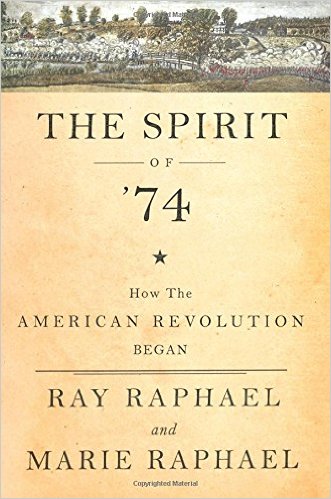
Review: The Spirit of ’74, How the American Revolution Began by Ray and Marie Raphael

ERW Book Reviews (1)Why did Boston’s act of political vandalism lead to a British military expedition against small towns in Massachusetts sixteen months later?

How, exactly did evolving political tensions result in actual warfare?

How did Lexington and Concord become, as Ralph Waldo Emerson wrote, “the shot heard around the world.”

The Spirit of '74, How the American Revolution Began by Ray Raphael and Marie Raphael
The Spirit of ’74, How the American Revolution Began by Ray Raphael and Marie Raphael

In a much-needed narrative, historians Ray and Marie Raphael fill in the movement toward those first shots at Lexington and Concord. In a primary source driven, easy to read history of that year before and leading up to 1775. However, “our story slows, pausing at additional markers that are often bypassed or slighted” (x).

Therein lies “only in a full telling is war a plausible outcome” (x).

The Raphael duo fluidly walks the reader through the build-up to that fateful April 1775 day. The book sheds light on developments in towns and counties across the colony of Massachusetts. A timeline in the beginning provides a good resource to remember the important dates as you read.

With the British response to the Boston Tea Party of December 1773, committed activists perceived that Britain had handed them a blueprint for disenfranchisement (44). What would be seen in the colony as the Coercive Acts, which, among other changes nullified the Charter of 1691 which colonists in Massachusetts held as sacrosanct. When the news of what the British government had did, which arrived in the harbor of Boston in May 1774 until the following April 1775, “resistance would mount, coalesce, and manifest itself in armed, relentless rebellion (44).

That coalescing would resemble an accordion, with Boston being one end and the countryside of Massachusetts the other end of the instrument. Both ends would reverberate the bellows as ideas, exchanges of opinions, passive and aggressive action, all marred the intervening months of 1774. Until as Abigail Adams wrote many months before April 1775, the”flame is kindled and like lightening it catches from soul to soul” (192).

The Raphael duo capture what the farmers in Berkshire set in motion, in accordance with capturing the attitude of townspeople in Worcester, Massachusetts at the same time. These various local uprisings, which put an emphasis on peaceful activities coalesced into the call for committees and eventually into the need for the Provincial Congress. This Congress acted as the de-facto governing body of Massachusetts in response to British measures to subdue and punish the intransigent rebels.

When viewed through the prism of the preceding years, what happened on the green of Lexington or the North Bridge at Concord becomes clearer as the pivot in which the simmering resentment in Massachusetts finally boiled over and led to the “shot heard around the world.”

Every once in a while a monograph is written that fills a necessary void in the field of early American Revolutionary history. This history is definitely one of those as it fills in that critical, yet overlooked, time period in the build-up to the fighting between British-American colonists and the redcoats that represented the mother country.

One cannot hope to understand the events of 1775 and beyond without knowing how the colonists of Massachusetts, so many that have unfortunately been lost to the passing of time, began the protests that led to independence, beginning in the years before.

Or as the authors more succinctly state; “and so begins a story we know” (214).


Book Information:

Publisher: The New Press, New York, NY

Pages: 219 pages plus acknowledgements, bibliography, index, and, timeline


Another Anniversary to Commemorate Next Week

RevWarWednesdays-header

As we observe the beginning of the end of the American Civil War this week at Appomattox Court House, Virginia, another anniversary is just around the corner.

240 years and 10 days ago and approximately 630 miles the first shots of the American War of Independence was fired on Lexington Green on April 19, 1775.

Two events, two weeks in April. One commemorating the end of what some combatants at the time referred to as the Second American Revolution, whereas the other anniversary began the First American Revolution (if one sticks with that same theme).

So, as you finish your time tracing the last steps of the Confederate Army of Northern Virginia at Appomattox Court House head north and traverse the Battle Road between Boston, Lexington, and Concord.

Our friends at the national park, Minuteman National Historical Park have multiple events going on leading up to, through, and after the 19th of April.

Check out their events here; http://www.nps.gov/mima/planyourvisit/calendar.htm


The Most Fateful Decision of April 19, 1775

RevWarWednesdays-header


Lord Hugh Percy, the 2nd Duke of Northumberland and holding the rank of brigadier general commanded the relief brigade that was ordered out from Boston by Sir Thomas Gage after Lieutenant Colonel Francis Smith had sent back a messenger asking for reinforcements.

Little did Lord Percy realize at the time that by the late afternoon of April 19th, one quick decision saved the lives of countless British Redcoats and hundreds of American militia and minutemen. Continue reading “The Most Fateful Decision of April 19, 1775”

Lexington Part II – “Our troops advanced towards them, without any intention of injuring them.” Who Fired First at Lexington?

RevWarWednesdays-header


Battle of Lexington, Engraved 1874

The above words were written by Lt. Col. Francis Smith in his official report to General Thomas Gage. Smith, in command of the British expedition to Concord recently returned from what would be the opening salvo of rebellion. Smith wanted to be clear that he never intended to start bloodshed. In the days afterwards, the Massachusetts militia made it clear that they intended to lay the blame at the “regulars.” As soon as the British returned to Boston, the war of words began on who fired the first shot to begin a worldwide war. The British column that was led by Smith was sent from Boston to capture supplies reportedly stored at nearby Concord.  To get to Concord, the British would have to march through Lexington.  Due to a complex warning system, the local militia in Lexington were mustered and called to arms.  Captain John  Parker and his minutemen were lined up on the Lexington green in two rows, facing the road to Cambridge and the Lexington meetinghouse. The road south of the green headed to Concord, and Parker had his mean assembled on the northern portion of the green, away from the Concord road.

Continue reading “Lexington Part II – “Our troops advanced towards them, without any intention of injuring them.” Who Fired First at Lexington?”