

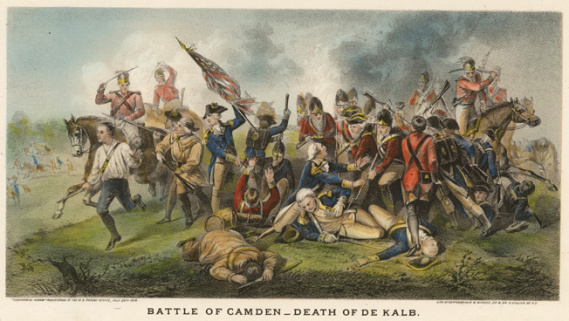
Picking up the story of Camden from Thursday morning, we continue with Col. Otho

Holland Williams comments on the events on the evening of August 15th. As Gates’ army moved southward at night, a dangerous undertaking even with a professional army, notwithstanding an army mostly comprised of militia that had never fought as a cohesive unit. Williams documents the meals that the Americans ate that night before their march. When reading American accounts of Camden, most mention the impact on the evening August 15th meal had on the men and the army as a whole. Williams also mentions there is much criticisms of Gates’ plan, but no official opposition was brought to Gates. Reading Williams’ account gives us insight today into the events leading up to the disaster at Camden. When reading Williams’ narrative, it is not hard to believe that the Americans were marching to a defeat.
“Although there had been no dissenting voice in the council, the orders were no sooner promulgated than they became the subject of animadversion. Even those who had been dumb in council, said that there had been no consultation –that the orders were read to them, and all opinion seemed suppressed by the very positive and decisive terms in which they were expressed. Others could not imagine how it could be conceived, that an army, consisting of more than two -thirds militia, and which had never been once exercised in arms together, could form columns, and perform other manoeuvres in the night, and in the face of an enemy. But, of all the officers, Colonel Armand took the greatest exception. He seemed to think the positive orders respecting himself, implied a doubt of his courage –declared that cavalry had never before been put in the front of a line of battle in the dark–and that the disposition, as it respected his corps, proceeded from resentment in the general, on account of a previous altercation between them about horses, which the general had ordered to be taken from the officers of the army, to expedite the movement of the artillery though the wilderness. A great deal was said upon the occasion; but, the time was short, and the officers and soldiers, generally, not knowing, or believing any more than the general, that any considerable body of the enemy were to be met with out of Camden, acquiesced with their usual cheerfulness, and were ready to march at the hour appointed. As there were no spirits yet arrived in camp; and as, until lately, it was unusual for the troops to make a forced march, or prepare to meet an enemy without some extraordinary allowance, it was unluckily conceived that molasses, would, for once, be an acceptable substitute; accordingly the hospital stores were broached, and one gill of molasses per man, and a full ration of corn meal and meat, were issued to the army previous to their march, which commenced, according to orders, at about ten o’clock at night of the 15th. …. The troops of general Gates’ army, had frequently felt the bad consequences of eating bad provisions; but, at this time, a hasty meal of quick baked bread and fresh beef, with a desert of molasses, mixed with mush, or dumplings, operated so cathartically, as to disorder very many of the men, who were breaking the ranks all night, and were certainly much debilitated before the action commenced in the morning. …. “ Continue reading ““Gentlemen, what is best to be done?” Gates Moves Towards Camden and Makes a Fateful Decision”
 Emerging Revolutionary War Era