Book Review: The Letters of Robert Morris: Founding Father and Revolutionary Financier. By Michael Aubrecht

Emerging Revolutionary War welcomes back guest historian Evan Portman for this review.

Among the pantheon of America’s Founding Fathers, Robert Morris is a name rarely mentioned beyond circles of historians. However, Michael Aubrecht sheds light on this phantom revolutionary figure with his book The Letters of Robert Morris: Founding Father and Revolutionary Financier. His work represents the first time the primary sources of Robert Morris have been compiled in print.
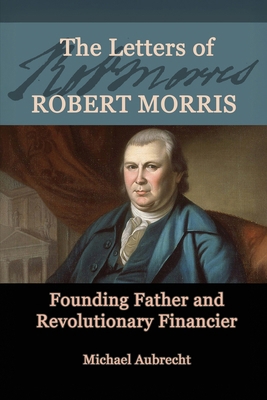
The Letters of Robert Morris spans the financier’s political life from his time in the Continental Congress to his time in debtors’ prison at the turn of the eighteenth century. Morris’s correspondence provides a fascinating window into his public life. His recipients often include the likes of George Washington, Thomas Jefferson, Benjamin Franklin, and Alexander Hamilton. Some of Morris’s most fascinating correspondence comes from late 1776 and early 1777, during which the financier provided Washington’s army with much needed supplies. His letters to Washington during the Ten Crucial Days reveal the anxiety and trepidation that pervaded the fledgling United States at that time.

Also compelling is Morris’s role in establishing the Bank of North America and a new national currency, which he outlined to a letter to John Hanson, the president of Congress, in 1782. His frequent exchanges with individuals like Hamilton and Franklin about the bank and its expenditures highlight Morris’s financial acumen but also how much of his own personal wealth he was willing to pledge to the American revolutionary cause.

Overall, Aubrecht’s editorial approach is sound and tactful. He adapts hundreds of Morris’s letters the National Archives’ online repository. While many of these letters are accessible on the internet, there is particular value in assembling them in print as Aubrecht has. While an online repository can sometimes feel disjointed, a printed volume can help readers to make connections and allow the editor to exert a bit more influence over the narrative.  

However, Aubrecht places Morris’s voice at the center of this volume, intruding little on the language and meaning of the original texts. Aubrecht occasionally inserts a missing word or clarifies a misspelling, but his methodology essentially allows Morris to speak for himself. Aubrecht also provides useful biographical information on his subject in the introduction as well as advocates for his importance as one of the Revolution’s most prominent financiers.

The collection could, however, benefit from a bit more contextual information, particularly in between substantial time gaps between letters. While most readers need no introduction to many of Morris’s illustrious correspondents, a brief paragraph providing the context of a set of letters could prove useful in providing a more detailed picture of Morris’s life. The collection could also make more liberal use of footnotes in defining key terms and antiquated language, as well as elaborating on some of the lesser-known people Morris mentions in his correspondence.

Regardless, The Letters of Robert Morris is a welcome contribution to the existing literature on one of America’s underappreciated Founding Fathers. Aubrecht’s selection proves to be a key asset to researchers and history buffs alike.

Information:

The Letters of Robert Morris: Founding Father and Revolutionary Financier. By Michael Aubrecht. Berwyn Heights, MD: Heritage Books, 2025. Softcover, 431 pp. $43.00.
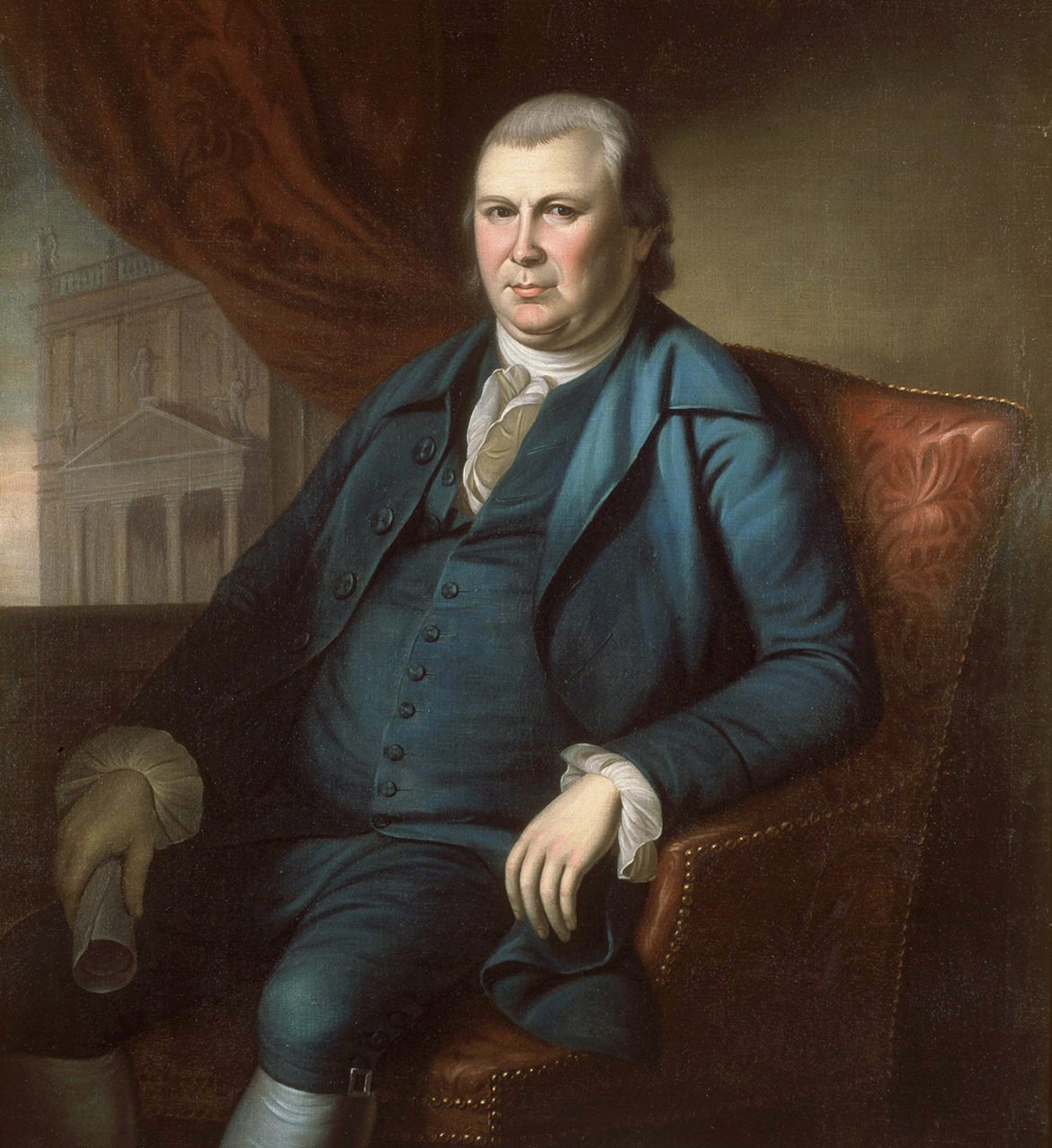
Robert Morris: Founding Father and Revolutionary Financier

Emerging Revolutionary War welcomes back guest historian Michael Aubrecht

To call Robert Morris “a political renaissance man” would be an understatement. He was vice president of the Pennsylvania Committee of Safety (1775–76) and was a member of the Continental Congress (1775–78) as well as a member of the Pennsylvania legislature (1778–79, 1780–81, 1785–86). Morris practically controlled the financial operations of the Revolutionary War from 1776 to 1783. He was a delegate to the Constitutional Convention (1787) and served in the U.S. Senate (1789–95). Perhaps most impressive is the fact that he signed the Declaration of Independence and the Articles of Confederation and later signed the U.S. Constitution.

At the start of the war Robert Morris was one of the wealthiest men in the colonies, but he would go on to claim bankruptcy after some catastrophic decisions. To fully appreciate the contributions of Robert Morris we must go back and examine him from the beginning.

Robert Morris

Robert Morris was born on January 31, 1734, in Liverpool, England, the son of Robert Morris, Sr., and Elizabeth Murphet Morris. His mother died when he was only two and he was raised by his grandmother. Morris’ father immigrated to the colonies in 1700, settled in Maryland and in 1738 he began a successful career working for Foster, Cunliffe and Sons of Liverpool. His job was to purchase and ship tobacco back to England. Morris Sr. was known for his ingenuity, and he was the creator of the tobacco inspection law. He was also regarded as an inventive merchant and was the first to keep his accounts in money rather than in gallons, pounds, or yards.

In 1750 tragedy would once again strike the Morris family. In July Morris Sr. hosted a dinner party aboard one of the company’s ships. As he prepared to depart a farewell salute was fired from the ship’s cannon and wadding from the shot burst through the side of the boat and severely injured him. He died a few days later of blood poisoning on July 12, 1750. The tragedy had a terrible effect on Morris who became an orphan at the age of 16. Looking for a change he left Maryland for Philadelphia in 1748. He was taken under the wing of his father’s friend, Mr. Greenway, who filled the gap left by the death of Morris’ father. Raised with a tremendous work ethic Morris flourished as a clerk at the merchant firm of Charles Willing & Co. 

Following in his father’s footsteps Morris was also gifted with successful ingenuity. In his twenties he took his earnings and joined a few friends in establishing the London Coffee House. (Today the Philadelphia Stock Exchange claims the coffee house as its origin.) Morris was sent as a ship’s captain on a trading mission to Jamaica during the Seven Years War (1756-1763). He was captured by a group of French Privateers but managed to escape to Cuba where he remained until an American ship arrived in Havana. Only then was he able to secure safe passage back to Philadelphia. 

Shortly after Morris’ return to the colonies Willing retired and handed the firm over to his son Thomas who offered him a partnership. This resulted in the formation of Willing, Morris & Co. The firm boasted three ships that were dispatched to the West Indies and England importing British cargo and exporting American goods. This relationship lasted for over 40 years and was immensely successful. At one point, Morris was ranked by the Encyclopedia of American Wealth, along with Charles Carroll of Carrollton, as the two wealthiest signers of the Declaration of Independence.

As influential merchants, Morris and Willing disagreed with the changes in tax policy. In 1765, the Stamp Act was passed and was met with massive resistance. Morris was at the forefront and led protests in the streets. His fervor was so striking that he convinced the stamp collector to suspend his post and return the stamps back to their origin. The tax collector stated that if he had not complied, he feared his house would have been torn down “brick by brick.” In 1769, the partners organized the first non-importation agreement, which forever ended the slave trade in the Philadelphia region.

Morris married Mary White on March 2, 1769, and they had seven children. In 1770, he bought an eighty-acre farm on the eastern bank of the Schuylkill River where he built a home he named “The Hills.” Due to his growing reputation Morris was asked to be a warden of the port of Philadelphia. Showing his tenacity, he convinced the captain of a tea ship to return to England in 1775.

Later on, Morris was appointed to the Model Treaty Committee following Richard Henry Lee’s resolution for independence on June 7, 1776. The resulting treaty projected international relations based on free trade and not political alliance. The treaty was eventually taken to Paris by Benjamin Franklin who transformed it into the Treaty of Alliance which was made possible by the Continental Army’s victory at Yorktown in 1781. 

Scholars disagree as to whether Morris was present on July 4 when the Declaration of Independence was approved. But when it came time to sign the Declaration on August 2 he did so. Morris boldly stated that it was “the duty of every individual to act his part in whatever station his country may call him to in hours of difficulty, danger and distress.” Until peace was achieved in 1783, Morris performed services in support of the war. His efforts earned him the moniker of “Financier of the Revolution.”

Michael is the author of “The Letters of Robert Morris: Founding Father and Revolutionary Financier.

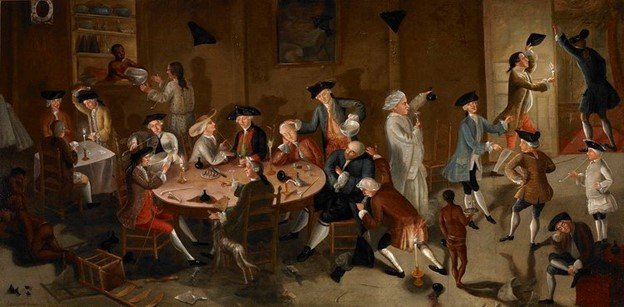
Founders and Drinkers

Emerging Revolutionary War welcomes back guest historian Michael Aubrecht

As someone who enjoys the occasional cocktail I am admittedly curious as to the rumored excessive-drinking habits of our Founding Fathers.

After conducting a casual examination, I think it would be fair to say that their wealth, power, and the period in which they lived in made alcohol a mainstay in their daily lives. Most of these gentlemen were the political playboys of their day and we already know that many of them had a penchant for wine, women and song. Today most people assume that the common table wine was the preferred beverage of colonial times and that most folks simply enjoyed it as a compliment to meals.

According to research conducted by Stanton Peele, the Founders had a much broader palette when it came to engaging in the Spirit of ‘76. Simply put, these boys liked to party:

How do we know the Founding Fathers as a group drank a lot? Well, for one thing, we have records of their imbibing. In 1787, two days before they signed off on the Constitution, the 55 delegates to the Constitutional Convention partied at a tavern.

According to the bill preserved from the evening, they drank 54 bottles of Madeira, 60 bottles of claret, eight of whiskey, 22 of porter, eight of hard cider, 12 of beer and seven bowls of alcoholic punch. That’s more than two bottles of fruit of the vine, plus a few shots and a lot of punch and beer, for every delegate. Clearly, that’s humanly impossible.

Continue reading “Founders and Drinkers”

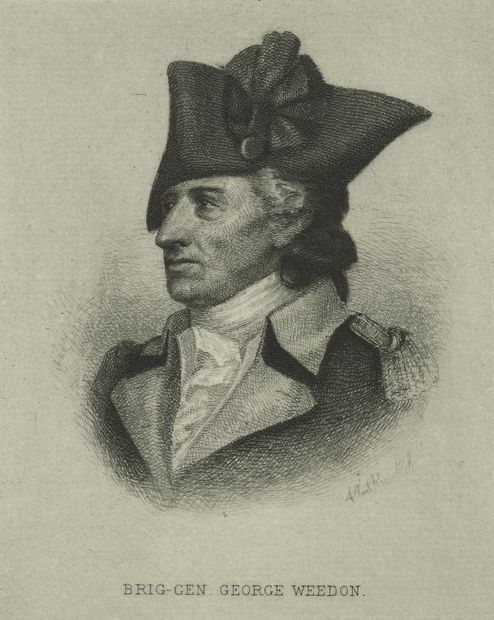
Jefferson and Weedon

Emerging Revolutionary War welcomes back guest historian Michael Aubrecht

In 1777 Thomas Jefferson and a committee of revisors came to the City of Fredericksburg for the purpose of revising several Virginia statutes. This led to Jefferson drafting the Virginia Statute for Religious Freedom.

When Jefferson and his comrades arrived in Fredericksburg they were met with a town bristling with military activity. Troops were drilling in the public square and filled the crowded streets, buildings and shops. Awaiting travel orders were the men of the Second Virginia and the Seventh Virginia, ordered here on January 9 for a rendezvous just prior to marching to join General Washington at the front. By the time Jefferson arrived in Fredericksburg, sixty of the more than two hundred battles and skirmishes of the war had already taken place.

Continue reading “Jefferson and Weedon”