Part One, of a series on the importance of Valley Forge in the American Revolution
On December 19, 1777, the Continental Army, under the command of General George Washington, marched into Valley Forge, Pennsylvania. Located approximately 20 miles from Philadelphia, which had fallen to the British that autumn, Washington’s army would spend the next five-plus months in this soon-to-be iconic place in the quest for American independence.
Yet, the accounts of how desperate the condition of the American forces were emanates throughout the centuries and strikes awe and amazement at the level of perseverance that the soldiers committed to. The winter of Valley Forge was just one of many cold, bleak, and destitute winters that the Continental Army faced during the seven-year conflict.
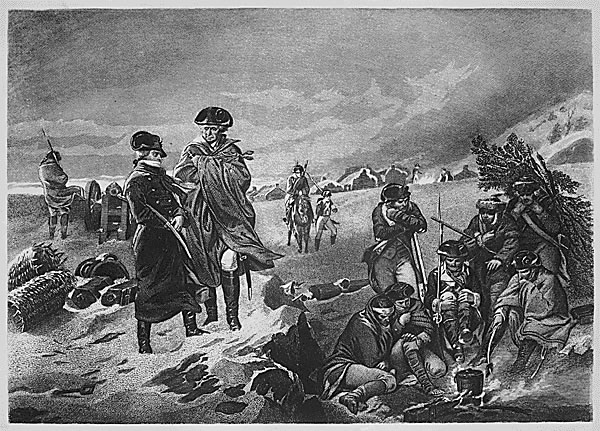
Artist depiction of the encampment at Valley Forge. George Washington and the Marquis de Lafayette are the two horsemen depicted prominently
However, that does not take away from the conditions of that winter. Especially when written from the ink and quill or pencil of the common soldier. Especially with what that winter cantonment did in the transformation of that Continental Army.
One of the best remembrances of that cold winter comes from Joseph Plumb Martin, whose Memoir of a Revolutionary Soldier, is still in print today.
Upon arrival at Valley Forge, Martin would write:
“We were now in a truly forlorn condition,–no clothing, no provisions, and as disheartened as need be. We arrived, however, at our destination a few days before christmas. Our prospect was indeed dreary.”
Just a short time after his arrival, Martin continued the plight of himself (and most likely many a soldier in that encampment) when he wrote;
“I lay here two nights and one day, and had not a morsel of any thing to eat all the time, save half a pumpkin, which I cooked by placing it upon a rock, the skin side uppermost, and making a fire upon it; by the time it was heat through I devoured it with as keen an appetite as I should a pie made of it at some other time.”
Martin’s account is supported by General James Varnum, who reported on December 20, 1777, “that his division had eaten no meat during 48 hours and had been three days without bread.”
Suffering at Valley Forge
Yet, during that winter, the experience of Valley Forge, according to another veteran of that harsh winter, “added iron to their souls.”
More than “iron souls” would be needed to defeat the British in the American Revolution. Winter, 1777, would see to that as well.
When most Americans think of Valley Forge the image of a cold, harsh and bleak winter landscape tends to spring to mind. They remember from their history books that this was the place where Gen. George Washington’s rag-tag Continental Army suffered greatly from the harsh elements. While Pennsylvania winters are rarely mild, the winter of 1777-1778 was not as harsh as what the army would later endure at Morristown, NJ. What truly plagued Washington’s army that winter at the Forge was a want of supplies: food, medicine, blankets, shoes, clothing, etc… If there was ever a time in the life of this army when the boys could have called it quits, when they could have disbanded and just gone home…..then Valley Forge would have been the place for it.
National Memorial Arch
I took my family to visit Valley Forge National Historical Park near the Schuylkill River, west of Philadelphia not long ago. Out of season, of course. It was a warm day in July when the five of us meandered through the little visitor’s center and museum and then drove along the park roads trying to take in everything this immense site had to offer. Entertaining three teenagers packed in a minivan isn’t always the easiest thing to do on a history tour but they seemed impressed with the National Memorial Arch, standing majestically alone on its green hilltop.
My attention, not surprisingly, was drawn to the restored cabins where the soldiers spent their winter days and nights and by the beautiful stone Potts House in which Washington lived and, along with his military “family”, used as headquarters. But this trip would prove to be an eye-opener for me.
Restored Cabins
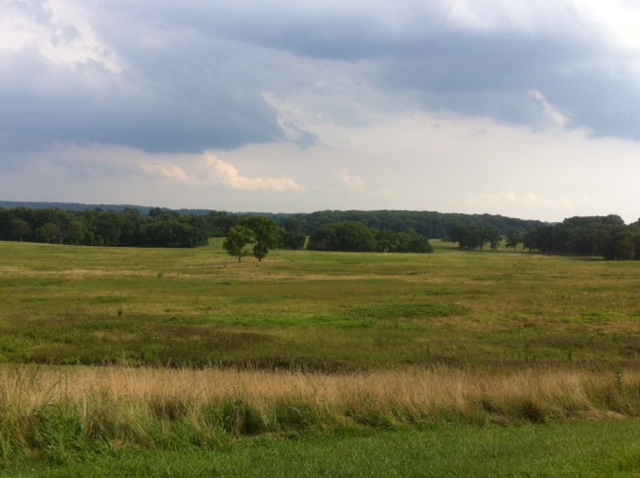
As we cruised along the park roads, through beautiful rolling hills, we came upon what is called The Grand Parade. It’s a large, grassy, open field bordered by trees that stands nearly in the center of the park. At first glance it appears no different than any other large, grassy, open field bordered by trees, but there is something extra special about this one. For this was the scene where, some 238 years ago, Washington’s regiments and battalions marched and drilled during that long winter.
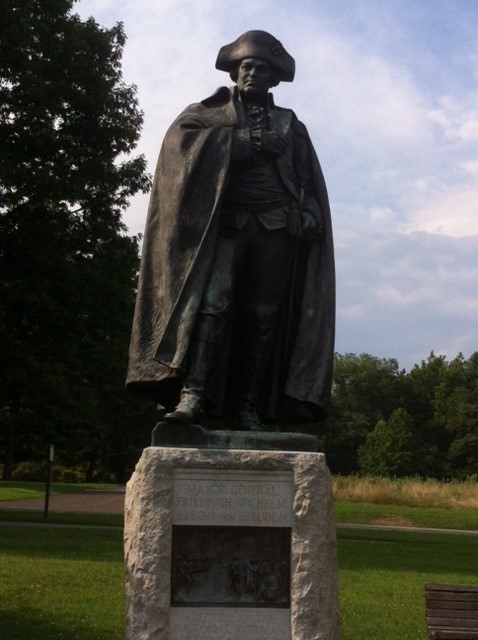
Baron Von Steuben
Standing on one side of the field is a statue; the man who’s responsibility it would become to train these men in the European military fashion. Friedrich Wilhelm August Heinrich Ferdinand Steuben, known as Baron von Steuben, came to America on the recommendation of none other than Benjamin Franklin. He was a veteran of the Prussian Army, he said; had attained the rank of Lieutenant General and served directly under the military genius Frederick the Great. At Valley Forge that winter, he would serve as a volunteer and would be appointed temporary Inspector General. As the historical record would later show, Steuben did serve as aide-de-camp to Frederick the Great but never attained a rank higher than that of captain. While his claim to rank and privilege was questionable at best and downright false at worst, Baron van Steuben would nonetheless prove invaluable to the United States. As an officer of the Prussian Army, he had the knowledge and skill necessary for training men in the art of war. He was the right man, for the right job, at just the right time.
The Baron spoke not a word of English; his orders had to be translated, but the manual of training he would compose was such that it turned a hungry, tattered, exhausted mass of farm boys and mechanics into a well-disciplined fighting force. He would mold them into an army.
Potts House
Unlike his British counterparts, George Washington was never to have a fully veteran army. Indeed, there were some men who served for the duration of the war but, by and large, enlistments expired and men returned to their homes, farms and families. But because of the training provided by this somewhat eccentric European who spoke and swore in German, the soldiers of the Army of the United States would go on to match the best in the world. On the field at Monmouth Courthouse in 1780, these men would prove their mettle. While the initial attack stalled, due mainly to poor leadership, the defensive position they would establish, under the watchful eye of their Commander-In-Chief, would prove the worth of their training. These lads stood off the best army in the world. And it all came together right here, on The Grand Parade at Valley Forge.
The Grand Parade
As I stood beside that statue on a warm day in July and gazed out on this wide open space, in my mind’s eye I could see those boys drilling; first by squad, then by company, then by regiment. I could see it all unfolding before me on this unassuming field. It looks like any other field you may pass on a drive in the country, but this field is where the war would change for the United States. This field, by God, was the birthplace of the American Army.
You can almost feel the cold weather from just looking at the painting. With the snow on the ground, and white specks of wintry mix falling in the distance, one almost wants to say “brrr.”
With rags wrapped around feet, heads bowed into the storm, and no two soldiers dressed a like the painting depicts winter 1777 for the American Continental Army. The title “The March to Valley Forge” also concocts images of the harshness of that winter during the American Revolution.
And in the middle of the picture, sits George Washington, astride his horse, staring at the marching soldiers in silent tribute. One of the soldiers is depicted doffing his cap at Washington. Respect, admiration, and solidarity of the joint struggle of the war, is present, by just examining the painting a little closer.
That is why this painting below, done by William Trego, a century and a few years after this march would have happened, is my favorite painting about the American Revolution.
Baron Frederich Wilhelm August Heinrich Ferdinand Steuben or Frederich Wilhelm Ludolf Gerhard Augustin von Steuben or more simply Baron von Steuben, may be the most recognizable German to serve with the American army during the American Revolution.*
Portrait of Baron Johann de Kalb (by Charles W. Peale)
His merits, pedigree, and how he came to America has been questioned and studied by many scholars and historians.
Another German has not fared so well in terms of recognition of his invaluable services to the American cause.
This post is about that other German-speaking military officer. He did something von Steuben did not.
Baron Johann von Robais de Kalb not only offered his services to the fledgling American Continental Army, he also gallantly gave his life for his adopted-cause.
Born June 19, 1721 in Huttendorf, near Erlangen in Bavaria, de Kalb led a life of privilege, learning multiple languages before earning a commission in the French army in the Loewendal Regiment. He served admirably in the War of Austrian Succession and the Seven Years War, in the later, he won the Order of Military Merit and gained his baronetcy.
Emerging Revolutionary War is honored to welcome guest historian Scott H. Harris, Director of the James Monroe Museum.
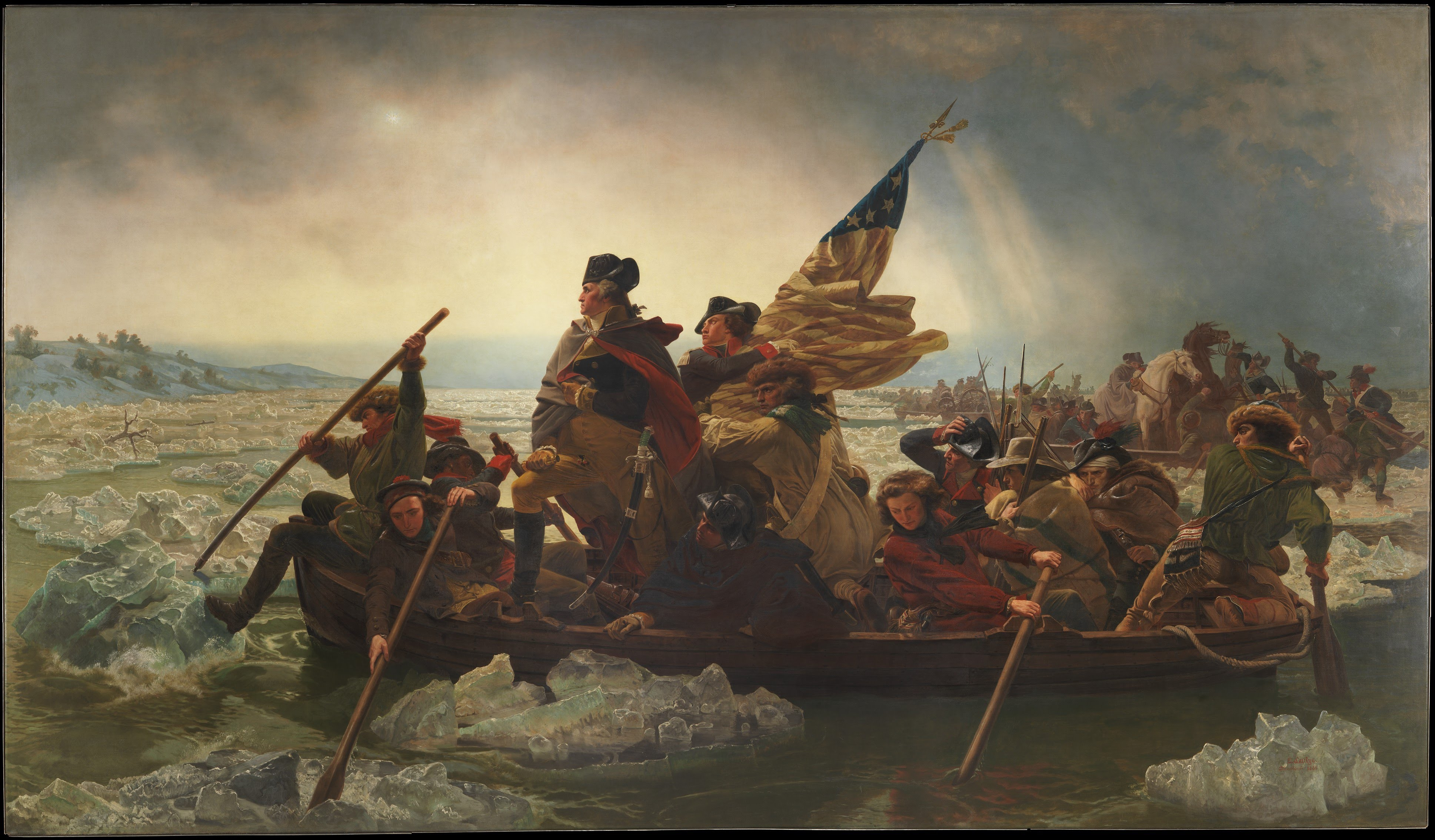
It is one of the great exploits of the American Revolution. On the night of December 25, 1776, General George Washington led the Continental Army across the icy Delaware River to attack a Hessian garrison at Trenton, New Jersey. Young Lieutenant James Monroe held the flag behind Washington as they were rowed across the freezing river (standing up).
Emanuel Gottlieb Leutze, Washington Crossing the Delaware. Oil on canvas, 1851. Only two figures in this fictitious image are identified—General George Washington and Lieutenant James Monroe (holding flag).








 Emerging Revolutionary War Era