

Emerging Revolutionary War welcomes back guest historian Eric Olsen. Eric is a historian with the National Park Service at Morristown National Historical Park. Click here for more information about the site.

Years ago, while I was looking at a list of disabled Revolutionary War veterans from Rhode Island I noticed some curious things. The list didn’t provide much information. It just gave the name and age of the veteran, their disability and how they were injured. At first, I was excited because I found a couple of guys who were wounded at the battle of Springfield in June 1780. But then I noticed a number of other men whose information seemed a little odd.
Several men were listed as having lost toes. Those same men had all lost their toes at a place called Oswego. Their wounds had all occurred in February 1783. A couple of the men even had the same unusual name of “Prince.” For me this raised several questions which required more research.

Where in the World is Oswego?
It turns out Oswego is a town in New York state on the eastern shore of Lake Ontario where it connects with the Oswego River. The name “Oswego” comes from the Iroquois word meaning “pouring out place” which is appropriate since it is where the Oswego River flows out into Lake Ontario. Heading inland, the Oswego River connects with the Oneida River which flows out of Oneida Lake.
In the 18th century lakes and rivers were the interstate highways of the day. Boats traveling on water could travel faster and carry heavier loads than wagons could on dirt roads. As a result, settlements developed along waterways and forts were built at strategic points where waterways connected.
The British originally established Oswego as a trading post on the northwest side of the mouth of the Oswego River. It was first fortified in 1727 and was known as the Fort of the Six Nations or Fort Oswego. By 1755 Fort Ontario was built on the opposite side of the river to bolster the area’s defenses during the French and Indian War. That fort was destroyed by the French in 1756 and rebuilt by the British in 1759. During the Revolutionary War, the fort was the starting point for St. Leger’s march against Fort Stanwix in 1777. Later the fort was abandoned by the British and destroyed by the Americans in 1778. The British returned and rebuilt the fort in 1782.
What’s the Story with the Frozen Toes?
Frostbite. Fortunately, Lt. Thompson explained,“We had two days a most severe storm and the whole of the time exceeding cold weather – we had three men perish before we could return to the lake [Lake Oneida]– and we dare not make fire for fear of being discovered. – we had one hundred and thirty bit with the frost, some very dangerously. I am myself one of the unfortunate.”
Why were there So Many Soldiers Named Prince?
It turns out the men named “Prince” were all African Americans. Prince was one of several names commonly given to enslaved men by their enslavers.
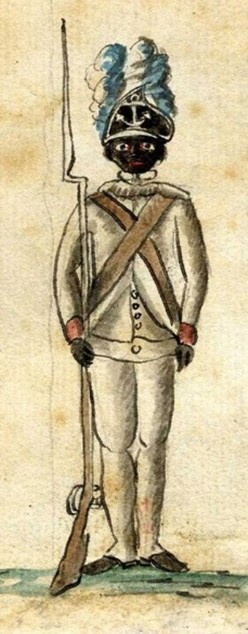
These men were formerly enslaved men who were promised their freedom if they agreed to serve in the Continental Army until the war ended. They were part of what had originally been the all-Black First Rhode Island Regiment. By 1783 with all of the Continental Army understrength, regiments were consolidated. The two Rhode Island Regiments were combined into one. What originally was an all-Black Regiment in 1783 was now an integrated regiment. The new Rhode Island Regiment was part of the 500-man force sent to attack Oswego.
Why Fight in February 1783?
February 1783 was an odd time to send out a major expedition against the enemy. Armies in the 18th century normally did not fight in the winter. Snow and cold were hard on the men, their clothing, and their equipment. In most cases armies would go into winter encampments in late fall and didn’t march off on the next campaign until late spring. Fighting in winter was rare and there had to be a good chance of success to risk the men in the bad weather.
The date of February 1783 also seemed to be an odd time to fight in terms of the overall American Revolution. After the American victory at Yorktown in October 1781 fighting in North America had almost stopped. The French, Spanish and British were focusing their efforts on other parts of the world. Plus, treaty negotiations to end the war had been taking place since April of 1782. Though they didn’t know it at the time, the final British evacuation of New York City was just nine months away in November 1783.
There didn’t seem to be a good reason to risk men’s lives in further fighting. But in February 1783 George Washington sent an expedition through the wilds of the New York frontier in the winter to capture a British outpost. Why?
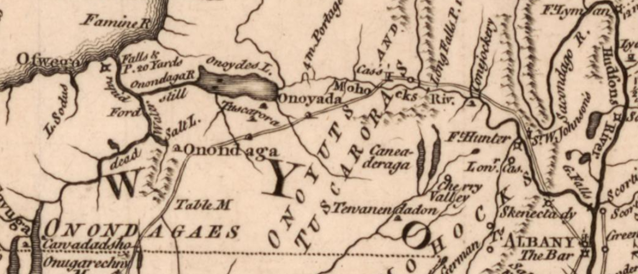
Oswego was the entrance to a system of waterways that connected Lake Ontario [left] with Albany, New York [lower right]. A British force under St. Ledger in 1777 had moved east from Oswego with the goal of joining forces with General Burgoyne in Albany. If successful they potentially could have driven a wedge between New England and the other rebellious colonies. But Burgoyne was defeated at Saratoga and St. Ledger was driven back at Fort Stanwix.
Check back next week for part II.
 Emerging Revolutionary War Era