 Spring has not get touched the tree-covered hills to the east of Elmira, New York, but the Chemung River sparkles in quiet anticipation as it flows between them. The Newtown Battlefield State Park won’t open for another few days or so—it operates seasonally May through October—but I have stopped nonetheless to see what might be here.
“I am very apprehensive our Expedition will not appear in History,” wrote Lt. Obadiah Gore, Jr., of the Continental Army.
And indeed Gore’s worries seem to have played out just that way. I know almost nothing about this Revolutionary War battle, although I have driven by the battlefield for decades. In fact, for two full years not so long ago, as I was doing my Ph.D. at Binghamton University, I drove through the battlefield four times a week on my way from and to Saint Bonaventure University, where I work. I really need to stop sometime, I kept telling myself.
For years, the old State Route 17 passed through the battlefield with little more than a sign telling motorists they were passing through and an arrow pointing up a road that could have been someone’s driveway. The expansion of Route 17 into Interstate 86 now gives motorists the chance to whisk right on by even faster, giving even less notice, despite signs that still say I am passing through.
But today, I’m finally stopping. Continue reading “A Stop at Newtown” →


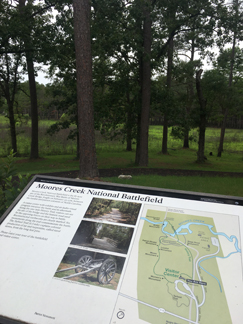 The Moores Creek battlefield manages to look simultaneously well manicured and primordial. Encompassing only 87 acres, it’s a landscape from before the dinosaurs that happens to have a rubberized pathway winding through its tall, thin pines.
 In Charleston’s Marion Square, an odd chunk of limestone, sand, and oyster shells sits inside a wrought-iron fence just beyond the normal boundaries of the weekend market. While shoppers buy their weekly produce or shop for gifts, the food court along King Street tempts them with just about anything you can image. Someone usually plays live music on the park-side of the market—and there, nearby, sits the hunk of rock.
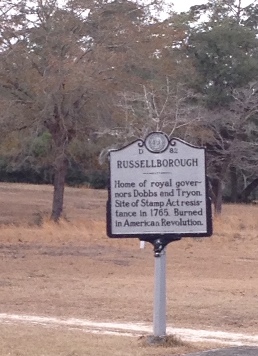 Russellborough doesn’t look like much now, but once upon a time, these ruins were one of the nicest homes along the North Carolina coast. Now, its spaciousness comes from the cavernous pavilion that protects the houses’ remains.
 Emerging Revolutionary War is pleased to present an excerpt from the forthcoming book
  Emerging Revolutionary War Era