1776 on Stage

When the musical 1776 debuted on Broadway, it came at what seemed like an unconventional time. The Vietnam War was underway, and American patriotism was being taxed as it had never been taxed before during wartime. Nonetheless, the production was a commercial and critical success, earning three Tony Awards, including Best Musical.

The show made the jump to film—I know a number of people who watch it every year on the Fourth of July—and it enjoyed revivals in 1997 and 2016. But the show never enjoyed the sort of enduring life off Broadway that classics like Hello, Dolly or Oklahoma! or Mame have enjoyed. (I could rattle off a dozen such names, and most readers would go, “Ohhhh, that’s a good one.” South Pacific? Meet Me in St. Louis? The Wizard of Oz? On and on….) As written, 1776 requires a cast of twenty-four men and only two women. That makes it exceptionally difficult to cast on the community theater level, where a majority of auditioners are typically female.

So perhaps the new national touring production of 1776, based on a 2022 Broadway revival, might offer a new way to look at the show. The new production, which I saw last week at the Kennedy Center in Washington, D.C., consists of “a company of artists who reflect multiple representations of race, ethnicity, and gender, and who identify as female, trans, nonbinary, and gender nonconforming.” That’s a mouthful, but the bottom line is that these are not your typical Founding Fathers because they aren’t “fathers” at all.

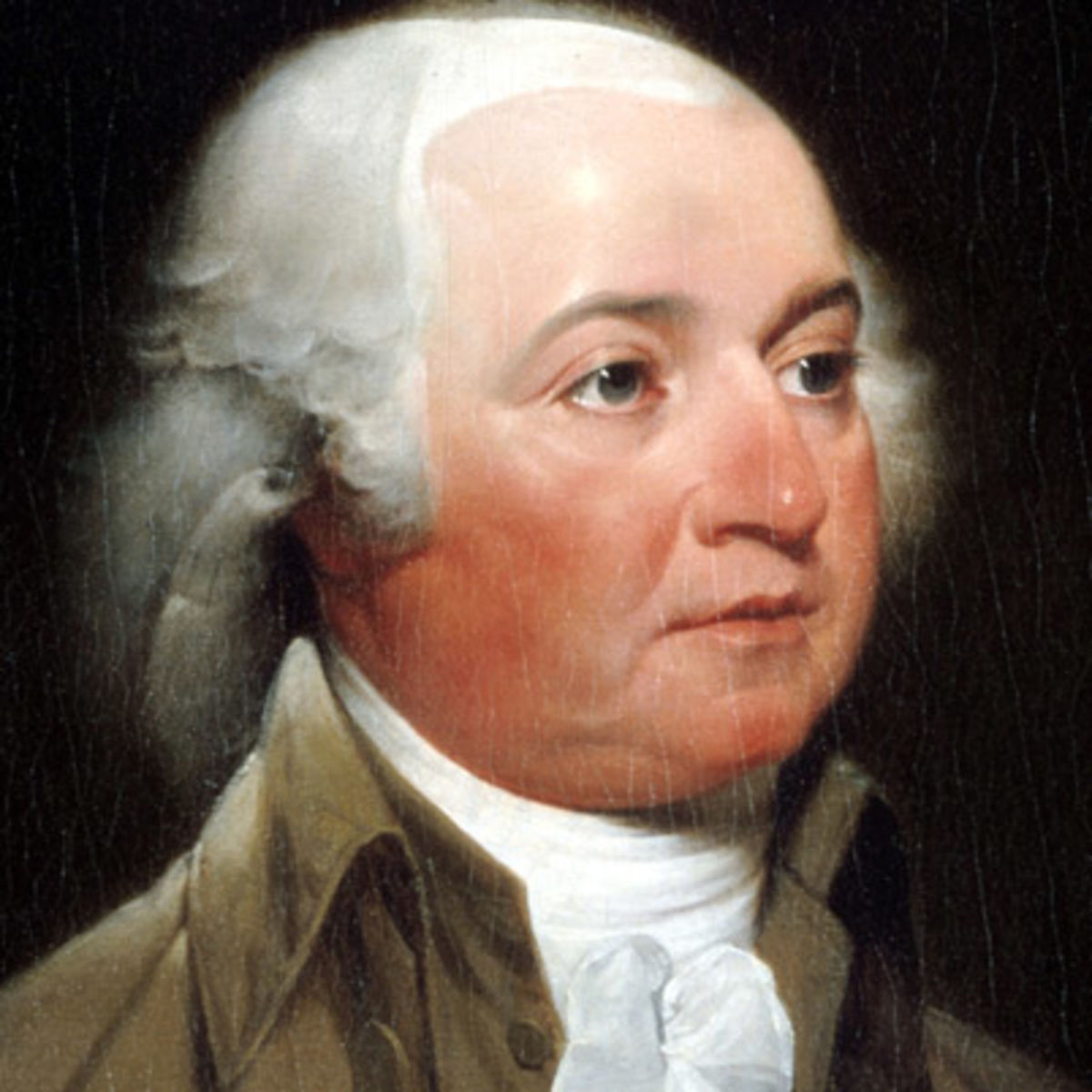
The production owns its new lens from the opening lines. To a backdrop of John Trumbull’s famous painting The Declaration of Independence, John Adams (as played by Gisela Adisa) begins the show: “In my many years, I have come to a conclusion that one useless man is a shame, two is a law firm, and three or more is a congress.” Adisa, a black woman, looks pointedly at the painting. “By God, I have had this Congress,” she says.

Her meaning is unmistakable: these dead white men are tired and old. Time for something new.

The cast comes onstage and literally steps into the buckle-topped leather shoes of the Founders. They hoist the bottom cuffs of their pantlegs up, transforming them into knickerbockers. And away they go! Soon enough, the whole cast is shout-singing at Adams to “Sit down, John!”

The production conceit obviously owes a lot to the Tony Award-winning Hamilton, which opened in 2015 with a multicultural cast. Writer Lin-Manuel Miranda reportedly read Ron Chernow’s biography of Alexander Hamilton and saw a lot of himself in the Founder: an Everyman from humble beginnings who transformed himself into a self-made man. If Miranda could see himself in this old “dead white male,” couldn’t others, as well?

Casting the Revolutionary generation outside of its historical color, race, and gender boundaries proved revolutionary in and of itself, but it proved remarkably successful. Hamilton’s story—and the larger story of America—became newly accessible to huge new audiences. Ditching fifes and drums for a hip-hop and soul soundtrack also reframed the story and increased history’s modern appeal.

Ironically, one of Miranda’s inspirations for Hamilton was the much more traditional 1776. “1776 certainly paved the way for Hamilton,” Miranda said in feature in Playbill, “not just in that it’s about our founders, but also in that it engages fully with their humanity. I think it makes them accessible to us in a very real way.” That Playbill piece, funny enough, consisted of a conversation between Miranda and William Daniels, who played John Adams in the original 1776 production and in the film. (It’s a neat interview. You can read it here.)

As I prepared to watch 1776 at the Kennedy Center, I pondered whether the same conceit would work for this show the way it had for Hamilton. I understand the “Everyman” idea, but on the other hand, the members of the Second Continental Congress were hardly “Everymen.” They were, quite literally, the political elites of their respective colonies. But there’s room, too, to get into the weeds on that. Benjamin Franklin and John Adams both came from humble origins even if Edward Rutledge or Richard Henry Lee did not. And that’s the point of good history: get into the weeds. Look at the shades of gray. Find new lenses to see the familiar in new ways so you can better understand what you’re looking at.

It would be a mistake to brush aside this production of 1776 as woke-ism or political correctness or any of that. “I’m not interested in talking about American history because I want to punish America,” said Bryan Stevenson, creator of the National Memorial for Peace and Justice in Montgomery, Alabama, quoted by the show’s directors in the program. “I want to liberate America.”

1776 proved liberating. While the production conceit didn’t work 100% of the time, it mostly did, and at those times it worked best, it added powerful, powerful resonance. When the delegates sang of the slave trade in “Molasses to Rum,” for instance, and some of those performers were Black women, the sinister nature of the dark bargain at the heart of the Founding reverberated with a tragic sense of the now. And when echoes of Adams’s plaintive “Is Anybody Out There,” sung by a black woman, wove through, it was chilling and urgent. History spoke from the stage to us in the present.

Newly sanctioned additions to the production gave us Abigail Adams’s “remember the ladies”—magnified in its power among a non-male cast. It also adds Robert Hemings, Thomas Jefferson’s enslaved servant, as a silent figure on stage, voiceless as Jefferson pens the enduring words “All men are created equal.” These were delightful, thought-provoking moments that confronted American history without being confrontational.

1776 is, to be sure, a delightful show, but it’s less jingoistic than one might expect for a story about America’s birthday. It asks us to consider the costs of that founding, not so we can feel bad about America but so can be reminded of the ongoing work to live up to our own ideals. It asks us not to think of a founding moment but, instead, the beginning of founding process that we are all invited to be part of because the work belongs to us all.

Reading Sam Adams…part 2

My recent comments about Stacy Schiff’s The Revolutionary Samuel Adams got me thinking about some of John Adams’s thoughts about his second cousin. In particular, John shared a neat story about Sam’s secretiveness—a problem that has bedeviled biographers, including Schiff, because Sam didn’t leave behind a trove of documentary evidence the way other Founders did.

“I have seen him . . .” said John, “in Philadelphia, when he was about to leave Congress, cut up with his scissors whole bundles of letters, into atoms that could never be reunited, and throw them out at the window, to be scattered by the winds. This was in summer, when he had no fire. In winter he threw whole handfuls into the fire. As we were on terms of perfect intimacy, I have joked him, perhaps rudely, upon his anxious caution. His answer was, ‘Whatever becomes of me, my friends shall never suffer by my negligence.’”[1]

John admired Sam, 13 years his senior, a great deal. The two were hardly acquainted growing up, but as John started off his legal career in Boston, Sam—a great cultivator of talent—pegged him as someone to develop. As tensions in Boston grew between the Sons of Liberty, British officials, and far-off Parliament, Sam brought John into the inner circle because of John’s sharp legal mind. The decision paved John’s eventual path to national politics.

“Mr. Adams was an original,” John said of Sam, saying he was “born and tempered a wedge of steel. . . .”[2]

In his common appearance, he was a plain, simple, decent citizen, of middling stature, dress and manners. He had an exquisite ear for music, and a charming voice, when he pleased to exert it.—Yet his ordinary speeches in town meetings, in the house of representatives and in congress, exhibited nothing extraordinary; but upon great occasions, when his deeper feelings were excited, he erected himself, or rather nature seemed to erect him, without the smallest symptom of affectation, into an upright dignity of figure and gesture, and gave a harmony to his voice, which made a strong impression on spectators and auditors, the more lasting for the purity, correctness and nervous elegance of his style.[3]

John spoke on several occasions of Sam’s “an air of dignity and majesty.” He admired Sam’s “harmonious voice and decisive tone” and his “self-recollection, a self-possession, a self-command, a presence of mind that was admired by every man present. . . .”[4] He also listed “his caution, his discretion, his ingenuity, his sagacity, his self-command, his presence of mind, and his intrepidity” as traits that “commanded the admiration” of friend and foe alike—friends who applauded him and foes who could not help but respect Sam Adams’s considerable populist powers.[5]

It is little doubt why John later said, “Without the character of Samuel Adams, the true history of the American Revolution can never be written.”[6]


[1] “From John Adams to William Tudor, Sr., 5 June 1813,” Founders Online, National Archives, https://founders.archives.gov/documents/Adams/99-02-02-6054. 

[2] “From John Adams to William Tudor, Sr., 5 June 1813,” Founders Online, National Archives, https://founders.archives.gov/documents/Adams/99-02-02-6054. 

[3] “From John Adams to William Tudor, Sr., 15 April 1818,” Founders Online, National Archives, https://founders.archives.gov/documents/Adams/99-02-02-6883.

[4] “From John Adams to William Tudor, Sr., 15 April 1818,” Founders Online, National Archives, https://founders.archives.gov/documents/Adams/99-02-02-6883.

[5] “From John Adams to Jedidiah Morse, 1 January 1816,” Founders Online, National Archives, https://founders.archives.gov/documents/Adams/99-02-02-6563. 

[6] “From John Adams to William Tudor, Sr., 15 April 1818,” Founders Online, National Archives, https://founders.archives.gov/documents/Adams/99-02-02-6883.

Reading Sam Adams…

I’m currently reading Stacy Schiff’s new biography The Revolutionary Samuel Adams. It’s a snappy-to-read, deeply researched book—all the more challenging to write because Sam Adams made careful effort not to leave much of a paper trail about himself.  

Schiff uses her introduction to sketch out this fundamental problem, and in doing so, she creates a compelling flash portrait of Adams that the rest of the book fleshes out. Adams the historiographical sphinx is well served by this portrait. Sam Adams simultaneously led from the front yet operated in the shadows, an apparent contradiction that Schiff nonetheless portrays fully and effectively. 

As the book goes on, Schiff manages to pull from a deep well of primary sources, even if there’s not a mountain from Sam himself. She handles those sources adroitly and comfortably, plucking this bit from here and that bit from there the way a conductor works an orchestra.  

The result is an admiring but not fawning portrait of Adams—a man without whom, said cousin John, “the true history of the American Revolution can never be written.”[1] 

Troubling to me in the text is that, in the late 1760s and early 1770s, the Adams-led Sons of Liberty often employed mob violence—real and threatened—to achieve their aims. Propaganda efforts were often tethered to reality by only thinnest of meager threads, if at all. Men were intimidated, bullied, tarred and feathered, humiliated, assaulted, and run out of town for opposing or even just disagreeing with them. Houses were ransacked. Livelihoods destroyed. Reputations ruined. I could not help but think of the Klan in the Reconstruction-era South—a comparison no-doubt tantamount to sacrilege when talking about a group of Bostonians popularly and fondly remembered as patriots.  

Yet Schiff merrily skates over such rough terrain, sharing vivid details about incidents without exploring the moral morass this tension suggests. Her hero acts in decidedly less-than-heroic ways, arguing that the ends justify the means. We as readers are left to ponder this ambiguity ourselves. Such work on the reader’s part isn’t a bad thing, but it does strike me as somewhat of an abdication on the biographer’s part when the rest of the narrative is so cheerfully pro-Adams. 

Overall, The Revolutionary Samuel Adams is an excellent work so far, and I highly recommend it for anyone who wants a fuller understanding of how the wheels of Revolution started turning—and who started them. 


[1]“From John Adams to William Tudor, Sr., 5 June 1813,” Founders Online, National Archives, https://founders.archives.gov/documents/Adams/99-02-02-6054.  

A “Passion for Superiority,” The Continental Army Officer Corps, and Middle School “Mean Girls”

John Adams woke on the morning of May 21, 1777, feeling light of heart. A spell of bad weather had finally broken, and the bright spring dawn cheered his spirits. He took a few minutes before beginning his day to pen a letter to his “Dearest Friend,” his wife, Abigail.[1]

“The Charms of the Morning at this Hour, are irresistible,” he told her. “The Streakes of Glory dawning in the East: the freshness and Purity in the Air, the bright blue of the sky, the sweet Warblings of a great Variety of Birds intermingling with the martial Clarions of an hundred Cocks now within my Hearing, all conspire to chear the Spirits.” Adams’s letters are filled with such descriptions, which are one of the many reasons they’re a delight to read. But then he got down to business.

As the Second Continental Congress’s de facto Secretary of War, he had spent the previous evening, May 21, at the War Department meeting with General Benedict Arnold. Arnold had been embroiled in controversy with several lower-level officers, one of whom claimed “Money is this man’s God, and to get enough of it he would sacrifice his country.” (The charge was untrue at the time but proved ironically prophetic.)

Adams told Abigail that he’d heard Arnold “fought like Julius Caesar” and came to believe Arnold’s side of the tale. “He has been basely slandered and libeled,” Adams concluded.

His political perch gave Adams a view of the Continental Army that might surprise us today. In his usual candor, he told Abigail:

“I am wearied to Death with the Wrangles between military officers, high and low. They Quarrell like Cats and Dogs. They worry one another like Mastiffs. Scrambling for Rank and Pay like Apes for Nutts.”

As he continued, he made an observation that touched close to home. Adams was notoriously vain—a vice he recognized and continually struggled with—so he was deeply familiar with the human tendency to compare oneself with one’s peers. Particularly early in his legal career, Adams measured himself against other young lawyers and pined for the chance to distinguish himself. It was, he said to Abigail, a “Passion for Superiority”:

“I believe there is no one Principle, which predominates in human Nature so much in every stage of Life, from the Cradle to the Grave, in Males and females, old and young, black and white, rich and poor, high and low, as this Passion for Superiority …. Every human Being compares itself in its own Imagination, with every other round about it, and will find some Superiority over every other real or imaginary, or it will die of Grief and Vexation[. . . .] I never saw it operate with such Keenness, Ferocity and Fury, as among military Officers. They will go terrible Lengths, in their Emulations, their Envy and Revenge, in Consequence of it.”

Adams had seen that sort of cattiness “among Boys and Girls at school, among Lads at Colledge, among Practicers at the Bar, among the Clergy in their Associations, among Clubbs of Friends, among the People in Town Meetings, among the Members of an House of Reps. [Representatives], among the Grave Councillors, on the more solemn Bench of justice, and in that awfully August Body the Congress, and on many of its Committees — and among Ladies every Where. . . . .” No where was it worse than among the “Mean Girls” of the army’s officer corps.

“So much for Philosophy,” Adams decided, and then inquired about his children and Abigail’s asparagus. Then he concluded with a note that resonates with all of us here at Emerging Revolutionary War:

“I would give Three Guineas for a Barrell of your Cyder — not one drop is to be had here for Gold. And wine is not to be had under Six or Eight Dollars a Gallon and that very bad. I would give a Guinea for a Barrell of your Beer. The small beer here is wretchedly bad. In short I can get nothing that I can drink, and I believe I shall be sick from this Cause alone. Rum at forty shillings a Gallon and bad Water, will never do, in this hot Climate in summer where Acid Liquors are necessary against Putrefaction.”

Cheers!


[1] All quotes from: Letter from John Adams to Abigail Adams, 22 May 1777 [electronic edition]. Adams Family Papers: An Electronic Archive. Massachusetts Historical Society. http://www.masshist.org/digitaladams/

Dills Bluff: A Sign of the End

Yorktown, of course, wasn’t the end of the Revolutionary War. It wasn’t even the end of military action.

Take, for instance, the battle of Dill’s Bluff on James Island, outside Charleston—the last military action of the Revolution in South Carolina. The engagement took place on Nov. 14, 1782.

Today, nothing remains of the battlefield, which is marked only by a single two-sided sign. Continue reading “Dills Bluff: A Sign of the End”

A Tree as Old as the Country

Muir Woods Bicentennial Tree

The coastal redwoods of Muir Woods form as close to a natural cathedral as I’ve ever visited. Tucked in a hidden valley in the Golden Gate Recreation Area, just north of San Francisco, the national park allows visitors to escape from the metropolitan hustle and bustle and step into a primordial landscape.

Some of the trees in the forest are estimated to be more than a thousand years old. One, not near so old, still lays claim to special historical significance: the Bicentennial Tree.

Continue reading “A Tree as Old as the Country”

Philip van Cortlandt’s Roadside Monument

Route 15 Marker-Painted PostI’m sure the men who’d embarked on the 1779 Sullivan-Clinton Campaign weren’t traveling along New York’s Southern Tier Expressway as they moved through the lands of the Iroquois Confederation. In the “Tory-Indian Town of Painted Post,” I’m sure members of the expedition didn’t decide on a detour down U.S. Rt. 15 south toward the Pennsylvania state line.

But that’s how I came across a monument to the expedition during recent travels, located at a parking area along Rt. 15 south. Continue reading “Philip van Cortlandt’s Roadside Monument”

The Sons of Liberty in Kentucky

In Louisville, Kentucky, earlier this month, I paid a visit to the Louisville Slugger Factory and Museum downtown. Across the street, I was pleasantly surprised to see a marvelous statue of a minuteman.

Sons of American Revolution Statue

The plaque on the back reads

Sons of Liberty—1775

To Honor the History
of
Philadelphia Continental Chapter
1901

Pennsylvania Society
Founded 1893

By its Compatriots
2009

The statue stands outside the headquarters of the National Society of the Sons of the American Revolution. “Located along Main Street’s Museum Row in downtown Louisville,” the society’s website says, “the Sons of the American Revolution is the leading male lineage society that perpetuates the ideals of the war for independence.”

Sons of American Revolution Museum

The statue was publicly unveiled in November 2015. According to the Louisville Courier Journal, “The 800-pound, 8-foot high bronze statue of the Minuteman holding a musket rests upon 19,000 pounds of quarried Kentucky limestone, material specifically requested by the artist James Muir.”

Oriskany Battlefield (part two)

part two of two

In my first post, I described my visit to the Oriskany Battlefield near Rome, New York, on a dreary day. Recent rain, mostly dried, still left streaks on the monuments. The denuded trees created deceptively open visibility quite unlike the heavy foliage that would’ve clogged the surrounding forest on August 6, 1777. Still, it was a great little battlefield to see, even in the off season. Today, I follow up with some photos from my visit. (Read part one for a battle summary and additional resources.)

01-Oriskany Open Field
The battlefield monument, dedicated in 1884, on the 107th anniversary of the battle

Continue reading “Oriskany Battlefield (part two)”

The Oriskany Battlefield (part one)

Monument 01part one of two

The rolling hills and dale that make up the Oriskany Battlefield look bleak and washed out on this overcast day. The battle took place in the full flush of August green, but I visit on a dreary off-season day. The battlefield sits next to state route 69, which winds through a rural part of upstate New York that, itself, looks time-forgotten.

The most prominent feature of the battlefield is the tall needle-like obelisk, dedicated on August 6, 1884—the 107th anniversary of the battle. The battlefield received formal protection from the state forty-six years later, in 1927, on the battle’s sesquicentennial. Initially comprised of five acres, the park now includes 70 acres, with the old Erie Canal running along its northern border. Continue reading “The Oriskany Battlefield (part one)”