

 I’m sure the men who’d embarked on the 1779 Sullivan-Clinton Campaign weren’t traveling along New York’s Southern Tier Expressway as they moved through the lands of the Iroquois Confederation. In the “Tory-Indian Town of Painted Post,” I’m sure members of the expedition didn’t decide on a detour down U.S. Rt. 15 south toward the Pennsylvania state line.
But that’s how I came across a monument to the expedition during recent travels, located at a parking area along Rt. 15 south. Continue reading “Philip van Cortlandt’s Roadside Monument”


 part one of two
 While Charleston, South Carolina, absolutely overflows with history dating all the way back to colonial times, I had the chance to explore a particularly historic churchyard recently.
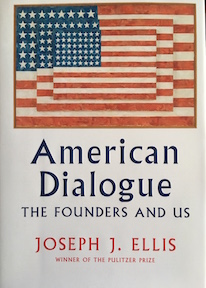 “The study of history is an ongoing conversation between past and present from which we all have much to learn,” write Joseph Ellis in his new book, American Dialogue: The Founders and Us. The book serves as Ellis’s attempt to sit with several of the Founders and carry on that conversation, with “us,” the readers, as spectators. As John Adams so often did with his own books, we can engage in the conversation by writing notes in the margins and underlining passages, and we can even read the original works of the Founders ourselves. Knowing they were writing as much to history as to each other, they left behind a rich documentary legacy.
 As I stood in Independence Hall, in the room where the Founders debated the Declaration of Independence, I suddenly started thinking of the opening scene from the musical 1776, when John Adams cries for independence while everyone else complains about either the heat or the flies. “Won’t somebody open up a window?” one of the delegates pleads. “Too many flies!” others respond, shouting him down. Adams is advocating the most lofty of ideas but everyone else is mired in their own personal discomfort. What a great metaphor.
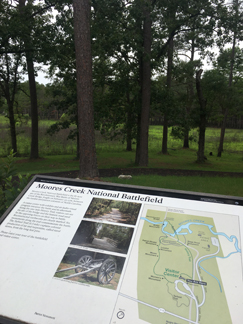 The Moores Creek battlefield manages to look simultaneously well manicured and primordial. Encompassing only 87 acres, it’s a landscape from before the dinosaurs that happens to have a rubberized pathway winding through its tall, thin pines.
 Emerging Revolutionary War Era