
 part one of two
The rolling hills and dale that make up the Oriskany Battlefield look bleak and washed out on this overcast day. The battle took place in the full flush of August green, but I visit on a dreary off-season day. The battlefield sits next to state route 69, which winds through a rural part of upstate New York that, itself, looks time-forgotten.
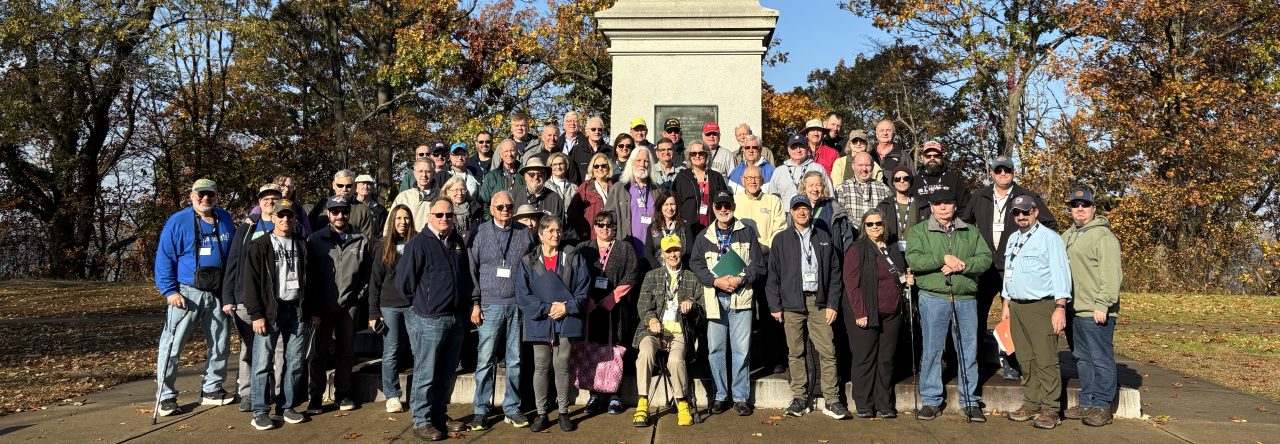
The most prominent feature of the battlefield is the tall needle-like obelisk, dedicated on August 6, 1884—the 107th anniversary of the battle. The battlefield received formal protection from the state forty-six years later, in 1927, on the battle’s sesquicentennial. Initially comprised of five acres, the park now includes 70 acres, with the old Erie Canal running along its northern border. Continue reading “The Oriskany Battlefield (part one)”

 While Charleston, South Carolina, absolutely overflows with history dating all the way back to colonial times, I had the chance to explore a particularly historic churchyard recently.

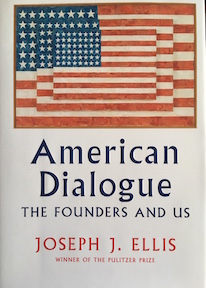 “The study of history is an ongoing conversation between past and present from which we all have much to learn,” write Joseph Ellis in his new book, American Dialogue: The Founders and Us. The book serves as Ellis’s attempt to sit with several of the Founders and carry on that conversation, with “us,” the readers, as spectators. As John Adams so often did with his own books, we can engage in the conversation by writing notes in the margins and underlining passages, and we can even read the original works of the Founders ourselves. Knowing they were writing as much to history as to each other, they left behind a rich documentary legacy.

 As I stood in Independence Hall, in the room where the Founders debated the Declaration of Independence, I suddenly started thinking of the opening scene from the musical 1776, when John Adams cries for independence while everyone else complains about either the heat or the flies. “Won’t somebody open up a window?” one of the delegates pleads. “Too many flies!” others respond, shouting him down. Adams is advocating the most lofty of ideas but everyone else is mired in their own personal discomfort. What a great metaphor.
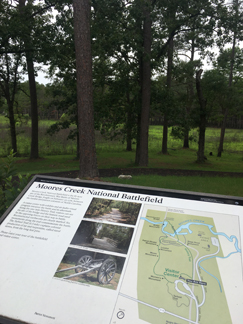 The Moores Creek battlefield manages to look simultaneously well manicured and primordial. Encompassing only 87 acres, it’s a landscape from before the dinosaurs that happens to have a rubberized pathway winding through its tall, thin pines.
 In Charleston’s Marion Square, an odd chunk of limestone, sand, and oyster shells sits inside a wrought-iron fence just beyond the normal boundaries of the weekend market. While shoppers buy their weekly produce or shop for gifts, the food court along King Street tempts them with just about anything you can image. Someone usually plays live music on the park-side of the market—and there, nearby, sits the hunk of rock.


