The Journal of Nicholas Cresswell, Part 5

Escape from America

Finally, in the spring of 1777, Cresswell again decided to try returning to England.  Thomson Mason, who had already intervened with two Committees of Safety to protect the Englishman, offered to help with Virginia authorities once more, provided that Cresswell swear not to join the British Army.  Cresswell did.  The best plan was to leave Leesburg, travel overland to Alexandria, then take a schooner down the Potomac and Chesapeake for Williamsburg and Hampton, where it might be possible go aboard a ship bound for British-occupied New York.  As he made his preparations, the local Committee of Safety arrived on April 16 to search his possessions for treasonable items.  They seized a shot pouch, powder horn, and bearskin he acquired from the Delaware Indians.  Cresswell decided not to contest the seizure lest it complicate his departure.

Continue reading “The Journal of Nicholas Cresswell, Part 5”

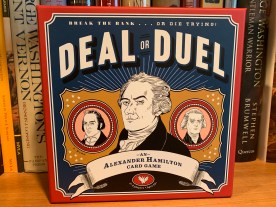
Gaming Away Social Distancing. Deal or Duel: An Alexander Hamilton Card Game

IMG_0611.jpeg
Game Box for Deal or Duel (Eric Sterner)

Among his many aphorisms, Ben Franklin reportedly said “games lubricate the body and the mind.”  Given the large number of quotes attributed to the sage, it is suspect.  But, his generation certainly understood games, both as a way of sharpening the mind and passing time in amicable company.  Franklin was fond of chess, but not above games of chance and gambling.  George and Martha Washington often played different card games with their guests.  George, of course, also made an occasional wager, particularly when traveling on business.  Even today, many parlors in restored colonial homes will contain a gaming table. Continue reading “Gaming Away Social Distancing. Deal or Duel: An Alexander Hamilton Card Game”

The Journal of Nicholas Cresswell, Part 4

A Loyalist under House Arrest

Having failed to reach the British Army in New York, Cresswell spent a miserable autumn and winter of 1776/1777 in northern Virginia, often arguing with his host, James Kirk, a Patriot and the only man who had ensured the Englishman could keep clothes on his back and a roof over his head.  Cresswell’s loyalist proclivities and extensive travels were widely known and on November 28, three men of the Committee of Safety in Alexandria “waited on me and informed me that the committee did not think it prudent to let me go out of the Country at this time and hoped that I would give  my word of honour not to depart this Colony for three months.  Otherwise they would confine me.  I was obliged to do the first as the lesser evil of the two.  They were polite enough not to search my chest.”[i]  Depressed as ever and suspecting Kirk of arranging the entire affair in order to keep him in Virginia, Cresswell did what he usually did when he was unhappy.  He got drunk.

Continue reading “The Journal of Nicholas Cresswell, Part 4”

The Journal of Nicholas Cresswell, Part 3

A Loyal Englishman in a Hostile Country

Part 2 click here.

When he arrived in Alexandria, Virginia in October 1775, Nicholas Cresswell, an Englishman visiting the colonies in search opportunity, found himself in dire straits.  The war had cut off his father’s money, while his loyalist principles strained his acquaintances and put him in an awkward position.  He summed it up: “if I enter into any sort of business I must be obliged to enter into the service of these rascals and fight against my Friends and Country if called upon.  On the other hand, I am not permitted to depart the Continent and have nothing if I am fortunate enough to escape the jail.  I will live as cheap as I can and hope for better times.”[i]

Continue reading “The Journal of Nicholas Cresswell, Part 3”

The Journal of Nicholas Cresswell, Part 2

An Englishman on the Frontier

Part 1 click here.

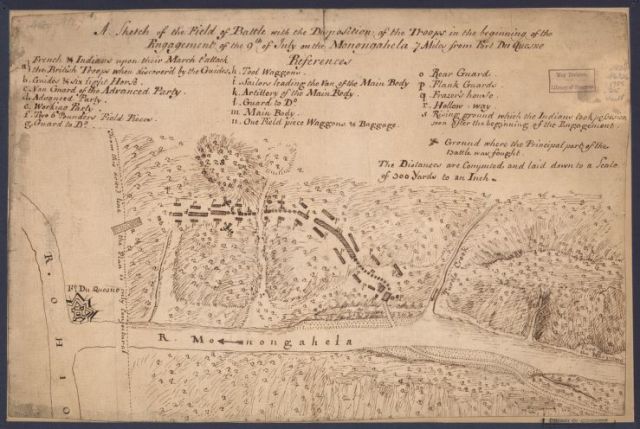
Nicholas Cresswell left Alexandria for the Illinois Country on March 16, 1775, his correspondence as yet unknown to the local Committee of Safety.  The Ohio River served as a highway to the west, so he headed for its origin at Pittsburgh.  Along the way, he stopped to visit the battlefield where French and Indian forces defeated Major General Edward Braddock in July, 1755.  Cresswell and his traveling companions found “great numbers of bones, both men and horses.  The trees are injured, I suppose by the Artillery…the greatest slaughter seems to have been made within 400 yards of the River…We could not find one whole skull, all of them broke to pieces in the upper part, some of them had holes broken in them about an inch diameter, suppose it to be done with a Pipe Tomahawk.”[i]

Monongaela Battle (Library of Congress)
Initial Dispositions of the Battle of the Monongahela.  Cresswell walked the battlefield on his way to Pittsburgh in 1775.  (Library of Congress)

Continue reading “The Journal of Nicholas Cresswell, Part 2”

The Journal of Nicholas Cresswell, Part 1


1BF5561D-F286-4DDD-BCEC-272C39979E49_1_201_a
Nicholas Cresswell from the Frontispiece of his Memoir (Library of Congress)

For some Englishman, the political conflict between the United Kingdom and its American colonies was an afterthought that should not interfere with their plans to build a future based on American wealth.  Nicholas Cresswell was one such person.  He traveled to the colonies on the eve of the American Revolution and returned home in 1777, having kept an extensive diary of his travels, experiences, thoughts, and conditions in America during the war’s first years.  Along the way, he met some of the most colorful and interesting people who played prominent roles in the war: George Rogers Clark, Delaware Indian leaders White Eyes and Killbuck, Thomas Jefferson, Patrick Henry, William Howe, Robert Rogers, and Charles Lee to name a few.  Since its publication, Cresswell’s journal has become a touchstone for historians looking for insight into those people, how a loyal Englishman like Cresswell saw the world and the Americans around him interpreted events.  In particular, he recounts the feelings and treatment of loyalists trapped in America during the war.  With that in mind, reviewing Cresswell’s diary might help spread the word about a worthwhile primary resource.

Continue reading “The Journal of Nicholas Cresswell, Part 1”

Groundhog Day and the Legend of Ponks Uteney

Before Americans began relying on a local groundhog to predict the weather, Punxsutawney, Pennsylvania had a legend attached to it.

In 1772, Native Americans converted to Christianity under the tutelage of missionaries from the Church of the United Brethren (known as Moravians for their European roots) began migrating from the Susquehanna River and Wyoming Valleys in Pennsylvania to the Muskingum River Valley in modern Ohio.  The exodus, which lasted much of the year, passed through many places, including a small, abandoned Indian village on Mahoning Creek northeast of Pittsburgh known as “Ponks Uteney,” which the missionaries understood to mean “habitation of the sand fly.”  One missionary recalled, “not a moment’s rest was to be expected at this place, otherwise than by kindling fires throughout the camp, and sitting in the smoke.”[1]  The refugees from the east hurried through the area, despite a wealth of game.

Sand flies, or gnats, were legion on the frontier, but Ponks Uteney’s insect inhabitants had become legendary by 1772, which of course required an explanation.  The missionaries were told that in the 1740s an old Indian hermit and shaman lived there on a rock.  Being a magician, from time to time he would magically appear to travelers and hunters passing by and scare or murder them.  Fed up with the harassment and danger, a local Indian chief surprised the shaman and killed him.  From there, oral history turns to mythmaking.  Some storytellers had it that the chief then burned the shaman’s body to ash, which he threw into the air to dispel the shaman’s magical powers.  Caught by the breeze, the ashes turned into “Ponksak” (sand flies) so they could continue the shaman’s habit of pestering anyone passing through.

The migrants survived the Ponksak and eventually arrived at their new homes on the eastern branch of the Muskingum River, known today as the Tuscarawas.  While their new communities flourished, the American Revolution plunged the frontier into war, which many of the people who had braved the plague of sand flies would not survive.

[1]                John Heckewelder, A Narrative of the Mission of the United Brethren among the Delaware and Mohegan Indians, (Philadelphia: McCarty & Davis, 1820), 121.


Historians from the Past: Lyman Draper

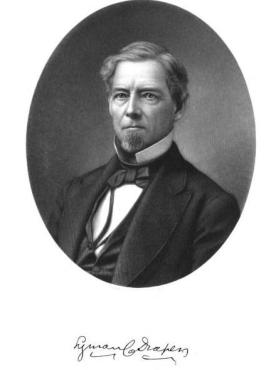
Lyman Copeland Draper (Wikimedia Commons)
Lyman Copeland Draper from the Fronts-pieceof his book, King’s Mountain and its Heroes, 1881 (Wikimedia Commons)

For the last century, everyone studying the frontier in the American Revolution has owed a debt to Lyman C. Draper.   Not many people are familiar with him, but he compiled one of the deepest and most extensive collections of original material related to the Trans-Appalachian Frontier, particularly during the American Revolution.  His hard work and extensive efforts represent a life dedicated to history that enabled his successors to continue his remarkable work .

Born in western New York in 1815, Draper’s grandfathers were both veterans of war with the British, either during the American Revolution or the War of 1812.  Given the number of veterans moving west to start farms after the war, a young and impressionable Draper heard their stories.  Draper’s family eventually settled in Lockport, NY on the Erie Canal and that is where he attended Continue reading “Historians from the Past: Lyman Draper”

Thanksgiving with George Washington

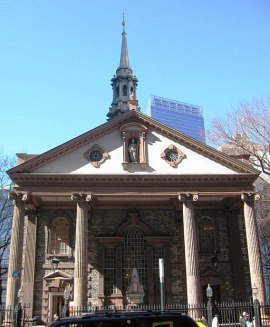
St Paul's Chapel New York (Wikimedia Commons)
St. Paul’s Chapel, New York (Wikimedia Commons)

Setting aside one day to give national thanks to God for the blessings of the prior year and beseech him for future blessings had been frequently practiced in England, but it merged with several Puritan traditions in New England during the 17th century.  By the time of the American Revolution, Thanksgiving was a well-established custom.   The Second Continental Congress turned a regional tradition into a national one when offered its first Thanksgiving Proclamation on November 1, 1777, recommending that the individual states of the new United States set apart December 18th as a day of Thanksgiving and praise.  During the Revolution, Congress continued the practice, issuing its last proclamation in 1784.

Continue reading “Thanksgiving with George Washington”

“I Have not Yet Begun to Fight!” or Words to that Effect (September 23, 1779)

Bonhomme Richard (Naval History and Heritage Command)

During the night of September 23/24, 1779, Captain John Paul Jones led his frigate, Bonhomme Richard, into its legendary fight with Serapis. In the midst of a battle that was not going well for the Americans, British Captain Richard Pearson asked if Jones was ready to strike his colors and surrender. Jones offered one of the most famous replies in American naval history: “I have not yet begun to fight!” Or did he? Continue reading ““I Have not Yet Begun to Fight!” or Words to that Effect (September 23, 1779)”