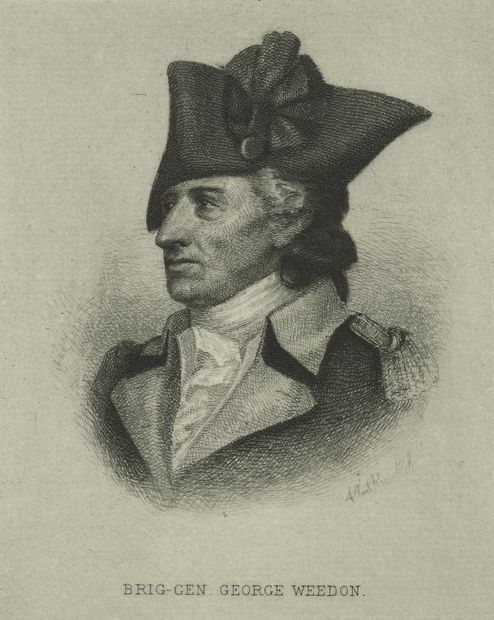
Jefferson and Weedon

Emerging Revolutionary War welcomes back guest historian Michael Aubrecht

In 1777 Thomas Jefferson and a committee of revisors came to the City of Fredericksburg for the purpose of revising several Virginia statutes. This led to Jefferson drafting the Virginia Statute for Religious Freedom.

When Jefferson and his comrades arrived in Fredericksburg they were met with a town bristling with military activity. Troops were drilling in the public square and filled the crowded streets, buildings and shops. Awaiting travel orders were the men of the Second Virginia and the Seventh Virginia, ordered here on January 9 for a rendezvous just prior to marching to join General Washington at the front. By the time Jefferson arrived in Fredericksburg, sixty of the more than two hundred battles and skirmishes of the war had already taken place.

Continue reading “Jefferson and Weedon”

Beverley Robinson to George Washington, August 8, 1757

On this date 167 years ago, the infamous siege of Fort William Henry raged along the southern shore of Lake George, New York. For nearly a week the British and Colonial garrison inside the fort and outside its walls had endured through a near hopeless situation. Casualties had mounted, guns and mortars had burst from incessant firing, and the French siege lines had crawled to within 150 yards of the northwest bastion. Reinforcements were not coming to relieve the defenders. The following day, Lieutenant Colonel George Monro had little choice but to surrender his force under honorable terms to the French commander, General Montcalm. On August 10, the column marched out of the fort and nearby entrenched camp in route to Fort Edward. French-allied Indians fell upon the soldiers, and the women and children who accompanied them, and the “massacre” of Fort William Henry ensued.

The following letter with news relating to the siege, was written to George Washington on August 8, 1757. The author was Beverley Robinson, a Virginian who through marriage inherited a large swath of land in the Hudson Highlands of New York. During the Revolution, Robinson remained loyal to the Crown and was made colonel of the Loyal American Regiment in 1777. He was directly involved in the plot to turn Benedict Arnold. Through reasons not clear, Robinson and Washington became acquainted enough beforehand that during the French and Indian War, the former wrote the young Virginia soldier frequently.  

“New York 8th Augt 1757

Dr Sir

The inclosed Lettrs came to my hands Yesterday by a Vassill from Halifax, they will I suppose give you all the News from that Quarter. Except the Arriva⟨l of⟩ the Highlanders wh. has been since they were wrote, all well and in good Order Lord Loudoun had not Left Halifax a fortnight ago.

we are now under the greatest apprehensions for fort Wm Henry having Certain Accots that it is Besieged by a Large Body of French & Indians & Mr Mont Calm himself at the head of them. a fryday Last the Express came away from fort Edward & they were then Very hotly Engaged—our Liut. Governer went up Last week to forward the Militia. Genl [William] Johnson was gone up with two thousand Militia & 100 Indians, and the Militia was going up from the adjacent Counties. Col. Young Command at Wm Henry he had Just got into that place with a Reinforcement of 1000 men. we hope the Best. I am Dr Sir Yr Humble Sert

Bev: Robinson[1]


[1] “To George Washington from Beverley Robinson, 8 August 1757,” Founders Online, National Archives, https://founders.archives.gov/documents/Washington/02-04-02-0239. [Original source: The Papers of George Washington, Colonial Series, vol. 4, 9 November 1756 – 24 October 1757, ed. W. W. Abbot. Charlottesville: University Press of Virginia, 1984, pp. 367–368.]


Rev War Revelry: The Road To Lexington with Alex Cain

This Sunday, August 3rd at 7pm we welcome back to Rev War Revelry historian and author Alex Cain. Alex is a well known expert on everything Lexington, MA (among many other topics) and hosts a well researched blog: https://www.historicalnerdery.com/ . Alex’s book, We Stood Our Ground: Lexington in the First Year of the American Revolution is highly recommended by ERW for a detailed account of Lexington and its role in the beginning of the American Revolution.

The events of Boston leading up 1775 are well documented, but it was in the countryside around Boston where the populace became militarized. Towns such as Lexington was just as influential in the push to revolution as Boston. Join us as we discuss the role of Lexington, Massachusetts before it was made famous in April 1775.

Be sure to visit our Facebook page or You Tube Channel this Sunday at 7pm as we release this prerecorded Rev War Revelry. Alex will also be joining us this October for our ERW Bus Tour of Lexington and Concord, there a few tickets left so be sure to register to experience Lexington with Alex!

Rev War Revelry: Saratoga 1777: The Turning Point

Join us on our YouTube page this Sunday at 7:00 p.m. for the latest installment of our Rev War Revelry series. We will sit down with producer Mark O’Rourke, to discuss an important film project focusing on the battles of Saratoga.

“Saratoga 1777: The Turning Point” is a noble, veteran-owned independent feature film project dedicated to bringing the compelling story of how the victories at Bennington and Saratoga kept the sacred flame of liberty from being extinguished during one of the darkest hours of the American War for Independence.

Rev War Revelry: Carpenters’ Hall and the First Continental Congress

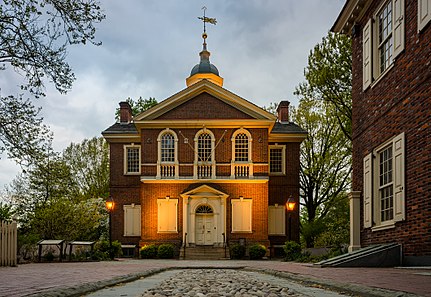
Join us this Sunday, July 7th at 7pm for our next Rev War Revelry as we continue to commemorate the 250th anniversary of the events that led to the American Revolution. We welcome Executive Director Michael Norris to discuss the historic Carpenters Hall in Philadelphia and the role it played in hosting the First Continental Congress. The First Continental Congress convened in Carpenters’ Hall in Philadelphia, Pennsylvania, between September 5 and October 26, 1774. Delegates from twelve of Britain’s thirteen American colonies attended. The Congress was a direct result of the Parliament’s reaction to the Boston Tea Party (December 1773). This gathering of colonial leaders intended to create a united front in their response to what they believed was Parliamentary over reach in the “Coercive Acts.”

Grab a drink and join us on our You Tube Channel: https://www.youtube.com/@emergingrevolutionarywar8217 Feel free to interact with the discussion by adding questions in the video chat. Once the video is over we will repost the video to our Facebook page and our Spotify account. We hope to see you then!

Rev War Revelry: BRPA

Join us Sunday, June 23, at 7:00 p.m. on our YouTube page (https://www.youtube.com/@emergingrevolutionarywar8217), for a chat with Doug Cubbison, Board President of the Braddock Road Preservation Association. We will discuss all things involving the group’s work to preserve and educate the public about the story of the French and Indian War in Western Pennsylvania.

The Braddock Road Preservation Association is an advisory organization that seeks to research, develop, interpret and promote the French and Indian War history of Jumonville, Dunbar Camp, and the Braddock Road. A secondary purpose is to research, develop, interpret and promote the history of the Pennsylvania Soldiers’ Orphans School. The Association functions in an advisory capacity to the Board of Directors of Jumonville, Inc. 

Washington’s March to the Ohio River: April 18, 1754

On this date in 1754, a young George Washington penned the letter below to Thomas Cresap explaining the difficulties of procuring supplies for the Virginian’s expedition to the Ohio River Valley. His main objective was to fortify the land at the confluence of the Allegheny, Monongahela, and Ohio Rivers – the “Forks of the Ohio.” The several hundred mile expedition would have to be made over treacherous terrain and through vast wildernesses, which meant a road needed to be cleared that could carry men, animals, and wagons. Years before, Cresap, while serving as an agent for the Ohio Company, had widened an old Indian trail leading to the west. Washington planned to utilize and improve this same route. That same day, he and 159 men under his command departed Winchester, Virginia, and began their march. Over a month later, they would fire the first shots of the French and Indian War at Jumonville Glen.

“Sir

The difficulty of getting Waggons has almost been insurmountable, we have found so much inconvenience attending it here in these roads that I am determined to carry all our provisions &c. out on horse back and should be glad if Capt. Trent with your Assistance would procure as many horses as possible against we arrive at Wills Creek that as little stoppage as possible may be made there. I have sent Wm Jenkins with 60 Yrds of Oznabrigs [Osnaburg] for Bags and hope you will be as expeditious as you can in getting them made and fill’d.

Majr Carlyle acquainted ⟨me⟩ that ⟨a number of kettles, tomhawks, best gun flints, and axes might be had⟩ from the Companys Store which we are much in ⟨want and s⟩hould be glad to have laid by ⟨for us, Hoes we sh⟩all also want, and several pair of Hand cuffs.

I hope all the Flower [flour] you have or can get you will save for this purpose and other provisions and necessary’s which you think will be of use (that may not occur to my memory at present) will be laid by till our Arrival which I expect will be at Job Pearsalls [20 miles from Wills Creek] abt Saturday night or Sunday next, at present I have nothing more to add than that I am Yr most Hble Servt

Go: Washington[i]


[i] “From George Washington to Thomas Cresap, 18 April 1754,” Founders Online, National Archives, https://founders.archives.gov/documents/Washington/02-01-02-0042. [Original source: The Papers of George Washington, Colonial Series, vol. 1, 7 July 1748 – 14 August 1755, ed. W. W. Abbot. Charlottesville: University Press of Virginia, 1983, pp. 82–83.]

Rev War Revelry: Battle of Paoli with Historian and Author Michael Harris

On September 20, 1777 an American force under General Anthony “Mad Anthony” Wayne was surprised and routed by British forces under General Charles Grey. Wayne’s entire division was put to flight losing nearly 300 men (with the British losing just a dozen). Called by many the “Massacre at Paoli”, the fight was one of many that was part of the 1777 Philadelphia Campaign.

Join ERW on Sunday, April 14th at 7pm on our Facebook page as we welcome back historian and author Michael C. Harris, expert on the Philadelphia Campaign, we will discuss the battle, its role in the campaign, the personalities and the myths around Paoli. Harris is now working on his third volume in his much acclaimed Philadelphia Campaign trilogy, that will include the Battle of Paoli. If you can not make the livestream, the Revelry will be posted to our You Tube and Spotify channels.

Encomium for Charles Burke Baxley, Esq.

The following is from David Reuwer, who was a good friend of Charles Baxley and worked with Charles to help preserve and interpret the story of Camden, Hobkirk’s Hill and South Carolina in the American Revolution. Both men shared an unmatched level of passion and enthusiasm for history.

      “I never heard that,” was a common cadence with which this practical lawyer and self-taught historian responded to new information about the American Revolution in South Carolina. He both challenged the statement maker to support it and welcomed the newbie into the fellowship of the Southern Campaigns. This is how Charles B. Baxley operated with both hands – one gladly shaking an entry to join our exploits and the other cautioning you to rise to ever higher and increasing standards. He would push, exacerbate, pull, and uplift you. The Southern Campaigns of the American Revolution was created in 2004 by Charles Baxley and David Reuwer when they delineated the tripod elements of scholarship, fellowship and fun. Charles defined scholarship as building blocks of historic research, inquisition and field evidence; fellowship as to include anyone who would cite source material gone before us while presently lifting others up around us; and fun as joyfully sharing one another’s knowledgeable victories as we pursued historic adventures.

      The substantive virtue Charles practiced daily was broad inclusion – come and join us!  There was always another chair at the table and more room for additional players according to him. However, you had to participate somehow, to care about the commonweal, and to help others with their project needs and requests. You had to give as well as take.

      Charles suffered from PAD – project aggrandizement disorder – in that he cajoled and made each of us go deeper when all the rest of us thought it had been done. He could come up with endless lists of questions when everyone else considered the subject utterly exhausted. History was neither boring, stale nor irrelevant the way Charles viewed and worked it. History is an experience, as much about the present as it was about the past. We must place our “boots on the ground” – the actual locatable sites – in order to fulfill our duties of scholarship and fellowship. Only when a little more (or a lot) is known and understood, that we can pass on, have we accomplished the tasks before us responsibly to the future generations. Charles achieved much of this by writing, sending and responding to multiplicative emails and countless phone calls while sitting in his “war room” den at home late into the night and wee morning hours.

      Charles was inherently an encourager of others making us to think hard about their historic project, to question everything, to counsel with others, to be in mentorship, and to ./explore new thinking about what one is doing. His queries to you could sometimes be unnerving but if you really worked for the answers, the growth toward historic truth was rewarding. No wonder he was awarded the Order of the Palmetto by Governor Mark Sanford in 2006; no surprise in 2022 that Governor Henry McMaster appointed him the Chairman of the South Carolina American Revolution Sestercentennial Commission (SC250). He was one of the key people who took on the gigantuan task of restoring South Carolina’s Revolutionary battlefield stories into their proper place in American history since 1856 when Senator Andrew Butler vociferously debated Charles Sumner of Massachusetts on the floor of the U.S. Senate.    

      It is true that he liked chairing the Round Tables with intervening commentary and being the centrifugal point-man in most other Revolutionary War conversations. His verbal editorials were always engaging and usually enlightening.

      He liked playing “director” and was sincerely effectual at connecting people with other people and endeavors with other projects. His brain was way ahead of most other thinking minds, historically, and he courteously provoked when he did. Perhaps no other single person currently had as much comprehensive breadth-and-depth knowledge about the Revolution in SC as Charles. “Learning is not virtue but the means to bring us an acquaintance with it. Integrity without knowledge is weak and useless, and knowledge without integrity is dangerous and dreadful. Let these be your motives to action through life, the relief of the distressed, the detection of frauds, the defeat of oppression, and diffusion of happiness,” professed 38-year-old General Nathanael Greene, final military commander of the Southern Department during the Revolution. Charles embodied this learning for 70 plus years and shared this way to live with all the rest of us. If you were not about doing a task, he would assign you one. Charles often related that we were only as good as our current task, project or mission and persuasively demanded that we focus on it for the purpose of sharing it with others.

      Our State has lost one most caring advocate of the Revolutionary founding 1770-1783 era – a hero of history. For him, it was about accurately working the historic puzzle and conclusively moving the story forward in truth. Most substantively, many of us State residents, numerous thousands of 250th out-of-state tourists, and untold future generations of all Americans will HEAR and HAVE HEARD of South Carolina’s significant persons, places, battles, and events of the Southern Campaigns because of Charles B. Baxley. Mirroring Christopher Gadsden, he lived for “What I can do for my country, I will do.”

                          David Paul Reuwer

“Rev War Revelry” Revolutionary Blacks, Discovering the Frank Brothers, Discussion with Dr. Shirley L. Green

Approximately 5,000 African-American or Black soldiers fought for the patriot cause in the American Revolution. Some joined state militias, some joined the Continental Army, and some sailed the seas with the fledgling navies of the United Colonies. William and Benjamin Frank were two of those 5,000. Both were free Blacks from Rhode Island who enlisted in the 2nd Rhode Island Regiment in 1777. Their father was a veteran of the French and Indian War, so the family was well-established in military tradition.

The 2nd Rhode Island fought and defended Fort Mercer during the campaigns of 1777 and survived harsh winters at Valley Forge and Morristown before returning to Rhode Island to literally defend the hearth and home from the British. Author and historian Dr. Shirley L. Green, adjunct professor at the University of Toledo, a 26-year veteran of the law enforcement community, and current Director of the Toledo Police Museum in Ohio, “takes the reader on a journey based on her family’s history, rooted in its oral tradition.”

Her book Revolutionary Blacks, Discovering the Frank Brothers, Freeborn Men of Color, Soldiers of Independence was published by Westholme Publishing in November 2023.

Furthermore, Dr. Green puts “together the pieces of the puzzle through archival research, interviews, and DNA evidence” to authenticate and expand the family history. The end result is a very readable and needed addition to the historiography of the American Revolution. Her ability to tell “a complex account of Black life during the Revolutionary Era demonstrates that free men of color…demonstrates that free men of color shared with white soldiers the desire to improve their condition in life and to maintain their families safely in postcolonial North America.”

Emerging Revolutionary War looks forward to an engaging and informative discussion with Dr. Green, this Sunday, at 7 p.m. EDT on our Facebook page. We hope you can tune in for this next episode of Emerging Revolutionary War’s “Rev War Revelry.”

For more information about the book and to order a copy, click here.