Winter, 1777

Part Two

In the lowest depths of one of the coldest winters in the American Revolution, the Continental Army uncovered the dedication that the core of the military movement had.

Suffering was beyond comparison.

The cause was supply, the crux of many an army before and after the Revolutionary War. The issue started from the top, the quartermaster general position.

“The lack of a competent, effective quartermaster general for the period from October 10, 1777 to May 2, 1778 threatened the Continental Army’s existence more than the enemy” wrote author and historian Herman O. Benninghoff, II.

His bold proclamation is chillingly on-point.

That time frame coincided with the approximately same length of time George Washington’s forces were at Valley Forge.
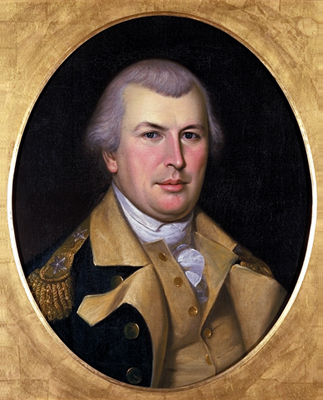
Nathanael Greene would become Quartermaster General in March 1778 during the encampment at Valley Forge

On January 5, 1778, Nathanael Greene, who would soon be tapped as quartermaster general of the Continental Army, wrote to fellow officer General Alexander McDougall;

“The troops are worn out with fatigue, badly fed, and almost naked. There are and have been thousands of the Army without shoes for months past. It is difficult to get sufficient supplies to cloath the Army at large.”

Moving directly to Valley Forge from active campaigning, the soldiers arrived with their supplies in a deplorable condition. Shoes had been torn to shreds with the long marches and many of the men had nothing but rags to wrap feet in. Shortly after arriving, the army numbered approximately 12,000 men under arms, yet 4,000 of these men, 1/3rd of Washington’s entire force, was deemed “unfit for duty” because a lack of supplies.

Another 1,100 would desert because of the horrid conditions of the winter encampment; no food, no pay, and barely clothes to keep warm.

Another 2,000 died of disease, including typhus, pneumonia, and other “camp fevers” which categorized a whole assortment of various ailments. Medicine was almost non-existent and lack of proper sanitation played a major role as well.

A delegate to the Confederation Congress was informed by an informant in Valley Forge that “a great portion of the soldiers are in a very suffering condition for want of necessary clothing, and totally unfit for duty.”

The suffering of the soldiers for a want of simple, basic clothing, becomes even more painful with the following realization by John Marshall, serving as an officer at Valley Forge, and the same Marshall who would become the Supreme Court Justice.

“In a desert which supplies not the means of subsistence, or in a garrison where food is unattainable, courage, patriotism, and habits of discipline, enable the soldier…..but to perish in a country abounding with provisions, requires something more than fortitude.”

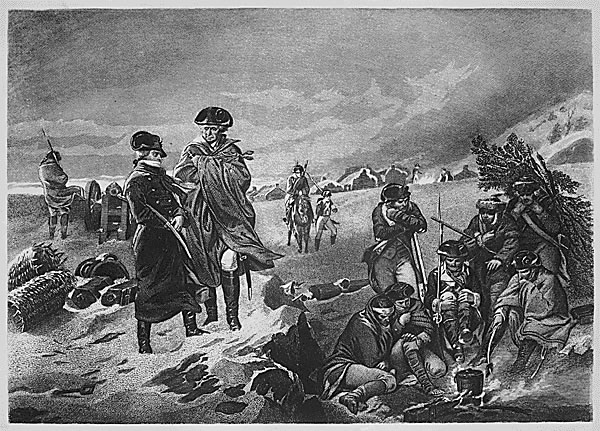
One artist's depiction of what the encampment at Valley Forge looked like
One artist’s depiction of what the encampment at Valley Forge looked like

That is what is most astonishing, that there were surpluses to be attained, but Continental currency had depreciated to the point that by late 1777 and early 1778 it was at an exchange rate of four Continental dollars to one dollar of hard specie. By 1779 that ratio would be 30 to 1.

To further complicate matters, the Continental Army did not even have the wagons to gather the materials. In mid-February, a report from camp to Henry Laurens, president of the Confederate Congress, deplored of the “want of Waggons & the like.”

Out of the depths of this despair, where cries of “No Meat, No Meat” rent the air as soldiers voice their frustration, came a self-proclaimed baron.

This man would leave a lasting impression on the make-up of the army, second only to George Washington.

His assessment of the army upon his arrival amazed him, the “fortitude of the common soldiers and that no army in Europe would hold together and endure under such deprivations of food and clothing and shelter.”

That prognosis shows the depth of commitment that boiled in the hearts of the dedicated survivors of the cold, hunger, and privations of Valley Forge.

The army was ready to be molded and with his arrival,  Baron Friedrich Wilhelm von Steuben would turn out to be the right guy at the right juncture in time. The Continental Army, held together by George Washington, would be transformed by this new inspector general.

Valley Forge would be the elixir of change for the army and the revolution.

Winter, 1777

Part One, of a series on the importance of Valley Forge in the American Revolution

On December 19, 1777, the Continental Army, under the command of General George Washington, marched into Valley Forge, Pennsylvania. Located approximately 20 miles from Philadelphia, which had fallen to the British that autumn, Washington’s army would spend the next five-plus months in this soon-to-be iconic place in the quest for American independence.

Yet, the accounts of how desperate the condition of the American forces were emanates throughout the centuries and strikes awe and amazement at the level of perseverance that the soldiers committed to. The winter of Valley Forge was just one of many cold, bleak, and destitute winters that the Continental Army faced during the seven-year conflict.

Artist depiction of the encampment at Valley Forge. George Washington and the Marquis de Lafayette are the two horsemen
Artist depiction of the encampment at Valley Forge. George Washington and the Marquis de Lafayette are the two horsemen depicted prominently

However, that does not take away from the conditions of that winter. Especially when written from the ink and quill or pencil of the common soldier. Especially with what that winter cantonment did in the transformation of that Continental Army.

One of the best remembrances of that cold winter comes from Joseph Plumb Martin, whose Memoir of a Revolutionary Soldier, is still in print today.

Upon arrival at Valley Forge, Martin would write:

“We were now in a truly forlorn condition,–no clothing, no provisions, and as disheartened as need be. We arrived, however, at our destination a few days before christmas. Our prospect was indeed dreary.”

Just a short time after his arrival, Martin continued the plight of himself (and most likely many a soldier in that encampment) when he wrote;

“I lay here two nights and one day, and had not a morsel of any thing to eat all the time, save half a pumpkin, which I cooked by placing it upon a rock, the skin side uppermost, and making a fire upon it; by the time it was heat through I devoured it with as keen an appetite as I should a pie made of it at some other time.”

Martin’s account is supported by General James Varnum, who reported on December 20, 1777, “that his division had eaten no meat during 48 hours and had been three days without bread.”

Suffering at Valley Forge

Yet, during that winter, the experience of Valley Forge, according to another veteran of that harsh winter, “added iron to their souls.”

More than “iron souls” would be needed to defeat the British in the American Revolution. Winter, 1777, would see to that as well.

Christmas, 1776

On Christmas, 1776, George Washington took the greatest gamble of the American Revolution, up to that date. On that cold and snowy night, with an ice-clogged river, and an army teetering on the verge of disintegration, the American commander led his command toward a signature, morale-improving, improbable victory.

He defeated Hessian soldiers, in the service of the British, at Trenton, New Jersey. The call sign –used to enter and exit the American camp– leading up to the offensive movement was “victory or death.”

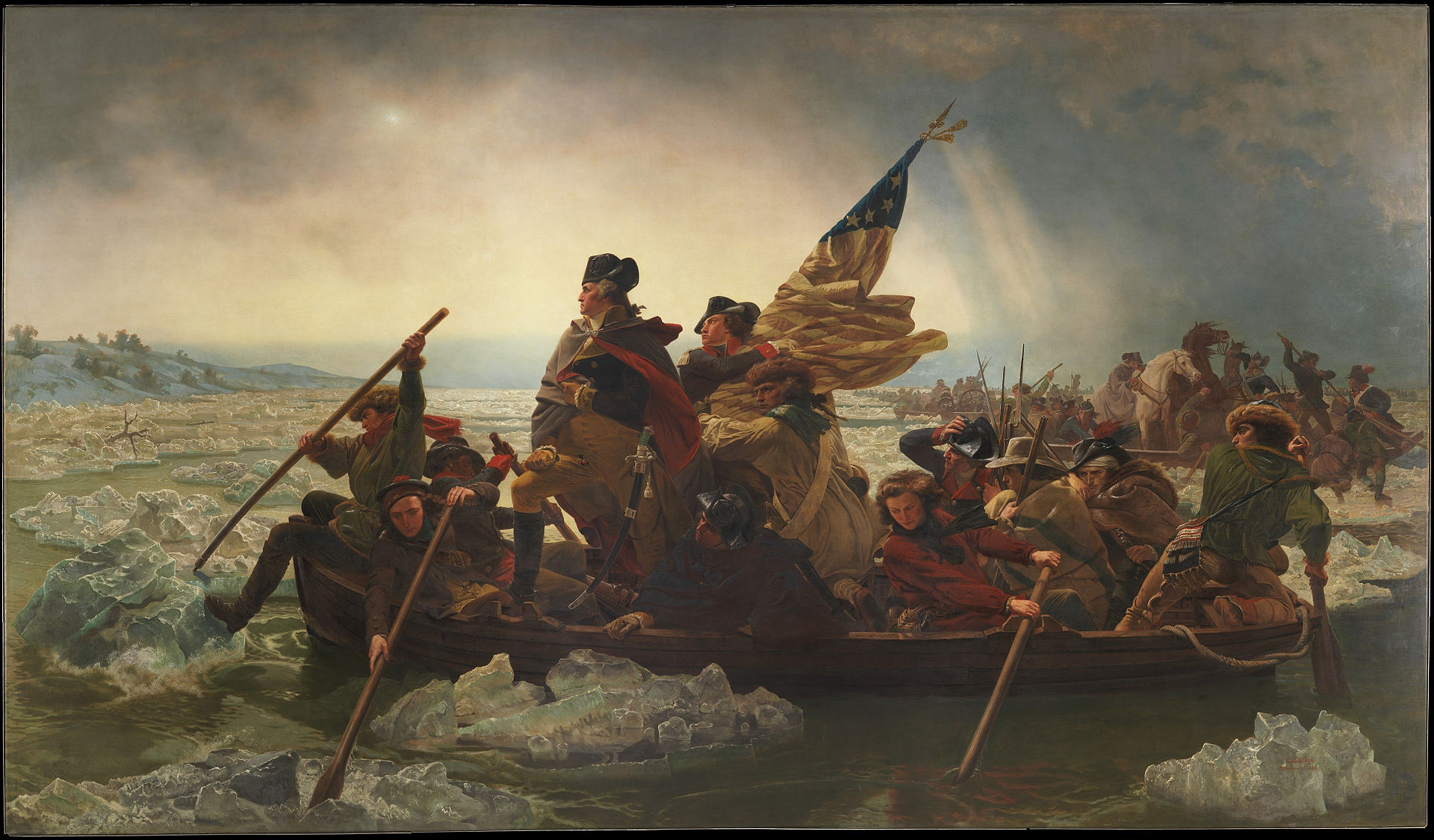
That was quite an accurate statement to summarize the dire straits the American cause of independence had become by winter 1776. The heroics of that night lent itself to the painting by Emanuel Leutze in 1851 that is chock full of historical inaccuracies. But the painting conjured up images of that noble band of American patriots that followed George Washington across the frozen waterway in 1776.

Emmanuel Leutze's painting, 1851
Emanuel Leutze’s painting, 1851

[Did you know that James Monroe, who would be wounded at the Battle of Trenton, is painted in holding the flag? There is no primary account that puts both men in the same boat that night, though.]

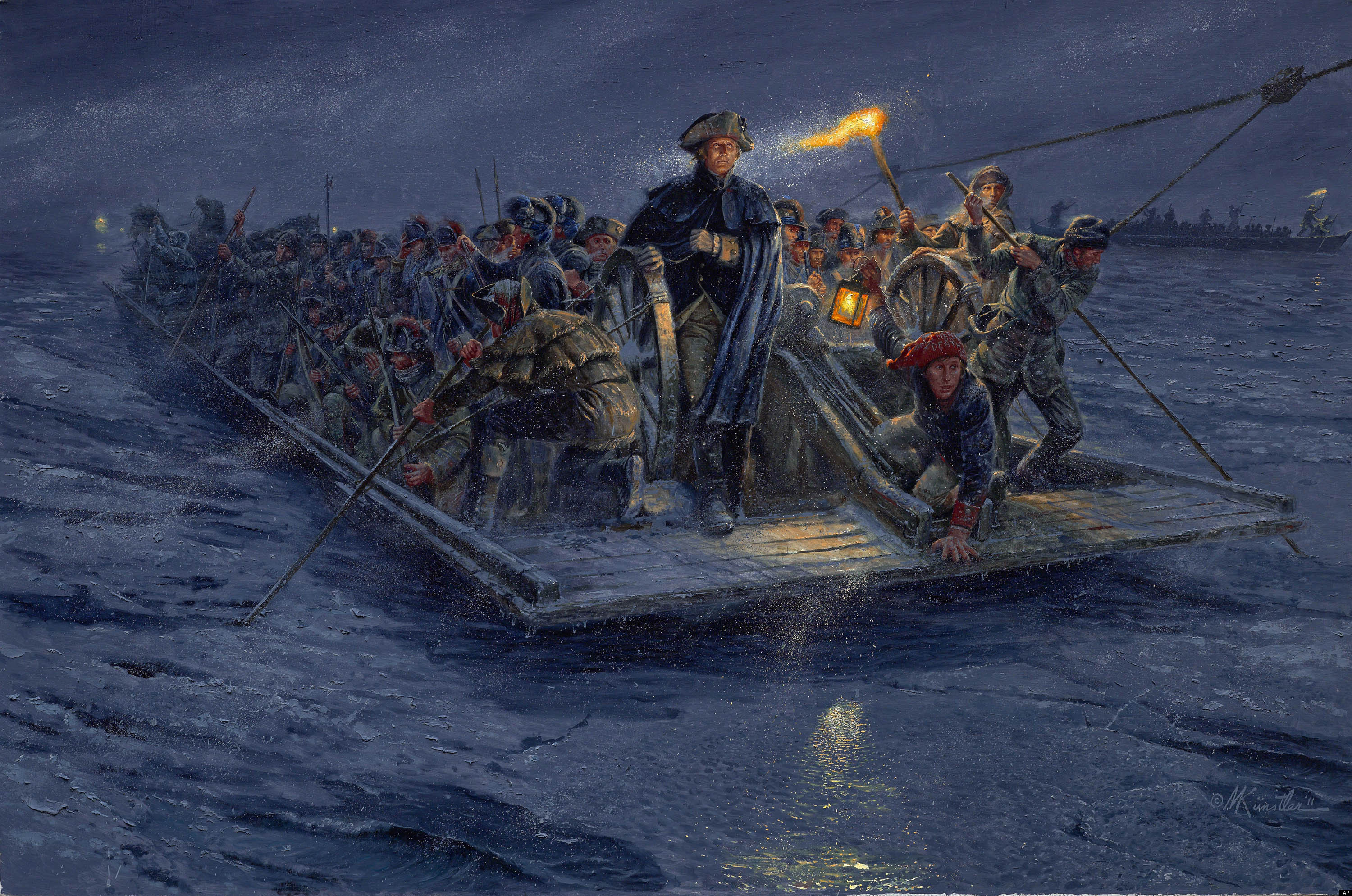
Luckily, famous historical artist Mort Kunstler, took a look at Leutze’s famous painting and decided to make it more historically accurate. Although initially reluctant to tackle the project given the popularity of the previous work, Kunstler studied, tackled history books, and diligently sought such information like the type of boats that would have been used, in the process of creating a more historically accurate depiction.

He succeeded.

Mort Kunstler painting of the "Crossing of the Delaware"
Mort Kunstler painting of the “Crossing of the Delaware”

So, as you celebrate the holidays, you now need a little more space on the wall for a second painting of Washington and his army crossing the Delaware.

Whether you have the space or not on your wall for two paintings, one thing these great illustrations have in common is showing the fortitude of the American soldier.

That fortitude is still on display to this very date. On Christmas Day 2015 thousands of men and women, in the service of America, will serve around the world, where the call sign of “victory or death” is not a mere anecdote from years past, unfortunately.

Thank you to all the men who crossed that icy river many cold nights ago to help win our independence and to the men and women who keep watch tonight on another cold night around the world.

To the readers of Emerging Revolutionary War, I wish you a Merry Christmas and Happy Holidays. Thank you for reading!


*Great article on Kunstler and the painting can be found here.

**Link to Mort Kunstler’s website can be found here.

Review: Washington’s Revolution by Robert Middlekauf

ERW Book Reviews (1)

The name Robert Middlekauf is very familiar to enthusiasts of the American Revolutionary War era. Twenty-three years ago, Middlekauf, Preston Hotchkiss Professor of American History, Emertius, at California-Berkeley, published A Glorious Cause. The book was a finalist for the Pulitizer Prize and was a thorough introduction to the build-up to and through the American Revolution.

Washington's Revolution, the Making of America's First Leader by Robert Middlekauff
Washington’s Revolution, the Making of America’s First Leader by Robert Middlekauff

For fans of Middlekauf, his most recent publication, Washington’s Revolution, the Making of America’s First Leader, will not disappoint.

Washington was the American Revolution according to Middlekauf, whom in the second sentence of the prologue writes that his title “emphasizes his [Washington’s] enormous importance for its course and outcome” (xv).  Middlekauf then takes the reader on a very concise, quick-paced, blend of biography and history, journey through Washington’s early years to the culmination of the American Revolution.

“All the time that he served as commander of the Continental Army, he was in fact also the leader of the Revolution” (304). A tall order for a tall man–both literally and figuratively–but Washington was able to succeed because “he understood that the Revolution represented a rare opportunity”

To evaluate, examine, and explain Washington, one has to do a series of reading between the lines and looking at other primary sources of the compatriots. Washington was meticulous in reviewing what he left for posterity about his life achievements.

Middlekauf’s skill blends the reasons Washington embodied the American Revolution–from his daring in the winter of 1776 that culminated in the twin victories of Trenton and Princeton to literally holding the Continental Army together every winter–the Virginian insisted, cajoled, pressured, and through his own strong determination saw the war through.

That success, was due “in large part because he understood the Revolution represented a rare opportunity–something quite new, in fact–to lead a people in defense of principle long honored in conceptions of liberty” (304).

Not only was Washington a military leader, he also understood the political ramifications of his actions and the need to keep the army subjected to the rules of Congress. Even if that body was the cause of his soldiers going hungry and bereft of other necessities.

His “grand imagination, a vision of his new country….set him apart and made him a great leader” (306). Not too bad for just “a general” (306).

This book is a welcome addition to any military historian’s library. The blending of biography and historical monograph allows one to learn about the entire American Revolution and then from the Notes on the Sources have a road-map to delve into longer narratives on specific subjects.

Book Information

Publisher: Alfred Knopf, 2015.

358 pages, including maps, acknowledgments, notes, and sources


Henry Shrapnel – “The Modern Archimedes”

RevWarWednesdays-header


His last name jumps off the page, much like the term shrapnel usually does when leaving an artillery piece.

“Shrapnel” as defined by Merriam-Webster Dictionary is “a projectile that consists of a case provided with a powder charge and a large number of usually lead balls that is exploded in flight” or more simply “bomb, mine, or shell fragments.”

Either definition brings to mind images of death, destruction, maiming, and killing for any military historian.

Henry Shrapnel
Henry Shrapnel

Yet, why is it attributed to Henry Shrapnel?  Continue reading “Henry Shrapnel – “The Modern Archimedes””

Mercer’s Grenadier Militia

RevWarWednesdays-headerThis is part two in the series by guest historian Drew Gruber. For part one, click here.

On the morning of October 3, 1781, British Colonels Tarleton and Thomas Dundas led another expedition north towards Gloucester Courthouse and away from the protection of their fortifications at Gloucester Point. Their command that day included some of the most renowned fighting men then in service. Cavalry and mounted infantry from Tarleton’s own British Legion, combined with a detachment of Colonel Simcoe’s Queen’s Rangers, elements of the 17th Dragoons, men from the 23rd Regiment (Royal Welch Fusiliers), German Jaegers and part of the 80th Regiment of Foot provided an impressive host for their American and French adversaries. Captain Johann Ewald, commander of the Jaegers commented after the war that he was sent out with “one hundred horse of Simcoe’s and the remainder of the jagers and rangers, which amounted to only sixty man in order to take a position between Seawell’s planatation and Seawall’s Ordinary. I was to form a chain there to protect a foraging of Indian corn.”[1]

Continue reading “Mercer’s Grenadier Militia”

Mercer’s Grenadier Militia

RevWarWednesdays-header


Emerging Revolutionary War and Revolutionary War Wednesday is pleased to welcome back guest historian Drew Gruber.

Part 1

When we think about American militia during the Revolutionary War, the image of an untrained rifle-toting citizen turned soldier comes to mind. This stereotype of the American soldier, popularized by movies like The Patriot is not completely false but such generalizations should give us pause and inspire us to investigate the roll of American militia, independent companies, and ‘irregular’ troops a bit closer. For example, how was it that on October 3, 1781 a group of Virginia militiamen defeated an elite British force? The story of Lieutenant Colonel John Mercer’s Grenadier Militia during the battle at Seawell’s Ordinary has been told and retold since 1781, however the formation of this illustrious group is often ignored and deserves a closer look. Continue reading “Mercer’s Grenadier Militia”

Cowpens: Defense in Depth

RevWarWednesdays-header


On a cold January morning 234 years ago, one of the most stunning events in American military history took place in a cattle pasture.   Cowpens, South Carolina, was an overwhelming American victory, at a time when one was desperately needed.

What went so well?  General Daniel Morgan understood the limitations and strengths of his troops, as well as those of his opponents.  He used that to his advantage, along with a keen eye for terrain and a good understanding of the strategic satiation.

Continue reading “Cowpens: Defense in Depth”

Looking Back to Cowpens: William J. Hardee and the Battle of Averasboro

Lieutenant General William J. Hardee.

After abandoning Fayetteville, North Carolina to Maj. Gen. William T. Sherman’s army group, Lieutenant General William J. Hardee withdrew his corps north of the city. Hardee had ordered the Clarendon Bridge over the Cape Fear River destroyed, removing the possibility of a vigorous pursuit by the Federals. The situation for the Confederates, however, remained dire. Hardee’s immediate superior, Gen. Joseph Johnston, was in the process of assembling a makeshift army to delay Sherman’s advance. By the middle of March, the forces that Johnston hoped to consolidate were still scattered throughout the state. More time would be needed for the Confederates to rendezvous. Since Hardee’s corps was naturally positioned to contest the enemy as they left Fayetteville, it would fall to him to engage Sherman once he resumed his march. The veteran officer would prove to be more than equal to the task.

Continue reading “Looking Back to Cowpens: William J. Hardee and the Battle of Averasboro”

Revolutionary Memory

RevWarWednesdays-header

Today, we are pleased to welcome guest authors Drew and Kate Gruber.

Fort Moultrie, Charleston Harbor by A. Vizitelly c.1861. Courtesy of the Library of Congress.

“There appears to be a romantic desire urging the South Carolinians to have possession of this work, which was so nobly defended by their ancestors in 1776…” wrote Major Robert Anderson from Fort Moultrie on November 28, 1860, less than five months before the first shots of the American Civil War. Many historians of American history have looked upon the Civil War as a continuation of the American Revolution. Looking back today, the similarities are not hard to see. According to historian Peter S. Carmichael, confederates “proclaimed their nation to be the keeper of America’s revolutionary heritage.”[1] Similarly, James McPherson notes that “Union volunteers invoked the legacy of the Founding Fathers…if disunion destroyed this nation, the generation of 1861 would prove unworthy of the heritage of republican liberty.”[2] This idea was not lost on Civil War soldiers, and their own connection to the ideals of the American Revolution grew even stronger when their marches and battles brought them close to, and even directly on, the landscapes and landmarks sacred to the memory of the American Revolution—soldiers were quick to identify the cause of the Revolution as their own. As soldiers converged on Mount Vernon, Williamsburg, and Yorktown, the connections they made to the revolutionary past of these locations strengthened their own resolve.

Continue reading “Revolutionary Memory”