The Revolution’s Southwest Front

Emerging Revolutionary War is honored to welcome back historian Robert “Bert” Dunkerly. 

During a trip to Mobile, Alabama for some Civil War research, I came across a fascinating and lesser-known aspect of the American Revolution.  When I travel, I always keep my eye out for unusual finds and hidden history.  I was rewarded on my trip to Mobile with a great discovery.
Ft C
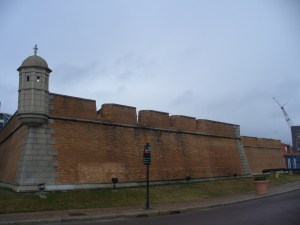
Fort Conde (author collection)

One of the main historic sites in downtown Mobile is the reconstructed Fort Conde.  This brick fort interprets the early history of Mobile and the region under the flags of France, Spain, and the United States.  Just outside the fort is a marker discussing the battle of Fort Charlotte.

Mobile was originally the capital of the French Louisiana Territory until the close of the French and Indian War.  As part of the settlement of that conflict in 1763, this French territory passed to the British.  Fort Conde, built in 1723, was renamed Fort Charlotte by its new owners.

Map
Map of Ft. Conde superimposed over modern Mobile streets, (photo by author)

Most of us know that the French were anxiously watching the American Revolution when the conflict broke out, hoping to score revenge against their English adversaries. Also watching with interest were the Spanish.

The British garrisons along the Gulf of Mexico coast (Pensacola, Mobile, Baton Rouge) were quite small and vulnerable.  The Spanish had been providing material aid and funds to the Americans, but finally declared war on Britain in 1779.  The Spanish were ambivalent about American independence, and unlike the French, did not recognize the United States, but did agree to help militarily.

Even before Spain’s entry into the war, New Orleans was a source of aid smuggled in for the American effort.  The Crescent City, and all the land west of the Mississippi, had been awarded to Spain at the close of the French and Indian War.  From here, supplies moved up the Mississippi to Fort Pitt at Pittsburgh, PA.  And from New Orleans, Governor Bernardo de Galvez attacked British posts up the Mississippi and along the Gulf Coast.

bernardo
General Bernardo de Galvez, (artist unknown)

A statue of the Spanish general who did much to wrest the Mississippi and Gulf coast areas away from the British stands near the World Trade Center in New Orleans.  A gift from Spain to the city of New Orleans, the statue is a reminder of this important but neglected aspect of the war.  A group known as Granaderos y Damas de Galvez are dedicated to preserving his memory and that of the Spanish role in the Revolution.

Oliver Pollock was a Philadelphia merchant with close ties in Cuba and New Orleans.  When the war broke out, he used his connections to aid the Revolutionary cause from the Crescent City.  In 1777 he was appointed “commercial agent of the United States at New Orleans” and used his fortune to finance American operations in the west, such as General George Rogers Clark.  When Spain entered the war he served as an aide to General Bernardo de Galvez.

Moving up from New Orleans, a force under General de Galvez, that included Spanish troops, American volunteers, Acadian settles, and free blacks, attacked and captured the British outpost of Fort Richmond at Baton Rouge on September 21, 1779.  Today a memorial with plaques and a cannon marks the site.

In February, 1780, Spanish troops and American volunteers under Governor Bernardo de  Galvez laid siege to the 300 British in Fort Charlotte at Mobile.  The siege lasted a month.  The garrison’s surrender gave the Spanish control of this important site, and removed all English military forces from the Gulf region.

This was one of the few actions of the war in which Spanish and American troops fought side by side.  Spain declared war on Britain but did not recognized the United States, their primary interest being to settle scores with the British.


For more information on these fascinating events, check the following websites: 

http://www.museumofmobile.com/ft_conde.php
http://granaderos.org/


HMS Invincible

A good friend, knowing my interest in military history brought me a very unique artifact, which led me to discover more about where this piece of history originated from. Here is what I discovered.

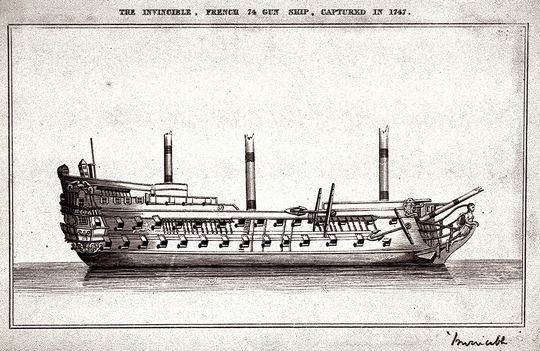
Launched in 1741 by the French as L’Invincible, this 74-gun French ship of line was captured by the British during the First Battle of Cape Finisterre on May 14, 1747.

The engagement during the War of the Austrian Sucession, was a five-hour engagement in the Atlantic Ocean, off the coast of northwest Spain. The British admiral, George Anson struck the 30-ship convoy of the French, which was under the command of Admiral de la Jonquiere and captured four ships of the line. One of those ships of the line was the L’Invincible.

The L’Invincible sacrificed itself to allow some of the convoy to escape and tried in vain to fend off six British warships.

L_Invincible_vaisseau_de_74_canons_capture_en_1747
A depiction of L’Invincible after being captured by the British in 1747

Given its more Anglicized name; HMS Invincible, the ship’s design was larger than the usual 74-gun vessels of the time. Her greater draft and lower center of gravity allowed her to carry much more sail. This allowed the ship to gain more speed.

Altogether her design helped revolutionize British warship making as she was the first 74-gun ship in the British Navy. By the time of the crucial Battle of Trafalgar in 1805, over three-fourths of the entire British Navy were line ships toting 74-guns.

In February 1758 while part of a large sailing of warships and transports, the HMS Invincible that left from St. Helens Roads near the Isle of Wight in England. The ship struck Horse Tail Sandbank and got stuck. Yet with the rising tide she was able to free herself.

Unfortunately, fate had it in for the ship, as the wind suddenly changed direction and increased in intensity and she dragged her anchor on the sandbank. A failed attempt to lighten her cargo and load of armament and putting her under full sail did not work either. She was marooned on the sandbar and began to take on water.

For the next three days, the majority of her cannons and stores were removed and on February 22, 1758 she rolled onto her side and was lost.

HMS Invincible laid wrecked, covered, and largely forgotten until the 20th century, when in May 1979 a local fisherman snagged his nets on the timbers. Local divers found more of the ship and has been investigated and parts recovered ever since.

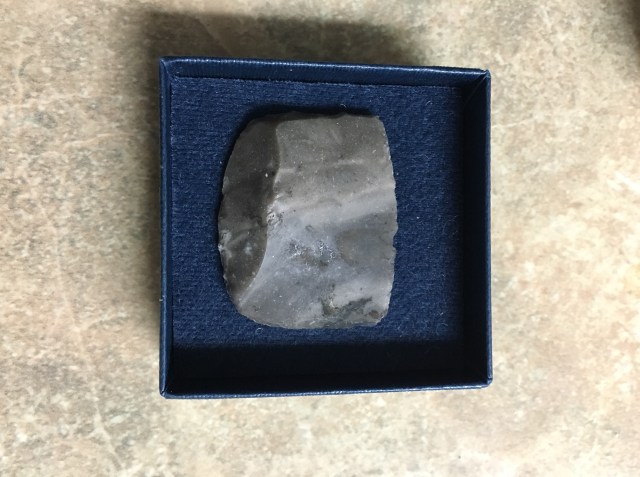
One of the interesting finds was the experimental flintlocks of the cannons of the HMS Invincible. Rather large, the nicely knapped flints were believed to be used in the canon locks. Canon locks and subsequent flints among the gunnery stores were considered a “unique find.”

IMG_1669
A “Large Wedge Type Gun Flint” from the HMS Invincible (author collection)

Fore more information about the ship, the wreck, and the discovery, check out Brian Lavery’s The Royal Navy’s First Invincible. Link to the book via Amazon is here.

ERW Weekender: The Brandywine Battlefield: A History & Visiting the Field

RevWarWednesdays-header


Emerging Revolutionary War and Revolutionary War Wednesday is pleased to welcome guest historian and author Michael C. Harris this week. 

The Battle of Brandywine was fought on September 11, 1777.  Visiting the battlefield to commemorate what took place there began just three years later.  On his way to Virginia in 1780, the Marquis de Lafayette made a point of stopping for day at the battlefield where he was wounded and giving a tour to the officers that were travelling with him.  An older Lafayette returned in 1825 during his celebrated 15-month tour of America.

However, it would not be until after the American Civil War during the golden age of preservation that any kind of markers or monuments began to appear around the ten-square-mile landscape.  During the 1877 centennial, artillery pieces were placed to mark the fighting near Sandy Hollow.  Eighteen years later, a monument was dedicated along Birmingham Road supposedly marking the spot where Lafayette was wounded.  Had Lafayette been alive, he would have been able to put out the error in location.

Continue reading “ERW Weekender: The Brandywine Battlefield: A History & Visiting the Field”

Cowpens: Defense in Depth

RevWarWednesdays-header


On a cold January morning 234 years ago, one of the most stunning events in American military history took place in a cattle pasture.   Cowpens, South Carolina, was an overwhelming American victory, at a time when one was desperately needed.

What went so well?  General Daniel Morgan understood the limitations and strengths of his troops, as well as those of his opponents.  He used that to his advantage, along with a keen eye for terrain and a good understanding of the strategic satiation.

Continue reading “Cowpens: Defense in Depth”