Book Review: Peckuwe 1780, by John F. Winkler

erw-book-reviews-11


9781472828859_6

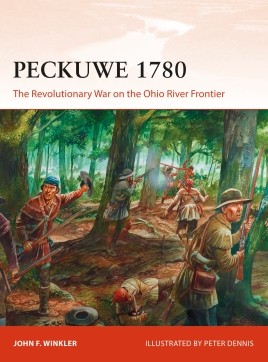
John F. Winkler, Peckuwe 1780: The Revolutionary War on the Ohio River Frontier, (Oxford: Osprey Publishing, 2018).   $24.00

I once read a review comparing Osprey Publishing’s monographs on particular battles, weapons, uniforms, or campaigns to “flash cards,” which made me smile.  As a kid, I somehow acquired stacks of flashcards laying out the technical specs of various military aircraft or ships and thought they were the greatest things since sliced bread.  Those were the days before Amazon or Barnes & Noble, when a kid had to depend on the local library and Waldenbooks for books about history, which they didn’t have in large numbers.  The Osprey monographs were a windfall of sorts when the local library started carrying them.  They’re not intended for an academic audience by any stretch, but can play a useful role in interesting popular audiences in places, people, and events that might otherwise prove too obscure or too intimidating for a young or casual reader.  So, when I came across John F. Winkler’s new monograph for Osprey, Peckuwe 1780, I snapped it up as much for sentimental reasons as for my interest in the American Revolution on the western frontier.

Continue reading “Book Review: Peckuwe 1780, by John F. Winkler”

Review: American Dialogue by Joseph Ellis

erw-book-reviews-11

American Dialogue-cover“The study of history is an ongoing conversation between past and present from which we all have much to learn,” write Joseph Ellis in his new book, American Dialogue: The Founders and Us. The book serves as Ellis’s attempt to sit with several of the Founders and carry on that conversation, with “us,” the readers, as spectators. As John Adams so often did with his own books, we can engage in the conversation by writing notes in the margins and underlining passages, and we can even read the original works of the Founders ourselves. Knowing they were writing as much to history as to each other, they left behind a rich documentary legacy.

Ellis’s book plumbs these writings to explore four salient points that trouble the American present. “By definition, all efforts to harvest the accumulated wisdom of the past must begin from a location in the present…” he admits. The present he writes from and that we read from, he says, is “inescapably shaped by our location in a divided America that is currently incapable of sustained argument and unsure of its destiny.” Continue reading “Review: American Dialogue by Joseph Ellis”

Book Review: Young Washington by Peter Stark

erw-book-reviews-11Peter Stark, Young Washington: How Wilderness and War Forged America’s Founding Father, Kindle ed., (New York: HarperCollins, 2018).

While traveling in southwestern Pennsylvania, outdoor writer Peter Stark discovered the region’s deep history and the central role it played in transforming George Washington from a callow young man on the make to the kind of leader who could forge a nation. Stark was not accustomed to thinking about Washington on those terms.  He decided to study the younger man in greater detail, retracing Washington’s steps as a surveyor and explorer, messenger for Virginia’s colonial governor, defeated commander at Fort Necessity, aide to General Braddock, commander in the Virginia militia, honorary brigadier during the Forbes Campaign, frustrated suitor of his neighbor and best friend’s wife, and prickly colonial frustrated with ill treatment at the hands of the British empire.  While Stark includes chapters that cover Washington’s early life and the circumstances that brought him to the frontier, Young Washington revolves around the period of Washington’s service just before and during the French and Indian War. Continue reading “Book Review: Young Washington by Peter Stark”

Book Review: One if by Land, Two if by Submarine, by Eileen Schnabel

erw-book-reviews-11

A few months ago, author Eileen Schnabel sent us her young adult novel, “One if by Land, Two if by Submarine” for a gander.  Not being specialists in middle school fiction, we turned to an expert, my 13-year old daughter, Abigail, who is a voracious reader and read the novel over the holiday break.   Here is her review:

Abigail Sterner, Book Review of Eileen Schnabel, One if by Land, Two if by Submarine, (Reston, VA: Curiosity Quills Press, 2018), Digital Edition.

One if by Land, Two if by Submarine, by Eileen Schnabel, is a perfect blend of historical and science fiction. The story centers around Kep, a 13-year-old boy who enjoys swimming. He and his genius, history-obsessed younger brother Max, go to a Revolutionary War reenactment camp for a competition with a grand prize of $200 dollars. It isn’t clear exactly what the competition involves, but it serves the purpose of bringing several main characters together into a team.  The team starts out with Max and Kep. They are later joined by the daughter-of-a-Senator-turned-animal-rights-activist named Tella. The fourth and final member of the team is an aspiring actor named T.J. During the competition, the four discover that they must travel back in time to prevent someone from foiling the famous ride of Paul Revere.  Thus, the kids have to save the American Revolution before it can even begin.

Continue reading “Book Review: One if by Land, Two if by Submarine, by Eileen Schnabel”

Book Review: Bob Drury & Tom Clavin, Valley Forge, Kindle ed., (New York: Simon & Schuster, 2018).

erw-book-reviews-11

Bob Drury and Tom Clavin have spent years writing books, both individually and as a team.  Between the two of them, they have explored topics ranging from baseball and golf to the old west and America’s 20th century wars.  With Valley Forge (Simon & Schuster, 2018), Clavin and Drury have turned to the American Revolution.  The result is another successful collaboration. (I’m biased as I have enjoyed several of their earlier books.)

Valley Forge tackles the Philadelphia Campaign, the winter encampment at Valley Forge (and elsewhere in truth), and the Continental Army’s emergence as a quality army capable of fighting the British on their own terms, which it demonstrated at Monmouth.  The focus is on Washington and the main army with him.  The reader sees both of them grow as Washington defeats political attempts to undermine his leadership and struggles to hold the army together in the face of harsh conditions and insufficient support from the rebelling states, Continental Congress, and local farmers.  Meanwhile, the Army develops into a core of hard-bitten professionals suitably trained in European methods specifically adjusted for their circumstances. After undergoing Steuben’s training program, it had the military skills needed to match its fighting spirit. By and large, it marked a turning point in the war.  Thus, at the end, the authors argue, “For those who survived, not least their inspired and inspiring commander in chief, the hardships they overcame had not so much transformed their innate character as revealed it.”[i] Continue reading “Book Review: Bob Drury & Tom Clavin, Valley Forge, Kindle ed., (New York: Simon & Schuster, 2018).”

Book Review: A Battlefield Atlas of the American Revolution by Craig L. Symonds

ERW Book Reviews (1)

As a young history buff, I remember well wearing out the pages of the original A Battlefield Atlas of American Revolution by Craig Symonds. Though I have no idea where that well worn out book is today, I am happy to see that Symonds has revised and re-released his encompassing atlas, published by Savas Beatie Publishing.917TV+p0UsL.jpg

Symonds, using his experience as a lifelong teacher, approaches the war from the viewpoint of an educator. Breaking the war into four parts chronologically, Symonds provides a short narrative at the beginning of each section giving an overview of the action in each region and year. The battle descriptions for each map are thorough and give a great account of the action and the impact each event had on the overall campaign or war effort.

Symonds should be commended for covering lesser known campaigns and battles of the American Revolution such as Valcour Island, Fort Stanwix, Oriskany, Newport, Penobscot Bay and others. This enhances the work as it shows where these battles took place and speaks to the depth that Symonds took to comb the entire continent to include these minor yet important engagements in the atlas. For many readers, this will be the first time these actions have been visualized through maps.

As in his previous work, cartographer William Clipson provides easy to read and clear maps. The maps provide a good mix of detail and broadness to appeal to the casual history buff and dedicated researcher. As in his other atlases, the text flows well with the map as Symonds has numbers in the text that relate to specific parts of the map.

Though I enjoyed this book, there are two critiques of this volume. First, the size of the text which is very small and condensed. The font style and size selected could prove to be hard for some people to read. Secondly, a few of the maps have been cropped to the point where parts of the maps and text have been cut off, making them incomplete.

This book is a great addition to any library or better yet, in the glove box of your car as you visit these battlefields. It is a perfect companion in the field that allows one to understand the action and provides just enough of an overview to fill in for those battlefields that do not have any signage or interpretation. The information is detailed enough to give you a clear understanding of the battle and campaigns and the maps provide a great visualization of the action.


Summer Lecture on Summer of 1787

This past July I had the pleasure to attend and present at the American Battlefield Trust Teacher Institute. One of the keynote speakers was David O. Steward, the author of Summer of 1787: The Men Who Invented the Constitution. During his talk, there were a few points that stuck out to me and I share them with you.summer of 1787 stewart

  • 72 elected, 55 attended, and 35 delegates were probably there all summer.
  • Out of the 55 that attended, 39 affixed their signatures to the document

In reference to George Washington, Stewart candidly remarked he had “more influence by keeping his mouth shut” almost as if by his calm, quiet demeanor, he was displaying that “I trust in you and I’ll try and make it work” with whatever the delegates designed in that hot and stuffy room in Philadelphia.  Continue reading “Summer Lecture on Summer of 1787”

Review: Rethinking America From Empire to Republic by John M. Murrin

erw-book-reviews-11

In the introduction, Andrew Shankman narrows down the one word that has driven the history career of Dr. John M. Murrin; “Anglicization.” (page 1).  This process happened in a period of approximately 60 years, as the colonists along the eastern seaboard of North America became “in virtually every measurable way…more not less British in their attitudes, outlooks, and actions…” (page 1).

With that thought in mind, the collection of essays from the pen of Dr. Murrin comprise this single volume, Rethinking America, From Empire to Republic published by Oxford University Press. Understanding the history and historiography of these decades and the military, political, social, and economic sub-themes of the time period define the work. Yet, this is not history from just the top down; from the perspective of the elites nor from the bottom-up, but a melding of the various tiers of society.  Continue reading “Review: Rethinking America From Empire to Republic by John M. Murrin”

Review: European Armies of the French Revolution, 1789–1802 (Campaigns and Commanders Series) Edited by Frederick C. Schneid

ERW Book Reviews (1)

Emerging Revolutionary War welcomes back guest historian Bill Backus

The American Revolution ultimately set in motion a chain of events that transformed not only society in the Americas but also back in the Old World.  Six years after the United States gained independence, revolution broke out across France.  While Americans focused on building a new nation, across the Atlantic the French Revolution sparked a series of wars subsequently known as the French Revolutionary Wars.  Eventually after many years of combat and political chaos, a young army officer named Napoleon Bonaparte emerged as the new Emperor of France.  Led by the Emperor the French army and nation embarked on a series of new wars that spread from Spain to Russia.  From the beginning of the French Revolution to the defeat of Napoleon at Waterloo, Europe was at war for nearly 26 years, or nearly the entire lives of people born during the American Revolutionary period.

51T9s0CvA5L._SX331_BO1,204,203,200_
European Armies of the French Revolution, 1789–1802 (Campaigns and Commanders Series) by Frederick C. Schneid

While Napoleon’s French Empire is widely known on both sides of the Atlantic, the wars that allowed Napoleon’s ascent to power are less prominent.  Concerned that revolution could spread to the rest of continental Europe, Revolutionary France found itself engaged fighting the European status co intent on restoring the Bourbon monarchy in France.  Over the course of years war and peace ebbed and flowed in Europe, with war sometimes sparked by the French in hopes of unifying a splintered public. In “European Armies of the French Revolution, 1789-1802”, historian Frederick Schneid has organized a study exploring the role of some of the prominent European armies in this period.  Collaborating with noted scholars in their respective fields, the essays explore the armies of the nation-states of France, Prussia, Austria, Russia, Great Britain, Spain, and the Ottoman Empire, along side the various German principalities and the armies of the Italian states. Continue reading “Review: European Armies of the French Revolution, 1789–1802 (Campaigns and Commanders Series) Edited by Frederick C. Schneid”

Review: First Founding Father: Richard Henry Lee and the Call for American Independence by Harlow Giles Unger

ERW Book Reviews (1)

A member of one of Virginia’s first families, Richard Henry Lee was a critical voice in America’s struggle against Great Britain. Born at the family home, Stratford Hall, in Westmoreland County, Lee was educated in England. In 1758, he entered Virginia’s House of Burgesses. Seven years later, Lee’s efforts on the road to independence began.

In response to the recent passage of the Stamp Act, Lee co-authored what became known as the Westmoreland Resolves. The document condemned fellow colonists who paid the related tax as well as the British Parliament. As tensions rose with Britain, Lee proposed a means for the individual colonies to communicate with one another. This idea birthed the Committees of Correspondence. In 1774, Lee was elected to the Continental Congress which met in Philadelphia. It was here in the early summer of 1776 that Lee suggested a bill for the colonies to break all allegiance with England and form a United States. The proposal was the basis of the Declaration of Independence. Continue reading “Review: First Founding Father: Richard Henry Lee and the Call for American Independence by Harlow Giles Unger”