“He said to his friend, “If the British march By land or sea from the town to-night, Hang a lantern aloft in the belfry arch Of the North Church tower as a signal light,– One, if by land, and two, if by sea;”
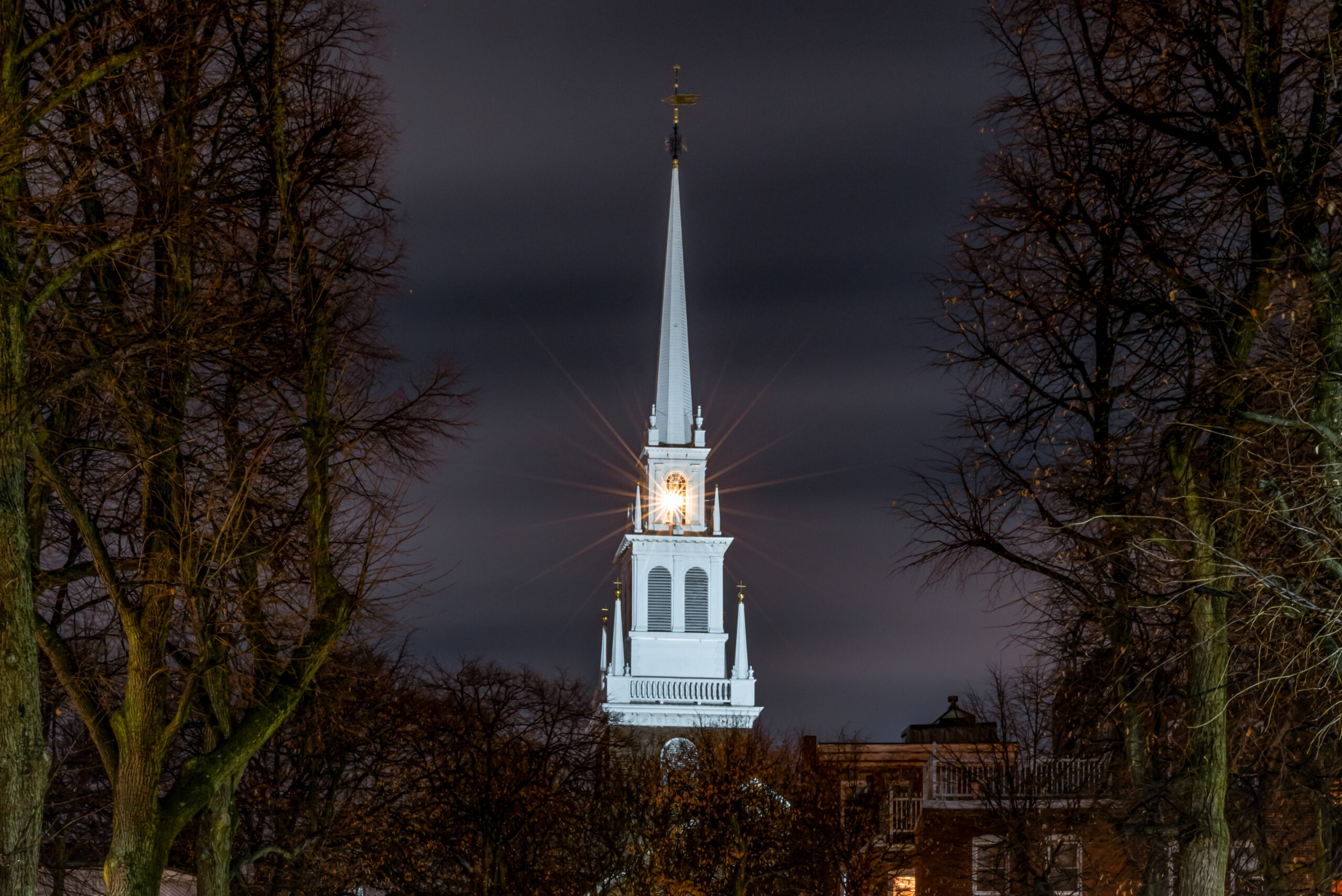
These famous words from Henry Wadsworth Longfellow’s poem about Paul Revere’s ride recount the important role the Old North Church played in the events leading up to the first shots of the Revolutionary War. Join us just a few weeks before the 250th anniversary as we sit down with Emily Spence, Director of Education at Old North Church in Boston. We’ll discuss the history of the church, what occurred on April 18, 1775 and what happened during the war. We’ll also discuss the exciting events the Old North Church will be doing on the 250th anniversary. This will be a pre-recorded video and you will be able to watch it when we post it at 7 p.m. on our Facebook page.
The spy network of Dr. Joseph Warren and the Sons of Liberty is well documented and written about. Few things happened in and around Boston that Warren, Paul Revere or Sam Adams were not aware of. In the winter of 1775, British General Thomas Gage also established a spy network (one of the more famous British spies was supposed “Patriot” Dr. Benjamin Church was not revealed as spy until October 1775). Gage was using all the resources at his disposal to figure out what the Whigs were doing and to find out where weapons (and four cannon that were stolen from the British in Boston) were located. On February 22nd, Gage sent out two officers, Captain John Brown and Ensign Henry De Berniere, to covertly ride out towards Worcester to locate stores and to map the road network for a possible British excursion. A few weeks later, on March 20th Gage sent out Brown and De Berniere again to map out routes towards Concord. Keeping in mind of potential geographic features that could endanger the future British column.
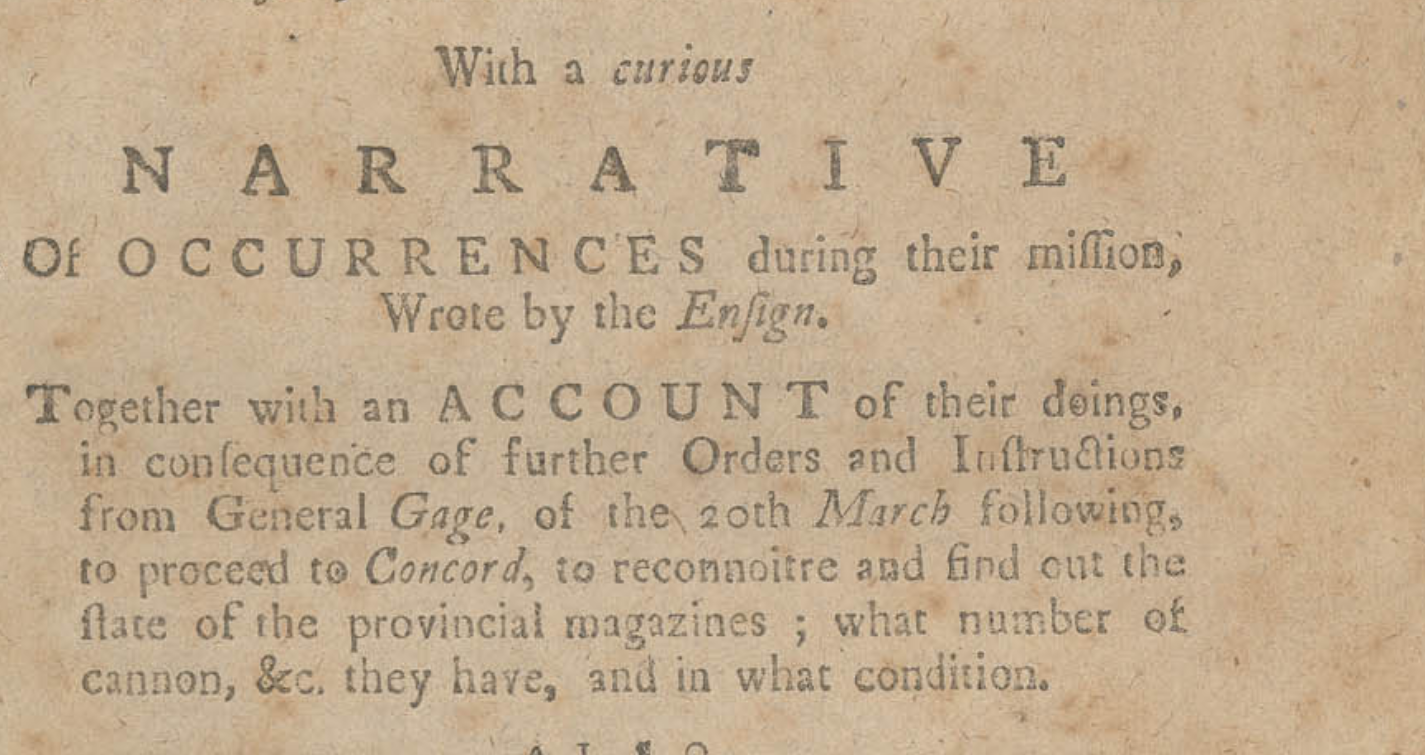
The following is an account of the March 20th mission by Ensign De Berniere. This account was found in Boston after the British evacuated and published by Boston printer J. Gill in 1779. Today it is located in the Massachusetts Historical Society. This mission was the precursor for the April 18-19th British raid to Concord that ignited the war.
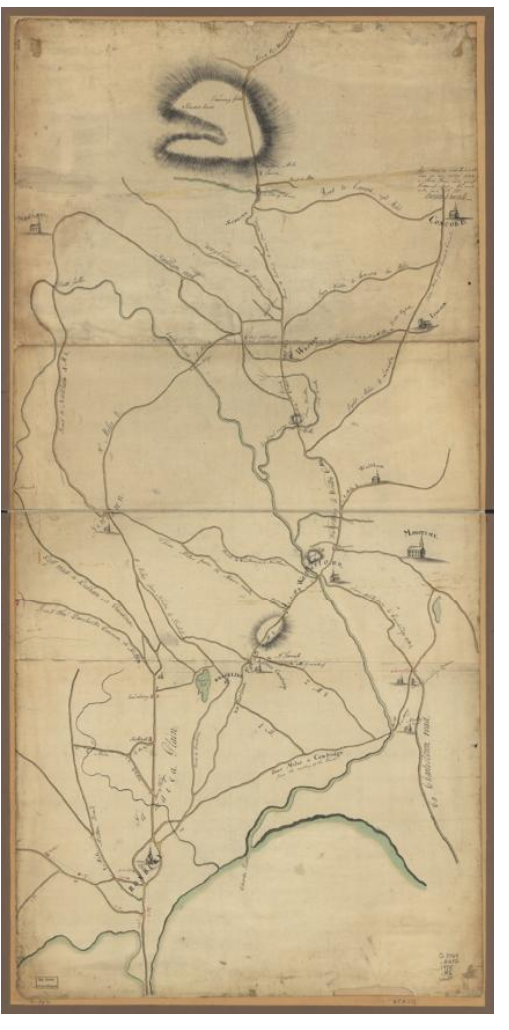
Map, Roxbury to Concord. Roads & distances; by Brown and De Berniere, Library of Congress
Account of the proceedings of the aforesaid officers, in consequence of further orders and instructions from General Gage, of the 20th March following ; with occurrences during their mission.
Scan of the original print by J. GILL, in Court Street. 1779, Massachusetts Historical Society
THE twentieth of March Captain Brown and myself received orders to set out for Concord, and examine the road and situation of the town ; and also to get what information we could relative to what quantity of artillery and provi- sions. We went through Roxbury and Brookline, and came into the main road between the thirteen and four- teen mile-stones in the township of Weston ; we went through part of the pass at the eleven mile-stone, took the Concord road, which is seven miles from the main road. We arrived there without any kind of insult being offered us, the road is high to the right and low to the left, woody in most places, and very close and commanded by hills frequently. The town of Concord lies between hills that command it entirely ; there is a river runs through it, with two bridges over it, in summer it is pretty dry ; the town is large and co- vers a great tract of ground, but the houses are not close together but generally in little groups. We were informed that they had fourteen pieces of cannon (ten
iron and four brass) and two cohorns, they were mounted but in so bad a manner that they could not elevate them more than they were, that is, they were fixed to one elevation ; their iron cannon they kept in a house in town, their brass they had concealed in some place behind the town, in a wood. They had also a store of flour, fish, salt and rice ; and a magazine of powder and cartridges. They fired their morning gun, and mounted a guard of ten men at night. We dined at the house of a Mr. Bliss, a friend to government ; they had sent him word they would not let him go out of town alive that morning ; however, we told him if he would come with us we would take care of him, as we were three and all well armed, — he consented and told us he could shew us another road, called the Lexington road. We set out and crossed the bridge in the town, and of consequence left the town on the contrary side of the river to what we entered it. The road continued very open and good for six miles, the next five a little inclosed, (there is one very bad place in this five miles) the road good to Lexington. You then come to Menotomy, the road still good ; a pond or lake at Menotomy. You then leave Cambridge on your right, and fall into the main road a little below Cambridge, and so to Charlestown ; the road is very good almost all the way.
In the town of Concord, a woman directed us to Mr. Bliss‘s house ; a little after she came in crying, and told us they swore if she did not leave the town, they would tar and feather her for directing Tories in their road.
[Left in town by a British Officer previous to the evacua tion of it by the enemy, and now printed for the information and amusement of the curious.]
BOSTON Printed, and to be sold, by J. GILL, in Court Street. 1779.
Emerging Revolutionary War welcomes back guest historian Michael Aubrecht.
Thomas Jefferson rejected the “divinity” of Jesus, but he believed that Christ was a deeply interesting and profoundly important moral or ethical teacher. He also subscribed to the belief that it was in Christ’s moral and ethical teachings that a civilized society should be conducted. Cynical of the miracle accounts in the New Testament, Jefferson was convinced that the authentic words of Jesus had been contaminated.
His theory was that the earliest Christians, eager to make their religion appealing to the pagans, had obscured the words of Jesus with the philosophy of the ancient Greeks and the teachings of Plato. These so-called Platonists had thoroughly muddled Jesus’s original message. Firmly believing that reason could be added in place of what he considered to be “supernatural” embellishments, Jefferson worked tirelessly to compose a shortened version of the Gospels titled The Philosophy of Jesus of Nazareth. The subtitle stated that the work was “extracted from the account of his life and the doctrines as given by Matthew, Mark, Luke and John.”
In 1820, Jefferson returned to his controversial New Testament research. This time, he completed a much more ambitious work titled The Life and Morals of Jesus of Nazareth Extracted Textually from the Gospels in Greek, Latin, French and English. The text of the New Testament appears in four parallel columns in four languages. Jefferson omitted the words he thought were inauthentic and retained those he believed were original. The resulting work is commonly known as the Jefferson Bible.
Using a razor and gum, Jefferson committed blasphemy. He cut and pasted his arrangement of selected verses from a 1794 bilingual Latin/Greek Bible using the text of the Plantin Polyglot, a French Geneva Bible and the King James Version. He selected excerpts from the gospels of Matthew, Mark, Luke and John in chronological order and combined the narrative with those of another to create a single chronicle.
No supernatural acts of Christ are included, as Jefferson viewed Jesus as strictly human. He also believed that Jesus himself recognized a more deistic belief system. In a letter to Benjamin Rush, Jefferson wrote, “I should proceed to a view of the life, character, and doctrines of Jesus, who sensible of incorrectness of their ideas of the Deity, and of morality, endeavored to bring them to the principles of a pure deism.” Jefferson also completely denied the resurrection. The book ends with the words: “Now, in the place where He was crucified, there was a garden; and in the garden a new sepulchre, wherein was never man yet laid. There laid they Jesus. And rolled a great stone to the door of the sepulchre, and departed.”
Jefferson engraving from 1867. Library of Congress.
Jefferson described the work in a letter to John Adams, dated October 12, 1813:
In extracting the pure principles which he taught, we should have to strip off the artificial vestments in which they have been muffled by priests, who have travestied them into various forms, as instruments of riches and power to them.…We must reduce our volume to the simple evangelists, select, even from them, the very words only of Jesus, paring off the Amphibologisms into which they have been led, by forgetting often, or not understanding, what had fallen from him, by giving their own misconceptions as his dicta, and expressing unintelligibly for others what they had not understood themselves. There will be found remaining the most sublime and benevolent code of morals which has ever been offered to man. I have performed this operation for my own use, by cutting verse by verse out of the printed book, and arranging the matter which is evidently his, and which is as easily distinguishable as diamonds in a dunghill. The result is an 8vo of 46 pages of pure and unsophisticated doctrines.
In a letter to Reverend Charles Clay, Jefferson described his results: “Probably you have heard me say I had taken the four Evangelists, had cut out from them every text they had recorded of the moral precepts of Jesus, and arranged them in a certain order; and although they appeared but as fragments, yet fragments of the most sublime edifice of morality which had ever been exhibited to man.” Most historians feel that Jefferson composed the book for his own satisfaction, supporting the Christian faith as he saw it. He did not produce it to shock or offend the religious community; he composed it for himself, for his devotion and for his own personal assurance.
After completion of the Life and Morals, Jefferson shared it with a number of friends, but he never allowed it to be published during his lifetime. The most complete form Jefferson produced was inherited by his grandson Thomas Jefferson Randolph.
The Life and Morals of Jesus of Nazareth.Monticello.org.
Next week on February 26, 2025, Salem, MA will mark the 250th anniversary of the Salem Alarm, or more commonly known today as “Leslie’s Retreat.” As British Gen. Gage received word from his spies that the local towns around Boston were securing various cannon for a possible war, he sent out Col. Leslie from Boston with several hundred British Regulars to Salem. Here Gage believed several of these cannon were we being refit and stored. Gage believed these cannon were to be used against him in a possible rebellion and were above and beyond a militia’s regular armament. After a tense stand off at the draw bridge across North River Bridge, Leslie returned to Boston without finding any cannon (which were removed during the stand off). This event was a critical step towards the open revolution that would take place on April 19 in Lexington. Though violence was avoided, the situation intensified the apprehension between Gage and the colonial leaders and militia of the towns around Boston. Below are two newspaper accounts of the events on February 26, 1775. One from Essex, Massachusetts and the other from London.
Essex Gazette, Feb. 28, 1775; an 1856 history of Leslie’s Retreat by Charles Endicott references the account was written by Col. Timothy Pickering.
” Last Sabbath the peace of the town was disturbed by the coming of a regiment of the King’s troops, the particulars relative to which are as follows. A transport arrived at Marblehead apparently manned as usual. Eetween 2 and o o’clock (as soon as the people had gone to meeting) the decks -were covered with soldiers, who having loaded and fixed their bayonets, landed with great dispatch, and instantly marched off. Some of the inhabitants suspecting they were bound to Salem to seize some materials there preparing for an artillery, dispatched several messengers to inform us of it. These materials were at the north side of the North River, and to come at them it was necessary to cross a bridge, one part of which was made to draw up for the convenience of letting vessels pass through. The inhabitants kept a look out for the appearance of the troops. The van-guard arrived, and took their route down in town as far as the Long-wharf; perhaps to decoy the inhabitants thither, away from the place to which the main body were destined. The main body arrived soon after and halted a few minutes by the Town-House. It is said inquiry was immediately made by some of the officers for a half brother of Col. Brown- the mandamus counsellor. Be this as it may, he was very soon whispering in the Colonel’s ear, in the front of the regiment and when he parted from the Colonel, the regiment marched off with a quick pace, in a direct course for the North Bridge ; just before their entrance upon which the draw-bridge was pulled up. The regiment however rushed forward till they came to the draw-bridge, not observing (as it seemed) that it was drawn up. The Colonel who led them expressed some surprise : and then turning about, ordered an officer to face his company to a body of men standing on a wharf on the other side the draw-bridge, and lire. One of our townsmen! (who had kept along side the Colonel from the time he marched from the Town House) instantly told him he had better not fire, that he had no right to fire without further orders, ” and if you do fire (said he) you will be all dead men.” The company neither faced nor fired.
Salem Alarm Monument at North River Bridge. Photo by Author
The Colonel then retired to the centre of his regiment, assembled his officers, and held a consultation ; At which being ended the Colonel advanced a little, and declared he would maintain his ground, and go over the bridge before he returned, if it were a month first. The same townsman replied, he might stay there as long as he pleased, no body cared for that. The half brother before mentioned (it is said) made towards the bridge, but seeing the draw-bridge up, says ” it is all over with us.” He has since disappeared. Meanwhile two large gondolas that lay aground (for it was low water were scuttled, lest they should cross the channel in them. But whilst one gentleman with his assistants was scuttling his own gondola, a party of about twenty soldiers jumped into it, and with their bayonets charged against our unarmed townsmen (some of whom they pricked) compelled them to quit it ; but before this a sufficient hole had been made in the bottom. This attack of the soldiers, and some other occurrences, occasioned a little bickering, but by the interposition of some of the inhabitants the disputes subsided.
At length some gentlemen asked the Colonel what was his design in making this movement and why he would cross the bridge? He said he had orders to cross it, and he would cross it if he lost his life, with the lives of all his men. And now (or before) asked why the King’s highway was obstructed? He was told it was not the King’s road, but the property of the inhabitants, who had a right to do what they pleased with it. Finally the Colonel said he must go over; and if the drawbridge were let down so that he might pass, he pledged his honor he would march not above thirty rods beyond it, and then immediately return. The regiment had now; been on the bridge about an hour and an half ; and every thing being secured, the inhabitants directed the drawbridge to be let down. The regiment immediately passed over, marched a few rods, returned, and with great expedition went back again to Marblehead, where they embarked on board the transport without delay. The regiment brought with them, lanthorns, hatchets, pickaxes, spades, hand-spikes, and several coils of rope.
When all the circumstances are considered, there can remain no doubt that the sole purpose of the menoeuvre was to steal away the artillery materials before mentioned. In the first place the regiment was taken from the Castle, so that the inhabitants of Boston might be prevented giving us any intelligence: The transport arrived at Marblehead a considerable time before the regiment was landed, but the men were kept snug under hatches: As soon as the inhabitants of Marblehead had got to meeting, the troops landed, and pushed on their march to Salem, and proceeded to the very spot where the materials for the artillery were lodged. But meeting with this sad rebuff and finding their plot was discovered, they then made a retreat. ‘Tis regretted that an officer of Colonel Leslie’s acknowledged worth, should be obliged, in obedience to orders to come upon so pitiful an errand.
Various reports were spread abroad respecting the troops —the country was alarmed ; and one company arrived in arms from Danvers just as the troops left the town. We immediately dispatched messengers to the neighboring towns to save them the trouble of coming in; but the alarm flew like lightning (and fame doubtless magnified the first simple reports) so that great numbers were in arms, and soon on the march before our messengers arrived.”
Little could the residents of London know that two days after the news of Salem was received in London, their American colonies would be in open rebellion.
We reshare a post from 2018 about the Salem Alarm also known as “Leslie’s Retreat.” As we approach the 250th anniversary of this important event (February 26, 1775), we will share primary source accounts of the event. This event set the kindling for the spark that lit a war in Lexington a month later.
As events quickly spiraled out of control in the winter and spring of 1774-1775 around Massachusetts, several armed confrontations between local “Patriots” and the British army heightened tensions. On many occasions, both sides adverted open confrontation and were able to diffuse the situation. Understanding these events and how they made an impression on both sides helps explain what happened on the Lexington Common on April 19, 1775.
As soon as British General Thomas Gage arrived in Boston in the spring of 1774, he set about enforcing the newly passed “Coercive Acts.” In response to these new laws that restricted many of the rights the people of Massachusetts had grown accustomed too, local groups began to arm themselves in opposition to British authority. Even though Gage was once popular in the colonies, he soon became an enemy to those around Boston who believed the Coercive Acts were an overstep of British authority. Continue reading ““If you Fire, You’ll all be dead men” The Salem Alarm”→
Emerging Revolutionary War welcomes back guest historian Eric Olsen. Eric is a historian with the National Park Service at Morristown National Historical Park. Click here to learn more about this site.
Visitors always want to know, “How much did “that” cost back then?” We used to tell them because of inflation and the conversion from pounds to dollars it was really hard to give a definitive answer. It is even harder to figure during the American Revolution when the value of the dollars changed dramatically just over the course of a few months. There are all sorts of fancy conversion sites on the internet today but since math was not my strong point, I don’t know how accurate they are.
One book tried another approach to explain 18th century vs. modern prices. “A person today, purchasing the same product made the same way out of materials made the same way, will pay roughly the same percentage of their wages for the product as a person of equal economic status in the past would have. For comparison, at the present time [1997 book] an average shop rate runs thirty-five dollars an hour for labor. If you make ten dollars an hour, this costs you three and a half hours of work, and the same ratio applied to a craftsman making thirty pounds a year or two pence per hour.” Makes sense but seems a bit too complicated.
However, I did find one primary source that can give a clue to the relative value of items. It comes from Theophile Cazenove, a Dutchman who traveled through New Jersey and Pennsylvania in 1794 looking for investment opportunities for Dutch bankers. At his various stops in Morris County, Cazenove recorded the prices of farms, livestock, and even labor.
Sometimes the prices were in pounds, other times they were in dollars. When he included both prices for one item, I did some very simple math and found that it took eight shillings to make one dollar, and that $2.50 equaled one pound. According to the online conversion applications, one pound in 1790 equaled 167.58 pounds today. One dollar in 1790 equaled 32.20 dollars in today’s money.
But without doing any math or conversions if we look at the prices Cazenove listed we can see what items were more expense than other ones. From that we can also assume the more expensive items were more highly valued.
Keep in mind, on the local level in 18th century America, it was not a cash driven economy. Specie, Hard Money or coins, made of valuable metals such as silver and gold were in short supply in North America and used infrequently. Paper Money was rarely used, appearing briefly during periods of war when armies needed a large source of money to buy goods and services.
“No taxation without representation” was one of the political cries of American colonists before the American Revolution. While the slogan inspired colonial enmity of the British Parliament and spearheaded efforts by prominent Americans and Britons to achieve some form of representation in the British government, it fell on deaf ears of common British citizens, including one correspondent of The Newcastle Chronicle, published in Newcastle upon Tyne, Tyne and Wear, England.
250 years ago today, this unknown correspondent’s opinion of the matter was printed for British citizens to read and consider:
When we consider (says a correspondent) in our present dispute with America, that there are large manufacturing towns in England, who, though they have no direct representative, yet pay the same taxes as those who have; thatthere are many thousands of merchants, manufacturers and others in Britan, who never had a vote for a representative, and therefore cannot be said to have consented to the taxes imposed upon them by the constituent powers of the legislature; and when we consider that the people of the Isle of Man, who once had superior privileges to any province in America, are deprived of all trade but with Britain, and obliged to pay taxes by British acts, without having one representative in the British Parliament. When we consider these things, how ill grounded must the complaints of the Americans appear to every man of feafe, and how necessary does it become to exact that obedience from their fears, which is neither to be hoped from their gratitude nor from their justice.
Many have heard of Paul Revere’s ride to Lexington and the shot heard round the world at Concord (and Lexington) but few know about the December 1774 raid and skirmish at Fort William and Mary in New Castle, New Hampshire. Here, inspired by news from Paul Revere, local militia attacked and captured a small British garrison at Fort William and Mary. Join us as we welcome Dr. Dr. Cynthia Hatch to discuss this much over looked action leading up the American Revolution.
Dr. Hatch is an Oklahoma State University Institute of Technology instructor specializing in Revolutionary War history. With a PhD in History, she explores the intricate political, social, and cultural dynamics of the 18th century, with a particular focus on the colonial legal system and the pivotal role of local narratives in shaping historical interpretations during the Revolutionary Era.
Join us as we discuss the events leading up and during the raid of Fort William and Mary and learn, were these the FIRST shots of the American Revolution? This Rev War Revelry will be pre-recorded and posted to our Facebook page at 7pm on Sunday, December 8th.
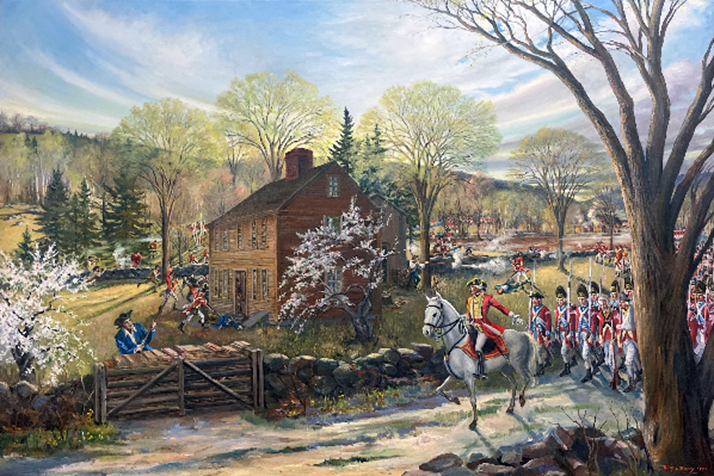
The Fight at the Jason Russell House, bicentennial painting by Ruth Linnell Berry (1974). Appearing with permission from the Arlington Historical Society.
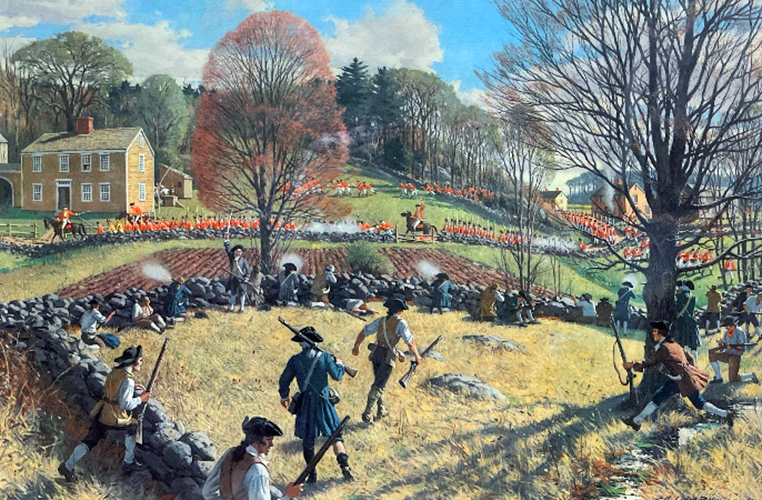
Though the American Revolution started on the green at Lexington and North Bridge in Concord, the bloodiest part of April 19, 1775 took place in the community of Menotomy (modern day Arlington). Join us as we welcome Matt Beres from the Arlington Historical Society. We will discuss the viciousness of the fighting on the afternoon of April 19th along the road back to Boston, including stories like the Jason Russell House, Cooper Tavern and more. Join us as we talk about the much overlooked part of April 19th, 1775 as we move towards the 250th anniversary. This episode is pre-recorded and will be posted on Sunday, November 24th at 7pm on our You Tube and Facebook pages.
Although 1781 is most known for the pivotal and successful victory at Yorktown, action in the American Revolution unfolded throughout the eastern seaboard. In early September 1781, Benedict Arnold returned to the land of his birth to lead a raid on New London and the port that harbored preying privateers.
During this raid, the American militia under Lieutenant Colonel William Ledyard especially, stoutly defended Fort Griswold until overcome by superior numbers. The town of New London was also torched and saw a rarity like the battle of Trenton, in that combatants fought through the very streets of the town.
Capturing all this and uncovering new primary sources, Matthew Reardon weaves a narrative that balances military history, from the fighting to the strategies, with the impact on New London and Connecticut. His book, “The Traitor’s Homecoming, Benedict Arnold’s Raid on New London, Connecticut, September 4 – 13, 1781” was recently published by Savas Beatie, LLC. Matthew is a native of northeastern Connecticut and is a public educator along with being a command historian for the Connecticut Military Department. He can be reached for inquiries on speaking engagements or how to purchase the book here.
The book will be the focus of this week’s “Rev War Revelry.” We hope you can join us on our Facebook page on Sunday, 7 p.m. EDT.
*Note* This “Rev War Revelry” will be recorded in advance as the Emerging Revolutionary War crew will be in Lexington and Concord, Massachusetts for the 4th Annual Emerging Revolutionary War bus tour.