ERW Book Review: Washington’s End: The Final Years and Forgotten Struggle by Jonathan Horn

George Washington retired from public life at the end of his second presidential term on March 4, 1797. Twenty months and ten days later he died on December 14, 1799. In between Washington was also the first in the United States to be a former president, first to deal with securing his legacy as both a military hero and political figure, and having to see the country he sacrificed so much to create, lurch forward without him having an active part in it.

Until now, these years have been either excluded, glossed over, or an anti-climatic ending to a Washington biography. Until now. Joseph Horn, a former presidential speechwriter and the author of The Man Who Would Not Be Washington lends his talent to a new biography of Washington, examining those last few years in-depth.

The author has a valid point when he argues that, “for too long, the story of Washington’s last years has been squeezed into the margins of manuscripts, if included at all” (pg. 14). Channeling the method of famed Washington biographer Douglas Southall Freeman, Horn writes this biography in the “fog of war” style that affords the reader the opportunity to read the history “through the eyes of those who made it rather than through the hindsight of historians” (pg. 14).

Continue reading “ERW Book Review: Washington’s End: The Final Years and Forgotten Struggle by Jonathan Horn”

Benjamin Henry Latrobe: Architect of the Republic

Emerging Revolutionary War welcomes guest historian Darien Ashley. A short bio follows this post.

The best architecture is that which reflects clearly the ideals and activities of the people which inhabit it. This is true for both private dwellings and public buildings. The objects of architecture serve as a lasting testament to identity. These objects, once created, continue to shape minds long after the architect is gone. A nation’s capital city is a site where man can establish glorious structures which convey a sense of who the people are, where they came from, and where they intend to go. The United States Capitol building is a prime example of a structure that continues to inform American identity long after its architects have passed. This article serves as an investigation of the life of one of the most important architects of not only the Capitol, but of the nation itself, Benjamin Henry Latrobe.

Guests to the United States Capitol building often get a shock from the fact that one of its primary architects, Benjamin Henry Latrobe, was an Englishman. Indeed, the man who designed the hallowed, old halls of Congress hailed from a Moravian religious settlement located on the outskirts of Leeds, England. However, Latrobe himself would have objected to the label “Englishman”. Indeed, throughout his life, Latrobe referred to the United States as “his” country and was quick to point out that his mother, Anna Margaretta Antes, was born and raised in Pennsylvania. Latrobe’s father, Benjamin Henry Latrobe Sr., met Anna after she had been sent to London to finish her education. Both of Latrobe’s parents held prominent positions within the Moravian ministry and raised their children to follow in their example.

Continue reading “Benjamin Henry Latrobe: Architect of the Republic”

The Journal of Nicholas Cresswell, Part 6


Vale of Edale (Photo by Atomviz, Wikimedia Commons)
Vale of Edale, Cresswell’s Home, the Beginning and End of His Adventures.  (Photo by Atomviz, Wikimedia Commons)

Skirmish in New Jersey

Cresswell found cheap lodging in New York and reunited with Joseph Brewer, who had fled Philadelphia himself, leaving his wife behind.  “The persecution against the friends of Gorvernment was too violent for a man of his warm temper to stay any longer amongst them with safety either of person or property.”[1]  While in New York, he watched the buildup of forces that Howe would later take on the Philadelphia campaign, but his focus remained on securing passage home.  It would take months, but Cresswell found ways to kill time, including watching a skirmish with the Americans he had so frequently cursed.

Continue reading “The Journal of Nicholas Cresswell, Part 6”

The Journal of Nicholas Cresswell, Part 5

Escape from America

Finally, in the spring of 1777, Cresswell again decided to try returning to England.  Thomson Mason, who had already intervened with two Committees of Safety to protect the Englishman, offered to help with Virginia authorities once more, provided that Cresswell swear not to join the British Army.  Cresswell did.  The best plan was to leave Leesburg, travel overland to Alexandria, then take a schooner down the Potomac and Chesapeake for Williamsburg and Hampton, where it might be possible go aboard a ship bound for British-occupied New York.  As he made his preparations, the local Committee of Safety arrived on April 16 to search his possessions for treasonable items.  They seized a shot pouch, powder horn, and bearskin he acquired from the Delaware Indians.  Cresswell decided not to contest the seizure lest it complicate his departure.

Continue reading “The Journal of Nicholas Cresswell, Part 5”

The Journal of Nicholas Cresswell, Part 4

A Loyalist under House Arrest

Having failed to reach the British Army in New York, Cresswell spent a miserable autumn and winter of 1776/1777 in northern Virginia, often arguing with his host, James Kirk, a Patriot and the only man who had ensured the Englishman could keep clothes on his back and a roof over his head.  Cresswell’s loyalist proclivities and extensive travels were widely known and on November 28, three men of the Committee of Safety in Alexandria “waited on me and informed me that the committee did not think it prudent to let me go out of the Country at this time and hoped that I would give  my word of honour not to depart this Colony for three months.  Otherwise they would confine me.  I was obliged to do the first as the lesser evil of the two.  They were polite enough not to search my chest.”[i]  Depressed as ever and suspecting Kirk of arranging the entire affair in order to keep him in Virginia, Cresswell did what he usually did when he was unhappy.  He got drunk.

Continue reading “The Journal of Nicholas Cresswell, Part 4”

The Journal of Nicholas Cresswell, Part 3

A Loyal Englishman in a Hostile Country

Part 2 click here.

When he arrived in Alexandria, Virginia in October 1775, Nicholas Cresswell, an Englishman visiting the colonies in search opportunity, found himself in dire straits.  The war had cut off his father’s money, while his loyalist principles strained his acquaintances and put him in an awkward position.  He summed it up: “if I enter into any sort of business I must be obliged to enter into the service of these rascals and fight against my Friends and Country if called upon.  On the other hand, I am not permitted to depart the Continent and have nothing if I am fortunate enough to escape the jail.  I will live as cheap as I can and hope for better times.”[i]

Continue reading “The Journal of Nicholas Cresswell, Part 3”

The Journal of Nicholas Cresswell, Part 2

An Englishman on the Frontier

Part 1 click here.

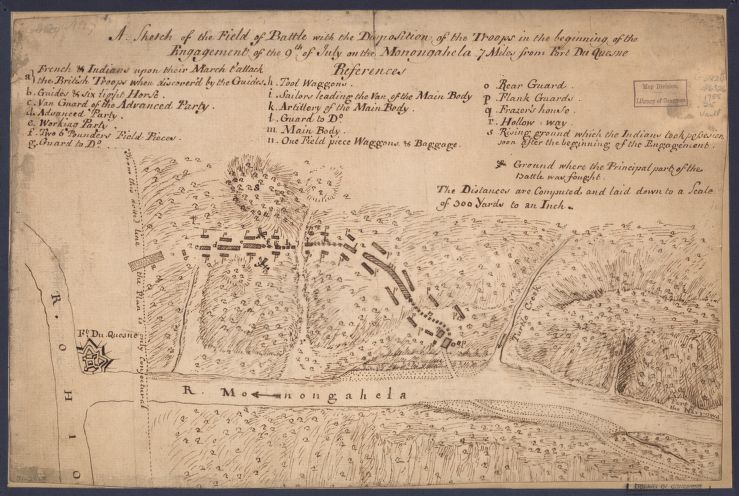
Nicholas Cresswell left Alexandria for the Illinois Country on March 16, 1775, his correspondence as yet unknown to the local Committee of Safety.  The Ohio River served as a highway to the west, so he headed for its origin at Pittsburgh.  Along the way, he stopped to visit the battlefield where French and Indian forces defeated Major General Edward Braddock in July, 1755.  Cresswell and his traveling companions found “great numbers of bones, both men and horses.  The trees are injured, I suppose by the Artillery…the greatest slaughter seems to have been made within 400 yards of the River…We could not find one whole skull, all of them broke to pieces in the upper part, some of them had holes broken in them about an inch diameter, suppose it to be done with a Pipe Tomahawk.”[i]

Monongaela Battle (Library of Congress)
Initial Dispositions of the Battle of the Monongahela.  Cresswell walked the battlefield on his way to Pittsburgh in 1775.  (Library of Congress)

Continue reading “The Journal of Nicholas Cresswell, Part 2”

The Journal of Nicholas Cresswell, Part 1


1BF5561D-F286-4DDD-BCEC-272C39979E49_1_201_a
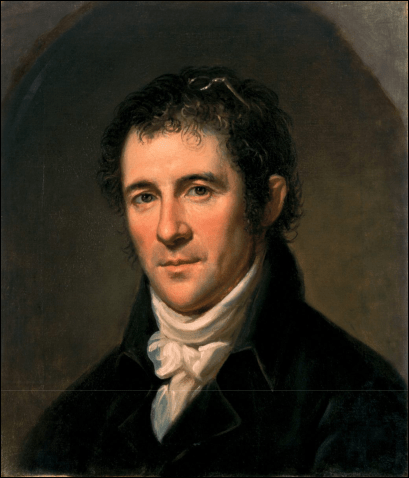
Nicholas Cresswell from the Frontispiece of his Memoir (Library of Congress)

For some Englishman, the political conflict between the United Kingdom and its American colonies was an afterthought that should not interfere with their plans to build a future based on American wealth.  Nicholas Cresswell was one such person.  He traveled to the colonies on the eve of the American Revolution and returned home in 1777, having kept an extensive diary of his travels, experiences, thoughts, and conditions in America during the war’s first years.  Along the way, he met some of the most colorful and interesting people who played prominent roles in the war: George Rogers Clark, Delaware Indian leaders White Eyes and Killbuck, Thomas Jefferson, Patrick Henry, William Howe, Robert Rogers, and Charles Lee to name a few.  Since its publication, Cresswell’s journal has become a touchstone for historians looking for insight into those people, how a loyal Englishman like Cresswell saw the world and the Americans around him interpreted events.  In particular, he recounts the feelings and treatment of loyalists trapped in America during the war.  With that in mind, reviewing Cresswell’s diary might help spread the word about a worthwhile primary resource.

Continue reading “The Journal of Nicholas Cresswell, Part 1”

ERW Weekender: Ninety Six, The Site That Has It All

Emerging Revolutionary War welcomes historian Vanessa Smiley to the blog.

The thing about Ninety Six National Historic Site is that it’s unassuming exterior hides a wealth of history. It’s also nowhere near a major highway, meaning you have to want to get there if you’re thinking of visiting. And when you do get there, you will realize that there’s more history per acre than its demur entrance lets on. Located in the back country of South Carolina, Ninety Six has a history that speaks to the stories of Native Americans, the American frontier of the 18th century, and the American Revolution.

Entrance to the park
(courtesy of Ninety Six NHS, NPS)

The site at Ninety Six holds a treasure trove of study on these subjects. Native American, mostly Cherokee, activity was heavy in the area long before European settlers arrived. One of the earliest backcountry trading posts, established by Robert Gouedy in 1759, made Ninety Six a hotbed of trading activity thanks to its location at the crossroads of twelve different roads and paths, linking the area to nearly all parts of the colonies.

Continue reading “ERW Weekender: Ninety Six, The Site That Has It All”

George Washington’s Birthday Celebration

During George Washington’s lifetime and maybe because he was such a great man, he had two birthdays beginning in the 1750’s. Born under the Julian calendar, George was born on February 11, 1731/32. When the English Parliament decreed in 1750 that two years hence England would switch calendars and adopt the Gregorian, used by the majority of countries/states in Europe, there was a discrepancy. So, 11-days was added (some believe that the old calendar was off by a year and a eleven days thus the slash in “1731/32” above).

Regardless, Washington’s birthday was moved to what we, in the United States, are taught now, that it fell on February 22, 1732. Just don’t tell his mother, who believed to her dying day that he was born on the aforementioned date. And who argues with mothers?

What we cannot argue with is that certain birthdays were celebrated at Gadsby’s Tavern, in Alexandria (a city a young George surveyed and helped lay out), Virginia. On October 6, 1796, John Gadsby leased the City Hotel from John Wise and quickly became the epicenter of social and political discourse in Alexandria.

Today the Gadsby Tavern and Museum is open to the public and run by Historic Alexandria a department within the City of Alexandria. For more information and to plan your visit, a bite to eat, or celebrate a birth night ball like George click here.

The balcony where musicians would sit and play at Gadsby’s Tavern (author’s collection)
The hall at Gadsby’s Tavern, which can still be rented out today for celebrations and ceremonies. (author’s collection)