Review: Russell Mahan, The Kentucky Kidnappings and Death March: The Revolutionary War at Ruddell’s Fort and Martin’s Station, Kindle ed. (West Haven, UT: Historical Enterprises, 2020).

In the summer of 1780, Captain Henry Bird crossed the Ohio River with some 800 Native Americans from various British-allied tribes and two companies of soldiers from Detroit (roughly 50 Canadians and Tories and a mixed group of regulars from the 8th and 47th regiments) to invade Kentucky.  More importantly, he brought two pieces of artillery, a three pounder and a six pounder.  It was one of the largest and most substantial attacks into Kentucky during the American Revolution.  

Bird’s goal was the Falls of the Ohio (today’s Louisville), which was critical to the American war effort on the frontier due to its critical position on the Ohio River.  Bird rendezvoused with the great bulk of the Native Americans at the confluence of the Great Miami and Ohio Rivers, (west of today’s Cincinnati) to discover that they had other plans.  Attacking fortified areas was less appealing than raiding small settlements and isolated farms, where the Indians might secure booty and terrorize the locals into abandoning Kentucky.  Constituting the vast majority of the army, the Native Americans won out. 

Continue reading “Review: Russell Mahan, The Kentucky Kidnappings and Death March: The Revolutionary War at Ruddell’s Fort and Martin’s Station, Kindle ed. (West Haven, UT: Historical Enterprises, 2020).”

Poet in a Patriot Prison

CONFINEMENT hail! in honour's justest cause.
True to our King, our Country, and our Laws;
Opposing anarchy, sedition, strife,
And every other bane of social life.
These Colonies of British freedom tir'd,
Are by the frenzy of distraction fir'd;
Rushing to arms, they madly urge their fate,
And levy war against their parent state.
Surrounding nations, in amazement, view
The strange infatuation they pursue.
Virtue, in tears, deplores their fate in vain; 
And Satan smiles to see disorder reign;
The days of Cromwell, puritanic rage,
Return'd to curse our more unhappy age.
We friends to freedom, government and laws; 
Are deem'd inimical unto their cause:
In vaults, with bard and iron doors confin'd,
They hold our persons, but can't rule the mind.
Act now we cannot, else we gladly wou'd;
Resign'd we suffer for the public good.
Success on earth sometimes to ill is given,
To brave misfortunes is the gift of Heaven.
What men could do we did, our cause to serve,
We can't command success, but we'll deserve. 

--- Dr. John Smyth

The American frontier west of the Appalachian mountains was a fluid place in 1775.  Settlers, officials, and Native Americans were all struggling to decide where their loyalties and interests lay, with the British government in London, colonial governments, or the rebelling Americans organizing themselves to determine their own fates.  Individuals often switched sides as the war unfolded

One man who was a constant in his loyalty to the crown was Dr. John Connolly of Pittsburgh.  Before the Revolution, he had led Virginia’s efforts as Lord Dunmore’s agent to seize control over the Forks of the Ohio and assert its claims westward, even receiving a promise of land in far-off Kentucky.  When the fighting started in Massachusetts, he developed a plan to mobilize Native Americans and Britain’s far-flung military forces on the frontier to attack Pittsburgh and then march on Virginia.  Dunmore and General Gage both approved.  So, Connolly and two loyalists, Allen Cameron of South Carolina and Dr. John Smyth of Maryland, plus Connolly’s enslaved servant travelled surreptitiously through Maryland, hoping to reach Detroit via Pittsburgh, the Ohio River, the Wabash River, and then anther overland trek.  Local patriots recognized them outside Hagerstown, Maryland and the trio was promptly arrested on the night of November 19.  A quick hearing by the local Committee of Safety decided to ship them off to Frederick, where a more thorough investigation revealed Connolly’s plan. Continue reading “Poet in a Patriot Prison”

“Rev War Roundtable with ERW” Tavern Talk

When the idea was formulated, back in April, to do a Sunday evening Zoom/Facebook live type history hour, the emphasis behind this “happy hour” was to style it as a more informal chat. Our goal was to create a virtual adaptation of what would occur if the same historians met at a tavern/bar/pub to casually chat about American history.

Speed up to this Sunday, June 7th, Emerging Revolutionary War will welcome three guest historians, who all have a connection to a historic tavern to join co-founder Rob Orrison on a talk about 18th century taverns. Yes, a “tavern talk about taverns.”

Joining Orrison on the hour-long happy hour chat will be:

Liz Williams, Executive Director of Gadsby’s Tavern in Alexandria, Virginia, part of The Office of Historic Alexandria, in which she has been employed with since 2004. She is a graduate of Mary Washington College in Fredericksburg, Virginia with a degree in Historic Preservation and a graduate degree in Tourism Administration from George Washington University. She has also worked at various historic sites in the Virginia and Washington D.C. area.

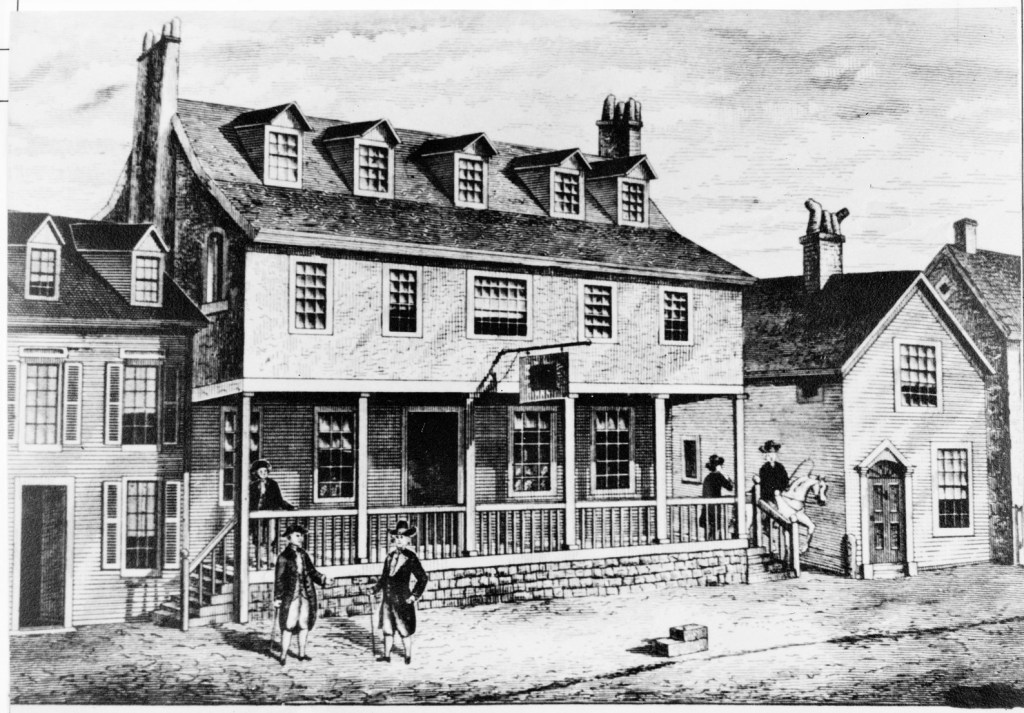
An ERW favorite and returning to the “Rev War Revelry” is Stacey Fraser, the Collections and Outreach Manager with Lexington (MA) Historical Society. One of the sites she oversees the collection of is Buckman Tavern, which played a role in the April 19, 1775 engagements that rolled through Lexington and Concord, Massachusetts.

The third guest historian is Sarah Kneeshaw, the Education and Public Programs Coordinator at Fraunces Tavern Museum. The tavern was built in 1719 in New York City by the De Lancey family. She joined the staff at the downtown New York City site (which is directly across from Federal Hall where George Washington was inaugurated president in April 1789) in 2016. Sarah holds a bachelor’s degree in Anthropology from Fordham University and also attained a graduate degree in Museum Studies from John Hopkins University. She is a native of Staten Island.

Thus, this Sunday, set a side an hour-ish, starting at 7pm EST, to hear these four historians discuss taverns, their importance, and roles in the 18th century social, military, and political history of the burgeoning United States. With your preferred drink, be it an 18th century tavern concoction or not, in hand, we look forward to your questions, comments and insights.

Rediscovery number 27587

A Connecticut Response to the Coercive Acts

On December 16, 1773, Bostonians dumped 340 chests holding 92,000 pounds or 46 tons of East India Company tea into the harbor. Due to the distance news had to travel across the Atlantic Ocean and then for the gears of government to crank a response, it was not until March of 1774 that Lord Frederick North, his administration, and Parliament passed the Coercive Acts.

The Coercive or Intolerable Acts as they were referred to in the American colonies were actually four acts in total, including the Boston Port Act, which closed the port to all commerce, the Massachusetts Government Act, restricting town meetings and changed the governor’s council to an appointed body, the Administration of Justice Act, which gave immunity to British officials from prosecution in Massachusetts, and lastly the Quartering Act, ordering colonists to house British troops when demanded.

Side note: A fifth act, the Quebec Act extended freedom of worship to Canadian Catholics and this decree was looped into the Intolerable Acts by the colonists.

Understandably the response in Massachusetts was one of defiance, protest, and angst and the acts are credited with promoting momentum toward independence. What was not truly appreciated by the British government was the outcry from other colonies.

On this date in 1774, the town of Farmington, Connecticut showed what the passage of the Coercive Acts meant. On May 19, a handbill, a small printed advertisement or notice, was distributed around the town inviting the inhabitants to a gathering to honor “the immortal Goddess of Liberty.”

Northwest View of Farmington from Round Hill – John Warner Barber, 1836
Continue reading “A Connecticut Response to the Coercive Acts”

The British Perspective….Best Book?

I recently needed to look up a quote from a British politician in the House of Commons during the American Revolutionary War. I went to my personal library (like to call it a study but since I have not found a desk to “study” on in there, I’ll continue to call it my library).

I grabbed Don Cook’s book The Long Fuse, How England Lost the American Colonies. A great read about the opposing side in the American Revolution. I found what I needed, but, as many of you probably do, that took me down a reading tangent.

Disclaimer; those of us under stay-at-home orders have some additional free time to explore more of our personal libraries. Those who can relate know what I am talking about. You pick up a book looking for something specific, which leads you to finish that book, then find one in the same genre or another micro-study of the same topic, until you have consumed multiple tomes within a matter of days, weeks.

Cook’s book led me to The Men Who Lost America: British Leadership, the American Revolution, and the Fate of the Empire. I gained a different appreciation for King George III, Lord Frederick North, and other British leaders from their perspective, filling in the gaps of historical scholarship that more America-centric volumes do not have the word count or inclination to fill.

I then went deeper down the proverbial rabbit-hole. Delving into With Zeal and With Bayonets Only: The British Army on Campaign in North America, 1775-1783, I went on a reading campaign with the British in the colonies.

Which now leads me to this blog post, what else would you recommend? What are your go-to books on the British perspective in the American Revolution?

Side note, I may delve into the loyalist viewpoint histories next, as I came across an interesting fact; the largest diaspora in the 18th century was American citizens that chose loyalty to the British crown who left or were forced to evacuate during and after the end of the American Revolution. So, as any history enthusiast will do, I will do more research….reading I mean.

“The Sword is Now Drawn…” The Powder Incident, Lexington and Concord moves Virginia to Revolution

download
Battle of Lexington by Amos Doolittle, December, 1775

One of the most amazing parts of the events on April 19, 1775 is just how sophisticated the colonial information network was. As soon as Lt. Col. Francis Smith’s British Regulars began to move across the Charles River, riders fanned out from Boston and to neighboring towns. Each town then had more riders that spread out and soon dozens of men were riding through the New England countryside warning of the fighting that took place. Soon information spread to the mid-Atlantic colonies and Philadelphia on April 24th. In the age of no electricity, the complexities and speed that news traveled from Boston to the other colonies was pretty amazing. Stories grew from person to person and it would take months and even years to decipher truth from exaggeration. It was imperative for both the “Patriots” and General Thomas Gage to get their version of the events of April 19th out as fast as possible. Facts or not, the importance of the public relations was of utmost importance to both sides to win the hearts and minds of the other colonies.

As the news reached Virginia, the colony was already at a crossroads with their

Sir_Joshua_Reynolds_-_John_Murray,_4th_Earl_of_Dunmore_-_Google_Art_Project_Square
Virginia Lt Governor, John Murray, 4th Earl of Dunmore

Governor. The last House of Burgesses that met in Williamsburg was dissolved in August 1774 over their vocal support of the people of Massachusetts after the Boston Port Act. The once popular Governor, John Murray, 4th Earl of Dunmore (Governor Dunmore), was angered over their overt support and ordered them dissolved and returned home. The legislature defied his orders and met soon after at the nearby Raleigh Tavern, thus constituting the “First Virginia Convention.” With questionable legal authority, the Convention called for solidarity and non-importation of British goods. They also agreed to meet again in the future. The “Second Virginia Convention” met in March of 1775 in Richmond, a safe distance from the Governor’s influence in Williamsburg. It was at this Convention that Patrick Henry made his famous “Give me Liberty or Give me Death” speech on March 23. Though considered radical at the time, the speech energized the Convention and set the tone. When the Governor learned of the Convention and especially Henry’s speech, he made a fateful decision to remove the gunpowder stored in the magazine in Williamsburg. Continue reading ““The Sword is Now Drawn…” The Powder Incident, Lexington and Concord moves Virginia to Revolution”

ERW Book Review: Washington’s End: The Final Years and Forgotten Struggle by Jonathan Horn

George Washington retired from public life at the end of his second presidential term on March 4, 1797. Twenty months and ten days later he died on December 14, 1799. In between Washington was also the first in the United States to be a former president, first to deal with securing his legacy as both a military hero and political figure, and having to see the country he sacrificed so much to create, lurch forward without him having an active part in it.

Until now, these years have been either excluded, glossed over, or an anti-climatic ending to a Washington biography. Until now. Joseph Horn, a former presidential speechwriter and the author of The Man Who Would Not Be Washington lends his talent to a new biography of Washington, examining those last few years in-depth.

The author has a valid point when he argues that, “for too long, the story of Washington’s last years has been squeezed into the margins of manuscripts, if included at all” (pg. 14). Channeling the method of famed Washington biographer Douglas Southall Freeman, Horn writes this biography in the “fog of war” style that affords the reader the opportunity to read the history “through the eyes of those who made it rather than through the hindsight of historians” (pg. 14).

Continue reading “ERW Book Review: Washington’s End: The Final Years and Forgotten Struggle by Jonathan Horn”

Benjamin Henry Latrobe: Architect of the Republic

Emerging Revolutionary War welcomes guest historian Darien Ashley. A short bio follows this post.

The best architecture is that which reflects clearly the ideals and activities of the people which inhabit it. This is true for both private dwellings and public buildings. The objects of architecture serve as a lasting testament to identity. These objects, once created, continue to shape minds long after the architect is gone. A nation’s capital city is a site where man can establish glorious structures which convey a sense of who the people are, where they came from, and where they intend to go. The United States Capitol building is a prime example of a structure that continues to inform American identity long after its architects have passed. This article serves as an investigation of the life of one of the most important architects of not only the Capitol, but of the nation itself, Benjamin Henry Latrobe.

Guests to the United States Capitol building often get a shock from the fact that one of its primary architects, Benjamin Henry Latrobe, was an Englishman. Indeed, the man who designed the hallowed, old halls of Congress hailed from a Moravian religious settlement located on the outskirts of Leeds, England. However, Latrobe himself would have objected to the label “Englishman”. Indeed, throughout his life, Latrobe referred to the United States as “his” country and was quick to point out that his mother, Anna Margaretta Antes, was born and raised in Pennsylvania. Latrobe’s father, Benjamin Henry Latrobe Sr., met Anna after she had been sent to London to finish her education. Both of Latrobe’s parents held prominent positions within the Moravian ministry and raised their children to follow in their example.

Continue reading “Benjamin Henry Latrobe: Architect of the Republic”

The Journal of Nicholas Cresswell, Part 6


Vale of Edale (Photo by Atomviz, Wikimedia Commons)
Vale of Edale, Cresswell’s Home, the Beginning and End of His Adventures.  (Photo by Atomviz, Wikimedia Commons)

Skirmish in New Jersey

Cresswell found cheap lodging in New York and reunited with Joseph Brewer, who had fled Philadelphia himself, leaving his wife behind.  “The persecution against the friends of Gorvernment was too violent for a man of his warm temper to stay any longer amongst them with safety either of person or property.”[1]  While in New York, he watched the buildup of forces that Howe would later take on the Philadelphia campaign, but his focus remained on securing passage home.  It would take months, but Cresswell found ways to kill time, including watching a skirmish with the Americans he had so frequently cursed.

Continue reading “The Journal of Nicholas Cresswell, Part 6”

The Journal of Nicholas Cresswell, Part 5

Escape from America

Finally, in the spring of 1777, Cresswell again decided to try returning to England.  Thomson Mason, who had already intervened with two Committees of Safety to protect the Englishman, offered to help with Virginia authorities once more, provided that Cresswell swear not to join the British Army.  Cresswell did.  The best plan was to leave Leesburg, travel overland to Alexandria, then take a schooner down the Potomac and Chesapeake for Williamsburg and Hampton, where it might be possible go aboard a ship bound for British-occupied New York.  As he made his preparations, the local Committee of Safety arrived on April 16 to search his possessions for treasonable items.  They seized a shot pouch, powder horn, and bearskin he acquired from the Delaware Indians.  Cresswell decided not to contest the seizure lest it complicate his departure.

Continue reading “The Journal of Nicholas Cresswell, Part 5”