This Sunday, at 7 p.m. join Emerging Revolutionary War on our Facebook page as we interview William “Billy” Griffith, author of the latest volume in the Emerging Revolutionary War Series.
His book, A Handsome Flogging, The Battle of Monmouth, June 28, 1778 was just released by Savas Beatie, LLC this month. The book is so new that Amazon still has it listed for pre-sale, but don’t worry, you can purchase the book directly from Savas Beatie by clicking here.
Billy Griffith is a full-time contributor to ERW and is also the author of The Battle of Lake George: England’s First Triumph in the French and Indian War, which was released in 2016 by HistoryPress. A native of Branchburg, New Jersey, he has a family connection to the the Monmouth area; he graduated with a degree in history from Shepherd University and holds a graduate degree in military history from Norwich University. He currently works as a full-time Gettysburg Licensed Battlefield Guide. We would be remiss if we did not include his other passion, besides American military history, the New York Yankees. Feel free to join the Facebook Live to disparage his love of the Evil Empire!
ERW looks forward to seeing you, hearing your questions, comments, and what personalized message you want inscribed on your copy of Billy’s latest publication. Although this happy hour historian discussion centers on an author interview, it is still a “happy hour” so bring your favorite brew; we can guarantee the two historians on the program will be imbibing theirs!
As the blog continues to grow and the accompanying book series enters its second year with volumes three and four being released in fall 2019, Emerging Revolutionary War thought it was time for our own logo.
As part of the “Emerging” family, we wanted a logo that tied us into that brand. So, this is the product of that aspect meeting artistry.
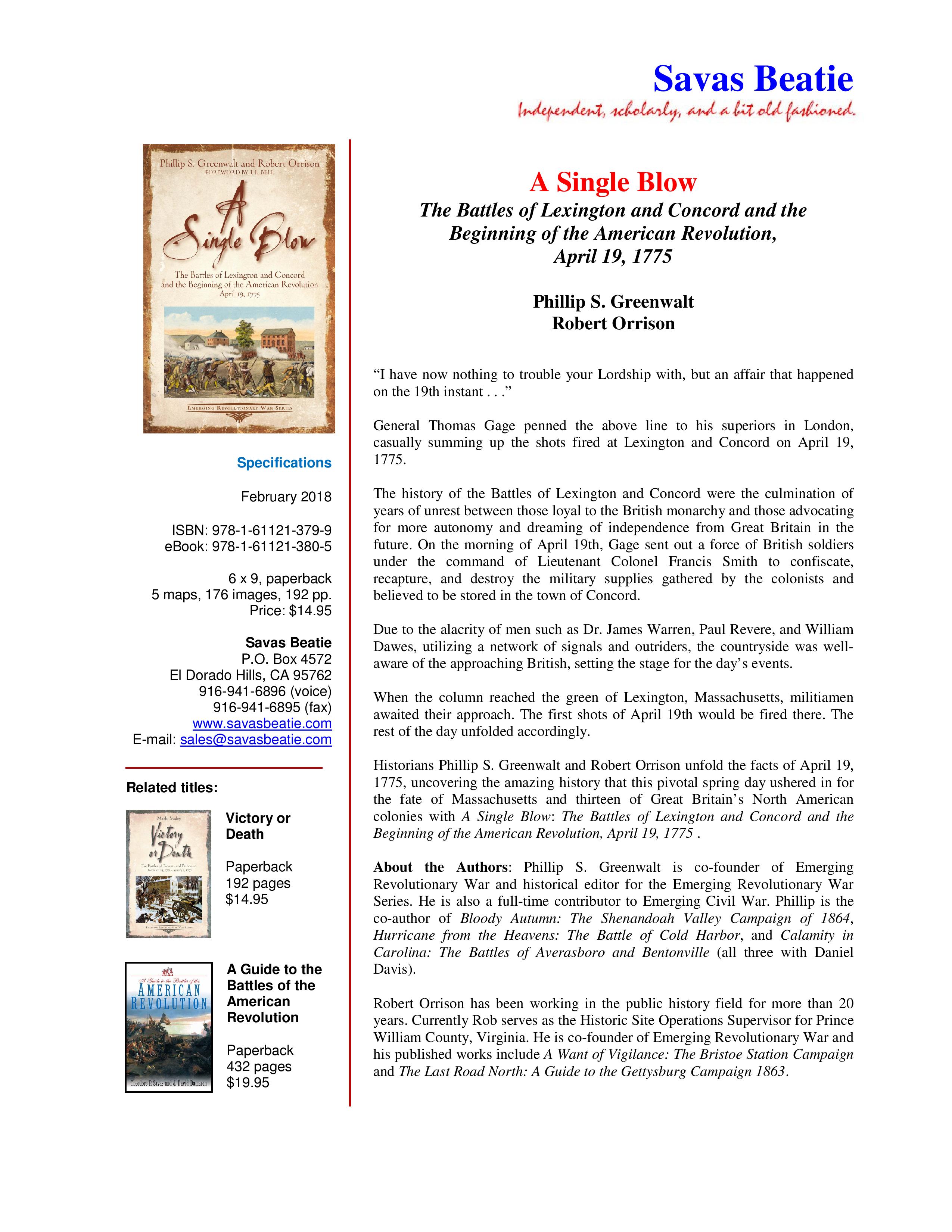
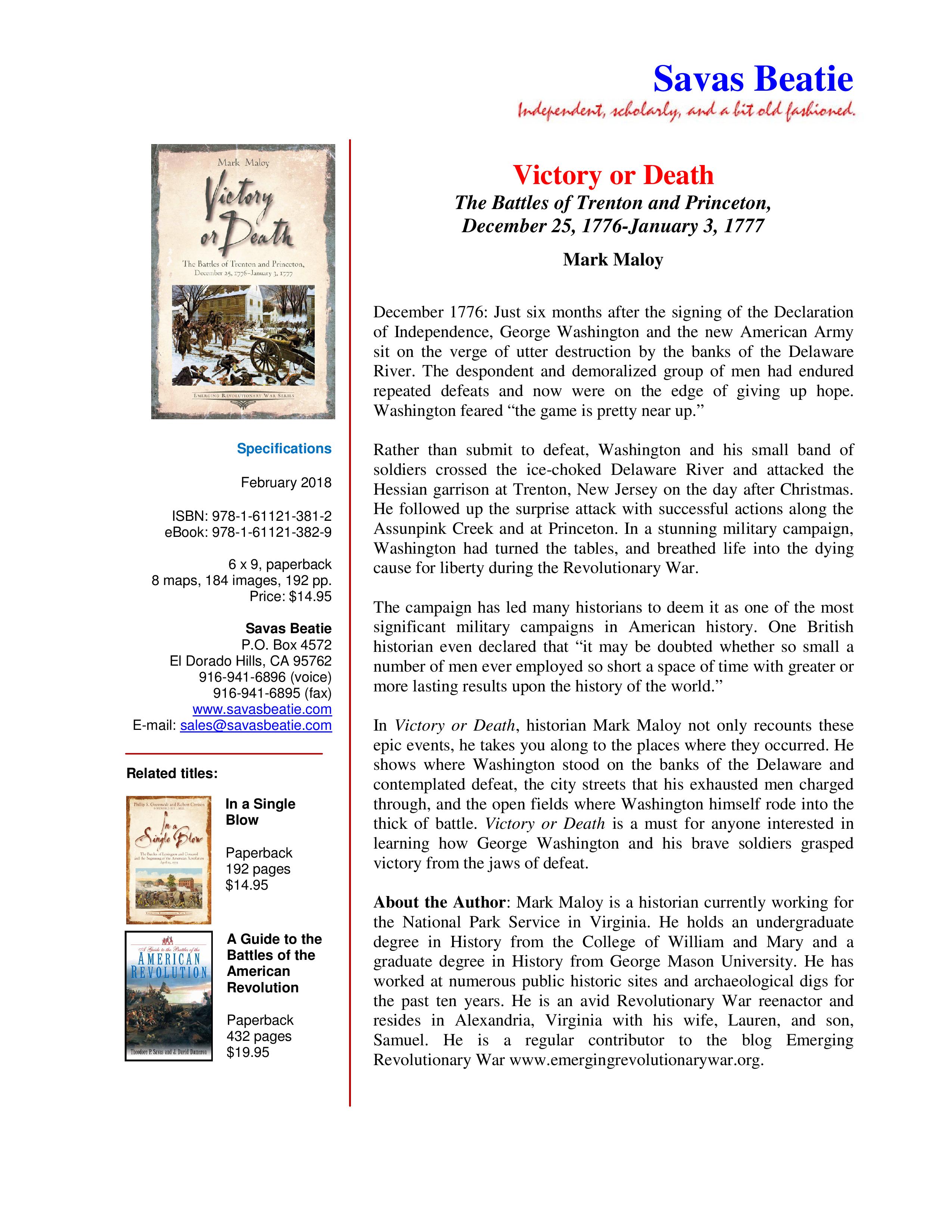
In 2018, the inaugural two volumes, of the Emerging Revolutionary War Series published by Savas Beatie, LLC. Those first two volumes were; A Single Blow, The Battles of Lexington and Concord and The Beginning of the American Revolution and Victory or Death, The Battles of Trenton and Princeton.
In 2019, the series is set to release the next two volumes. The Winter that Won the War, The Winter Encampment at Valley Forge, 1777-1778 and A Handsome Flogging, The Battle of Monmouth, June 28, 1778. This past week, the covers of both were released by Savas Beatie so get a sneak peak below.
Both titles are scheduled for a release later this year. Stay tuned for updates!
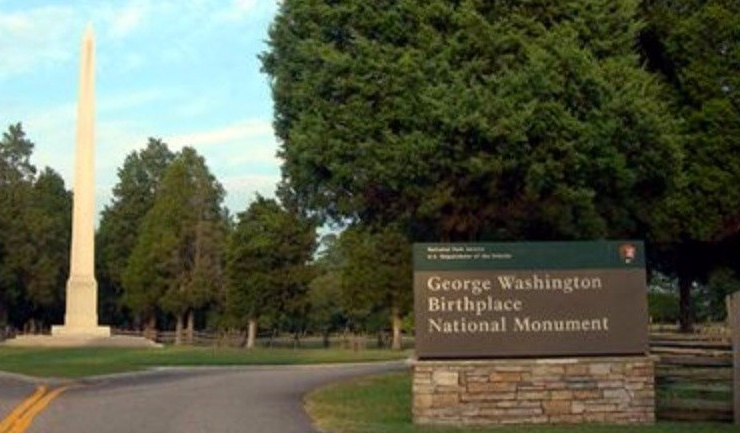
Not long ago, I had the pleasure of accompanying our group of student interns from Richmond National Battlefield Park on a short field trip to the George Washington Birthplace National Monument (GWBNM), in Westmoreland County on Virginia’s famed Northern Neck. First established near Pope’s Creek by John Washington, great-grandfather of our future first president, it was, as the name implies, the site of George Washington’s birth on February 22, 1732. This much we know.
George Washington Birthplace National Monument
The grounds were designated a United States National Landmark in 1930 and deeded to the Federal government. In honor of George Washington, the current Memorial House was constructed at the site in 1931. Along with the house, visitors can find a colonial-style kitchen building and blacksmith’s shop. Costumed interpreters also manage the Colonial Living Farm with barn, pastures and livestock. The site depicts life on a middling-sized Virginia tobacco plantation during the mid-18th Century. Continue reading “Inheriting the Preservation Efforts of the Past”→
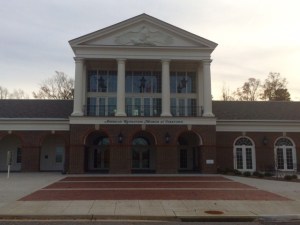
Over the years, it has been my pleasure to stop in at the old Yorktown Victory Center. The primary focus of the museum, as one might expect, was on the October 1781 siege, which not only brought about the surrender of British forces under General Charles, Lord Cornwallis, but also hastened the eventual end of hostilities between Britain and her former colonies. More recently, I’ve had the pleasure of working at the museum for special occasions as a volunteer for the Jamestown-Yorktown Foundation (JYF).
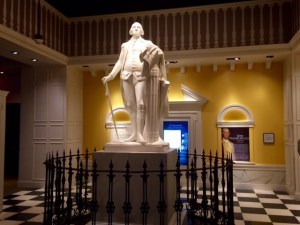
The Foundation has since expanded its view of Revolutionary America with a new museum, built upon the bones of the original, which looks beyond the confines of the Yorktown siege and takes a broader view of the conflict as a whole. In the fall of 2016, JYF opened its new American Revolutionary War Museum at Yorktown.
The building itself is large and impressive, with over 22,000 square feet (I’m told) of exhibition space. There is a natural flow between the various galleries, which chronicle our nation’s journey from subjugated colonies to Republic. Visitors, especially those who are not well versed in the history of the Revolutionary War, can more easily follow “the road” that led to our independence.
I started my visit by viewing the new introductory film, “Victory Forever”. The story of the Revolution is told by a 19th century showman who has visited many of the sites associated with the war and the events preceding its outbreak. As I began my own trip “down the road”, I was happy to see that the Foundation’s impressive collection of 18th century weapons and other artifacts are part of this new vision. There are new acquisitions on display as well, such as an original broadside of the Declaration of Independence which dates back to 1776.
There are new interactive films and exhibition galleries that tell the story first of the changing relationship between America and Britain after the end of the Seven Year’s War or, as it was known in America, the French and Indian War. This, of course, includes the rifts that arose beginning in the 1760’s over taxation.
The “Revolution” exhibition chronicles the weapons and tactics used in the conflict itself, from Lexington and Concord to Yorktown. And I was pleased to see an exhibition that focuses on the war in the south and the major players who led those events such as Daniel Morgan, the “Gamecock” Thomas Sumter, and the notorious Banastre Tarleton.
In prior years, the site also featured a Continental Army encampment and a 1780’s-era Virginia farmstead. The encampment has been expanded to include a small amphitheater for use in artillery and small arms demonstrations. This farm area is also undergoing considerable change as it will now represent a Virginia farmstead during the Revolutionary War era. Not yet completed, a conversation with friend and farm site manager Jay Templin gave me an idea as to some of the changes that are coming. “We’re now presenting life during the Revolution so we’ll need to scale back; there will be changes to what we’re growing.” Said Templin. “We’ll certainly still be growing some tobacco but not the large field as in years past.”
Although the American Revolutionary War Museum at Yorktown opened to the public in October, it is generally considered a “soft opening” as the entire site is not yet in its completed state. I’m told by staff there that the grand opening is slated for March 2017. I have to say that I was pleased with the new facilities and the fact that the focus of the museum is now on the broader era of the war. I wholeheartedly recommend a visit.
Debuting yesterday, the Campaign 1776, an initiative by the Civil War Trust, released an animated map that covers the “entirety of the American Revolution,” according to Civil War Trust Communications Manager Meg Martin.
At eighteen minutes in length, the video is a “succinct and engaging” access to gaining an overview of the entirety of the American Revolution, from the first shots in Massachusetts at Lexington and Concord to the culmination of the Siege of Yorktown in 1781. The video even includes a segment entitled “The Twilight Years” which explains the two years the war continued on after the victory at Yorktown; from 1781 to 1783. One can also jump to different parts, as the video has subheadings at the bottom to break the eighteen minute video into segments.
The video combines modern photography,with “live-action footage, 3-D animation, and in-depth battle maps” to give the viewer a sense of what the American Revolution, the pivotal event that “shaped America” was like.
Furthermore, “The Revolutionary War” animated map is part of a larger series of animated battle maps of battles on Civil War battles, which can be found here.
This animated map may be the first in the series of American Revolution and War of 1812 battles that the Campaign 1776 and Civil War Trust team is contemplating doing. We will all have to stay tuned and find out.
Yet, this animated map, of the entire American Revolution, is a great beginning introduction, so sit back, dedicate eighteen minutes, and learn about this defining moment in American history.
*Emerging Revolutionary War would like to thank Meg Martin of the Civil War Trust for the information about this release.*
Although it’s been nearly 250 years since America’s founding, the Revolutionary era continues to capture people’s imaginations. To explore that story even further, the editors of Emerging Revolutionary War have partnered with publisher Savas Beatie, LLC, for a new book series that will highlight the key events, people, and stories of America’s foundational experience.
The Emerging Revolutionary War Series will offer overviews of battles, politics, and biographies aimed at general audiences. Each book will be supplemented with dozens of original photos and all-new maps.
“These books are modeled after our highly popular Emerging Civil War Series,” explains publisher Theodore P. Savas. “The books are reader-friendly, and offer the perfect introductory-level chance to explore some great stories.”







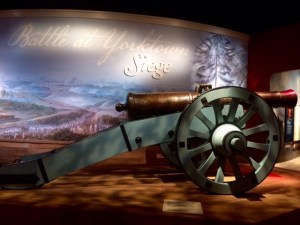
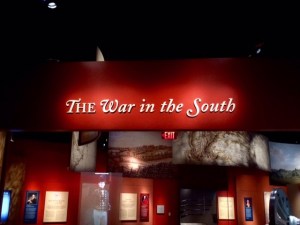 The “Revolution” exhibition chronicles the weapons and tactics used in the conflict itself, from Lexington and Concord to Yorktown. And I was pleased to see an exhibition that focuses on the war in the south and the major players who led those events such as Daniel Morgan, the “Gamecock” Thomas Sumter, and the notorious Banastre Tarleton.
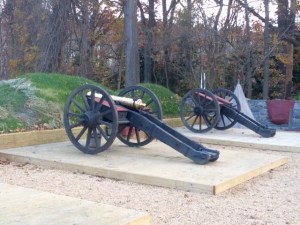 This farm area is also undergoing considerable change as it will now represent a Virginia farmstead during the Revolutionary War era. Not yet completed, a conversation with friend and farm site manager Jay Templin gave me an idea as to some of the changes that are coming. “We’re now presenting life during the Revolution so we’ll need to scale back; there will be changes to what we’re growing.” Said Templin. “We’ll certainly still be growing some tobacco but not the large field as in years past.”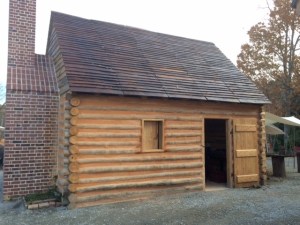
 Debuting yesterday, the Campaign 1776, an initiative by the Civil War Trust, released an animated map that covers the “entirety of the American Revolution,” according to Civil War Trust Communications Manager Meg Martin.
 Although it’s been nearly 250 years since America’s founding, the Revolutionary era continues to capture people’s imaginations. To explore that story even further, the editors of Emerging Revolutionary War have partnered with publisher
  Emerging Revolutionary War Era